Showing 6828 results

Archival description
2091 results with digital objects Show results with digital objects
GB 235 GBY/8/2/3 · Item · 2003
Part of Professor Mary Gibby Collection

1 envelope with a note written in ink. Enclosed is 1 pressed plant specimen of Pichisermollodes x terminalis.

'Isotype of Edinburgh'

Collected 4 Sept 2003, collection number 30072

Fraser-Jenkins, Christopher Roy
Pilling, Liz
GB 235 PIL · Collection · 2015

•Folder of slide collection of Icelandic Plants
•Box of slide collection of Arctic Plants

Pilling, Liz
LSH/1/1/9/1/21 · Part · 1949-04-21
Part of The Ludlow & Sherriff Collection

SUMMARY:
The page describes conifer- and rhododendron-dominated terrain and extensive cultivation in the Tang valley, contrasting land use practices with those near Kalimpong. On 15th April, the party traveled from Pimi over the RUDO LA in persistent snow, observed few flowers, and received wine and food sent by Asha Wangmoo at the pass.

CONTENT:
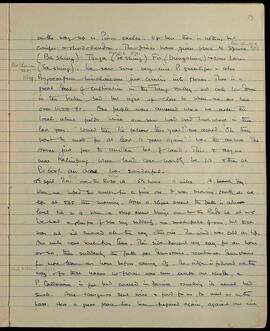
On the way up is Pinus excelsa. Up here there is nothing but conifers & rhododendron. The pines have given place to Spruce (Picea spinulosa 18702) (Bashing), Tsuga (dumosa 18701) (Seshing), Fir (Dungshing) & some Larix (Sasuing) (Rhod. thomsonii 18697). We saw some very nice P. gracilipes — also (15699) Bryocarpum himalaicum just coming into flower. There is a great deal of cultivation in the Tang valley, not only low down in the valley bed, but right up close to where we are here, over 11,000 ft. Our people were amused when we asked the locals about fields which we saw had had buckwheat in them last year. "Would they lie fallow this year?" we asked. "Oh they won't be used for at least 12 years again!" was the answer. The owner just goes to another bit of land. This to anyone near Kalimpong, where land can hardly be got, often at Rs 600/- an acre, was wonderful.

15th April. PIMI. over the RUDO LA (9690, 12600). 5 1/2 hours, 11 miles. A beastly day when we hoped so much for a fine one. It was snowing gently as we left at 5:45 this morning. After a slight ascent, the path is almost level till 4 when a steep ascent brings one to the Rudo La at 11:30. We had a glimpse of blue sky suddenly, & a small patch of sun, but that was all, it snowed all the way otherwise. The wind was cold on top. Our mules were back from there. This side descent very easy for an hour or so, then suddenly the path goes downstairs, & continues downstairs for more than an hour before easing off. The ridge is followed all the way, & for that reason no flowers were seen, except one Rhod. (Rhod. arboreum 18703), & P. Calderiana in fat bud, covered in farina, smelling its usual bad smell. Asha Wangmoo sent wine & food for us to meet us on the pass. Here a great place has been prepared again, against our visit.

LSH/1/1/3/3/127 · Part · 1933-04-09
Part of The Ludlow & Sherriff Collection

SUMMARY:
A plant noted on the 26th was photographed and pressed. Pintso visited with a notebook to describe the Lopas, and observations were made about their recognition of upside-down camera images compared to Kashmiris and servants. Dawang reported an old Gompa on the route from Dotrang to Kashongha, now a pilgrimage site with oil lamps in early June, and a marking on Bailey’s map is noted as mistaken.

CONTENT:
on 26th has nearly come to full bloom, so I photographed it &
had it pressed. May it turn out to be a new one. Fine.
Pintso was asking more about the Lopas & came in with
his little notebook to tell us all about it. He described
the various tribes & finished with the lowest of the low. "These
he said "have tails about 4 to 5 inches long." It was said
in all seriousness, & he & all the Kashmiris of course,
believe it. It was curious how all the Lopas, when I
let them look through the back end of the camera, at
once recognized whoever was sitting in front. And he saw
too that the image was upside down. A jungly Kashmiri
would never see that, I doubt even if our own servants
would. The 'temple' which Dawang reported seeing on the
way to the Kashongha from Dotrang is an old Gompa of
considerable size. It used to be an important & holy place,
till looted by the Lopas. Even now though it has no
occupants, it is a place of pilgrimage. All the people in
the district go there on the 15th of the 4th month (about the
beginning of June) & make a circle of oil light lamps round.
The marking of this on Bailey's map is the only mistake we