Showing 6828 results

Archival description
2091 results with digital objects Show results with digital objects
LSH/1/1/2/1/255 · Part · 1969-04-29
Part of The Ludlow & Sherriff Collection

SUMMARY:
At Diwangiri, mail and bulb specimens (Nos. 573, 1041, 717, 553, 564) were sent to Ramsbottom, and 19 loads of kit were sent via the Pradhan to the station at Rangiya; the area teemed with birds, with 23 shot and Ramzana handling the skins. After halting at Diwangiri with cool, rainy weather, the party set out early for Rangiya following night rain.

CONTENT:
night, and was fine and cool today.

Lil. giganteum 573
n. nanum 1041
Noth. bulbulifera 717
Lil. nepal. var concolor 553
Lil. wallichianum 564

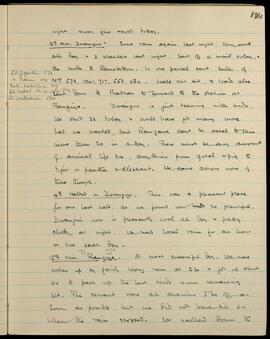
12th Nov. Diwangiri - Some rain again last night. Very cool all day and 3 blankets last night. Sent off a mail today, and the bulbs to Ramsbottom. In one parcel sent bulbs of Nos 573, 1041, 717, 553, 564. Half our kit, 19 loads also sent down to Pradhan to forward to the station at Rangiya. Diwangiri is just teeming with birds. We shot 23 today and could have got many more had we wanted, but Ramzana can't be asked to skin more than 20 in a day. There must be any amount of animal life too, anything from goral and pig to tiger or panther and elephant. We came across none of these though.

14th Halted in Diwangiri: This was a pleasant place for our last halt, as we found new birds so plentiful. Diwangiri now is pleasantly cool all day and pretty chilly at night. We had local rain for an hour or two each day.

15th Nov. To Rangiya. A most successful day. We were woken up by fairly heavy rain at 2.30 and got up about 4.0 to pack up the last birds and our remaining kit. The servants were all anxious to be off as soon as possible, but we did not leave till 6.0 when the rain stopped. We walked down to

LSH/1/1/7/1/1 · Part · 1940-05-24
Part of The Ludlow & Sherriff Collection

SUMMARY:
The expedition splits, with Ludlow and Taylor heading to passes east of Tsela Dzong while Sherriff works the Lanyong area and passes between Roro and Bela Dzong, departing Roro on 24 May. The page describes the Lanyong Chu valley, its isolated inhabitants and seasonal conditions, and notes early-season floral observations on high slopes, including Rhododendron repens and Primula species.

CONTENT:
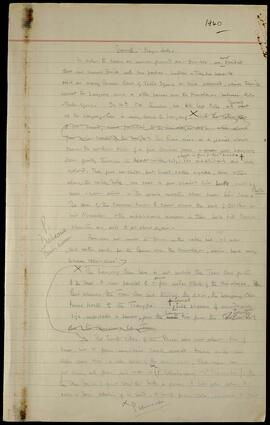
1940.

Sherriff - May - July -

In order to cover as much ground as possible, we now decided that we should divide into two parties. Ludlow and Taylor were to visit as many passes East of Tsela Dzong as time allowed, while Sherriff worked the Lanyong area and other passes over the Himalayas between Roro and Bela Dzong. On 24th May therefore we all left Roro, and Sherriff went up the Lanyong Chu in easy stages to Lanyong.

The Lanyong Chu here is not unlike the Tsari Chu further to the West. It runs parallel to and about four miles North of the Himalayas. But whereas the Tsari Chu cuts through the axis, the Lanyong Chu turns North to the Tsangpo. Several side streams of considerable size, unfordable in summer, join the Lanyong from the South.

The valley, which is from 300-600 yards wide, flows gently through the valley bed. The inhabitants are very isolated. They grow no crops, but breed cattle and yaks. Here and there along the valley bed, one sees a few chalet-like huts, used by men and yaks alone in the winter months when snow lies deep. The rain of the summer turns to snow about the end of October or mid-November, and the inhabitants remain in their huts till March when they are able to get about again.

There was not much in flower in the valley bed, as it was still rather early for the passes over the Himalayas, which here vary between 13,500 - 15,000'.

The South sides of the passes were now almost free of snow, but North faces were still deeply covered. However on the open slopes about 14,000' a little North of the main axis, Rhododendron repens was just coming into flower, and with it (P. valentinianum and P. franchetii). On the same day as I first saw the latter in flower, I was also able to make a large collection of its seed. A north facing slope on which it grew P. vernicosa.

LSH/1/1/7/1/10 · Part · 1940-05-24
Part of The Ludlow & Sherriff Collection

SUMMARY:
Notes indicate the western extremity for Mec. florindae and where P. caliantha begins, with P. elizabethae meeting it at this point and not occurring eastward. The writer first found these further west in Bari Tana or Umkumbala.

CONTENT:
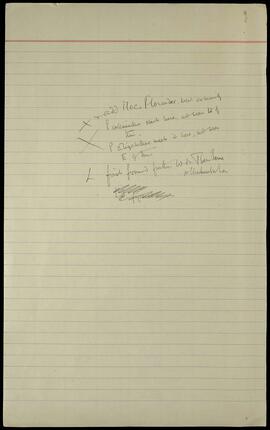
add Mec. florindae, west extremity
P. caliantha starts here, not seen W of
this.
P. elizabethae meets it here, not seen
E of this
I first found further W in Bari Tana
or Umkumbala

LSH/1/1/9/1/107 · Part · 1949-07-12
Part of The Ludlow & Sherriff Collection

SUMMARY:
The writer reports finding a new lily and abundant Notholirion macrophyllum, and receives mail from Kalimpong with news that Branklyn is for sale and may be acquired. A letter from Taylor confirms P. umbratilis roots arrived safely and began to show growth after soaking. On 23rd July they marched to Dhur, noting an uninteresting, damp route where two rivers join.

CONTENT:
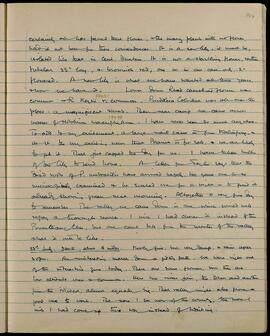
certainly all has passed their flower, the many plants with no flower, had it not been for these coincidences. It is a new lily: it must be, isolated like that in Cent. Bhutan. It is not a startling flower, rather tubular 2 1/2" long, a brownish red, one or in one case only, 2-flowered. A new lily is what we have wanted all these years, now we have it. Lower down Rhododendron camelliiflorum was common. R. keysii v. common. Buddleja colvilei was all over the place - a magnificent shrub. Then near camp we came across masses of Notholirion macrophyllum. I have never seen so much anywhere. To add to my excitement, a large mail came in from Kalimpong, & in it, the very exciting news that Branklyn is for sale, & we are likely to get it. That just capped the day for us. I have taken bulbs of the lily to send home. A letter from Taylor says that the dried roots of P. umbratilis have arrived safely. He gave one to be microscopically examined & he soaked one for a night - to find it already showing green next morning. Altogether a very fine day to remember. The valley we came down is one which would well repay a thorough search. I wish I had chosen it instead of the Bumthang Chu, but one can't tell from the mouth of the valley what it will be like.

23rd July. DHUR, about 4 miles. Mostly fine, but very damp, & rain after 2.0pm. An uninteresting march down a filthy path. We were right out of the interesting zone today. There are some flowers, but they are low altitude ones & common. Here two rivers join, the Dhur and another from the N-West, almost equal size. That valley might also prove a good one to work. The more I see now of the country, the more I wish I had come up this way instead of waiting.

LSH/1/1/10/1/10 · Part · 1949-09-14
Part of The Ludlow & Sherriff Collection

SUMMARY:
The diarist halts in the Diruphuang valley amid heavy rain, notes a sense of the monsoon ending, and reaches a nearby pass without difficulty. Skimmia seed brought by Pasang is abundant and promising. Letters and plans are mentioned, including Tobgye writing from Kalimpong, Betty in Calcutta, and Hicks intending to be in Bumthang earlier than expected.

CONTENT:
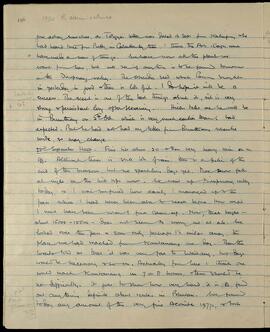
146 19768 P. alboviana x brunosa

gone astray somewhere, as Tobgye's letter was dated 4 Sept from Kalimpong, she had heard twice from Betty in Calcutta by then. I think the Arts & Crafts must have made a mess of things. We have now all the plants we want from here, but will see if another is to be found tomorrow in the Diruphuang valley. The Skimmia seed which Pasang brought in yesterday is good and there is lots of it. I do hope it will be a success. The scent is one of the best things about it, and it is very strong and persistent long after flowering. Hicks tells me he will be in Bumthang on 5th Oct. which is very much earlier than I had expected. But he had not had my letter from Bumthang when he wrote, so may change.

23rd September Halt. Fine till about 2.0 and then very heavy rain on and off. Although there is still lots of rain, there is a feeling of the end of the monsoon, but no sparkling days yet. More snow falls at night on the hill tops now. We went up Diruphuang valley today, and I was surprised how easily I managed up to the pass which I had never been able to reach before. How unfit I must have been when I first came up. Now, that height - about 15000 - 15500 - does not seem to worry me at all. We looked over the pass and saw