Showing 6828 results

Archival description
2091 results with digital objects Show results with digital objects
LSH/1/1/1/1/108 · Part · 1933-07-27
Part of The Ludlow & Sherriff Collection

SUMMARY:
Specimen entries 2092–2105 record birds collected at Donya La on 27 July 1933, noting sexes and a juvenile. Species listed include Lophophorus juv. impeyanus, multiple Ithaginis cruentus tibetanus (Blood Pheasant), Heteroxenicus cruralis, Pnoepyga ?, Aethopyga i. ignicauda, Lophophanes r. beavani, Myzornis p. pyrrhoura, and Pyrrhula erythrocephala.

CONTENT:
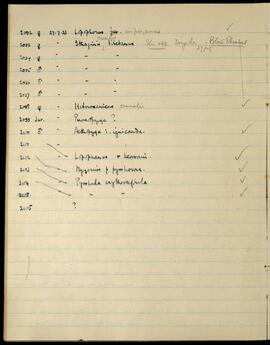
2092 ♀ 27.7.33 Lophophorus juv. impeyanus
2093 ♀ " Ithaginis cruentus tibetanus No 499. Donya La - Blood Pheasant 27 July.
2094 ♀ " " " "
2095 ♂ " " " "
2096 ♂ " " " "
2097 ♂ " " " "
2098 ♀ " Heteroxenicus cruralis
2099 Juv. " Pnoepyga ?
2100 ♂ " Aethopyga i. ignicauda.
2101 -
2102 - Lophophanes r. beavani.
2103 - Myzornis p. pyrrhoura.
2104 - Pyrrhula erythrocephala
2105 - " "
2105 ?

LSH/1/1/8/1/51 · Part · 1947-01-13
Part of The Ludlow & Sherriff Collection

SUMMARY:
The diarist notes failed banana trees in Dongkar, widespread illness, and persistent bad weather during a series of halts while collecting birds. They visit Denchan Gompa, hunt game birds with local shikaris, and criticize Elliot’s contribution. Bill visits Yigong Tso and learns from the Be Gyimpon of a summer route to Tongkyuk over the TRESUR LA; Ludlow departs for Suowa with companions.

CONTENT:
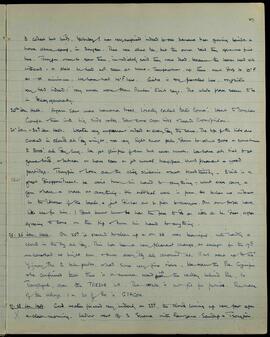
to collect bush birds. Yesterday I was very surprised indeed to see banana trees growing beside a house above camp, in Dongkar. There were about ten, but the owner said they gave no fruit here. Tseringpon, when he saw them, immediately said they were dead, because the leaves had all withered - a state he had not seen at home. Temperatures up there must drop to 10°F as a minimum. We have had 14°F here. Goitre is very prevalent here, syphilis very bad indeed - "very much worse than Bhutan" Elliot says. The whole place seems to be in decay generally.

20th Jan Halt. Again saw more banana trees, locally called 'tali loma'. Went to Denchan Gompa then into big side valley. Saw some crossbills & heard Crossoptilon.

21st Jan - 24th Jan. Halt. Weather very unpleasant indeed & every day the same. The tops of the hills are covered in clouds all day & night, & a very light snow falls, down to about 9000' or sometimes to 8000', all day long. We get glimpses of sun but never much. We have all tried to get game birds, & between us have seen or got monal, tragopan, blood pheasant & wood partridge. Tseringpon & Laku are the chief shikaris & most bloodthirsty. Elliot is a great disappointment. He won't turn his hand to anything; won't even carry a gun & have a crack at anything. His medical work is poor. He takes no interest in the illnesses of the locals, & just dishes out 2 pills to everyone. Our own people have little use for him. I don't know how he has the face to do as little as he does, after agreeing to come on this trip & turn his hand to anything.

25-26 Jan. Halt. On 25th it started to clear up & on 26 was beautiful, with hardly a cloud in the sky all day. This has been a very pleasant change, as except for the 19th we have had no bright sun, & snow every day all around us. Bill went up to the Yigong Tso to take photos, & had some very fine views. He saw the Be Gyimpon who confirmed that there is a summer road up from the valley behind Be, to Tongkyuk, over the TRESUR LA. The route is not fit for ponies. The name of the village 1 m W of Be is GYAGON.

27-28 Jan. Halt. Good weather finished very suddenly on 28th, the clouds coming up very fast after a clear morning. Ludlow went off to Suowa with Ramzana, Sandup & Tseringpon.

LSH/1/1/2/1/125 · Part · 1933-07-18
Part of The Ludlow & Sherriff Collection

SUMMARY:
After descending about 1000 ft and collecting butterflies, the party reached Dongkar where a load fell off a bridge; Purbo later recovered the tent two miles downstream after nearly drowning. They enjoyed fine views and a garden-like camp, noted abundant Delphinium grandiflora and borage, observed Ramzana’s meagre condition after fever at Tsuna, and outlined transport changes from Bhutan via Mago toward the Cho La and Shingbe.

CONTENT:
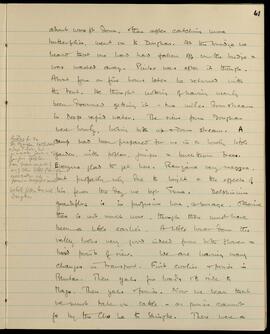
about 1000 ft down, then after catching more butterflies, went on to Dongkar. At the bridge we heard that one load had fallen off on the bridge and was washed away. Purbo was after it though. About four or five hours later he returned with the tent. He thought nothing of having nearly been drowned getting it - two miles downstream in deep rapid water. The views from Dongkar were lovely, looking both up and down stream. A camp had been prepared for us in a lovely little "garden", with poplar, juniper and buckthorn trees. Everyone glad to get here. Ramzana very meagre, but probably only due to height and the effects of his fever the day we left Tsuna. Delphinium grandiflora is in profusion here, and borage. Otherwise there is not much now, though there must have been a little earlier. A little lower down the valley looks very good indeed from both flower and bird points of view. We are having many changes in transport. First coolies and ponies in Bhutan. Then yaks for loads and to ride to Mago. Then yaks and ponies. Now we hear that we must take on cattle - as ponies cannot go by the Cho La to Shingbe. There were a

[Marginal notes:]
Ludlow p. 92
D. grandiflorum has produced a large and blue flower in a water garden in a garden from Bhutan.
From grass carpets with blue Delphinium flowers, wild aster etc. form a delightful sward.
We both fell in love with Dongkar.