Showing 6828 results

Archival description
2091 results with digital objects Show results with digital objects
LSH/1/1/6/1/34 · Part · 1933-04-14 - 1933-05-17
Part of The Ludlow & Sherriff Collection

SUMMARY:
The party crossed the snow-bound Lo La at night, then traversed the Nyug La and Kargong La to reach Shalong by April 27, describing the Shalong plain and listing notable birds collected. On returning to Molo they secured Sclater's Monal on the south face of Lo La and, during May 17–24, recorded additional species, with marginal notes on pheasants and Picea spinulosa.

CONTENT:
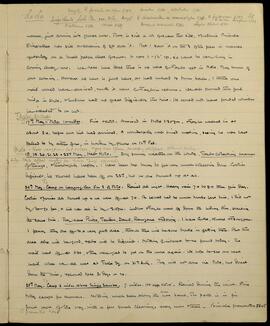
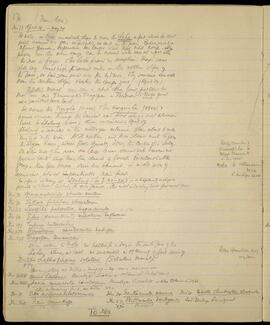
17a. (from 16a).
'33 April 14 - May 24

At Molo we took immediate steps to cross the Lo La, a feat which the local people assured us was impossible so early in the year. But we were of a different opinion. Experience has taught us that most knife-edge passes over the main range can be crossed with ease at night when the snow is frozen. The Lo La proved no exception. Though snow still lay breast high for several miles on the northern slopes of the pass, we had scampered over this by dawn, and by sunrise were well down the southern slopes within the conifer zone. (April 24.)

Sclater's Monal was seen in rhododendron and fir forest just below the snow line, and Temminck's Tragopan in deciduous and Tsuga forest at a somewhat lower level.

We crossed the Nyug La (11,000) and the Kargong La (13,800) and pressed onwards through the densest rain forest along a most atrocious track to Shalong (6,300) which we reached on April 27.

Shalong is situated in the middle of an extensive plain about 8 miles long by a mile wide. At its northern end three streams unite to form the Siyom River, which flows quietly down the centre of the valley. On either side of the river are large areas covered with bracken and pasture land which have been cleared of forest. Excellent cattle graze on these open downs, which are hemmed in on all sides by luxuriant, almost impenetrable, rain forest.

We spent 10 days at Shalong (See p. 22-28) — a hopelessly inadequate period in which to study its avifauna. The most interesting birds procured were:

No. 78 Grammatoptila striata austeni
No. 70 Suthora fulvifrons chayulensis
No. 83 Leioptila pulchella nigroaurita
No. 84 Sibia (Actinodura?) nipalensis daflaensis
No. 197 Tribura luteoventris
No. 372 Hirundapus caudacutus nudipes
No. 379 Tragopan temminckii

[Marginal note: Large numbers of Crossoptilon or Blood Pheasants in the wood. Molo. R. vellereum 3623, R. hirtipes 3624]

On our return to Molo we halted for a day on the south face of the Lo La, where, at last, we succeeded in obtaining a good series of No. 376-377 Lophophorus sclateri (Sclater's Monal).

[Marginal note: Picea spinulosa 3627 very common]

During stay at Molo — May 17-24 came across:
No. 356-8 Spinus thibetanus Himalayan Siskin — 1st time L. D. had seen it.
No. 348-9 Loxia curvirostra himalayensis Himalayan Crossbill — also obtained in 1936.

Other interesting birds at Molo were:
No. 71. Sitta europaea tibetosinensis
No. 368. Picus canus kogo
No. 74. Ianthocincla maxima
No. 81. Fulvetta striaticollis striaticollis
No. 371. Psittacula derbyana Lord Derby's Paroquet.
No. 372. Paroquet

To 28a

LSH/1/1/6/1/140 · Part · 1936-10-02
Part of The Ludlow & Sherriff Collection

SUMMARY:
At Lo La the diarist records clear, cold weather, intensive seed collecting of Primula and Omphalogramma, and notes on phenology and collection numbers. He mentions health issues (Kusho’s fever, his own heart), logistics and routes for Ludlow and Taylor via Gacha to Rolo, a returned coolie from Tsungpain, and observations over Lopa country, with Jia remembered for recognizing past camps.

CONTENT:
70 Lo La
omph. brachysiphon 6546

Could see, I have nearly two full packets of seed. Both the Omphalogrammas are over, hardly a seed left. I have not had time for more yet. There is not a cloud in the sky these evenings and the whole place is most beautiful. Very cold, hard frost at night. Kusho is sick tonight, but just a touch of fever I think. One of Tsungpain's coolies has returned, so I fear he may have some trouble. I don't know the reason: he merely says he was sent back. Ludlow and Taylor will I hope get over the bridge tomorrow up to Rolo. It was hard luck on them, and will make them late. However I believe all transport is ready for them in Rolo when they arrive, and that is something. I have been feeling my heart the last two days, and must go quietly for a bit. It is a pity now, just when there is such a lot to do, which means a lot of climbing. We still have Tsari Sama (2 passes), Tsela, Chikung La, Chubumbu La and the two to Nyigutun, Todo, and one at Nyigutun and Chikchar.

6th October. Halt. Lo La. Not a cloud all day. I went on collecting P. Elizabethae 6547, and have now five packets. Surely since one will raise something from these. That represents about seven hours work, four of them with 2 of us collecting. No P. Valentiniana seed. Omphalogramma all thrown too almost. P. Elizabethae was under 3-4 ft of snow on 15th May. The seeds must have been at their best for collecting on about 15-25th Sept. — a wonderfully short season. I hear today that Ludlow and Taylor have gone round by Gacha: presumably Pintso has come to Rolo, and if that is so, there can be no mail, or I should have heard. Jia is funny the way she remembers all our camps of even April, where we stopped only a night. She runs ahead when near them and sits down there waiting for the transport to come up.

7th October. Halt. Lo La. Fine, but cloudy a good deal of the day. Although cloudy here, I could see over the Lo La and away down over Lopa country as far as one could see, and it was absolutely clear, so I don't think there will be much snow or hail. The clouds too are coming from the East. I went up today to see if I could find Primula lactea. We got good seeds of P. Valentiniana, and found both P. Subularia and my new Dryadifolia Sect Prim (5865) tsangpoensis and got seed of them — a good collection of the latter, which was coming into flower again. I saw P. Jonarduni flowering.

LSH/1/1/6/1/57 · Part · 1936-06-26
Part of The Ludlow & Sherriff Collection

SUMMARY:
Diary records travel from Lo La and Singo Samba to Molo, where Taylor arrives, followed by several halt days to reorganise. The party then moves to camps on the Langong Chu and above Singo Samba while Ludlow and Taylor explore down the Lilung Chu; mail and future rendezvous plans are noted. Botanical collecting is mentioned throughout, though limited by logistics and weather.

CONTENT:
Lo La
May 16. R. forrestii var. repens 3783, Primula 3784, Calostrotum 3785.
Singo Samba, Loda Chu near Molo. May 16. R. chaetomallum var. chamaephytum 3786. R. ponderosum 3792. 78.
P. calderiana 3788, locosa 3789. Paraquilegia anemonoides 3790. Lloydia tibetica 3791. R. laudum var. lucidum 3793.

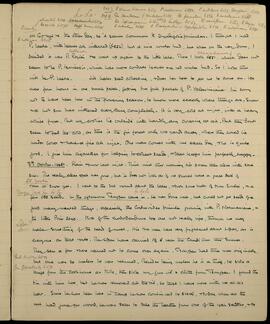
masses, just coming into flower now. There is still a lot of snow on this side; Ludlow's Primula elizabethae has still a covering of 3ft over it. But I saw it on the south of the pass in masses yesterday on a small patch clear of snow. It was 1-1 1/2" up, so it won't be very long in coming away now. We hear here that there is no news of Taylor yet in Molo. They know of our coming. However, no news is good news, as had he had to turn back, I think our mail would have arrived with news of Taylor's return. We all crossed this fine bridge in style; Ludlow had no great difficulty this time. He could not have turned whether he wanted to or not.

Taylor arrives
17th May. To Molo. 10 miles. Fine road. Arrived in Molo 1:30 pm. Taylor walked in at about 3:00, before our kit had arrived. A wonderfully well-timed meeting, seeing he was last talked to by either of us in London by phone on 12th Feb.

Molo - Halt, reorganise kit and loads, buying bags of flour, developing photographs, planning future.
18, 19, 20, 21, 22 and 23rd May. Halt Molo. Dry sunny weather on the whole. Taylor is collecting masses of things, thoroughly happy. I have been too busy to get very much collecting done. Coolies were difficult. We should have been off on the 23rd, but no one turned up at all.

24th May. To Camp on Langong Chu, 5 miles south of Molo. Rained all night. Heavy rain 7:00 to 9:00 then a fine day. Coolies and ponies all turned up and we were off at 7:00. As we had had so much trouble last time, I did not try to go far, and kit was all in by 2:00 pm. Ludlow and Taylor went off down the Lilung Chu, starting at the same time. They have Pinso, Tenduk, Dawd, Ramzana and Tsering. I have Cutha, Kusho and Tsourpon. I fancy they are off to a very good area, though there will be some trouble in getting there. But this area also will be good, and also will be difficult. Nothing of interest to me was found today. The mail went off at 6:30, and then we were glad to get on the move again. We hope to see our next mail when we all meet at Tsala Dz. on 31st July. They will not come via Molo, but direct down the river, and should take 21 days or so.

25th May. To Camp 3 miles above Singo Samba. 7 miles. Height approx. 11,500'. Rained during the night. Fine today except for showers. Nothing much seen along the river bank. The path is in fine forest most of the way, with a few small clearings every now and then. Primula prenantha 3848.

LSH/1/1/6/1/141 · Part · 1936-10-02
Part of The Ludlow & Sherriff Collection

SUMMARY:
At Lo La, the diarist collected Primula and Rhododendron specimens around a small lake amid frost, snow, and sun, noting Jill’s reluctance to collect seeds and the coolies’ hardiness. On October 8 a halt was made; a circuit to the southwest of the lakes yielded a few bulbs, and Tsongpen arrived reporting difficulties obtaining ripe seed, fears of Lhopas on the route, and a theft problem with a dismissed man.

CONTENT:
Lo La. Oct 7. P. chamaethauma 6551, P. calderiana 6552, P. subularia 6553, tsangpoensis 6554.
Oct 8. Gent. hamberxii f. caulibaccans 6555, Rh. pumilum 6556, R. concatenans 6560.
Rh. lopsangianum 6561, 6567 R. lindleyi 6562, R. xeriflorum 6563, R. haysii 6565.
R. elatum 6568, R. brachyanthum v. hypolepidotum 6576, R. sulphureum 6580.
abrivale 6558, normaniana 6574.
laccata 6575, Omph. minor 6585.

On Gonyi-re the other day, so it seems common to Omphalifolia primulas. I thought I had P. laeta, with leaves all withered (6552), but a nice winter bud, but when on the way down, I decided it was P. calderiana so went up again to the little lake. There I took 6551, which does not seem to be P. tsariensis, which has more cordate leaves & a red winter bud. So I hope this will be P. laeta. Jill hates seed collecting, & does her best to get me to come on. We were four hours in one small patch, getting two full packets of P. valentiniana. I'm sorry not to have been here in the flowering season, to know more exactly where things are. Snow & a hot sun has withered everything completely. It is very cold at night, with a heavy white frost. But my coolies lie outside with hardly any covering at all. But they don't seem to feel the cold, as there is the fir forest only 100 yards away, where they could lie under cover & have a fire all night. One man comes into me each day, this is quite good. I give him cigarettes for helping to collect seeds, & that keeps him perfectly happy.

8th October. Halt. Rain & snow last night. Thick mist this morning till 9.00 am then clear with some sun. The really clear spell has gone, but it does not look as if we should have a great deal of rain or snow yet. I went to the SW round about the lakes, & took some bulbs of Nom. souliei, & a few odd seeds. In the afternoon Tsongpen came in. He has done well, but could not get seeds of a good many wanted things, especially the Cortusoides primula growing with P. normaniana, & the little Prim 3640. Most of the rhododendrons too are not really ripe, though we may make something of the seeds of most. His two men were very frightened about Lhopas, as is everyone on that route. The Lhopas have carried off 5 near the Chudi-Cun this summer. They saw a few & were warned not to come over again. Tsongpen had three men originally, but one was so useless he was returned. Besides being useless he is a thief. He stole a knife from the cookhouse at Molo, then stole my gun oil & cloth from Tsongpen. I found the tin with him here, but he has removed all the oil, so that I have none with me at all now. Since he has been here in camp he has continued to steal, & today when all the rest had gone for wood, he was seen to take the leather from one of the yak saddles, & to...

LSH/1/1/1/1/171 · Part · 1933-09-05
Part of The Ludlow & Sherriff Collection

SUMMARY:
Describes the daily casting of lots for distributing loads among villagers and observations of women using black plasters and face paste recommended by lamas. Notes foraging mushrooms and wild gooseberries for tarts, local beliefs about tomatoes, and carrying Delphinium grandiflorum plants to obtain seed.

CONTENT:
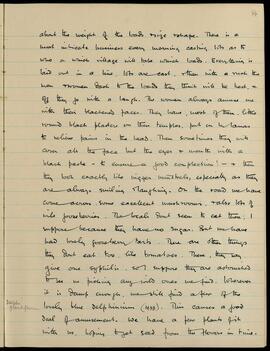
about the weight of the loads, size & shape. There is a most intricate business every morning casting lots as to who or which village will take which loads. Everything is laid out in a line, lots are cast, then with a rush the men & women dash to the loads they think will be best, & off they go with a laugh. The women always amuse me with their blackened faces. They have, most of them, little round black plasters on their temples, put on by lamas to relieve pains in the head. Then sometimes they will cover all the face but the eyes & mouth with a black paste - to ensure a good complexion! - & then they look exactly like nigger minstrels, especially as they are always smiling & laughing. On the road we have come across some excellent mushrooms, & also lots of wild gooseberries. The locals don't seem to eat them; I suppose because they have no sugar. But we have had lovely gooseberry tarts. There are other things they don't eat too, like tomatoes. These, they say, give one syphilis, so I suppose they are astonished to see us picking any wild ones we find. Wherever it is damp enough, we still find a few of the Delphin. grandiflorum lovely blue delphinium (499). This causes a good deal of amusement. We have a few plants of it with us, hoping to get seed from the flowers in time.

LSH/1/1/8/1/183 · Part · 1947-04-27
Part of The Ludlow & Sherriff Collection

SUMMARY:
List of local names with language codes (P, T, Lep) for Monal, Tragopan, Crossoptilon, Kalij, partridges (Arborophila), and Tetraophasis.

CONTENT:
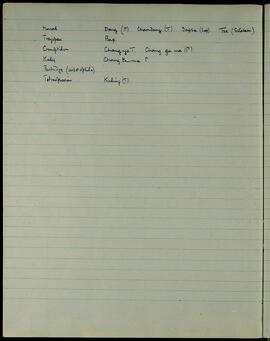
Monal Dong (P) Chamdang (T) Daphe (Lep) Tse (Sclateri)
Tragopan Bap.
Crossoptilon Changnga T. Chang ga ma (P)
Kalij Chang ka ma P.
Partridge (Arborophila)
Tetraophasis Kuling (T)

GB 235 MOS · Item · c.1869

Manuscript titled 'Localities for New or Rare Mosses in Scotland'.
The names Alexander McKinlay, James Stirton and John Shaw are mentioned as collectors in the manuscript, alongside three dates, 1861, 1864 and 1868. Although not definite, the handwriting in the documents compares very favourably to that of James Hardy (1815-1898), Secretary of the Berwickshire Naturalists Club and compiling a work on Mosses of Berwickshire at the end of the 1860s.

Hardy, James
LSH/1/1/4/1/44 · Part · 1936-04-28
Part of The Ludlow & Sherriff Collection

SUMMARY:
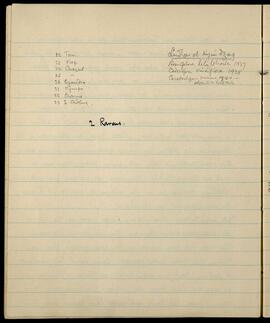
Brief notes list several localities with associated plant records (including Adenophora liliifolia, Codonopsis viridiflora, and Ceratostigma minus) dated 1937, 1938, and 1940. Mentions Ludlow at Kyim Dzong, notes that Gyandro abounds on the hillside, and records an observation of two ravens.

CONTENT:
22 Trun. Ludlow at Kyim Dzong
23 Kap. Adenophora liliifolia 1937
24 Chaqul Codonopsis viridiflora 1938
25 - Ceratostigma minus 1940 -
26 Gyandro abounds on hillside.
27 Kyuphu
28 Charme
29 S. Chöling

2 Ravens.

Logan Botanic Gardens
GB 235 LOG · Collection · 1965 - 2015

Logan Botanic Gardens, Stranraer, Wigtownshire
•2 boxes of papers marked ‘Acquisition’
•1 box of papers marked ‘Deed of Gift from Trustees’
Logan Gardens Trust
•1 file containing miscellaneous correspondence (1965-67)
•1 file containing miscellaneous correspondence and minutes of the trustees meetings (1961-63)
•2 different rough drafts of ‘A Guide to the Gardens’ (Logan Gardens)
Logan House
•2 boxes of papers marked ‘Sale to Sir Ninian Buchan-Hepburn’ London, Royal Botanic Society
•Regulations and lists of members (1877)

Logan Botanic Gardens
London, University of
GB 235 LUV · Item · 1886

Regulations for the Preliminary Scientific (M.B.) Examination, 1st Feb 1886
•Syllabus of a Course of Ten Lectures on Botany by George Masse

London, University of