Showing 4 results

Archival description
4 results with digital objects Show results with digital objects
LSH/1/1/9/1/86 · Part · 1949-06-30
Part of The Ludlow & Sherriff Collection

SUMMARY:
Seed collections are listed with specimen numbers and brief locality notes around camp, river, lake, and cliffs, including several Primula species, anemones, Rheum, and Androsace. Notes record seed sent to Taylor and to G.T.

CONTENT:
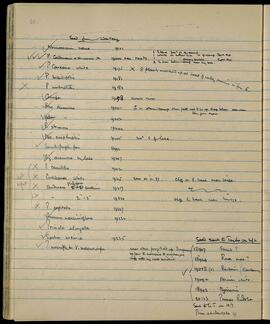
Seed from Waitang

Nomocharis nana 19121 1 ½ blue 300' N of camp.
P. calderiana x strumosa 19000 ABC roots. 1 white in bottom ½ m N of camp. Dark eye.
1 " " " among shrubs. light eye.
2 ½ blue below camp near big rock.
P. caveana white 19175 X 8 plants marked up at head of valley, river in from E.
P. bellidifolia 19181
P. muscarioides 19183
Conifer 19198 across river
Blue anemone 19201 ½ m above camp where path used to go up. Keep below near where they join again.
Yellow " 19202
P. strumosa 19204
Rheum spiciforme 19205 200' S of lake.
Small purple pea 18992
Big anemone by lake 19207
P. tenuifolia 19212
Cochlearia white 19215 some as in 37. Cliff on L. bank near bridge. (not ripe)
Androsace globifera cushion 19217 (not ripe)
" " 2" - 3" 19220 cliff L. bank near bridge.
P. capitata 19227
Anemone narcissiflora 19232
Primula elongata
Sorbus ursina 19235
P. macrophylla v. macrocarpa near where pony tied up Dumpra. up past R moraine to overhanging cliff with big rock beside it.

Seed sent to Taylor on 30/6
18907 Surus?
18924 Rosa mac?
19058 (2) Berberis (Kautam)
19092 Allium white.
18943 Myricaria.
20123 Prunus Rudolpha
Sent to G.T. on 10/7.
Prim. atrodentata 19
LSH/1/1/10/1/128 · Part · 1949-04-16
Part of The Ludlow & Sherriff Collection

SUMMARY:
Page lists Primula and other plant specimens with numbers. The 'ROOTS COLLECTED' section records species with day-month dates in September and October, notes such as 'NOT TO BE DIVIDED' and 'ONLY TWO PLANTS', and that Sorbus ursina seed was eaten by caterpillars.

CONTENT:
19836 Primula uniflora.
(2) 19835 " tsariensis (alba).
(3) 19832 " umbratilis (alba).
19842 " tsariensis.

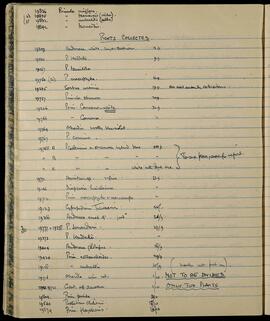
ROOTS COLLECTED.

19309 Androsace white, large cushions. 13.9.
19330 P. Waddellii. 9.9.
19167 P. tenuiloba
19750 (2) P. macrophylla. 16.9.
19235 Sorbus ursina. 19.9. All seed eaten by caterpillars.
19757 Primula strumosa 20.9.
19226 Prim. Caveana white. 21.9
19766 " Caveana. "
19764 Alardia woolly blue violet. "
19767 P. concinna. "
19768 A P. Calderiana x strumosa hybrid blue 22.9 }
B " " " " " } To one place, see for report.
C " " white with dark eye " }
19771 Aconitum sp. v fine. 23.9.
19146 Diapensia himalaica "
19712 Prim. macrophylla v macrocarpa "
19123 Cypripedium tibeticum. 25.9.
19366 Androsace small 4" pink 26/9.
2 19777 = 19378 P. jonardunii. 27/9
19373 P. Waddellii. "
19404 Androsace globifera. 28/9.
19420 Prim. sonchifolia. 29/9.
19128 " umbratilis 30/9 (number not put on).
19716 Alardia wine red. 1/10. NOT TO BE DIVIDED.
19721 Gent. aff amoena 1/10 ONLY TWO PLANTS

  1. Prim. pusilla 3/10
    19544 Thalictrum chelidonii. 13/10
    19574 Prim. flagellaris. 16/10
LSH/1/1/10/1/8 · Part · 1949-09-14
Part of The Ludlow & Sherriff Collection

SUMMARY:
Seed collecting was limited by pests and grazing yaks; noted species include P. elongata, Arabis, Gueldenstaedtia, Cypripedium tibeticum, Sorbus ursina, and an Aconite bulbifera with bulbils in leaf axils. After rain and colder weather, the party planned to go to the pass; on 20th September they halted, dug roots of P. strumosa, photographed Gentiana veitchiorum, and admired a green lake below the pass with snowy peaks.

CONTENT:
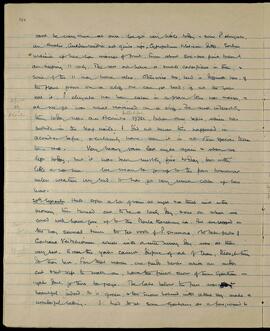
can be everywhere at once. We got very little today - some P. elongata, an Arabis, Gueldenstaedtia not quite ripe, Cypripedium tibeticum ditto. Sorbus ursina up here has masses of fruit. From about 500-600 fruit taken I am keeping 11 only. The rest all have a small caterpillar in them, & some of the 11 may have also. Otherwise too, seed is difficult here. If the plant grows on a cliff, one can get seed; if not the yaks eat it. P. elongata has been eaten in a place there was masses, & all we got was what remained on a cliff. The most interesting thing today was an Aconite bulbifera 19752, taken once before, which has bulbils in the leaf axils. I did not know this happened in aconites before, & certainly have seen it in no other species than this one. Very heavy rain last night again & when we left today, but it has been mostly fine today, but with little or no sun. We mean to go up to the pass tomorrow unless weather very bad. It has got very much colder up here now.

20th September. Halt. After a lot of rain at night & a thick mist in the morning, this turned out to be a lovely day, one on which we could well have gone up to the Mula Karchung La. But we stopped on the way several times to get roots of P. strumosa, & to take photos of Gentiana Veitchiorum, which with a nice sunny day, were at their very best. Even the yaks cannot dispose of all of them, though they do their best. For that reason, one finds banks which are undercut and safe to walk on, have the finest show of this Gentian - yaks don't go there to graze. The lake below the pass was beautiful indeed. It is green, & the snows behind with a blue sky make a wonderful setting. I tried to get some Gentians as a foreground to

LSH/1/1/9/1/83 · Part · 1937-06-23
Part of The Ludlow & Sherriff Collection

SUMMARY:
Persistent cold rain kept the party in camp. The diarist noted Sorbus ursina in flower and extensive but unflowered Thalictrum chelidonifolia, hoped for a clear day to reach the Monla Karchung La to see Kula Kangri, and on the 25th a delayed pony and arrival of mail and supplies forced a return to camp.

CONTENT:
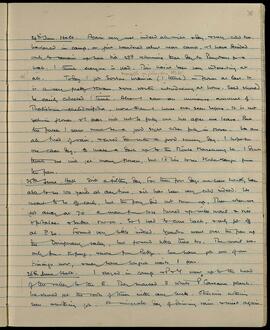
24th June. Halt. Again very wet indeed all night and day, and very cold too. We stayed in camp, or just wandered about near camp, and I have decided only to remain up here till 28th returning that day to Pangotang for a week. I think everyone is glad. This hasn't been very interesting at all. Today I found Sorbus ursina (I think) in flower at last. It is a very pretty rowan, well worth introducing at home. Seed should be easily collected I think. Also I saw an immense amount of Thalictrum chelidonifolia, more than I have ever seen before. It is not yet in flower, and I fear will not be fully out till after we leave. But the patch I saw must be a good sight when fully in flower. We are all tired of rain, and would do with a good sunny day. I hope for one clear day, to make a dash up to the Monla Karchung La. I don't think we will get many flowers, but I'd like to see Kula Kangri from the pass.

25th June. Halt. Still a filthy day. For these four days we have hardly been able to see 100 yards at any time, and it has been very cold indeed. We meant to be off early, but the pony did not turn up. Then when we got away at 7.0 a man from HH turned up with mail and rice and potatoes and butter and so on. So I had to come back,