Showing 45 results

Archival description
45 results with digital objects Show results with digital objects
LSH/1/1/3/3/213 · Part · 1996-06-18
Part of The Ludlow & Sherriff Collection

SUMMARY:
At Yume, the diarist notes wet, misty conditions, sparse flowering, and prominent rhododendron, pays off the coolies, and arranges horses to Sangacholing. The following day, during a halt, the diarist and Tsungpen follow the Yume Chu on a difficult, muddy route through dense jungle and see little in flower.

CONTENT:
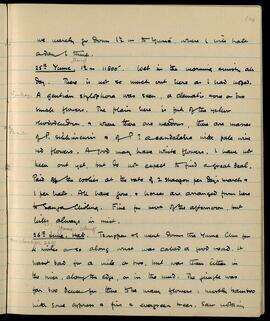
we merely go down 1½ m to Yume, where I will halt a day I think.

25th June. Yume. 1½ m. 11800'. Wet in the morning and misty all day. There is not so much out here as I had hoped. A Gentian stylophora was seen, a clematis one or two small flowers. The plain here is full of the yellow rhododendron, and where there are meadows, there are masses of P. sikkimensis and of P? a candelabra with pale wine red flowers. A good many have white flowers. I have not been out yet, but do not expect to find a great deal.

Paid off the coolies at the rate of 2 shoogon per day's march and 1 per halt. All have gone, and horses are arranged from here to Sangacholing. Fine for most of the afternoon, but hills always in mist.

26th June. Halt. Tsungpen and I went down the Yume Chu for 4 miles or so along what was called a good road. It wasn't bad for a mile or two, but was then either in the river, along the edge, or in the mud. The jungle was far too dense for there to be many flowers: mostly bamboo with some cypress and fir and evergreen trees. Saw nothing.
LSH/1/1/6/1/93 · Part · 1938-07-08
Part of The Ludlow & Sherriff Collection

SUMMARY:
The diarist travels through swampy valleys near Tum La in persistent rain, noting mallard and snipe, yakherd huts, and that the pass is very low. Botanical work records several Primula species mostly past flowering; an attempt to explore the ridge in thick mist results in getting lost and retracing the route with help from a local.

CONTENT:
Tum La

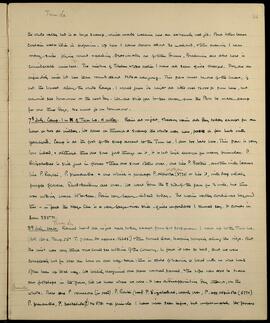
the whole valley bed is a huge swamp, which made walking here an extremely wet job. But these lakes contain water lilies in profusion. Up here I came across about 30 mallard, this evening I hear many snipe flying round and calling. Occasionally one of them drums. Brahmins are also here in considerable numbers. The mixture of Tibetan and Lopa coolies I have all seem quite cheerful. They are an infinitely nicer lot here than round about Molo and Langong. This pass must be one of the lowest, if not the lowest along the whole Range. I would guess its height at little over 12000 ft from here, but we will see tomorrow or the next day. We are still far too far away from the Pass to make camp for our three days, so must go on tomorrow.

7th July. Camp. 1 m N of Tum La. 4 miles. Rain at night, then rain all day today except for an hour or two at midday. We came on through a swamp the whole way here, past a few huts with yakherds. Camp is at the foot of the steep ascent to the Tum La. I am too late here. This pass is very low indeed, and although there are some good things on it, it is not high enough for many primulas. P. Elizabethae is still just in flower and there are some others over, one like P. Boothii, another with leaves like P. Roylei, P. prenantha and one which is perhaps P. alpicola violacea (3770) or like it, with deep velvety purple flowers. Rhododendrons are over. We went down the S side of the pass for ½ mile, but there was nothing much to be seen. Rain very heavy indeed today. The main valley continues beyond this - in fact the Nyam Chu is a very large river still - quite unfordable I should say. It comes in from 285° M.

8th July. Halt. Tum La. Rained hard all night and all today except from 4.0 to 6.0 am. I went up to the Tum La, (B.P. 190.4. Temp. 55° T. 7.0 am. Ht approx. 12243') then turned East, keeping roughly along the ridge. But the mist was very thick and we could see nothing of the country. In fact it was so bad, that we were completely lost for over an hour on our way back: this in spite of having a local with us who had often been up that way. We luckily recognized one place we had passed, and the Lopa was able to track our footsteps in the grass, till we knew where we were. It was a disappointing day though, on the whole. There are P. vernicosa (in seed). P. Roylei (seed) P. Elizabethae, nearly over, P. aff. alpicola (5770) P. prenantha, P. barbatula No 5791 a primula I have never seen before, but unfortunately the flowers

LSH/1/1/7/1/11 · Part · 1940-05-24
Part of The Ludlow & Sherriff Collection

SUMMARY:
The author describes the low Tum La pass and nearby areas, noting limited finds there but abundant primulas and a notable prostrate yellow-flowered rhododendron. After wet weather they returned toward Nagu, collected aquatic and tree specimens, noted Magnolia globosa and Lilium giganteum in the Nagu Chu valley, and then proceeded toward Paka to visit the Tsanang La and Kuchala passes, observing that Tsanang La is steep and little used but botanically promising.

CONTENT:
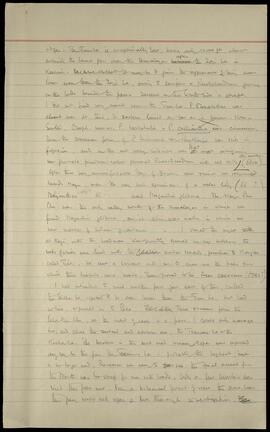
ridge. The Tum La is exceptionally low, being only 12,000 ft, almost certainly the lowest pass over the Himalayas after the Zoji La in Kashmir. It gives the appearance of being even lower even than the Zoji La, owing to conifers & Rhododendrons growing on the hills beside the pass. Descent on the south side is abrupt. I did not find very much near the Tum La. P. Elizabethae was almost over at this, its eastern limit as far as is known. Nom-Soulei, Omph. minus, P. barbata & P. calliantha were common. Here the common form of P. Dickieana var. Pantlingii was still in profusion, and on the wet rocky hillside was that most intriguing new prostrate primrose yellow flowered Rhododendron, with red spots (6600).

After three very uncomfortable days of driving rain & mist we returned towards Nagu, & on the way took specimens of a water lily (66?) Menyanthes trifoliata 66-- and Magnolia globosa. The Nagu Chu was the only valley north of the Himalayas in which we found Magnolia globosa, & it also was in which we saw masses of Lilium giganteum. I stayed the night at Nagu with the headman who proudly showed me his kitchen the walls of which were lined with wooden teapots, peculiar to Kongbo, called Tisti. He sent a servant with me to show me the trees from which these teapots were made. These proved to be Acer caesium (5740?).

I had intended to visit another pass just east of this, called the Shoka La, reputed to be even lower than the Tum La, but had no time, & pushed on to Paka. Three streams form the Paka Chu Chu, at the head of each is a pass. I could only manage two, and chose the central and eastern one, the Tsanang La & the Kuchala. The western is the most used & many Lopas were expected any day by this pass. The Tsanang La is probably the highest, but is no longer used. The reason was easy to see. The final ascent from the North was too steep for men with loads. Only a few hunters ever visit this pass now. From a botanical point of view the area near this pass, would well repay a more thorough investigation.

LSH/1/1/4/1/73 · Part · 1933-08-15
Part of The Ludlow & Sherriff Collection

SUMMARY:
At Tso Burnag Lake Camp, the writer describes fir- and rhododendron-covered hillsides, notes deer sign, and mentions Gulla suffering severe pain after Lumsden treated his poisoned foot. The writer and Lumsden bathe in the cold lake at high altitude. On 16th August, they halt and search hillsides east of the lakes, find no new plants, and the writer briefly encounters a herd of burhel without success.

CONTENT:
neither so big nor so interesting. Hillsides well covered with fir for 500 ft. then rhododendron. Many crenophilum about, and much deer, and there are said to be kuling also. Gulla had a rotten day today. His foot is poisoned, Lumsden cut it 2 days ago, putting in a local anaesthetic in a septic wound. The result is awful pain to poor old Gulla. L. has made a mess of everything he has done in that way, and can only give iodine with safety. This afternoon, as it was sunny, Lumsden and I had a bathe in the lake, which shelves down pretty quickly just 10 yards in front of our camp. It was cold of course, though not as bad as I would have thought. The temp of the water was 51°. Swimming at 13000' is hard work, and I only went out 10 yards or so. It was lovely, especially when out!

Tso Burnag Lake Camp.
16th August. Halt. Tried the hillside to the E of the lakes. But they held nothing new, and the only gentian in any numbers was G. stictantha (?? Przewalskii), which was not yet out. I walked almost into a herd of 20 burhel, but had my eyes on a cliff. They were off at once, though I just had time to change ammunition and have two snapshots at them without doing any damage.

LSH/1/1/6/1/23 · Part · 1938-03-21
Part of The Ludlow & Sherriff Collection

SUMMARY:
Notes a ruined iron chain bridge below Tsetang and a night spent in a newly renewed but empty Dzong. The party travels to Lagyari/Lhagyari, halts for transport arranged by a helpful ruling nun, then crosses the Potrang La to Lasor, recording birds and early-season botanical observations.

CONTENT:
27 March Ludlow 22. "No European seems to have travelled this stage. Bailey avoided it - p. 313 F.K.W. u. 1924."

top joint & hurt my wrist. It might have been much worse. There are still the remains of an old iron chain suspension bridge.

Chain bridge 1 1/2 m below Tsetang - two huge piles of rocks & two chains still hanging down from one.

No one was in the Dzong which had just been renewed, so we spent the night in it, & were very comfortable. The Tsangpo here takes a very sharp 100° turn to the North. (70 13100' see Ludlow p. 22-23.)

27th March. Lagyari. 15 miles. Perfect weather & v. hot. Started at 7.0 am, in at 4.0 pm. Transport mostly bullock, & again many boxes badly damaged. Half way up we came across geese & shot three. Also saw a Sheldrake & some pintail, mallard & teal. Lagyari is a lovely place: Dzong & monastery on the edge of a cliff on the river bank, & beautiful wooded flats below, in which we are camped. They threaten to keep us here a day, but we still hope for the best. Ludlow has gone to the Dzong to call for both of us. There are no flowers out here yet, though Iris (ensata?) is 1" above ground & there is a very small gentian showing flowers here & there. P. tibetica not yet in flower. This place seems independent of Lhasa & is ruled, & ruled well by a nun.

28th March. Halted Lhagyari. Fine. As ponies could not be produced in time, we had to halt. However the nun gave orders for donkeys & bullocks to come today & take on as much kit as we could spare - about 28 loads. The remainder will be carried by mules & ponies tomorrow. We lunched today in the gompa, a beautifully clean place. The nun is a fine looking woman, related to many people of importance - of some importance herself. She was very friendly & helpful. From here to Tsona is only 4 days march, so this might be a good way home. There is little snow of course up here in winter.

29th March. Lasor (12,200' ap). 16 miles. Beautiful day. Left at 7.15 am, in at 4.0 pm. The ascent to the Potrang La (16500 ft) is steeper than we expected. Gradually the hills become more vegetated, & there are many dwarf junipers & a small Rhododendron near the top. But the East side shows a more marked contrast, & the rainfall on the E must be very considerably more than on the West. From the very top, it is apparent. Rhododendron covers the hillside (R. lepidotum). Among these we saw many old stalks of Primula - P. macrophylla(?) & P. sikkimensis. There are also gentians, these seen being much too early for flowers on the north side of the main range & at this altitude.

LSH/1/1/7/1/7 · Part · 1940-05-24
Part of The Ludlow & Sherriff Collection

SUMMARY:
The diarist notes bodies with bows left beside them and observes alpine flora on nearby snow slopes and streambeds. Accompanied by Langong coolies, they visit the Tsari Sama (Sarpa) pilgrimage area, finding it rich in Primula, Rhododendron, and a new white-flowered Daphne near the pass to Lopa territory. Trashiyang is mentioned as the starting and finishing point of the pilgrimage.

CONTENT:
Beside each body, the owner's bow had been stuck in the ground. All arrows had been taken away, but all their other possessions seemed to have been left intact, even to their meagre rations of food. Near here, at the top of the snow slopes, were vertical cliffs. Tucked away in dust-dry pockets, completely sheltered from rain, were fine clumps of P. littledalei.

A little lower down, at 14,000', the first Meconopsis simplicifolia were coming into flower. Beside this, P. chamaethauma was in flower, and on a steep bank just above this, a little creeping Lonicera, only an inch or two off the ground, showed its yellow flowers. Some of the open swampy flats held masses of a fine Allium (No. ). On stony beds beside streams grow P. macrophylla v. macrocarpa.

There remained, near Langong, one area to visit, that was Tsari Sama. This is a place of pilgrimage, called Tsari Sama or Sarpa—the new Tsari—to distinguish it from the better-known, more important Tsari Chikchar. The Langong coolies were not anxious to go round the pilgrimage, for which I could not blame them. However, they took me, and it was a most interesting trip. As at the Lo La, there is in Tsari Sama a fairly extensive, reasonably open flat bit of country, just north of the immediate Himalayas, gradually rising to a steep rocky ridge. The whole of this area was very rich in flora. This, to a certain extent, can, I think, be put down to the fact that no yaks are kept here in the summer. None of the dwarf rhodos were now in flower, and R. campylogynum (5560), R. trichocladum (5555), R. glaucum (5565). Also 5568.

A Primula not seen elsewhere, P. Kingii covered acres of open ground with its deep wine-coloured blooms, P. laeta, a glorified form of P. Roylei. Primula, P. gracilipes.

Perhaps the most interesting Rhododendron was 5571 (yellow, red spots). Growing among rocks just below the ridge before reaching the pass to Lopa territory, we came across a fine large, white-flowered new Daphne. No seeds.

At Trashiyang, the starting and finishing point of the pilgrimage,

LSH/1/1/8/1/45 · Part · 1947-01-13
Part of The Ludlow & Sherriff Collection

SUMMARY:
Travel from Namdi to Trulung was exhausting with frequent ascents and descents, few rhododendrons observed, and views over the junction of the Po Tsangpo and Tanghyuk Chu towards Gompo Ne; takin were reported abundant, and kalij pheasants were shot en route. After halting at Trulung with rain and snow, Sandup found the first rhododendron; the party then moved to Chakzam opposite Tangme at the junction of the Po Tsangpo and Yigrong Chu.

CONTENT:
Jan
10th Jan. TRULUNG. Fine and clear. A very tiring day. The path leaves the valley bottom at once on leaving Namdi and does not come down again till Trulung is reached. It keeps going up and down in a most distressing way, and made us all very tired. Ponies must go this way. Coolies go by the valley road, but it also rises to a pass before the very steep descent to Trulung. However the road was interesting all along, and we got another 15 specimens or so. The most remarkable and disappointing thing about these hills, is the lack of Rhododendrons. We hardly saw any, or I should say we only saw in all 3 species. One was an interesting big flowered Maddenii Series one, near here, on the pass, of which we got seed (12117). From there the junction of the Po Tsangpo and Tanghyuk Chu is seen, and the valley down to Gompo Ne. The latter looks much drier than I ever imagined it could be, and has large areas of pine forest on the left bank. Here too there are curious areas of pine on the S. faces. There are many takin about, both down towards Gompo Ne, and also on this side of the river, up the Trulung Chu. The locals say that they keep high up the hillside, just below the snow. The head of one was brought in for us to see, and obviously a good many are shot, and they are described by the locals as being numerous hereabouts. On our way here, at a place where there is considerable deserted cultivation, we came across kalij pheasant, shot 3, having seen a dozen or more. I also put up one woodcock at the same place.

11th & 12th Jan. Halt Trulung. Clear fine morning, clouding up and starting to rain here by 5.30 pm on 11th. Snowed that night at 7000' and rained here till 11.0 am. All the lads went out to shoot something, but were not successful. We heard barking deer close to. Sandup found the first Rhododendron — a poor specimen of an arboreum series of trunk. Nothing else of interest.

13th Jan. Chakzam (Opposite Tangme at junction of Po Tsangpo and Yigrong Chu) Rain again at night and snow down to 7500'. Fine but cloudy and misty all day. Road better than to Trulung but still a great deal up and down. Nothing of interest in the

LSH/1/1/8/1/38 · Part · 1946-12-31 - 1947-02-23
Part of The Ludlow & Sherriff Collection

SUMMARY:
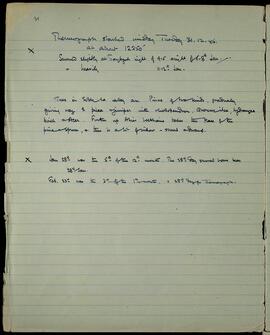
Notes the thermograph start on 31 December 1946 at about 12,250 feet, with snowfall events at Tomjuk in early to mid-January. Describes tree composition in the Sobhe la valley and records date correspondences for Jan 28 and Feb 23 related to the thermograph.

CONTENT:
34

Thermograph started midday Tuesday 31.12.46.
at about 12,250'
Snowed slightly at Tomjuk night of 4-5, night of 6-8th Jan.
Snowed heavily 11-12th Jan.

Trees in Sobhe la valley are Pinus of two kinds, gradually
giving way to Picea and Juniper with Rhododendron, Quercus ilex, Hydrangea,
Birch and Acer. Further up Abies webbiana takes the place of the
Pine and Spruce, and there is a lot of Willow - shrub and dwarf.

Jan 28th was the 5th of the 12th month. The 28th day should have been
28th Jan.
Feb. 23rd was the 3rd of the 1st month. = 28th day for Thermograph.

LSH/1/1/4/1/210 · Part · 1936-11-07 - 1936-11-11
Part of The Ludlow & Sherriff Collection

SUMMARY:
Page lists specimen numbers and taxa with collection sites including Ralala, Lasiak, Chusam, Bum La, Sangacholing Kympu, Shas, Kechen La, and Tawang, with dates ranging from 21/09/1936 to 14/11/1936. Notes indicate some number ranges with instructions to see the Book for species details.

CONTENT:
2795 Gentianaceae sp. Ralala. 7/11 7 Lasiak (perhaps 2455) Ralala. 7/11
2044 Primula welshii 30 10. Chusam. 14/11 2531 Meconopsis argemonetta. Bum La. 31/10
Gentiana waltonii. Sangacholing Kympu. 2597. 30.10.36. 21/9 2820 Primula sapphirina. Shas. 10/11
2821 Primula tenuiloba. Kechen La 10/11 2822 Gentiana (Lomatogonium brachyantherum) like 2724. Shas. 10/11
2823 Gentiana ornata. Shas. 10/11 2824 Rhododendron anthopogon Kechen La 10/11

2601 - 2700 with a few exceptions (see Book for spp.)
27 - 27 see Book. Field notes.
2801 - 28 see Book -- --

2825 Rhododendron arboreum? Tawang 11/11 2826 Rhododendron thomsonii O leaf. Tawang 11/11
2827 Rhododendron

LSH/1/1/8/1/84 · Part · 1947-03-20
Part of The Ludlow & Sherriff Collection

SUMMARY:
Notes list Primula specimens (including P. winteri, P. jaffreyana, P. atrodentata) and Rhododendron series, with observations on flowering and leaf characters. Kodachrome entries mention willow catkins at Lomo (same as Lusong willow), peaches at Tongkyuk and Tongkyuk Dzong, quince, and Rhododendron in snow at Lumang. Several entries are dated in late March and April.

CONTENT:
78

  1. P. Winteri. See No 12052 taken same spot. Still not in flower. More particularly the great amount of farina on these plants which are not yet in flower, compared with specimens in full flower under other numbers.
  2. P. Jaffreyana not in flower.
    12317 P. atrodentata.
    12319 P. Winteri - note crenulation of leaves, and length of scape.
    12320 P. aff. chungensis not in flower.

Kodachrome 18
Willow catkins Lomo 31/3. Same as Lusong willow.
Rhod. pink = No. 12313 "
Piptanthus sp -
Yellow flowered tree - 12321 peach blossom behind.
Peaches at Tongkyuk 7/4.

No 19.
Rhododendron virgatum ser. No. 12326 5/4
Tongkyuk Dzong peach blossom. "
Prim. atrodentata. "
Rhod. ? Thomsonii ser. 12313. "

No 20.
T. Henrici on Rhod. 12313. ② Rhod. 12313 close up. ③ Rhod. 12329.
Quince 11/4. Rhod 12375 11/4 Fine specimen of Rhod 12313 in snow Lumang. 12/4 //