Showing 4 results

Archival description
LSH/1/1/6/1/39 · Part · 1933-05-17
Part of The Ludlow & Sherriff Collection

SUMMARY:
The party moved up the valley with coolies burdened by heavy loads and delays at Molo, noted weather changes, and observed several rhododendrons and primulas. On 22 April at a camp above Singo Samba, a hazardous bridge crossing led Ramzana to cross while Ludlow forded downstream with Tseringpen. On 23 April, despite fresh snow and the coolies’ refusal to move, Ludlow, Tseringpen, and the diarist scouted and broke a path to the Lo La pass, checking known plant sites now under snow.

CONTENT:
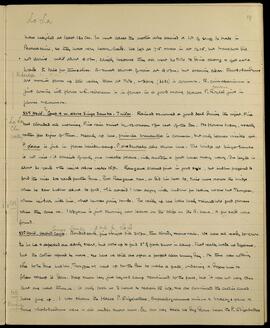
have weighed at least 130 lbs. In most cases the coolies also carried a lot of stuff to trade in Pachakshiri, so they have very heavy loads. We left at 7:15 and were in at 12:15, but transport did not arrive until about 4:00 pm, chiefly because they all went to Molo to drink chang and get extra loads to take for themselves. A small shower of rain at 4:00 pm, but evening clear. Rhododendrons are more in flower up this valley than at Molo, R. 3624 (3631) is common. R. cinnabarinum is just coming into flower and R. vellereum is in flower in a good many places. P. Roylei just in flower common.

22nd April. Camp 4 m. above Singo Samba. 7 miles. Rained and snowed a good deal during the night. Fine but clouded all morning. Fine rain and mist by 12:00 noon and for rest of the day. No flowers today, and really rather few signs of them. Nearly up here, Primula prenantha is common, but only leaves visible yet. P. glabra is just in flower beside camp. P. atrodentata also shown here. The bridge at Singo Samba is not nice - it consists of only one usable plank, with another a foot lower and very wavy. The length is about 30 yards and the height above water 15 ft. Ramzana crossed first in good style, but Ludlow preferred to ford the river 200 yards further down. Poor Ramzana ran, or did his best to, twice more across the bridge when he saw Ludlow about to ford. I'm afraid I was angry with Ludlow for telling no-one but Tseringpen, whom he took with him, what he was going to do. The valley up here looks lovely and should hold good flowers when they come on. Isopyrum is just showing new leaves on the cliffs on the R. bank. A few seed were found.

23rd April, Halted Camp. Clouded early, fine and bright till 2:00 pm, then cloudy and some rain. We were all ready to cross the Lo La and expected an early start, but woke up to find 2" of fresh snow in camp. That really made no difference, but the coolies refused to move, so here we still are after a perfect clear sunny day. As there was nothing else to be done Ludlow, Tseringpen and I went up to the Pass to make a path, ordering a dozen men to follow and stamp it down. Deep snow lay just beyond camp and continued to the pass, but it was not very often that one went through. It only took us 3 hours to reach the top, and we are convinced the coolies could have gone up. I was shown the places P. Elizabethae, Omphalogramma minus and brachysiphon and some rhododendrons were - all under snow now. On our way back we dug down near the P. Elizabethae
LSH/1/1/6/1/34 · Part · 1933-04-14 - 1933-05-17
Part of The Ludlow & Sherriff Collection

SUMMARY:
The party crossed the snow-bound Lo La at night, then traversed the Nyug La and Kargong La to reach Shalong by April 27, describing the Shalong plain and listing notable birds collected. On returning to Molo they secured Sclater's Monal on the south face of Lo La and, during May 17–24, recorded additional species, with marginal notes on pheasants and Picea spinulosa.

CONTENT:
17a. (from 16a).
'33 April 14 - May 24

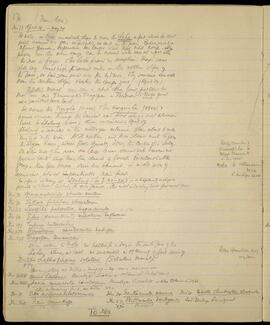
At Molo we took immediate steps to cross the Lo La, a feat which the local people assured us was impossible so early in the year. But we were of a different opinion. Experience has taught us that most knife-edge passes over the main range can be crossed with ease at night when the snow is frozen. The Lo La proved no exception. Though snow still lay breast high for several miles on the northern slopes of the pass, we had scampered over this by dawn, and by sunrise were well down the southern slopes within the conifer zone. (April 24.)

Sclater's Monal was seen in rhododendron and fir forest just below the snow line, and Temminck's Tragopan in deciduous and Tsuga forest at a somewhat lower level.

We crossed the Nyug La (11,000) and the Kargong La (13,800) and pressed onwards through the densest rain forest along a most atrocious track to Shalong (6,300) which we reached on April 27.

Shalong is situated in the middle of an extensive plain about 8 miles long by a mile wide. At its northern end three streams unite to form the Siyom River, which flows quietly down the centre of the valley. On either side of the river are large areas covered with bracken and pasture land which have been cleared of forest. Excellent cattle graze on these open downs, which are hemmed in on all sides by luxuriant, almost impenetrable, rain forest.

We spent 10 days at Shalong (See p. 22-28) — a hopelessly inadequate period in which to study its avifauna. The most interesting birds procured were:

No. 78 Grammatoptila striata austeni
No. 70 Suthora fulvifrons chayulensis
No. 83 Leioptila pulchella nigroaurita
No. 84 Sibia (Actinodura?) nipalensis daflaensis
No. 197 Tribura luteoventris
No. 372 Hirundapus caudacutus nudipes
No. 379 Tragopan temminckii

[Marginal note: Large numbers of Crossoptilon or Blood Pheasants in the wood. Molo. R. vellereum 3623, R. hirtipes 3624]

On our return to Molo we halted for a day on the south face of the Lo La, where, at last, we succeeded in obtaining a good series of No. 376-377 Lophophorus sclateri (Sclater's Monal).

[Marginal note: Picea spinulosa 3627 very common]

During stay at Molo — May 17-24 came across:
No. 356-8 Spinus thibetanus Himalayan Siskin — 1st time L. D. had seen it.
No. 348-9 Loxia curvirostra himalayensis Himalayan Crossbill — also obtained in 1936.

Other interesting birds at Molo were:
No. 71. Sitta europaea tibetosinensis
No. 368. Picus canus kogo
No. 74. Ianthocincla maxima
No. 81. Fulvetta striaticollis striaticollis
No. 371. Psittacula derbyana Lord Derby's Paroquet.
No. 372. Paroquet

To 28a

LSH/1/1/4/1/139 · Part · 1933-10-12
Part of The Ludlow & Sherriff Collection

SUMMARY:
The diarist describes a magnificent view and fine autumn colours on the descent, notes Karutra is shut for winter, and mentions trouble with a few coolies not turning up from a village above Natrampa. At Lung (9200 ft), after rain and an up-valley wind, they note remaining iris seeds at Natrampa and collect ripe rhododendron seeds (R. glaucophyllum 1355; R. ciliatum 2739), observing Lopas in the area and sighting Raprang at the junction of the Char and Chayul Chus.

CONTENT:
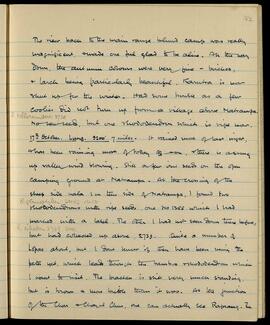
The view back to the main range behind camp was really magnificent, and made one feel glad to be alive. All the way down, the autumn colours were very fine - birches, and larch being particularly beautiful. Karutra is now shut up for the winter. Had some trouble as a few coolies did not turn up from a village above Natrampa.
R. vellereum, seeds 2738
No new seeds, but one rhododendron which is ripe now.

17th October. Lung. 9200' 7 miles. It rained most of last night, and has been raining most of today off and on. There is a strong up valley wind blowing. Still a few iris seeds on the open camping ground at Natrampa. At the crossing of the steep side nala on this side of Natrampa, I found two
R. glaucophyllum seeds 1355
rhododendrons with ripe seeds, one No 1355 which I had marked with a label. The other I had not seen down there before,
R. ciliatum 2739 seeds
but had collected up above, 2739. Quite a number of Lopas about, but I don't know if they have been using the path yet, which leads through the bamboo rhododendron which I have to visit. The bracken is still very much standing, but is brown and more brittle than it was. At the junction of the Char and Chayul Chus, one can actually see Raprang. The

LSH/1/1/6/1/22 · Part · 1938-03-21
Part of The Ludlow & Sherriff Collection

SUMMARY:
Detailed route description from Rong up the side valley via Ringdi Kenza to Lagyari, noting meadows, a Dzong, a gompa, and cultivation. Continues from Lagyari to Lasor over the Putrang/Potrang La (16,470 ft), with steep descents and hills covered in rhododendron, rose, berberis, willow, and birch, and mentions limited supplies. Notes Gent. Waltoni as common along the Tsangpo between Tsetang, Rong, and Lagyari Dzong.

CONTENT:
11a

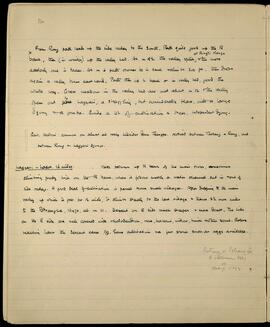
From Rong path leads up the side valley to the South. Path quite good up the R bank, then (in winter) up the valley bed. At m 4 1/2 the valley splits at Ringdi Kenza and the more easterly one is taken. At m 6 path crosses to L bank, climbs 300 ft, then drops again as a valley turns eastward. Path then up L bank or in valley bed, good the whole way. Grass meadows in the valley bed are met about m 12 and the valley opens out to Lagyari, a straggling, but considerable place, with a large Dzong and a gompa. Quite a lot of cultivation and trees. Independent Dzong.

Gent. Waltoni common on almost all rocky hillsides down Tsangpo. Noticed between Tsetang and Rong, and between Rong and Lagyari Dzong.

Lagyari - Lasor. 16 miles. Path follows up R bank of the main river, sometimes climbing pretty high on the R bank, where it follows mostly a water channel cut in side of side valley. A good deal of cultivation is passed and some small villages. After dropping to the main valley, up which it goes for 1/2 mile, it climbs steeply to the last village and thence 2 1/2 more miles to the Potrang La, 16,470, at m 11. Descent on E side much steeper and more direct. The hills on the E side are well covered with rhododendron, rose, berberis, willow, birch and other scrub. Before reaching Lasor the descent eases off. Some cultivation and a few stores such as eggs available.

Putrang or Potrang La
R. vellereum 3557
etc.
Sherriff 11072