Showing 4 results

Archival description
4 results with digital objects Show results with digital objects
LSH/1/1/3/3/221 · Part · 1996-06-18
Part of The Ludlow & Sherriff Collection

SUMMARY:
Notes prolific flowering and collections including a new primula (P. jaffreyana 2257), an iris (2251), Incarvillea lutea (2252), and Thalictrum chelidonii. Reports shortage of drying paper, and mail issues: the runner found no mail at Tsona but had a chit from the Dzongpen; outgoing mail was forwarded by the Dzongpen and more is to be sent via Chayul.

CONTENT:
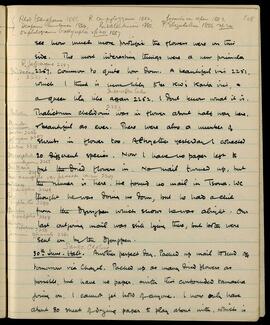
Rhod. sanguineum 1881, R. campylogynum 1882, forrestii var. repens 1883.
Diapensia himalaica 1884, Prim. valentiana 1885. P. Elizabethae 1886 sp. nov.
Omphalogramma bathysepala sp. nov. 1887

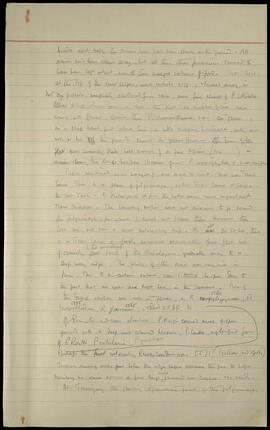
...see how much more prolific the flowers were on this side. The most interesting things were a new primula P. jaffreyana 2257. Common to quite low down. A beautiful iris 2251, which I think is near the K.W.'s Karta iris, a queer lily-like affair 2252 (Incarvillea lutea), I don't know what it is.

Thalictrum chelidonii was in flower about halfway here, beautiful as ever. There were also a number of shrubs in flower too. Altogether yesterday I collected 20 different species. Now I have no paper left to put the dried flowers in. No mail turned up, but the runner is there. He found no mail in Tsona. We thought he was doing us down, but he had a chit from the Dzongpen which shows he was alright. Our last outgoing mail was still lying there, but both were sent on by the Dzongpen.

30th June. Halt. Sanga Choling. Another perfect day. Packed up mail to send off tomorrow via Chayul. Packed up as many dried flowers as possible, but have no paper; with this confounded tamasha going on, I cannot get hold of anyone. I now only have about 80 sheets of drying paper to play about with, which is...

[Marginal Notes:]
P. jaffreyana 2257
Iris decora 2251
Thalictrum 2253
Meconopsis 2256
Jeffreyana 2257
Tibetica 2258
Dracocephalum 2255
Primula 2255
Rosa macrophylla var. farreri 2259
Gentiana 2249
Cryptantha 2250
Clematis 2254
Gentiana tibetica 2258
Jasminum officinale 2261
LSH/1/1/7/1/13 · Part · 1940-05-24
Part of The Ludlow & Sherriff Collection

SUMMARY:
The writer describes difficult access near a Himalayan pass, noting most rhododendrons were over, while several primulas remained in flower, including a new species later named P. tsangpoensis. After retreating to the drier Tsangpo valley, they explored a nearby spur called Go ngi re, recording diverse alpine plants and collecting seed with the help of a hopa.

CONTENT:
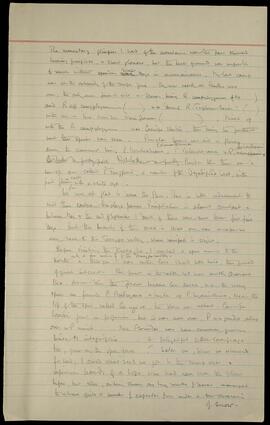
The momentary glimpses I had of the mountains near the pass showed towering precipices and short glaciers, but the best ground was impossible to reach without spending some days in reconnaissance. The last camp was at the extremity of the conifer zone. By now nearly all Rhodos were over, the only ones found still in flower being R. campylogynum (No. ) and R. aff. campylogynum ( ) and a dwarf R. Triflorum series? ( ) with one or two crimson neriiflorum ( ). Mixed up with the R. campylogynum was Cassiope wardii, this being the furthest west this species was seen. Primulas however were still in flower, among the commonest being P. morsheadiana, P. chamaethauma, P. valentiniana and P. tsariensis. Besides this there was a new sp. now called P. tsangpoensis, a member of the Dryadifolia section, with pink flowers each with a white eye.

We were all glad to leave the Pass. There is little inducement to visit these eastern Himalayan passes. Precipitation is almost constant between May and the end of September; I doubt if there were more than five fine days. But the beauty of the area is that one can escape so easily back to the Tsangpo valley, where rainfall is slight.

Before visiting the Kucha La, I worked a spur only a few miles N. of the Tsangpo valley. Though I was rather late and had little time, this proved of great interest. The forest in the valley bed was mostly Quercus ilex. Above this the forest became less dense, and on the rocky spurs we found P. baileyana, and higher up P. hyacinthina. Near the top of the spur, called Go ngi re, the flora was richest. Cassiope wardii grew in profusion, but it was now over, P. unijuga also over and of merit. Meconopsis florindae was here common, growing beside M. integrifolia. A delightful little saxifrage too, grew on the open scree. Later on, when we returned for seed, I owed what seed we got to the sharp eyes and unwearying hands of a hopa who had never seen the plant before, but who, on being shown one tiny rosette of leaves, managed to retrieve quite a number of capsules from under a thin covering of snow.

LSH/1/1/4/1/59 · Part · 1933-07-23
Part of The Ludlow & Sherriff Collection

SUMMARY:
The writer discusses notable rhododendrons collected, plans to leave on the 6th, and having sent mail via the Trim headman to Chayul, asking him to collect meconopsis seeds from the Drichung La. A passport misunderstanding with the local Lama is resolved, leading to assistance, and the writer comments on Lumsden’s poor performance while noting Ludlow’s rhododendron likely matches R. campylogynum.

CONTENT:
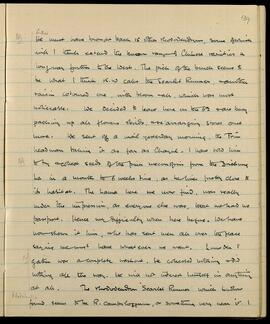
He must have brought back 15 other rhododendrons, some of which will I think extend the known range of Chinese varieties a long way further to the West. The pick of the bunch seems to be what I think K.W calls the Scarlet Runner, and another raisin coloured one, with bloom and all, which was most noticeable. We decided to leave here on the 6th and are busy packing up all flowers and birds, and re-arranging stores once more. We sent off a mail yesterday morning, the Trim headman taking it as far as Chayul. I have told him to try and collect seeds of the pink meconopsis from the Drichung La in a month to 6 weeks time, as he lives pretty close to its habitat. The Lama here we now find, was really under the impression, as everyone else was, that we had no passport. Hence our difficulty when here before. We have now shown it him, and he has sent men all over the place saying we must have whatever we want. Lumsden I gather was a complete washout. He collected nothing and did nothing all the way. He will not interest himself in anything at all. The rhododendron 'Scarlet Runner' which Ludlow found seems to be R. campylogynum, or something very near it. I

LSH/1/1/7/1/7 · Part · 1940-05-24
Part of The Ludlow & Sherriff Collection

SUMMARY:
The diarist notes bodies with bows left beside them and observes alpine flora on nearby snow slopes and streambeds. Accompanied by Langong coolies, they visit the Tsari Sama (Sarpa) pilgrimage area, finding it rich in Primula, Rhododendron, and a new white-flowered Daphne near the pass to Lopa territory. Trashiyang is mentioned as the starting and finishing point of the pilgrimage.

CONTENT:
Beside each body, the owner's bow had been stuck in the ground. All arrows had been taken away, but all their other possessions seemed to have been left intact, even to their meagre rations of food. Near here, at the top of the snow slopes, were vertical cliffs. Tucked away in dust-dry pockets, completely sheltered from rain, were fine clumps of P. littledalei.

A little lower down, at 14,000', the first Meconopsis simplicifolia were coming into flower. Beside this, P. chamaethauma was in flower, and on a steep bank just above this, a little creeping Lonicera, only an inch or two off the ground, showed its yellow flowers. Some of the open swampy flats held masses of a fine Allium (No. ). On stony beds beside streams grow P. macrophylla v. macrocarpa.

There remained, near Langong, one area to visit, that was Tsari Sama. This is a place of pilgrimage, called Tsari Sama or Sarpa—the new Tsari—to distinguish it from the better-known, more important Tsari Chikchar. The Langong coolies were not anxious to go round the pilgrimage, for which I could not blame them. However, they took me, and it was a most interesting trip. As at the Lo La, there is in Tsari Sama a fairly extensive, reasonably open flat bit of country, just north of the immediate Himalayas, gradually rising to a steep rocky ridge. The whole of this area was very rich in flora. This, to a certain extent, can, I think, be put down to the fact that no yaks are kept here in the summer. None of the dwarf rhodos were now in flower, and R. campylogynum (5560), R. trichocladum (5555), R. glaucum (5565). Also 5568.

A Primula not seen elsewhere, P. Kingii covered acres of open ground with its deep wine-coloured blooms, P. laeta, a glorified form of P. Roylei. Primula, P. gracilipes.

Perhaps the most interesting Rhododendron was 5571 (yellow, red spots). Growing among rocks just below the ridge before reaching the pass to Lopa territory, we came across a fine large, white-flowered new Daphne. No seeds.

At Trashiyang, the starting and finishing point of the pilgrimage,