Showing 4 results

Archival description
4 results with digital objects Show results with digital objects
LSH/1/1/8/1/39 · Part · 1947-02-23
Part of The Ludlow & Sherriff Collection

SUMMARY:
Travel from Tongkyuk up the Sobshe La valley to a camp below the pass, with notes on pine, spruce, Tsuga, Quercus ilex, and a quince-like shrub locally called 'Tingle' (Chaenomeles lagenaria). Reports widespread bamboo die-off mentioned in Kongbo and camping near a clearing with a wooden hut and yak.

CONTENT:
35

L.D. 96 to Sobshe La with thermograph

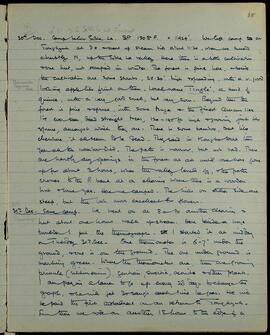
30th Dec. Camp below Sobshe La. B.P. 190.8° F. = 11424'. We left camp at Tongkyuk at 9.0 and went up stream till about 11.30, when we turned abruptly N, up the Sobshe La valley. Here there is a little cultivation, some huts, not occupied in winter. The forest is pine here, and beside the cultivation are some shrubs, 25-30' high spreading, with a very good looking apple-like fruit on them. Local name 'Tingle' (Chaenomeles lagenaria 12061), a kind of quince, with a very good smell, but very sour. Beyond this the forest is pine & spruce, with some Tsuga & the finest Quercus ilex I've ever seen, dead straight trees, 120-140 ft high & growing just like spruce, amongst which they are. There is some bamboo, but like elsewhere, it all seems to be dead. They said in Kongbo that last year all the bamboo died. The path is narrow, but not bad. There are hardly any openings in the forest at all until one has gone up for about 3 hours, when the valley levels off, the path crosses to the R bank at a clearing where there is a wooden hut & some yak. Here we camped. The hills on either side are steep, but
LSH/1/1/3/3/102 · Part · 1933-04-09
Part of The Ludlow & Sherriff Collection

SUMMARY:
Notes list characteristic birds of Chayal Dzong with distribution observations across the Tsangpo and nearby regions. Locality records include sightings at Trimo (April 1936) and Keupup, Sikkim (Feb. 1938), with mentions of areas such as Subansiri, Gyamda Chu, and Tsari.

CONTENT:
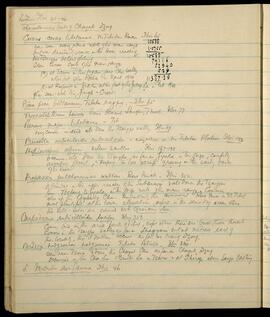
Ludlow Ibis 45-46
Characteristic birds of Chayal Dzong

Corvus corax tibetanus The Tibetan Raven - Ibis 65
Was seen everywhere north of the main range
but was decidedly scarce in the lower reaches of
the Tsangpo below Lilung.
Seen twice south of the main range
(a) at Trimo in the Nyam Jang Chu valley
at the foot of the Poda in April 1936
(b) at Keupup in Sikkim at the foot of the Jelep La in Feb. 1938
Often seen with the Jungle-Crow.

Pica pica bottanensis Tibetan Magpie. - Ibis 65

Trochalopteron henrici Prince Henri's Laughing Thrush. Ibis 77

Parus major tibetanus - Tit
Very common indeed all down the Tsangpo valley. Ibis 67

Prunella rubeculoides rubeculoides - everywhere on the Tibetan Plateau Ibis 192

Phylloscopus affinis Willow Warbler. Ibis 197-198.
Occurs all down the Tsangpo as far as Gyala in the Gorge, carefully
avoiding forest, keeping to low scrub growing on the sandy banks
of the river.

Propasser pulcherrimus waltoni Rose Finch. Ibis 352.
Abundant in the upper reaches of the Subansiri & all down the Tsangpo
from Tsetang to Gyala in the Gorge north of the main range common
also up the Gyamda Chu. Undoubtedly the commonest Rose Finch in SE Tibet
most plentiful at the lower elevations especially in the semi-dry areas where
the hill-sides are covered with Quercus ilex.

Carpodacus rubicilloides lucifer Ibis 353
Common bird in the arid parts of Tibet, especially where there are buckthorn thickets
Common in the Tsangpo Valley as far as Lhagyari but not noticed east of
this locality, though it doubtless occurs as far as Nang Dzong.

Perdix hodgsoniae hodgsoniae Tibetan Partridge. Ibis 384.
Seen near Tsong & down the Chayal Chu as far as Chayal Dzong.
Occurred on the Cha La & Bimbi La in Tsari & at Shira above Sanga Chöling

L Describe avifauna Ibis 46

LSH/1/1/7/1/13 · Part · 1940-05-24
Part of The Ludlow & Sherriff Collection

SUMMARY:
The writer describes difficult access near a Himalayan pass, noting most rhododendrons were over, while several primulas remained in flower, including a new species later named P. tsangpoensis. After retreating to the drier Tsangpo valley, they explored a nearby spur called Go ngi re, recording diverse alpine plants and collecting seed with the help of a hopa.

CONTENT:
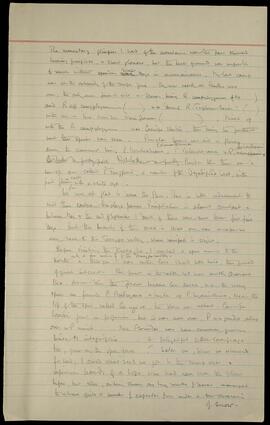
The momentary glimpses I had of the mountains near the pass showed towering precipices and short glaciers, but the best ground was impossible to reach without spending some days in reconnaissance. The last camp was at the extremity of the conifer zone. By now nearly all Rhodos were over, the only ones found still in flower being R. campylogynum (No. ) and R. aff. campylogynum ( ) and a dwarf R. Triflorum series? ( ) with one or two crimson neriiflorum ( ). Mixed up with the R. campylogynum was Cassiope wardii, this being the furthest west this species was seen. Primulas however were still in flower, among the commonest being P. morsheadiana, P. chamaethauma, P. valentiniana and P. tsariensis. Besides this there was a new sp. now called P. tsangpoensis, a member of the Dryadifolia section, with pink flowers each with a white eye.

We were all glad to leave the Pass. There is little inducement to visit these eastern Himalayan passes. Precipitation is almost constant between May and the end of September; I doubt if there were more than five fine days. But the beauty of the area is that one can escape so easily back to the Tsangpo valley, where rainfall is slight.

Before visiting the Kucha La, I worked a spur only a few miles N. of the Tsangpo valley. Though I was rather late and had little time, this proved of great interest. The forest in the valley bed was mostly Quercus ilex. Above this the forest became less dense, and on the rocky spurs we found P. baileyana, and higher up P. hyacinthina. Near the top of the spur, called Go ngi re, the flora was richest. Cassiope wardii grew in profusion, but it was now over, P. unijuga also over and of merit. Meconopsis florindae was here common, growing beside M. integrifolia. A delightful little saxifrage too, grew on the open scree. Later on, when we returned for seed, I owed what seed we got to the sharp eyes and unwearying hands of a hopa who had never seen the plant before, but who, on being shown one tiny rosette of leaves, managed to retrieve quite a number of capsules from under a thin covering of snow.

LSH/1/1/8/1/38 · Part · 1946-12-31 - 1947-02-23
Part of The Ludlow & Sherriff Collection

SUMMARY:
Notes the thermograph start on 31 December 1946 at about 12,250 feet, with snowfall events at Tomjuk in early to mid-January. Describes tree composition in the Sobhe la valley and records date correspondences for Jan 28 and Feb 23 related to the thermograph.

CONTENT:
34

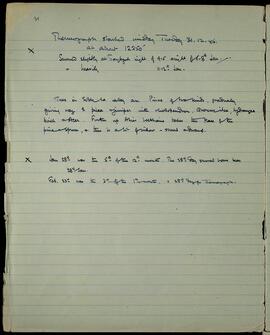
Thermograph started midday Tuesday 31.12.46.
at about 12,250'
Snowed slightly at Tomjuk night of 4-5, night of 6-8th Jan.
Snowed heavily 11-12th Jan.

Trees in Sobhe la valley are Pinus of two kinds, gradually
giving way to Picea and Juniper with Rhododendron, Quercus ilex, Hydrangea,
Birch and Acer. Further up Abies webbiana takes the place of the
Pine and Spruce, and there is a lot of Willow - shrub and dwarf.

Jan 28th was the 5th of the 12th month. The 28th day should have been
28th Jan.
Feb. 23rd was the 3rd of the 1st month. = 28th day for Thermograph.