Mostrando 33 resultados

Descripción archivística
33 resultados con objetos digitales Muestra los resultados con objetos digitales
LSH/1/1/5/1/108 · Part · 1937-06-07
Parte de The Ludlow & Sherriff Collection

SUMMARY:
Notes compare Primula gracilipes var. (No. 3206) with P. Boothii and P. whitei across altitudes and relate it to a prior specimen from Nyuksam La in March 1936. Also assesses No. 3228 as P. sikkimensis (alpine form) or P. Hopeana, noting pale yellow flowers with reddish suffusion, possible hybridization, absence of P. Waltoni nearby, and a pink form seen on the Tulung La in 1934.

CONTENT:
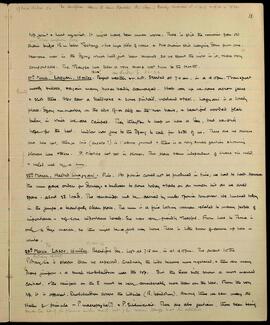
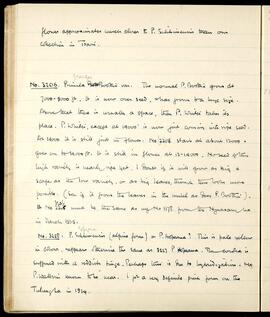
flower approximates much closer to P. sikkimensis than our collection in Tsari.

No. 3206. Primula gracilipes var. The normal P. Boothii grows at 7000-9000 ft. It is now over seed, and has grown to a huge size. Above that there is usually a space, then P. whitei takes its place. P. whitei, except at 14000' is now just coming into ripe seed. At 14000 it is still just in flower. No 3206 starts at about 12000 - goes on to 14000 ft. It is still in flower at 13-14000. No seed of this high variety is nearly ripe yet. I doubt if it will grow as big a scape as the low variety, or as big leaves, though this looks more possible. (See if it grows the leaves in the umbel as does P. Boothii). No 3206 must be the same as my No 1178 from the Nyuksam La in March 1936.

No. 3228. P. sikkimensis (alpine form) or P. Hopeana? This is pale yellow in colour, appears otherwise the same as 3227 P Hopeana. The corolla is suffused with a reddish tinge. Perhaps this is due to hybridization. No P. Waltoni known to be near. I got a very definite pink form on the Tulung La in 1934.

LSH/1/1/5/1/139 · Part · 1936-06-27
Parte de The Ludlow & Sherriff Collection

SUMMARY:
Describes the route along the left bank of the Rinchen Chu from Maruthang, including forest entry, stream crossings, grazing areas, and wet weather conditions. Notes that Primula involucrata and P. sikkimensis flourish, and records collecting a distinctive lemon-colored primula possibly a variety of sikkimensis.

CONTENT:
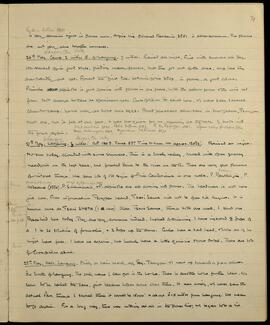
seems to prefer cliff ledges, and are really best seen from below, as
only then does one see the colour inside. The majority
have 1 flower, a great many two, while some are three and
four flowered. Flies again very bad here, but there are
practically no dimdams now.

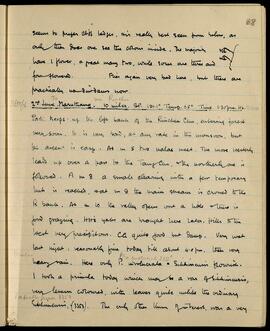
11800 ft 2nd June. Maruthang to via Rinchen. 10 miles. BP. 191.1° Temp. 65° Time 1.30pm. Ht. 12,400

Path keeps up the left bank of the Rinchen Chu, entering forest
very soon. It is very bad, at any rate in the monsoon, but
the ascent is easy. At m 5 two nalas meet. The more westerly
leads up over a pass to the Tang Chu, the northerly one is
followed. At m 8 a small clearing with a few temporary
huts is reached, at m 9 the main stream is crossed to the
R bank. At m 10 the valley opens out a little & there is
good grazing. Its yaks are brought here later. Hills to the
west very precipitous. CG quite good but damp. Very wet
last night: reasonably fine today till about 4.0 pm, then very
heavy rain. Here only P. involucrata & Sikkimensis flourish.
I took a primula today which may be a var of sikkimensis,
very lemon coloured, with leaves quite unlike the ordinary
Sikkimensis, (3353). The only other thing of interest, was a very

LSH/1/1/5/1/142 · Part · 1933-07-04
Parte de The Ludlow & Sherriff Collection

SUMMARY:
Notes compare Primula specimens by corolla color and presence of a farina ring, as well as habitat and elevation, including a white form possibly related to earlier collections from the Kashong La, Tibet. Mentions localized patches and proximity between sites.

CONTENT:
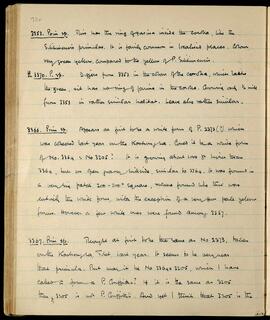
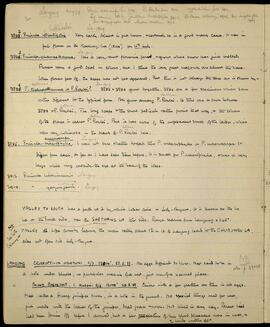
70a

  1. Prim sp. This has the ring of farina inside the corolla, like the Sikkimensis primulas. It is fairly common in localized places. Colour very green yellow, compared to the yellow of P. Sikkimensis.

  2. P. sp. Differs from 3353 in the colour of the corolla, which lacks the green, and has no ring of farina in the corolla. Growing only 1/2 mile from 3353 in rather similar habitat. Leaves also rather similar.

  3. Prim sp. Appears at first to be a white form of P. 2373(?) which was collected last year on the Kashong La. Could it be a white form of No. 3364 = No 3205? It is growing about 1000 ft higher than 3364, but on open grassy hillside, similar to 3364. It was found in a very big patch, 200 - 300 yds square, where found like this was entirely the white form, with the exception of a very few pale yellow forms. However a few white ones were found among 3367.

  4. Prim sp. Thought at first to be the same as No 2373, taken on the Kashong La, Tibet, last year. It seems to be very near that primula. But may it be No 3364 =

LSH/1/1/5/1/163 · Part · 1937-07-14
Parte de The Ludlow & Sherriff Collection

SUMMARY:
The diarist receives supplies from H.H.'s man, then moves to Chendebi where they bathe and have clothes washed by Tenduk. Mail and wireless batteries arrive from Tobgye during a halt at Chendebi, and they then march to Tsanka amid heat, leeches, and flies, with few notable flowers. Notes include photography of Lil. nepalense and comparison of a large Primula with related species.

CONTENT:
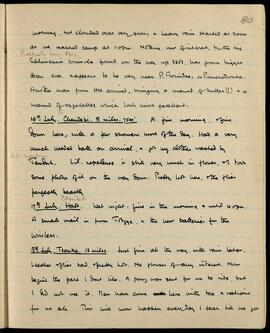
80

morning, but clouded over very soon, and heavy rain started as soon as we reached camp at 1:00 p.m. Nothing new of interest, but the big Sikkimensis primula (P. alpina have 3353) found on the way up 3353, has grown bigger than ever, and appears to be very near P. florindae, or P. microdonta. Another man from H.H. arrived, bringing a maund of butter (!) and a maund of vegetables, which look most excellent.

16th July. To Chendebi. 8 miles. 7,500'
A fine morning, and fine down here, with a few showers most of the day. Had a very much needed bath on arrival, and got my clothes washed by Tenduk. Lil. nepalense is still very much in flower, and took some photos of it on the way down. Pretty hot here, and the flies perfectly beastly.

17th July. Chendebi Halt.
Wet night: fine in the morning and until 4:00 p.m. A small mail in from Tobgye, and the new batteries for the wireless.

18th July. Tsanka. 13 miles.
Just fine all the way, with rain later. Leeches and flies bad, and pretty hot. No flowers of any interest. Now begins the part I don't like. A pony was sent for me to ride, but I did not use it. Men have come here with tea and rations for us all. This will now happen every day I fear till we get

LSH/1/1/6/1/8 · Part · 1938-06-06
Parte de The Ludlow & Sherriff Collection

SUMMARY:
Notes record aquatic plant specimens near Lingmathang and observations of Primula sikkimensis above Gautsa. The writer considers a fish ladder around a waterfall above Gautsa, mentions fatigue and sneezing from cold wind, and reports shooting a mallard, pintail, and teal at the hot springs.

CONTENT:
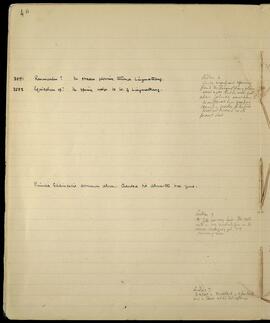
4A

3581 Ranunculus? In stream flowing through Lingmathang.
3582 Equisetum sp? In spring water to W. of Lingmathang.

Ludlow 6
What a magnificent stairway
round the Lingmathang plain
would make but the waterfall
above Gautsa would have to
be outflanked by a winding
channel or ladder for the fish
could not descend in its
present state

Primula sikkimensis common above Gautsa till above the tree zone.

Ludlow 7
I was very tired. The cold
wind in my nostrils gave me the
usual sneezing fits and a
running nose

Ludlow 7.
I shot a mallard, a pintail
and a teal at the hot springs.

LSH/1/1/6/1/23 · Part · 1938-03-21
Parte de The Ludlow & Sherriff Collection

SUMMARY:
Notes a ruined iron chain bridge below Tsetang and a night spent in a newly renewed but empty Dzong. The party travels to Lagyari/Lhagyari, halts for transport arranged by a helpful ruling nun, then crosses the Potrang La to Lasor, recording birds and early-season botanical observations.

CONTENT:
27 March Ludlow 22. "No European seems to have travelled this stage. Bailey avoided it - p. 313 F.K.W. u. 1924."

top joint & hurt my wrist. It might have been much worse. There are still the remains of an old iron chain suspension bridge.

Chain bridge 1 1/2 m below Tsetang - two huge piles of rocks & two chains still hanging down from one.

No one was in the Dzong which had just been renewed, so we spent the night in it, & were very comfortable. The Tsangpo here takes a very sharp 100° turn to the North. (70 13100' see Ludlow p. 22-23.)

27th March. Lagyari. 15 miles. Perfect weather & v. hot. Started at 7.0 am, in at 4.0 pm. Transport mostly bullock, & again many boxes badly damaged. Half way up we came across geese & shot three. Also saw a Sheldrake & some pintail, mallard & teal. Lagyari is a lovely place: Dzong & monastery on the edge of a cliff on the river bank, & beautiful wooded flats below, in which we are camped. They threaten to keep us here a day, but we still hope for the best. Ludlow has gone to the Dzong to call for both of us. There are no flowers out here yet, though Iris (ensata?) is 1" above ground & there is a very small gentian showing flowers here & there. P. tibetica not yet in flower. This place seems independent of Lhasa & is ruled, & ruled well by a nun.

28th March. Halted Lhagyari. Fine. As ponies could not be produced in time, we had to halt. However the nun gave orders for donkeys & bullocks to come today & take on as much kit as we could spare - about 28 loads. The remainder will be carried by mules & ponies tomorrow. We lunched today in the gompa, a beautifully clean place. The nun is a fine looking woman, related to many people of importance - of some importance herself. She was very friendly & helpful. From here to Tsona is only 4 days march, so this might be a good way home. There is little snow of course up here in winter.

29th March. Lasor (12,200' ap). 16 miles. Beautiful day. Left at 7.15 am, in at 4.0 pm. The ascent to the Potrang La (16500 ft) is steeper than we expected. Gradually the hills become more vegetated, & there are many dwarf junipers & a small Rhododendron near the top. But the East side shows a more marked contrast, & the rainfall on the E must be very considerably more than on the West. From the very top, it is apparent. Rhododendron covers the hillside (R. lepidotum). Among these we saw many old stalks of Primula - P. macrophylla(?) & P. sikkimensis. There are also gentians, these seen being much too early for flowers on the north side of the main range & at this altitude.

LSH/1/1/6/1/59 · Part · 1936-06-26
Parte de The Ludlow & Sherriff Collection

SUMMARY:
Entries describe camps and travel around the Langong Chu Valley near Langong with rainy weather, extensive botanical observations (including Berberis, Meconopsis, and several Primula), and bird sightings such as snowcock eggs and blood pheasant. Notes mention an attempt toward the Lo La pass, information that Tsari Sama (Tsari SARPA) will not open until August, and companions Tsongpen and Chulia (the latter unwell).

CONTENT:
29

Berberis ludlowii 3851 is very common just in flower now. A fine big-flowered Berberis, 3851 is also common. The flowers are not yet close together however.

Langong Chu Valley
26th May. Camp 2 miles E. of Langong. 7 miles. Rained all night. Fine with showers all day. We started off in good style, finding many flowers, but then got out of the area, and here they are hardly out yet. Found the first Meconopsis betonicifolia 3869, in flower, a good colour. Primula alpicola is just coming into flower in one place, with the yellow form, otherwise red form. Not enough to take as specimens yet. Cremanthodium do exist here; I have seen several close to camp. Saw many snowcock eggs. Blood pheasant also seen in two places. Tsongpen shot one, but it fell at our feet and was too quick for us, running at the rate of knots into the forest again.
Fritillaria cirrhosa 3865, Pieris diffusa 3863, Rhododendron anthopogon 3861, Lysimachia prolifera 3860
Meconopsis betonicifolia 3859, Myricaria dahurica 3870

To Langong, Langong Chu Valley
27th May. Langong. 3 miles. B.P. 190.8. Temp. 58°. Time 11.00 am. Ht approx. 12083'. Rained at night. No sun today, clouded with some showers. This is a lovely valley, broad, with open grassy meadows on the left bank, but forested down to the river on the right. There are very few flowers of interest though. We saw lots of old signs of Primula cawdoriana in one nala. Primula pantlingii, P. hopeana (3880), P. sikkimensis, and P. alpicola are all coming into flower. The headman is not here just now. From information Tsongpen heard, Tsari Sama will not be open till August. It is known more as Tsari SARPA (= new) than Tsari Sama, though both are used. I shot one blackbird here today. They are very common indeed. Instead of skinning, I have injected 8 drops of a 1 to 20 solution of formalin, and 2 drops up the anus. Chulia has a bad head, looks as if he might have fever. I have no aspirin, but luckily have a little quinine and some Ortal. There are lots of Cremanthodium about.

28th May. Halt. Langong. Misty and rain nearly all day. Tsongpen T. went up towards a pass almost due South of Langong. The only name I can get is the Lo La. There is another Lo La further West. All seem to be called the same, just because Lopas come over them. It was misty; I never saw the actual Pass, though I should think it would be 15,000' and about 5-6 miles from Langong. We mean to go again. For a long way, there was nothing at all in the flower line; it began to be a bit...

LSH/1/1/6/1/60 · Part · 1938-05-28 - 1938-05-29
Parte de The Ludlow & Sherriff Collection

SUMMARY:
Field notes from Langong list multiple Primula specimens with observations on flowering, variation, and a possible hybrid, and note nearby passes (Lo La/Shethang La and Chubumbu La) used in July–August. Bird nesting records for Crossoptilon harmani and Blood Pheasant at about 12,000 ft are dated 28–29 May 1938.

CONTENT:
Langong - May 38. Primula macrocephala 3889, R. laudandum 3900, agglutinatum form 3902, Lil. nanum 3903, Gaultheria trichophylla 3905, Androsace delavayi 3906, Mec. integrifolia 3909, Trichophragma 3910, Lloydia serotina 3915.

30a Littledalei Langong

  1. Primula rotundifolia. Very early. Almost in full bloom, certainly so in a good many cases. It was in full flower on the Kashong La (15000') on 15th July.

  2. Primula chamaethauma. Has a very short flowering period, and grows where snow has just melted.
    Flowers vary a good deal in colour, but I think the very great majority are almost the same.
    When flowers fall off, the scape has not yet appeared. But this is not always the case as is shown by —

3894 P. chamaethauma x P. Roylei? 3893 and 3894 grow together. 3894 are a few specimens which seem rather different to the typical form. Both grow among P. Roylei. Is this one a cross between 3893 and P. Roylei? The long scape and the short pedicels rather point that way, and the colour of the flower is nearer P. Roylei. But it has none of the unpleasant smell of the latter, which was very noticeable in the plants of P. Roylei here.

  1. Primula macrophylla. I was not sure whether to call this P. macrophylla or P. macrocarpa. It differs from each, as far as I have seen them before. It is small for P. macrophylla, and has a very large white ring outside the eye at the base of the lobes.

  2. Primula sikkimensis. Langong.

  3. Primula yargonjensis. Langong.

VALLEY TO SOUTH has a path up it by which Lopas come in July - August. It is known as the Lo La on the South side, and the SHETHANG LA this side. Rough bearing from Langong = 145°.

VALLEY to Lopa country leaving the main valley about 1 1/2 m W. of Langong leads to the CHUBUMBU LA, also not open till July - August.

LANGONG CROSSOPTILON HARMANI. c/7. 12000'. 28.5.38. All eggs difficult to blow. Nest said to be in a hole under shrubs, no particular making of a nest, just use of a natural place.

BLOOD PHEASANT. I. kuseri. c/6 12000' 29.5.38. Chicks with a few feathers on them in all eggs. Nest under a dwarf juniper bush, in a hole in the ground. No special things used for nest, just made with the leaves of the juniper, dead grass and moss. Not lined in any way. Parent bird had been driven off before I arrived, but a few feathers of her blood pheasant were in nest, and 2 birds within 40 yds.

LSH/1/1/6/1/72 · Part · 1938-06-09
Parte de The Ludlow & Sherriff Collection

SUMMARY:
The page describes the route from the Upper Bridge over the Lanjung to Sinjo Samba, including bridge crossings and path conditions through fir forest. At Tsari Sama (13 June), the author records Primula collections (Nos. 5537–5541), discussing color variation among P. sikkimensis forms and considering P. ioessa and P. Hopeana as true species. Additional route notes describe a path from the lower bridge up the right bank to Trashijing, a small gompa site used by yakherds, with reference to Tolo and the Lanjung Chu.

CONTENT:
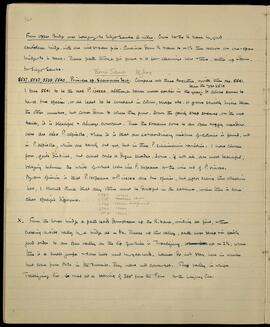
36a

From Upper Bridge over Lanjung to Sinjo Samba 6 miles. Cross to the R bank by good cantilever bridge, with one mid stream pier. Continue down R bank to m 1 1/2 then recross on one-span bridge to L bank. Thence path through fir forest & a few clearings here & there, rather up & down, to Sinjo Samba.

Tsari Sama 13 June

5537, 5538, 5539, 5540. Primulae sp. sikkimensis Sect. Compare all these together, & with them No. 5541.
I take 5541 to be the real P. ioessa, although taken much earlier in the year than the type 2514. It alone seems to be a true species, or at least to be constant in colour, shape etc. It grows slightly higher than the other numbers, but comes down to where they grow. Down the fairly steep streams, on the wet banks, it is plentiful & always constant. Then the streams come to an open boggy meadow. Here are also P. alpicola, & here it is that an extraordinary mixture of colours is found, not in P. alpicola, which are barely out yet, but in these P. sikkimensis varieties. I have chosen four, quite distinct, but could take a dozen shades. Some, if not all, are most beautiful, varying between the white of what looks like P. Hopeana to the wine red of P. vinosa. My own opinion is that P. Hopeana & P. ioessa are true species, but after seeing this collection here, I should think that any others must be doubtful in the extreme, unless there is some clear specific difference.
5537 cocoa
5538 reddish cocoa
5539 cocoa incipient
5540 cocoa
5541 cocoa

X. From the lower bridge a path leads downstream up the R. bank, winding at first, then crossing a side valley by a bridge at m 3/4. Thence up this valley, path never steep & in fairly good order to an open valley on the lip of which is Trashijing, at m 2 1/2, where there is a small gompa & some huts used by yakherds. Lamas do not stay here in winter but come from Tolo in the summer. They have not come yet. The valley in which Trashijing lies, runs at a bearing of 340° from the Pass to the Lanjung Chu.

LSH/1/1/6/1/152 · Part · 1938-10-22
Parte de The Ludlow & Sherriff Collection

SUMMARY:
Field notes list several Primula species with localities, habitat and elevation details, flowering or seed status, and comparisons to collections made in 1936. There is uncertainty about the exact P. ioessa type locality near Lo Migyitun due to mist and deep snow, and sites such as KHERI GOMPA at Chungkar are referenced.

CONTENT:
78a

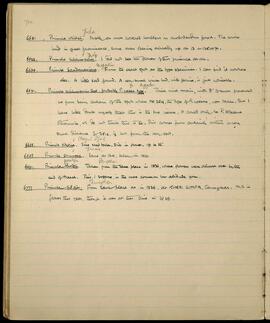
  1. Primula winteri. Yuda. Mostly on moss covered boulders in Rhododendron forest. The winter bud in great prominence, some even opening already up at 13 or 13,500 ft.

  2. Primula sikkimensis. Yuda. I did not see the flowers of this primula at all.

  3. Primula Sandemaniana. Migyitun. From the exact spot as the type specimen. I can find it nowhere else. A little seed found. A very small winter bud, with farina, is just noticeable.

  4. Primula sikkimensis Sect. probably P. ioessa type. Lo Migyitun. Thick mist rain, with 8" of snow prevented us from being certain of the spot where No 2514, the type of P. ioessa, was taken. But I have little doubt myself that this is the true ioessa. It could only be P. Hopeana otherwise, and I do not think this is so. This comes from certainly within a very short distance of 2514, if not from the very spot.

  5. Primula tibetica. Chayul Dzong. Some seed taken. Still in flower. Up to 3½".

  6. Primula strumosa. Tremo. Same as 1300, taken in 1936.

  7. Primula Boothii (gracilipes). Pangchen. Taken from the same place in 1936, where flowers were almost over by the end of March. This, I suppose, is the more common low altitude form.

  8. Primula filipes. Chungkar. From same place as in 1936, at KHERI GOMPA, Chungkar. Not in flower this year, though it was at this time in 1936.