Mostrar 21 resultados

Descrição arquivística
21 resultados com objetos digitais Mostrar resultados com objetos digitais
LSH/1/1/5/1/69 · Part · 1937-05-22
Parte de The Ludlow & Sherriff Collection

SUMMARY:
Travel over a pass to the holy lake Kesar Tso and on to Wangchelakh, noting yakherd shelters and good grazing near Chapepusa. Morning mist cleared before departure; after reaching camp there was hail and sleet. Several Primula species (Nos. 3076, 3078, 3079) were found in flower up to 14,000 ft, and local yaks belong to H.H., the Trompa Zimpon, and the Wangdupotrang official.

CONTENT:
North side of Black Mountain Dungshinggang.

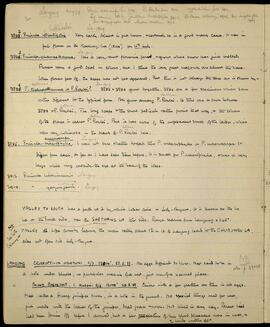
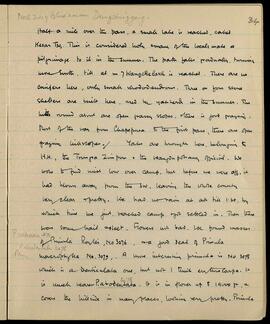
Half a mile over the pass, a small lake is reached, called Kesar Tso. This is considered holy, and many of the locals make a pilgrimage to it in the summer. The path falls gradually, turning more south, till at m 7 Wangchelakh is reached. There are no conifers here, only small rhododendrons. Three or four stone shelters are built here, used by yakherds in the summer. The hills round about are open grassy slopes, there is good grazing. Part of the way from Chapepusa to the first pass, there are open grazing hillslopes. Yaks are brought here, belonging to H.H., the Trompa Zimpon and the Wangdupotrang official. We woke to find mist low over camp, but before we were off, it had blown away from the SW, leaving the whole country very clear and pretty. We had no rain at all till 1.30, by which time we just reached camp and got settled in. Then there was some hail and sleet. Flowers not bad. We found masses of Primula Roylei, No 3076, and a good deal of Primula macrophylla No. 3079. A more interesting primula is No 3078 which is a Denticulata one, but not I think erythrocarpa. It is much nearer P. atrodentata. It is in flower up to 14000 ft, and covers the hillside in many places, looking very pretty. Primula
LSH/1/1/5/1/117 · Part · 1870-03-15
Parte de The Ludlow & Sherriff Collection

SUMMARY:
The diarist records abundant Primula species near camp between two passes on the way to Wangchelabh, noting P. stirtoniana (No. 3258), P. obliqua (3257), and others, with P. umbratilis not yet flowering and a small nivalis primula of special interest. During a halt at Tsophu and Dungchewang they experienced rain and thunder with brief views of snow mountains toward Tibet.

CONTENT:
Rhododendron Primulas 57

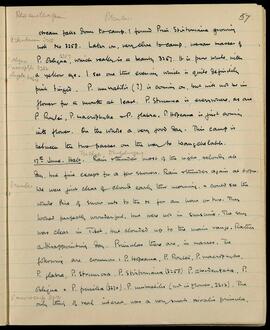
...stream falls down to camp. I found Primula stirtoniana growing well No. 3258. Later on, very close to camp, we saw masses of P. obliqua, which really is a beauty 3257. It is pure white, with a yellow eye. I see one this evening which is quite definitely pink tinged. P. umbratilis (?) is coming on, but will not be in flower for a month at least. P. strumosa is everywhere, as are P. roylei, P. macrophylla and P. glabra. P. hopeana is just coming into flower. On the whole a very good day. This camp is between the two passes on the way to Wangchelabh.

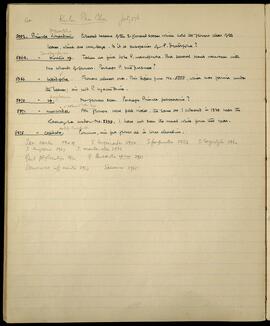
17th June. Halt. Tsophu. Dungchewang. Rain and thunder most of the night, and cloudy all day, but fine except for a few showers. Rain and thunder again at 6:00 pm. We were just clear of clouds early this morning, and could see the white line of snow mountains to the N for an hour or two. They looked perfectly wonderful, but were not in sunshine. The sky was clear in Tibet, but clouded up to the main range. Rather a disappointing day. Primulas there are, in masses. The following are common: P. hopeana, P. roylei, P. macrophylla, P. glabra, P. strumosa, P. stirtoniana (3258), P. atrodentata, P. obliqua and P. pusilla (3270). P. umbratilis (not in flower, 3213). The only thing of real interest, was a very small nivalis primula,

LSH/1/1/6/1/23 · Part · 1938-03-21
Parte de The Ludlow & Sherriff Collection

SUMMARY:
Notes a ruined iron chain bridge below Tsetang and a night spent in a newly renewed but empty Dzong. The party travels to Lagyari/Lhagyari, halts for transport arranged by a helpful ruling nun, then crosses the Potrang La to Lasor, recording birds and early-season botanical observations.

CONTENT:
27 March Ludlow 22. "No European seems to have travelled this stage. Bailey avoided it - p. 313 F.K.W. u. 1924."

top joint & hurt my wrist. It might have been much worse. There are still the remains of an old iron chain suspension bridge.

Chain bridge 1 1/2 m below Tsetang - two huge piles of rocks & two chains still hanging down from one.

No one was in the Dzong which had just been renewed, so we spent the night in it, & were very comfortable. The Tsangpo here takes a very sharp 100° turn to the North. (70 13100' see Ludlow p. 22-23.)

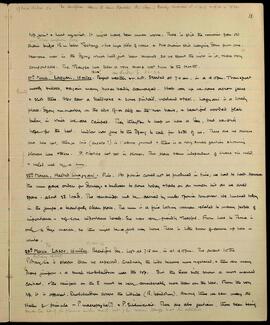
27th March. Lagyari. 15 miles. Perfect weather & v. hot. Started at 7.0 am, in at 4.0 pm. Transport mostly bullock, & again many boxes badly damaged. Half way up we came across geese & shot three. Also saw a Sheldrake & some pintail, mallard & teal. Lagyari is a lovely place: Dzong & monastery on the edge of a cliff on the river bank, & beautiful wooded flats below, in which we are camped. They threaten to keep us here a day, but we still hope for the best. Ludlow has gone to the Dzong to call for both of us. There are no flowers out here yet, though Iris (ensata?) is 1" above ground & there is a very small gentian showing flowers here & there. P. tibetica not yet in flower. This place seems independent of Lhasa & is ruled, & ruled well by a nun.

28th March. Halted Lhagyari. Fine. As ponies could not be produced in time, we had to halt. However the nun gave orders for donkeys & bullocks to come today & take on as much kit as we could spare - about 28 loads. The remainder will be carried by mules & ponies tomorrow. We lunched today in the gompa, a beautifully clean place. The nun is a fine looking woman, related to many people of importance - of some importance herself. She was very friendly & helpful. From here to Tsona is only 4 days march, so this might be a good way home. There is little snow of course up here in winter.

29th March. Lasor (12,200' ap). 16 miles. Beautiful day. Left at 7.15 am, in at 4.0 pm. The ascent to the Potrang La (16500 ft) is steeper than we expected. Gradually the hills become more vegetated, & there are many dwarf junipers & a small Rhododendron near the top. But the East side shows a more marked contrast, & the rainfall on the E must be very considerably more than on the West. From the very top, it is apparent. Rhododendron covers the hillside (R. lepidotum). Among these we saw many old stalks of Primula - P. macrophylla(?) & P. sikkimensis. There are also gentians, these seen being much too early for flowers on the north side of the main range & at this altitude.

Langong botanical notes and bird nesting records, May 1938
LSH/1/1/6/1/60 · Part · 1938-05-28 - 1938-05-29
Parte de The Ludlow & Sherriff Collection

SUMMARY:
Field notes from Langong list multiple Primula specimens with observations on flowering, variation, and a possible hybrid, and note nearby passes (Lo La/Shethang La and Chubumbu La) used in July–August. Bird nesting records for Crossoptilon harmani and Blood Pheasant at about 12,000 ft are dated 28–29 May 1938.

CONTENT:
Langong - May 38. Primula macrocephala 3889, R. laudandum 3900, agglutinatum form 3902, Lil. nanum 3903, Gaultheria trichophylla 3905, Androsace delavayi 3906, Mec. integrifolia 3909, Trichophragma 3910, Lloydia serotina 3915.

30a Littledalei Langong

  1. Primula rotundifolia. Very early. Almost in full bloom, certainly so in a good many cases. It was in full flower on the Kashong La (15000') on 15th July.

  2. Primula chamaethauma. Has a very short flowering period, and grows where snow has just melted.
    Flowers vary a good deal in colour, but I think the very great majority are almost the same.
    When flowers fall off, the scape has not yet appeared. But this is not always the case as is shown by —

3894 P. chamaethauma x P. Roylei? 3893 and 3894 grow together. 3894 are a few specimens which seem rather different to the typical form. Both grow among P. Roylei. Is this one a cross between 3893 and P. Roylei? The long scape and the short pedicels rather point that way, and the colour of the flower is nearer P. Roylei. But it has none of the unpleasant smell of the latter, which was very noticeable in the plants of P. Roylei here.

  1. Primula macrophylla. I was not sure whether to call this P. macrophylla or P. macrocarpa. It differs from each, as far as I have seen them before. It is small for P. macrophylla, and has a very large white ring outside the eye at the base of the lobes.

  2. Primula sikkimensis. Langong.

  3. Primula yargonjensis. Langong.

VALLEY TO SOUTH has a path up it by which Lopas come in July - August. It is known as the Lo La on the South side, and the SHETHANG LA this side. Rough bearing from Langong = 145°.

VALLEY to Lopa country leaving the main valley about 1 1/2 m W. of Langong leads to the CHUBUMBU LA, also not open till July - August.

LANGONG CROSSOPTILON HARMANI. c/7. 12000'. 28.5.38. All eggs difficult to blow. Nest said to be in a hole under shrubs, no particular making of a nest, just use of a natural place.

BLOOD PHEASANT. I. kuseri. c/6 12000' 29.5.38. Chicks with a few feathers on them in all eggs. Nest under a dwarf juniper bush, in a hole in the ground. No special things used for nest, just made with the leaves of the juniper, dead grass and moss. Not lined in any way. Parent bird had been driven off before I arrived, but a few feathers of her blood pheasant were in nest, and 2 birds within 40 yds.

LSH/1/1/6/1/61 · Part · 1938-05-29
Parte de The Ludlow & Sherriff Collection

SUMMARY:
At Langong, the diarist records collecting several Primula and other alpine plants, observing a new warbler (P. tibetanus), and noting marmots and lingering snow. A clutch of Crossoptilon eggs and a blood pheasant egg are obtained; the gyimpon arrives and promises coolies, and plans are made to explore valleys between Pa La and Lo La before visiting the Pachakshiri Loba.

CONTENT:
Langong

depressed, but then we saw P. bariensis, and knew that there would be other things as well. For a change, the second time only, I did not take a gun, and of course saw the new warbler P. tibetanus. There were two of them, in juniper scrub, just as on the Bimbi La. Of interesting things, we saw Mec. simplicifolia - and I particularly examined the filaments, which were white. Then Tsonypon brought in a primula, which I think must be P. chamaethauma 3893 (P. chionantha 3893). Then P. macrophylla 3894, 3895 (P. macrophylla var. macrocarpa 3895) was seen. Then over a ridge we found in almost full flower that delightfully pretty - and fragrant - P. rotundifolia. On the whole a good day. There are many marmots running about, now the snow is off the ground. The actual pass is probably still covered with snow, as there were huge drifts a good deal lower than the highest we went, on the North faces. I heard on return that one man had already found a nest of Crossoptilon, but he has not brought the eggs yet.

29th May. Halt. Langong. Fine most of the day, but clouded and showery. Started in the morning about at 11.00 a.m. Saw nothing much. In fact there is remarkably little in the valley. Collected Primula yargongensis 3914. Our offer for eggs is doing well. Today got a clutch of seven eggs of Crossoptilon, nest on the ground in a bush. Later on a man came in with one blood pheasant's egg, and will see the nest tomorrow. The eggs were very difficult to blow, having chicks inside. (P. dryadifolia 3917, Rhododendron v. microstoma 3918, Ranunculus 3919, 3923, Primula 3925, Gal. nambanensis 3920, Corydalis 3921, 3922, Lonicera litangensis 3926).

30th May. Halt. Langong. Mostly fine in Langong, but rain mist on the hills all day. I went up the valley immediately North of Langong village, running parallel to the Tscha valley. There is nothing in any of these valleys till one gets to 13,500 feet or so. Then primulas appear. This is a fine valley, with a good sized lake at about 13,500 feet above which there is a fine waterfall. But flowers are few and far between, and I think we are really too early yet. The gyimpon has arrived, seems very helpful and friendly. He wants to go off for 8 days, but has promised coolies all I want in the meantime. My plans are to stay here two more days, and then go West, up a valley which lies between the Pa La and Lo La routes. Stay there four days and return here for two before going off to the Pachakshiri Loba on the 9th, for a week. That will take up all the time I can spare in this area. Everything here seems to be late. Snow lies pretty thick on the hills yet, and nearly all passes are shut. Tsari Sama - known generally as Tsari Sarpa, "the new Tsari" is not

Langong to Chiniung La route and plant notes, 20 June 1938
LSH/1/1/6/1/80 · Part · 1938-06-20
Parte de The Ludlow & Sherriff Collection

SUMMARY:
Notes record plant collections around Chiniung La and Langong, including Primula and Pedicularis species with specimen numbers. The 4-mile route from Langong to Chiniung La over the Main Range is described, with fir forest, deep snow drifts near the pass, Lopas crossing the pass with past fatalities, and a large lake south of the pass still half iced.

CONTENT:
Chiniung La 20 June

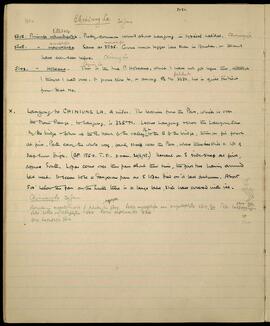
  1. Primula rotundifolia. Pretty common round about Langong in typical habitat. Chiniung La

  2. Primula macrophylla. Same as 3895. Grows much bigger here than in Bhutan, or than I have ever seen before. Chiniung La

  3. Primula hopeana. This is the true P. hopeana, which I have not got before this, although I thought I had once. It grows close to, or among Pedicularis No 3932, but is quite distinct from that No. Chiniung La

X. Langong to CHINIUNG LA. 4 miles. The bearing from the Pass, which is over the Main Range, to Langong, is 325°M. Leave Langong across the Langong Chu by the bridge & follow up the R. bank of the valley 1/2 m to the E of the bridge, through fir forest at first. Path easy the whole way, fairly steep near the Pass, where there are still a lot of deep snow drifts. (BP. 185.0. T. 51. 9.0am. 20/6/38.) Descent on S side steep at first, approx South. Lopas come over this pass about this time, the first two having arrived last week. It seems to be a dangerous pass as 5 Lopas died on it last autumn. About 500' below the pass on the South there is a large lake, still half covered with ice.

Chiniung La 20 June

Pedicularis megalochila f. rhodantha 5607. Pedicularis mycophylla var. megalophylla 5613, type. Pedicularis takpoensis 5614.
Pedicularis bella var. holophylla 5615. Pedicularis siphonantha 5616.
Meconopsis horridula 5612.

Sba Kulu Phu Cher – Specimen notes (July 27)
LSH/1/1/6/1/112 · Part · 1933-07-27
Parte de The Ludlow & Sherriff Collection

SUMMARY:
Field notes from Sba Kulu Phu Cher listing Primula specimens with numbers and identification remarks, including flowering condition and comparisons among taxa. Mentions uncertainty between several Primula determinations and references a similar collection made in 1936 near the Kashong La. Additional entries include Saxifraga, Gentiana, and Saussurea taxa with specimen numbers.

CONTENT:
Sba Kulu Phu Cher July 27th

  1. Primula dryadifolia. Collected because of the 2-flowered scapes which have the flowers clear of the leaves, which are very large. Is it a subspecies of P. dryadifolia?

  2. Primula sinopurpurea (nivalis sp.). Taken at first to be P. macrophylla. But several plants were seen with two whorls of flowers. Perhaps P. sinopurpurea?

  3. Primula bellidifolia. Flowers almost over. This differs from No. 5888, which has farina under the leaves; it is not P. hyacinthina.

  4. Primula kongboensis sp. No flowers seen. Perhaps Primula petrocharis?

  5. Primula muscoides v. roseotincta var. nov. The flowers were pale violet, the same as I collected in 1936 near the Kashong La under No. 2399. I have not seen the usual white form this year.

  6. Primula capitata subsp. crispata. Common, in full flower at its lower elevation.

Sax. wardii 5949. S. bergenioides 5950. S. perpusilla 5953. S. longistyla 5962.
S. kingdonii 5967. S. montanella 5968.
Gent. phyllocalyx 5972. G. leucantha sp. nov. 5951.
Saussurea aff. wardii 5963. Saussurea 5965.

Kulu Pher Chu: Primula observations and march to Lamdo
LSH/1/1/6/1/113 · Part · 1933-07-27
Parte de The Ludlow & Sherriff Collection

SUMMARY:
Field notes detail several Primula species around Kulu Pher Chu and plans with the Tsungpen to reach Lamdo over a high ridge en route to Tseladzong. A wet halt day included further plant observations on avalanche-swept slopes and concerns about mail and Shadu, followed by a cold, rain-soaked march to Lamdo (11 miles) with a guide who initially took the wrong spur.

CONTENT:
Kulu Pher Chu
58
Primula

P. rhodochroa No. 5890, about 6 more flowers. P. capitata (subsp. crispata?) 5975 is common close to camp on the steep hillside. P. micropetala? (P. hesperidium) 5888 is also fairly common higher up. Then we found a few P. bellidifolia 5966 with flowers just over. Also what I at first took to be P. macrophylla, but which I think maybe P. sinopurpurea 5964. We saw a few seed specimens with two whorls of flowers. (P. kongboensis) 5970 I think might be P. petrocharis, but I don't know. P. muscoides, the violet form was just in flower still, 5971: and a fine form of P. jonardunii (P. dryadifolia) 5952, with all scapes 2-flowered was seen. Perhaps this is P. dryadifolia. The scapes held the flowers clear of the leaves which were bigger than usual. Saxifrages abound, over from a good many. This was a hard day's climb, or don't think we will do very much tomorrow, but prepare for the next day, when Tsungpen and I intend to go to Lamdo via the top of the ridge, instead of along the valley bed. It will be a long climb first, to over 15000 ft, then a long tedious traverse, before the steep descent. But I think it should be worth it, a good finish up before reaching Tseladzong. I hope to finish this book of Field Notes, up to 6000, which will give me up to 920 specimens this year. Taylor will likely have 1500 or so.

28th July. Halt. Rained a good deal at night. Clouded all day, with light rain most of the day. Had a fairly slack day today, crossing the river and going up one of the side valleys opposite camp to 13000'. It was a very steep slope which is swept by avalanche every spring, and kept bare. A good deal of snow still near the bottom, and snow has kept several plants back. We saw for instance, several Prim. atrodentata still in flower. Nomocharis nana also common, in flower. All thoughts in camp are about the mail, and whether Shadu also will be at Tsela before us. I rather doubt whether either will be before us. We ourselves will be one day early. I rather dread tomorrow's trek, especially if wet, as seems likely. We climb over 2000 ft to start off with, then have a long traverse along the hillside, before a steep descent of 5000 ft to Lamdo. However camp will be waiting ready for us, which always is nice to have.

29th July. Lamdo. 11 miles. Yesterday was a disastrous day. It poured all day and up on the hill was very cold indeed, with a strong wind. We had a Lopa to 'show us the way'. He did not start off too well, by going up the hill the wrong spur. Then we got into thick
30th July. Halt.

Ascent of Le La and alpine plant observations
LSH/1/1/3/3/135 · Part · 1933-03-08
Parte de The Ludlow & Sherriff Collection

SUMMARY:
After a sleepless night the party set off before dawn and crossed the Le La in mist with fresh snow. They observed numerous Primula species, dense rhododendrons, Abies, and a Corydalis, noting the area would be spectacular later in the season.

CONTENT:
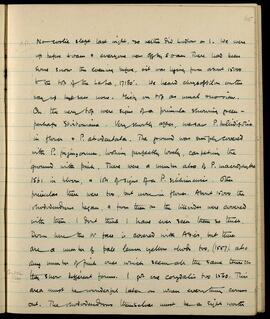
No coolie slept last night, so neither did Ludlow or I. We were up before 4.0 am & everyone was off by 5.0 am. There had been some snow the evening before, and it was lying from about 15000 to the top of the Le La, 17180'. We heard chrysochlora on the way up but saw none. Misty on top as usual no view.

On the very top were signs of a Primula showing green - perhaps Stirtoniana. Very shortly after, we saw P. bellidifolia in flower & P. atrodentata. The ground was simply covered with P. pryingorum, looking perfectly lovely, carpeting the ground with pink. There were a number also of P. macrophylla 1561 in bloom, & lots of signs of a P. sikkimensis. Other primulas there were too, but none in flower. About 15000 the rhododendrons began, & from then on the hillsides were covered with them. I don't think I have ever seen them so thick.

Down here the W face is covered with Abies, but there are a number of pale lemon yellow rhodos too, (1557). Also any number of pink ones which seem all the same though they show different forms. I got one Corydalis too 1560. This area must be wonderful later on when everything comes out. The rhododendrons themselves must be a sight worth

Specimen notes: Crossoptilon and Primula species
LSH/1/1/3/3/136 · Part · 1983-05-05
Parte de The Ludlow & Sherriff Collection

SUMMARY:
Brief note of L. Nos 377–79 dated 5 May 1983, listing Crossoptilon crossoptilon harmani and Primula species (bellidifolia, calderiana, macrophylla).

CONTENT:
NB
L. Nos 377-79. v May 83
Crossoptilon crossoptilon harmani

Primulas -
bellidifolia
Calderiana
macrophylla