Showing 10 results

Archival description
10 results with digital objects Show results with digital objects
LSH/1/1/6/1/102 · Part · 1933-07-05
Part of The Ludlow & Sherriff Collection

SUMMARY:
Notes from Tsarang La on July 18 record several Primula, including P. dryadifolia with a pompom of soft white hairs at the throat, very profuse P. valentiniana, rare P. chamaethauma, and a notable Primula in the nivalis section with withered yellow flowers. P. valentiniana was also seen a few miles west of Langing in early June, and additional taxa are listed.

CONTENT:
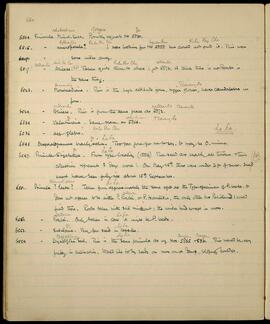
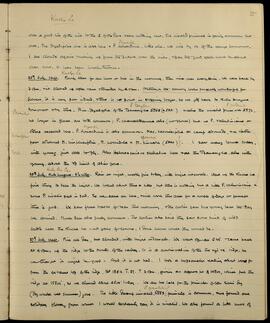
51a . Tsarang La July 18.

Tsongpen's of our Type Tsarang La

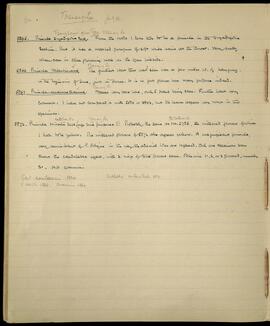
  1. Primula dryadifolia Sect. From the roots I take this to be a primula in the Dryadifolia Section. But it has a marked pompom of soft white hairs at the throat. Very pretty when seen in close flowering mats on the open hillside.

5866 Primula valentiniana Tsarang La
The furthest West this was seen was a few miles W. of Langing, in the beginning of June, just in flower. It is in full flower here, very profuse indeed.

5867 Primula chamaethauma. Tsarang La
Appears very rare here, only 5 plants being seen. Further West very common. I have not compared it with 5589 or 3893, but the leaves appear very rough in this specimen.

  1. Primula nivalis Sect. (aff. calliantha Tsarang La sino purpurea ?) Probably the same as No. 5785, the withered flowers of which I took to be yellow. The withered flowers of 5872 also appear yellow. A magnificent primula, very reminiscent of P. obliqua in the way the adaxial lobes are reflexed. Only one specimen seen shows the candelabra effect, with 2 rings of three flowers each. Otherwise 1-, 2-, or 3-flowered, usually 2-. Not common.

Gent. nanlaensis 5864 Scobbelia melanotricha 5871
R. wardii 5868, Geranium 5869
LSH/1/1/3/3/209 · Part · 1996-06-18
Part of The Ludlow & Sherriff Collection

SUMMARY:
Notes from fir forest observations and collecting, including comparison of a Primula resembling tsariensis, signs of shao, and an encounter with blood pheasants with chicks. At Tomtsang the day was misty with heavy rain; the route to the pass is steep and direct, with abundant Primula species observed but little new.

CONTENT:
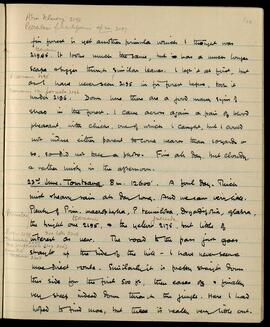
Abies delavayi 2198
Pedicularis filiculiformis sp. nov. 2197

In fir forest is yet another primula which I thought was tsariensis 2194. It looks much the same, but it has a much longer scape & bigger though similar leaves. I left it at first, but as I have never seen 2195 in fir forest before, took it under 2196. Down here there are a good many signs of shao in the forest. I came across again a pair of blood pheasant, with chicks, one of which I caught, but I could not induce either parent to come nearer than 10 yards or so, so did not take a photo. Fine all day, but cloudy, & rather misty in the afternoon.

23rd June. Tomtsang. 8 m. 12600'. A foul day. Thick mist & heavy rain all day long. And we saw very little. Plenty of Prim. macrophylla, P. tenuiloba, dryadifolia, glabra, the bright one tsariensis 2195, & the yellow jucunda 2175, but little of interest as new. The road to the pass just goes straight up the side of the hill - I have never seen more direct route. Similarly it is pretty straight down this side for the first 500 ft, then eases off & finally very steep indeed down through the jungle. Here I had hoped to find more, but there is really

LSH/1/1/6/1/136 · Part · 1933-09-07
Part of The Ludlow & Sherriff Collection

SUMMARY:
The page lists Primula and Omphalogramma specimens (nos. 6504–6554) with identifications, comparisons to earlier numbers, and locality notes. It records that Primula Elizabethae was collected at its type locality (1886), that on May 15th plants were under 3 ft of snow, and seed likely ripened about 15th September. Several entries note proximity to prior collections (e.g., 5872) and observations on forms and seed set.

CONTENT:
68a

6504 Primula rhodochroa Minut. Sect. Gonyore. Possibly equals no 5890. Yes.

  1. " micropetala? belle-ish? Kulu Phu Chu. hyacinthina. Kulu Phu Chu. I was looking for No 5888 but could not find it. This was some miles away.

  2. " Aliceae. Calliantha. Kulu Phu Chu. Kulu Phu Chu. Calliantha. Taken quite close to where I got 5872, I think there is no doubt it is the same thing.

  3. " Morsheadiana. prenautha. Tsarang La. This is the high altitude form, bigger flower, never candelabra in form.

  4. " Aliceae. calliantha. calliantha Tsarang La. This is from the same place as 5872.

  5. " Valentiniana. Yes. valentiniana Tsarang La. Same place as 5866.

  6. " aff glabra. ? Kulu Phu Chu. Lo La.

  7. Omphalogramma brachysiphon. v. Lo La. Too far gone for me to say. It may be O. minus.

  8. Primula Elizabethae. Yes. La La. From type locality (1886). The seeds are nearly all blown out. This collection represents 2 days' work! On May 15th these were under 3 ft. of snow. Seed must have been fully ripe about 15th September.

  9. Primula ? laeta? Chamaethauma. Do La. Taken from approximately the same spot as the type specimen of P. laeta. It does not appear to be either P. Roylei (calderiana), or P. tsonanensis, the only other two Petiolares I could find there. Roots taken with soil without: the winter bud wrapped in moss.

  10. " Roylei. calderiana. Do La. Only taken in case it might be P. laeta.

  11. " Subularia. v. Do La. Very few seeds in capsules.

  12. " Dryadifolia Sect. tsonapensis. Do La. tsonapensis tsonapensis. This is the same primula as my Nos. 5865 + 5931. This would be very pretty in cultivation. Would like to try seeds on moss on a damp, sloping boulder.

LSH/1/1/6/1/173 · Part · 1938-11-24
Part of The Ludlow & Sherriff Collection

SUMMARY:
A catalog of specimens numbered 6517–6616, chiefly Primula with one Omphalogramma entry, noting collected material (seed, roots), sectional attributions, and cross-references to earlier numbers. Includes remarks on identifications and that Primula capitata has seed only with no herbarium specimen.

CONTENT:

  1. Primula Nivalis sect. nov. = (? 5872). Seed. Calliantha
  2. " " Morsheadiana " 210
  3. " " Niv. sect. nov. = 5872. Calliantha
  4. " " Valentiniana = 5856 "
  5. " " aff. glabra "
  6. Omphalogramma brachysiphon? "
  7. Primula Elizabethae. Roots and " 215
  8. " " laeta? roots as well.
  9. " " Roylei. " "
  10. " " subularia " C.S.
  11. " " Dryadifolia = 5865, 5931. "
  12. " " aff. atrodentata = 3636. " 220
  13. " " Boothii. = 3671 Roots.
  14. " " tsariensis = 3873 Roots.
  15. " " Normaniana = 3650 Roots & "
  16. " " Cawdoriana sect. = 3699 Roots.
    aff. bariensis Roots taken. Taken for small yellow Pet. primula which was not seen. 225
  17. " " odontica Kingii = 5570. Seed
  18. " " Pet. sect. yellow = 5573. Roots also.
  19. " " chamaeuthamna = 5589 Roots also
  20. " " prenantha var. Morsheadiana = 5587. Seed.
  21. " " pudibunda? = ? 3982? " 230
  22. " " aff. strumosa = 3983 Roots.
  23. " " Elizabethae = 3985. Roots.
  24. " " capitata. v. good Seed. No Herb. specimen.
  25. " " sikkimensis sect. " " Might be P. weissii.
LSH/1/1/6/1/112 · Part · 1933-07-27
Part of The Ludlow & Sherriff Collection

SUMMARY:
Field notes from Sba Kulu Phu Cher listing Primula specimens with numbers and identification remarks, including flowering condition and comparisons among taxa. Mentions uncertainty between several Primula determinations and references a similar collection made in 1936 near the Kashong La. Additional entries include Saxifraga, Gentiana, and Saussurea taxa with specimen numbers.

CONTENT:
Sba Kulu Phu Cher July 27th

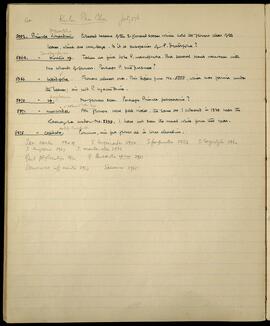
  1. Primula dryadifolia. Collected because of the 2-flowered scapes which have the flowers clear of the leaves, which are very large. Is it a subspecies of P. dryadifolia?

  2. Primula sinopurpurea (nivalis sp.). Taken at first to be P. macrophylla. But several plants were seen with two whorls of flowers. Perhaps P. sinopurpurea?

  3. Primula bellidifolia. Flowers almost over. This differs from No. 5888, which has farina under the leaves; it is not P. hyacinthina.

  4. Primula kongboensis sp. No flowers seen. Perhaps Primula petrocharis?

  5. Primula muscoides v. roseotincta var. nov. The flowers were pale violet, the same as I collected in 1936 near the Kashong La under No. 2399. I have not seen the usual white form this year.

  6. Primula capitata subsp. crispata. Common, in full flower at its lower elevation.

Sax. wardii 5949. S. bergenioides 5950. S. perpusilla 5953. S. longistyla 5962.
S. kingdonii 5967. S. montanella 5968.
Gent. phyllocalyx 5972. G. leucantha sp. nov. 5951.
Saussurea aff. wardii 5963. Saussurea 5965.

LSH/1/1/6/1/177 · Part · 1938-11-24
Part of The Ludlow & Sherriff Collection

SUMMARY:
A page listing Primula taxa with specimen numbers, sectional notes, and collection localities including Tsongpen, Kucha La, Concholoka, Kulu Phu Chu, Tse, Pu Chu, Nyang Chu, Mira La, and Kyabden. Some entries note missing flowers or tentative identifications, and one entry is marked 'By Ludlow.'

CONTENT:

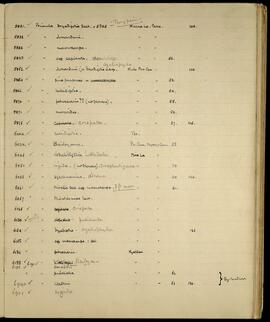
  1. Primula Dryadifolia Sect. = 5865 - Tsongpen - Kucha La. Para. 106.
  2. " Jonardunii. " " "
  3. " macrocarpa. " " "
  4. " aff capitata. Concholoka " " 52.
  5. " Jonardunii (or Dryadifolia subsp. cycliophylla) Kulu Phu Chu " 110
  6. " sino purpurea or macrophylla " " 53.
  7. " bellidifolia. " " 54.
  8. " petrocharis ?? (no flowers). " " 55.
  9. " muscoides. " " 56.
  10. " capitata. crispata. " " 57. 115.
  11. " bellidifolia. Tse.
  12. " Baileyana. Pu Chu. Nyang Chu. 58
  13. " Littledalei Mira La "
  14. " rigida - (no flowers). Sinoplantaginea " " 59
  15. " szechuanica. advena " " 60 120.
  16. " Nivalis sect. aff macrocarpa. sp nov " " 61.
  17. " Minutissimae Sect. " "
  18. " capitata. crispata " "
  19. " pudibunda " "
  20. " Dryadifolia cycliophylla " " 125
  21. " aff macrocarpa : 6061. " "
  22. " petrocharis. Kyabden "
    6188 / 6191. " Baileyana " "
  23. " amabilis " " 62
    " pulchella " " 63 130. } By Ludlow.
  24. " Waltoni " "
  25. " rigida
LSH/1/1/6/1/62 · Part · 1938-05-29
Part of The Ludlow & Sherriff Collection

SUMMARY:
Field notes from Langong record several Primula taxa with observations on abundance, flower color, and phenology, including comparisons to a prior Bhutan primula (3366). P. tsariensis is noted as abundant north and south of the Main Himalayan Range, and a bearing for the Langong valley is given.

CONTENT:
31a
Langong.

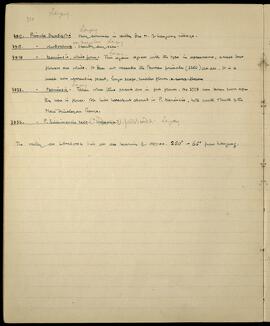
  1. Primula dryadifolia. Langong. Very common in valley due N. of Langong village.

    • var. microdonta. Langong. Hardly any seen.
    • tsariensis, white form. Langong. This again agrees with the type in appearance, except that flowers are white. It does not resemble the Bhutan primula (3366) at all. It is a much more upstanding plant, longer scape, smaller flower.
    • tsariensis. Langong. Taken when these plants are in full flower. No 3779 was taken soon after they were in flower. The hills hereabouts abound in P. tsariensis, both north & south of the Main Himalayan Range.
    • P. sikkimensis sect. (? Hopeana?). pudibunda. Langong.

The valley at LANGONG lies at a bearing of approx. 250° - 65° from Langong.

LSH/1/1/6/1/61 · Part · 1938-05-29
Part of The Ludlow & Sherriff Collection

SUMMARY:
At Langong, the diarist records collecting several Primula and other alpine plants, observing a new warbler (P. tibetanus), and noting marmots and lingering snow. A clutch of Crossoptilon eggs and a blood pheasant egg are obtained; the gyimpon arrives and promises coolies, and plans are made to explore valleys between Pa La and Lo La before visiting the Pachakshiri Loba.

CONTENT:
Langong

depressed, but then we saw P. bariensis, and knew that there would be other things as well. For a change, the second time only, I did not take a gun, and of course saw the new warbler P. tibetanus. There were two of them, in juniper scrub, just as on the Bimbi La. Of interesting things, we saw Mec. simplicifolia - and I particularly examined the filaments, which were white. Then Tsonypon brought in a primula, which I think must be P. chamaethauma 3893 (P. chionantha 3893). Then P. macrophylla 3894, 3895 (P. macrophylla var. macrocarpa 3895) was seen. Then over a ridge we found in almost full flower that delightfully pretty - and fragrant - P. rotundifolia. On the whole a good day. There are many marmots running about, now the snow is off the ground. The actual pass is probably still covered with snow, as there were huge drifts a good deal lower than the highest we went, on the North faces. I heard on return that one man had already found a nest of Crossoptilon, but he has not brought the eggs yet.

29th May. Halt. Langong. Fine most of the day, but clouded and showery. Started in the morning about at 11.00 a.m. Saw nothing much. In fact there is remarkably little in the valley. Collected Primula yargongensis 3914. Our offer for eggs is doing well. Today got a clutch of seven eggs of Crossoptilon, nest on the ground in a bush. Later on a man came in with one blood pheasant's egg, and will see the nest tomorrow. The eggs were very difficult to blow, having chicks inside. (P. dryadifolia 3917, Rhododendron v. microstoma 3918, Ranunculus 3919, 3923, Primula 3925, Gal. nambanensis 3920, Corydalis 3921, 3922, Lonicera litangensis 3926).

30th May. Halt. Langong. Mostly fine in Langong, but rain mist on the hills all day. I went up the valley immediately North of Langong village, running parallel to the Tscha valley. There is nothing in any of these valleys till one gets to 13,500 feet or so. Then primulas appear. This is a fine valley, with a good sized lake at about 13,500 feet above which there is a fine waterfall. But flowers are few and far between, and I think we are really too early yet. The gyimpon has arrived, seems very helpful and friendly. He wants to go off for 8 days, but has promised coolies all I want in the meantime. My plans are to stay here two more days, and then go West, up a valley which lies between the Pa La and Lo La routes. Stay there four days and return here for two before going off to the Pachakshiri Loba on the 9th, for a week. That will take up all the time I can spare in this area. Everything here seems to be late. Snow lies pretty thick on the hills yet, and nearly all passes are shut. Tsari Sama - known generally as Tsari Sarpa, "the new Tsari" is not

LSH/1/1/6/1/113 · Part · 1933-07-27
Part of The Ludlow & Sherriff Collection

SUMMARY:
Field notes detail several Primula species around Kulu Pher Chu and plans with the Tsungpen to reach Lamdo over a high ridge en route to Tseladzong. A wet halt day included further plant observations on avalanche-swept slopes and concerns about mail and Shadu, followed by a cold, rain-soaked march to Lamdo (11 miles) with a guide who initially took the wrong spur.

CONTENT:
Kulu Pher Chu
58
Primula

P. rhodochroa No. 5890, about 6 more flowers. P. capitata (subsp. crispata?) 5975 is common close to camp on the steep hillside. P. micropetala? (P. hesperidium) 5888 is also fairly common higher up. Then we found a few P. bellidifolia 5966 with flowers just over. Also what I at first took to be P. macrophylla, but which I think maybe P. sinopurpurea 5964. We saw a few seed specimens with two whorls of flowers. (P. kongboensis) 5970 I think might be P. petrocharis, but I don't know. P. muscoides, the violet form was just in flower still, 5971: and a fine form of P. jonardunii (P. dryadifolia) 5952, with all scapes 2-flowered was seen. Perhaps this is P. dryadifolia. The scapes held the flowers clear of the leaves which were bigger than usual. Saxifrages abound, over from a good many. This was a hard day's climb, or don't think we will do very much tomorrow, but prepare for the next day, when Tsungpen and I intend to go to Lamdo via the top of the ridge, instead of along the valley bed. It will be a long climb first, to over 15000 ft, then a long tedious traverse, before the steep descent. But I think it should be worth it, a good finish up before reaching Tseladzong. I hope to finish this book of Field Notes, up to 6000, which will give me up to 920 specimens this year. Taylor will likely have 1500 or so.

28th July. Halt. Rained a good deal at night. Clouded all day, with light rain most of the day. Had a fairly slack day today, crossing the river and going up one of the side valleys opposite camp to 13000'. It was a very steep slope which is swept by avalanche every spring, and kept bare. A good deal of snow still near the bottom, and snow has kept several plants back. We saw for instance, several Prim. atrodentata still in flower. Nomocharis nana also common, in flower. All thoughts in camp are about the mail, and whether Shadu also will be at Tsela before us. I rather doubt whether either will be before us. We ourselves will be one day early. I rather dread tomorrow's trek, especially if wet, as seems likely. We climb over 2000 ft to start off with, then have a long traverse along the hillside, before a steep descent of 5000 ft to Lamdo. However camp will be waiting ready for us, which always is nice to have.

29th July. Lamdo. 11 miles. Yesterday was a disastrous day. It poured all day and up on the hill was very cold indeed, with a strong wind. We had a Lopa to 'show us the way'. He did not start off too well, by going up the hill the wrong spur. Then we got into thick
30th July. Halt.

LSH/1/1/6/1/111 · Part · 1933-07-25 - 1933-07-27
Part of The Ludlow & Sherriff Collection

SUMMARY:
Notes from Kucha La and nearby valleys describe poor flowering despite promising terrain, with common Primula (including Dryadifolia/tsangensis and nivalid forms) and several Meconopsis. Weather shifts from clear to mist, rain, and thunder lead to a move back to Kulu Lungma; wildlife seen or reported include lerwa with young, Heteroxenicus stellatus, bear tracks and cubs, deer, and possible wild cattle. A hypsometer reading near the Go nyi re ridge suggests an elevation around 15,800 ft.

CONTENT:
Kucha La

over a good bit of the hill to the E of the Pass saw nothing new. The nivalid primula is fairly common but over. The Dryadifolia one is also here & P. jonardunii (Dryadifolia). Little else. We move by N of the range tomorrow. I see clouds again rushing up from the S west over the hills, that the good spell must be about over now. It has been lovely weather.

Kucha La
25th July. Halt. Fairly clear for an hour or two in the morning, then mist over everything. We were back by 3.0pm, it cleared up after rain & thunder by 4.0pm. Although the country looks perfectly wonderful for flowers, it is very poor indeed, there is no point in stopping longer, so we go back to Kulu Lungma tomorrow & try there. Prim. Dryadifolia (P. tsangensis) of the Tsanangha 5865 (= 5931) & also the nivalid primula 5872 (P. calliantha), no longer in flower, are both common; P. chamaethauma also (no flower) but no P. valentiniana or others expected here. P. jonardunii (Dryadifolia) is also common. Mec. betonicifolia at camp abounds, & a rather poor coloured M. simplicifolia, M. horridula & M. sinuata (speciosa) (5940). I saw many lerwa today, with young just able to fly. Also Heteroxenicus stellatus near the Tsanangha, also with young, about the top limit of abies zone.

Kulu Phu Chu
26th July. Kulu Lungma. 6 1/2 miles. Rain at night, mostly fine today, with bright intervals. Went up the Kucha La first thing to take the height. We looked about there a little, but there is nothing but a little P. valentiniana & some P. nivalis sect. in seed. So we came on here, will work this area for a couple of days as perhaps there is good. We saw fresh tracks of bear this morning, the coolies saw two young bear the day we arrived. Much deer also pretty common. The coolies also said they saw some kind of wild cattle near the Kucha La - not yaks of course. I don't know what they would be.

27th July. Halt. Fine all day, but clouded, with bright intervals. We went off at 5.45 & came back at 4.0pm, up the ridge to the North of the valley. It is a continuation of the Go nyi re ridge, so we thought it might be good. And it is not bad. I took a hypsometer reading about 400 ft from the extreme top of the ridge, BP 186.2 T. 57. at 2.0pm., giving an approx ht of 14800, which puts the ridge at 15800', so we climbed about 4500' today. We are too late for the primulas of the semi dry (dry winter wet summer) zone. The little dwarf nivalid (P. amabilis?), 5889, primula is common, we found one solitary flower, from which I would certainly say it is nivalid. We also found a little more of