
Showing 3 results

Archival description
3 results with digital objects Show results with digital objects
LSH/1/1/6/1/145 · Part · 1936-10-02
Part of The Ludlow & Sherriff Collection

SUMMARY:
The diarist reports uneasiness about leopards and persistent heavy rain and mist that make seed collecting difficult around Tsari Sama and Sacua Pebo. Despite the weather, they gather significant Primula and Rhododendron seeds, note hut damage, and record that team members Cunha, Kuku, and Souypen choose to sleep under an overhanging rock.

CONTENT:
There is considerable uneasiness among the coolies about Leopards here. They have been here during the summer, but I think we are too late to be worried by them now. Anyway I take my gun, which they have great faith in.

To Tsari Sama:
11th October. Sacua Pebo. Rained all night, poured all day today, with a thick mist. A great pity the weather has broken so, as we have a lot to do here, and it is very difficult collecting, collecting many seed when so wet as this. There are several rather astonishing things. Rhod. campylogynum has thrown practically all its seed, though we managed to get sufficient as it is very common on the way here: the little yellow deciduous rhod. (R. mckenziana) has thrown all its seed and I doubt if we have any in the capsules collected (5555). So has Rhod. faucium. But we got a little Prim. morsheadiana (menantra), some P. pudibunda or flexilipes and will have a grand collection of P. odoritica (Kinga 6595). What I take to be Omphalogramma brachysiphon (6596) too has still some seed, is fairly common here. Although such a foul day, it is not nearly so cold as it was on 15th June when we were here last. That is probably due to the lack of wind. I was hoping to see the place in sun, but the hut is not visible from more than 40 yards. There is a v. small gompa here, there were two rooms when we were here last. But one has fallen down altogether. I meant all of us to be together here, but Cunha, Kuku & Souypen seem to think that wrong, and have put their bedding in the open, but under the shelter of the overhanging rock. So they will be dry at any rate. Rats bad, and probably fleas though they have not appeared yet. (Gent. lancantha sp. nov 6592, P. taylorii sp. nov 6593, Sax. probata 6594).

Tsari Sama
12th October. Halt. A perfectly fine day, with thick mist and driving rain all day long. Very hard to collect seeds and impossible to dry them. A good day would have resulted in many more seed. However we have the biggest collection of seed I have ever made, of P. odoritica, (6595) (P. chionogenes 6601). There must be a dozen packets anyway, and all are just ripe. Another good collection was the small rhodo. with large yellow flower (R. ludlowii 6600). (R. forestii repens 6598).

It is curious here that we have found no rhododendron with unripe seeds. All are fully ripe or have thrown their seed. The yellow petioled primula from the other side of the Lo La was not found: we could see no trace of its dead leaves at all. One man with us here has been round the full pilgrimage, and he tells me that from here to the second Tsukang is as
LSH/1/1/7/1/3 · Part · 1940-05-24
Part of The Ludlow & Sherriff Collection

SUMMARY:
The diarist describes a difficult crossing of the Chubumbu La in mist, rain, and snow, followed by notable finds of Primula species and hybrids on the southern slopes. They also note a later visit to the Chimi La, where melting snow revealed several bodies of Lhopas from the previous autumn.

CONTENT:
In profusion had just been uncovered by melting snow, and seed capsules were still full of good seed. On the edge of the Abies forest, Omphalogramma minus was seen, while on very damp swampy slopes, O. brachysiphon was again found. As before, the flowers of this were mostly 5-partite, though a small percentage had six segments. On June 7th, I crossed the Chubumbu La (13,900'), the last 1,000 ft of which was deep in snow on the North side. The South face, however, was clear except for piles of avalanche snow 1,000' down the very steep slopes. It was a beastly day of driving mist and rain, over cold conditions which we had on every single Himalayan Pass this year, with the solitary exception of one fine morning on the Ka La in April. However, I was soon compensated for this. We took a last breather behind a rock on the summit before plunging down the southern slopes, and a compass bearing to keep us right as there was no path visible. Almost at once, we saw a mass of golden yellow Primulas. This proved to be the same as found south of the Do La in Ap at 11,500'; but here it was with proper habitat. This has now been named P. chionogenes. With it was also another Petiolarid Primula - P. tsariensis, and occasionally these two had hybridized and produced a queer but pretty Primula, the colour of which was about halfway between golden yellow and blue-violet. These covered the steep, slippery slopes for 500 ft, where their place was taken by equally large numbers of P. elizabethae, one of the most magnificent of Primulas. Among other Primulas found here were P. pudibunda, P. firma, P. normandiana, P. aff. clutterbuckii (3937), P. dickieana var. pantlingii, and P. barbatula.

The next Pass visited was only a few miles further East - the Chimi La, of 15,000'. Here again, snow lay deep on the North face, the last 1,000' of the N face, but it was melting fast, and we came across several bodies of Lhopas who had been overcome by bad weather the previous Autumn. I was surprised to find that

LSH/1/1/6/1/66 · Part · 1937-06-05
Part of The Ludlow & Sherriff Collection

SUMMARY:
Field notes describe the ascent to Chubumbu La with bearings, terrain, and vegetation changes, and map labels for nearby locations. The page records locations and observations for several alpine plants, including Rhododendron, Omphalogramma, and Primula specimens, with altitudinal ranges and morphological notes.

CONTENT:
33a

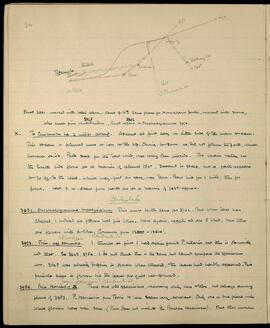
[Map Labels]
Potsangla
Chianang
Pass
Peak
Lagyong
Sheltangla
Chubumbu La
46°
65°
145°
162°

Rhododendron 3941 marked with label above camp of 6th. Same place for Nomocharis souliei, marked with stone, also small pink Rhododendron 3925, Rhododendron repens 3942 and Omphalogramma 3970.

X - To Chubumbu La 2 miles ascent. Ascent at first easy on either side of the main stream. This stream is followed more or less to the top. Owing to snow, we did not follow the path, which however exists. Path steep for the last mile, over rocky open hillside. The main valley on the South side flows at a bearing of almost 180°. Descent is steep, but a path appears to go off to the West, which may find an easy way down. Bare hill for 1 mile, then fir forest. Last 2 miles ascent from North are at a bearing of 142° approx.
Chubumbu La

  1. Omphalogramma brachysiphon. This must be the same as 3762. But when that was collected, I noticed all flowers had five lobes. Here again, nearly all are 5 lobed, but there are flowers with 6 lobes. Common from 13,000 - 13,500'.
    Chubumbu La

  2. Primula aff. strumosa. (chionogenes? Chubumbu La) I thought at first I had again found P. hilaris, but this is obviously not that. See 3648, 3754. I do not think this is the same, but cannot compare the specimens now. 3648 was already dropping its flowers when collected, the leaves had hardly appeared. This primula keeps its flowers till the leaves are quite well formed.
    (tsariensis x chionogenes? Chubumbu La)

  3. Primula tsariensis X. These are odd specimens, occurring only here and there, but always among plants of 3983. P. tsariensis from Tsari to here seems very constant. Only one or two plants with white flowers have been seen. (This does not include the Bhutan specimens). But this number