SUMMARY:
Lists live plants to be sent by KLM freight to London and the R.B.G. Edinburgh, noting a large quantity of roots, bulbs, and tubers collected. Describes severe weather at Chumbumbu La and successful but difficult seed collecting trips from Langong to the Chiniung La, with plans to march to Migyitun.
CONTENT:
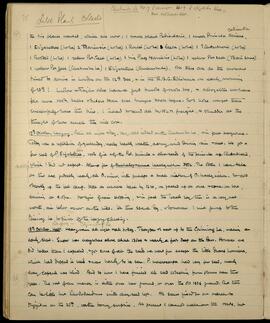
75 Live Plants Collected
Chumbumbu La Oct 17 P. chionantha 6609 P. elizabethae 6610
mec. violacea 6611.
...the live plants wanted, which are now: 1 small plant Pedicularis, 1 small Primula Aliciae, 1 Elizabethae (Lola) 2 Tsariensis (Lola) 1 Rowlei (Lola) & laeta (Lola) 1 ? Clutterbuckii (Lola) 1 Boothii (Lola) 1 yellow Pet. Sect. (Lola) 1 big plant Tsariensis (Lola) 1 yellow Pet sect (Tsari Sama) 1 yellow Pet sect (Chumbumbu La) 1 Elizabethae (Chumbumbu La). All these are at the moment timed to arrive in London on the 12th Dec, & in the R.B.G. Edinburgh on early morning of 13th! Ludlow & Taylor also have a good bundle of roots too, & altogether we have far more roots, bulbs & tubers than ever brought back before. So I hope we get them successfully home this time. I intend to send all by KLM freight, & shudder at the thought of how much they will cost.
17th October. Langong. Rain all night & day. Very cold indeed on the Chumbumbu La, in fact everywhere. Today was a repetition of yesterday, really beastly weather, a strong wind driving rain & sleet. We got a few seed of P. Elizabethae 6610, roots of it & of the Pet. Primula & also seeds of the Primula aff. Clutterbuckii, which I did not expect. Also a few of Omphalogramma brachysiphon 3952. The others I have taken as these are probably nearly all O. minus, with perhaps a small mixture of O. brachysiphon. So cold & beastly up the last camp, that as we were back by 12.30, we packed up at once & came on here, arriving at 4.0pm. No sign of rain stopping, in fact the locals say this is a very wet month, rain below & snow on the hills. We thus save a day, & tomorrow I must go up to the Chiniung La to finish off the Langong collecting.
18th October. Halt. Heavy rain all night & all today. Tsongpen & I went up to the Chiniung La, making an early start. Snow was everywhere above about 13500 & nearly a foot deep on the Pass. However we did better than I expected, & got some of all the seeds we were for except the little dwarf Lonicera, which had dropped its seed & was hardly to be seen. P. macrocarpa had very few seed, nearly every capsule was blind. And so now I have finished all seed collecting from flowers seen this year. The rest of our march is either over new ground, or over the old 1936 ground. But there can be little but Rhododendrons with any seed left. All seems fixed for our march to Migyitun on the 20th, rather to my surprise. At present I cannot make out the route, but