Showing 5 results

Archival description
5 results with digital objects Show results with digital objects
LSH/1/1/5/1/45 · Part · 1933-05-09
Part of The Ludlow & Sherriff Collection

SUMMARY:
The writer describes startling wildlife encounters including partridges and a close sighting of a panther, with no time to photograph. Notes record hot, windy conditions and a route descending from Phunzor to a cantilever bridge over the Rindi Chu, then along the Mangde Chu right bank through Pinus longifolia forest with some cultivation observed.

CONTENT:
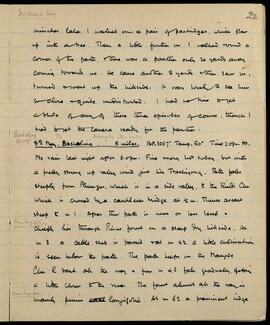
minutes later I walked on a pair of partridges, which flew up into a tree. Then a little further on I walked round a corner of the path, there was a panther only 20 yards away coming towards us. He came another 5 yards then saw us, turned and went up the hillside. It was lovely to see him so close and quite undisturbed. I had no time to get a photo of any of these three episodes of course, though I tried to get the camera ready for the panther.

9th May. Bashaling. 8 miles. BP. 105.7° Temp. 80° Time 2:00 pm. HV.

No rain last night after 6:00 pm. Fine and very hot today, but with a pretty strong up valley wind just like Trashigong. Path falls steeply from Phunzor, which is in a side valley, to the Rindi Chu which is crossed by a cantilever bridge at 1/2 m. Thence ascent steep to m 1. After this path is more or less level.

Chiefly lies through Pinus forest on a steep dry hillside. At m 3 a cattle shed is passed and at m 4 1/2 a little cultivation is seen below the path. The path keeps on the Mangde Chu R bank all the way and from m 4 1/2 falls gradually, getting a little closer to the river. The forest almost all the way is mainly Pinus longifolia. At m 6 1/2 a prominent ridge
LSH/1/1/8/1/33 · Part · 1946-12-23
Part of The Ludlow & Sherriff Collection

SUMMARY:
The party trekked through spruce, oak, pine, and larch forest, passed below Chunyima, obtained butter and fresh milk from herdsmen with yaks, and noted several plants including Primula atrodentata and Lilium wardii. They reached Tongkyuk Dzong after 68 days, glimpsing the Po Yigrong Range and collecting limited seed of an unidentified Rhododendron, a Gaultheria, and an evergreen Berberis.

CONTENT:
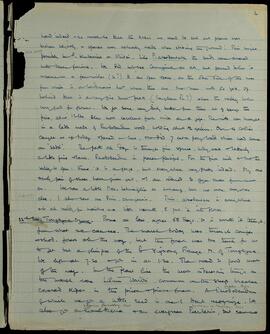
hard indeed - so much so that the kukri we used to cut out plants was broken slightly, & sparks were actually made when striking the ground! This might possibly be P. bhutanica or Whitei. Like P. atrodentata the buds were covered with dense farina. We did not see Chunyima at all, but passed below it scarcely a few miles (2?) to an open space, on the other side of the river from which is a herdsman's hut where there are two men with 50 yaks. Up behind that is a very fine snow peak (Sangdam Pu?) where the valley looks very good for flowers. We got some very dirty butter from them at 9 sangs the piece, about 1 1/2 lbs. Also most excellent fresh milk as a gift. The milk was brought in a ladle made of Rhododendron wood, holding about 1/2 gallon. Our 4 coolies caught us up today joined us here, so did 7 extra pony loads which had come on "sadsi". The path all day is through fine spruce, holly oak & latterly a little pine larch. Rhododendron in places plentiful. For the first mile or two the valley is open: thence it is a gorge, but everywhere very pretty indeed. My one only pair of shoes have given out, & am reduced to gym shoes from now on. We saw a little Mec. betonicifolia at Lunang, but no more anywhere else. I also saw one Prim. chungensis. Prim. atrodentata is everywhere & is all ready for moisture & a little warmth, to put it into flower.

22nd Dec. Tongkyuk Dzong. Home at last, after 68 days. It is worth it though, from what we can see. The march today was through conifer & rhod. forest all the way, but the forest was too thick for us to get but a glimpse of the Po Yigrong Range N. of Tongkyuk. We left at 7.30 & got in at 1.30. The road is good most of the way. In the plant line the most interesting things on the march were Lilium Wardii, common on the steep bracken covered slopes in the picea & pinus forest. A Rhododendron of which we got a little seed is one I don't recognize. We also got a Gaultheria & an evergreen Berberis, but saw no...

LSH/1/1/5/1/47 · Part · 1933-05-09
Part of The Ludlow & Sherriff Collection

SUMMARY:
The diary describes travel along the Mangde Chu with a cantilever bridge leading to Langti, Yundruchöling, and Beling, noting Ashe Paldon's old winter residence and nearby pinus forest. Observations include absence of a small iris seen previously, many monkeys feeding in a large tree, effects of grass burning on regeneration, river suitability, and mapping inaccuracies, with the route leaving Bashaling toward Kiji La.

CONTENT:
23

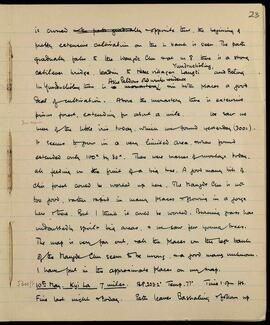
is crossed opposite this, the beginning of pretty extensive cultivation on the left bank is seen. The path gradually falls to the Mangde Chu at mile 8 there is a strong cantilever bridge, leading to three villages Langti, Yundruchöling, and Beling. In Yundruchöling there is Ashe Paldon's old winter residence and in both places a good deal of cultivation. Above the monastery there is extensive pinus forest, extending for about a mile. We saw no more of the little iris today, which we found yesterday (3001). It seems to grow in a very limited area, where found extended only 100 by 30. There were masses of monkeys today, all feeding on the fruit of a big tree. A good many bits of chir forest could be worked up here. The Mangde Chu is not too good, rather rapid in many places and flowing in a gorge here and there. But I think it could be worked. Burning grass has undoubtedly spoilt big areas, and we saw few young trees. The map is very far out, all the places on the left bank of the Mangde Chu seem to be wrong, and a good many unknown. I have put in the approximate places on my map.

10th May. Kiji La 7 miles. BP 203.2 Temp. 77° Time 1.0pm. Ht. 5300ft.
Fine last night and today. Path leaves Bashaling and follows up

LSH/1/1/3/3/80 · Part · 1936-03-10
Part of The Ludlow & Sherriff Collection

SUMMARY:
The page is largely illegible, but right-margin notes list botanical names and abbreviations, including P. abies, P. mariana, P. glauca, Picea, Pinus, Larix, and terms like grandis and palustris. These appear to be botanical shorthand likely related to adjacent content.

CONTENT:
The image provided appears to be a page from a notebook with extremely faint, almost illegible handwriting. The main body of the page contains text that is too faded to transcribe accurately. However, there are some legible notes on the right-hand margin, which likely belong to the adjacent page. These notes appear to be botanical names or abbreviations:

P. abies
P. white
P. mariana
grandis

palustris

Rh.
Rh.

Picea

P. glauca

Pinus
Larix

LSH/1/1/8/1/38 · Part · 1946-12-31 - 1947-02-23
Part of The Ludlow & Sherriff Collection

SUMMARY:
Notes the thermograph start on 31 December 1946 at about 12,250 feet, with snowfall events at Tomjuk in early to mid-January. Describes tree composition in the Sobhe la valley and records date correspondences for Jan 28 and Feb 23 related to the thermograph.

CONTENT:
34

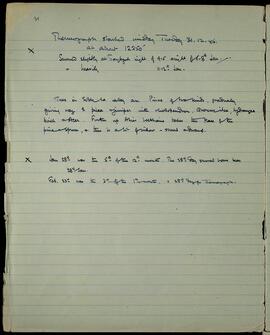
Thermograph started midday Tuesday 31.12.46.
at about 12,250'
Snowed slightly at Tomjuk night of 4-5, night of 6-8th Jan.
Snowed heavily 11-12th Jan.

Trees in Sobhe la valley are Pinus of two kinds, gradually
giving way to Picea and Juniper with Rhododendron, Quercus ilex, Hydrangea,
Birch and Acer. Further up Abies webbiana takes the place of the
Pine and Spruce, and there is a lot of Willow - shrub and dwarf.

Jan 28th was the 5th of the 12th month. The 28th day should have been
28th Jan.
Feb. 23rd was the 3rd of the 1st month. = 28th day for Thermograph.