Showing 6 results

Archival description
6 results with digital objects Show results with digital objects
LSH/1/1/9/1/99 · Part · 1933-07-11
Part of The Ludlow & Sherriff Collection

SUMMARY:
The party crossed a pass and lakes into another valley but found few flowers, noting several Primula species and plants of “Pasang's Abardia” without bloom. The writer criticizes Lhakpa and Ngudup for damaging collections and considers asking Holt to replace Ngudup; on the 9th a fresh Yertsa-gumbu was found by the pony man and taken by Ngudup for rheumatic pains.

CONTENT:
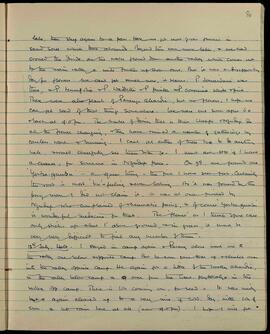
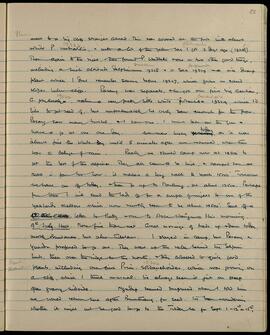
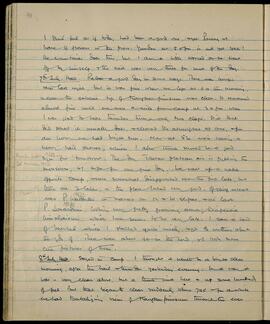
lake, then steep again to a pass. Here we got more prim flowers in sand scree which there abound. Beyond this were more lakes, and we had crossed the divide, as the water flowed down another valley which comes out to the main valley a mile further up than ours. But it was a disappointing day for flowers. We can't get much now, it seems. P. jonarduni was there, and P. tenuifolia and P. waddellii and P. pusilla and P. concinna white and pink. There were also plants of Pasang's Abardia, but no flowers. I hope we can get seed of that thing somewhere. We were out soon after 6:00 and back at 4:00 pm. The trouble of doing that is that Lhakpa and Ngudup do all the flower changing, and they have ruined a number of gatherings by careless work and burning. I can't get either of those two to do anything well, and would cheerfully see them both go. I must ask Holt if I have a chance for someone in Ngudup's place. On 9th, we found one 'Yertsa-gumbu' - a queer thing - the first I have seen fresh. Certainly the root is most 'bug'-feeling and even looking. As it was found by the pony man I did not claim it. It was at once pinched by Ngudup who complained of rheumatic pains, and of course 'Yertsa-gumbu' is wonderful medicine for that. The 'flower' or
LSH/1/1/9/1/93 · Part · 1933-07-03
Part of The Ludlow & Sherriff Collection

SUMMARY:
The diarist describes plant collecting on cliffs and sand slopes, with Pasang separately gathering notable specimens, and notes wildlife sightings, weather, and plans to camp higher and visit Marlung. Letters were sent to Betty and Asha Wangmoo. On 4 July, amid active trade movement, Pasang and Yundun collected more plants near the Sekpen's huts, and plans are considered for a September trip to the Tibdey La after returning from Bumthang.

CONTENT:
1 June
Went to a big cliff straight ahead. This was covered at the foot with almost white P. umbratilis (19332), and with a lot of the yellow Sax I saw 2 days ago, glabricaulis (19306). Then again to the right, then found P. waddellii and one or two other good things, including a high altitude Delphinium muscosum (19328) and a Sax bergianoides (19329) and a nice dwarf plant which I don't remember seeing before (19327), which grows in sand slopes below cliffs. Pasang was separate, and he got one fine big Gentian, G. phyllocalyx (19322), and also a very pretty little white Potentilla coriandrifolia (19324), which I'd like to get seed of, but unfortunately he only saw enough for the press.

Pasang saw many bharal, I saw one. I must take out the gun and have a go at one one day. We were lucky today, as it was almost fine the whole day until 5 minutes after we returned, when there was a deluge of rain. Really we should camp now at 14,500' to get the best of the alpines. They all seem to be high, and camping here at 12,000' is far too low: it makes a long walk to reach 15,000'. Tomorrow we have an off day, then go up to Marlung, at about 13,500'. Perhaps from there I will send the lads off for a couple of nights to one of the yakherds' shelters, which now mostly seem to be about 14,500'. Sent off a letter to Betty and one to Asha Wangmoo this morning.

4th July. Halt. More fine than wet. Great moving of trade up and down today, mostly Bhutanese, but also Tibetans. I stayed in camp, but Pasang and Yundun preferred to go out. They went up the valley behind the Sekpen's huts, then over the ridge to the north, and they collected 10 quite good plants, including one fine Prim. soldanelloides (19346), which was growing on a cliff, which I think unusual. I've always seen it just on steep open grassy hillside. Ngudup seemed surprised when I told him we would return here after Bumthang, for seed. I've been wondering whether it might not be good to go to the Tibdey La for Sept 1-12th or 15th.

LSH/1/1/9/1/96 · Part · 1933-07-03
Part of The Ludlow & Sherriff Collection

SUMMARY:
The diarist and Pasang pressed 16 flowers, while worrying that Yumden had not yet returned in thick mist. On 7 July at Haat, after heavy night rain the weather cleared with hail; they explored a nala with lakes, found masses of P. waddellii and P. jonarduni among Diapensia himalaicum, and the diarist stalked a herd of burrhel.

CONTENT:
I don't feel as if today had been a good one, and Pasang and I have 16 flowers in the press. Yumden at 5.0 pm. is not yet back! He sometimes does this, but I am a little worried as he went off by himself, and the mist was very thick for most of the day.

7th July. Haat. Rather a good day in some ways. There was terrific rain last night, but it was fine when we left at 6.0 this morning, and even the extreme tip of Kangkar Punsum was clear. It remained almost fine until we were a mile from camp at 3.0 pm. when I was glad to hear thunder, though only two claps. Since that did what it usually does, and cleared the atmosphere at once, after an hour we had bright sun. Now at 5.30 we're having a heavy hail shower, which I also think should be a good sign for tomorrow. The dry Tibetan plateau air is fighting the monsoon, and I hope for one fine day. We went up a nala opposite camp, and were somewhat disappointed near the first lake, but there are 3 lakes, and the place looked very good. Of chief interest were P. waddellii in masses on N & W slopes, and at last P. jonarduni, looking very pretty growing among Diapensia himalaicum, which here seems to be very late. I saw a herd of burrhel which I stalked quite nicely, and got to within about 50

LSH/1/1/10/1/13 · Part · 1949-09-27
Part of The Ludlow & Sherriff Collection

SUMMARY:
Notes the arrangement of numbered plant specimens in bottom, middle, and top layers, with plans to add several Primula species. Describes a shift from mist to thunder and heavy rain, followed by a clear day on 26 September at Marlung, colder than Waitang, with yaks, dzopas, and mention of a local boy who had previously broken his arm.

CONTENT:
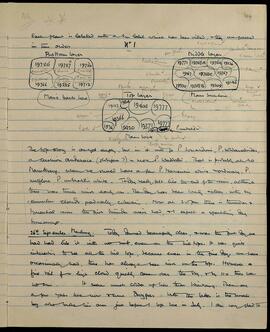
Each plant is labelled with a tin label which has been oiled, they are packed in this order.
No. 1

Bottom layer
19750 19757 19750
19766 19235 19712
Maus back here

Middle layer
19771 19768A 19764 19226
19167 19768C 19767
19330 19768B 19309 19146
Maus back here

Top layer
19123 19804 19404 19777
19366
19716 19420 19373 19722
Maus back

The top story is as yet empty, but in it will go P. tsariensis, P. soldanelloides, a cushion androsace (globifera?) - more P. Waddellii. That is probably all the Marlung, when we should have a few P. tsariensis white ordinary, P. uniflora, P. umbratilis white. Today really felt like the end of the rain, although there was much mist early on. The day has been lovely and clear, with big cumulus clouds gradually collecting. Now at 3.0 pm there is thunder and torrential rain, the first thunder we've had, and I expect a sparkling day tomorrow.

26th September. Marlung. Today dawned beautifully clear, and was the first day we had had like it with no mist, even on the hill tops. It was quite interesting to see all the hill tops, because even in the fine days we have occasionally had, there has always been mist on the tops. However a fine veil of high cloud quickly came over the sky, and by 11.0 there was no sun. It seems much colder up here than Waitang. There are a few yaks here now and some dzopas: with the latter is the small boy who broke his arm just before I left here in July. I am very glad to

LSH/1/1/9/1/144 · Part · 1933-09-01
Part of The Ludlow & Sherriff Collection

SUMMARY:
Page lists Primula specimens with notes on morphology, flower colors, abundance, and growth habits, including forms such as P. caveana, P. muscoides, P. glabra, and P. waddellii. Mentions comparison with earlier collections at Waitang and a reference to a specimen from 1938.

CONTENT:
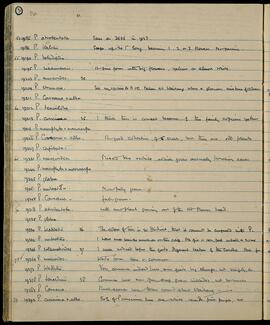
(3) 136 33.

  1. 19185 P. atrodentata Same as 3636 in 1938.
    19186 P. walshii Scape up to 1" long bearing 1, 2 or 3 flowers. No farina.
  2. 19190 P. bellidifolia.
    19195 P. sikkimensis. A fine form with big flowers, yellow or almost white.
    19203 P. muscoides. 34.
    19204 P. strumosa. See my 19000 A B or C taken at Waitang where a glorious mixture of colours
    19211 P. caveana v. alba
  3. 19212 P. tenuiloba
    19213 P. concinna 35. I think this is correct because of the fairly copious yellow
    19216 P. macrophylla v. macrocarpa
    19226 P. caveana v. alba. A good collection of 5 sheets, but they are odd plants
    19227 P. capitata.
  4. 19231 P. muscoides. Mixed blue and white, which grow actually touching each
    19244 P. macrophylla v. macrocarpa
    19245 P. glabra
    19251 P. umbratilis. Not fully grown.
    19255 P. caveana - full grown.
  5. 19318 P. atrodentata. With new plants growing out from old flower head.
    19325 P. glabra.
    19330 P. waddellii 36. The colour of this is so distinct, that it cannot be confused with P.
    19332 P. umbratilis. I have never seen so much as on this cliff. All of it is very pale indeed, or some
    19346 P. soldanelloides 37 I never noticed before the quite different texture of the corolla. Ask for
  6. 19364 P. muscoides. White form. Here v. common.
    19373 P. waddellii. Very common indeed here, in quite big clumps, not singly, as
    19378 P. jonardunii. 38 Common here, on open steep grass hillsides, not so much
    19383 P. caveana. Much scarcer here than round about Waitang.
  7. 19392 P. concinna v. alba. 80% of P. concinna here are white, remainder pink purple, no
LSH/1/1/5/1/118 · Part · 1870-03-15
Part of The Ludlow & Sherriff Collection

SUMMARY:
Page lists plant taxa with associated numbers: Lilium nanum (3277), Saxifraga tricuspidata (3278), Anemone rupicola (3279), P. waddellii (3281), Aster lichiangensis (3282), and an accession noted as 3286.

CONTENT:
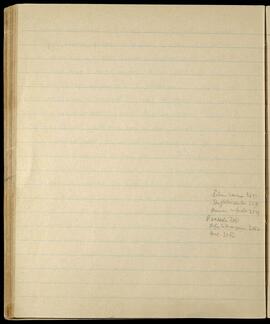
Lilium nanum 3277
Saxifraga tricuspidata 3278
Anemone rupicola 3279
P. waddellii 3281
Aster lichiangensis 3282
Acc. 3286.