Showing 8 results

Archival description
8 results with digital objects Show results with digital objects
LSH/1/1/6/1/65 · Part · 1937-06-05
Part of The Ludlow & Sherriff Collection

SUMMARY:
From Chianang the diarist reports illness among companions, a reconnaissance with Kunio toward Chubumbu La with notable rhododendrons and Nomocharis, persistent rain, and route details. Plans to attempt the Chubumbu La despite local advice are noted, along with Brahminy Ducks near Lanyong; subsequent halts include botanical collecting and bird observations, before proceeding up-valley toward a pass.

CONTENT:
Chianang.

...vomiting everything he tried to swallow. He has no strength today at all. I went with Kunio towards Chubumbu La, which is about 6 miles from here, and has not too much snow on it to be crossed. There was nothing to be seen till we reached the head of the valley, then rhododendrons in profusion, P. pauliana all over the place, Nomocharis souliei the best of all, masses of Rhod. aff. repens, in full flower.

3rd June. CAMP CHIANANG. 5 miles. B.P. 189.0° Temp. 50° Time 11:30 am. Ht. approx. 12929'.
Rained most of the night and all today without a stop. Path follows the left bank for 2 miles, then crosses by a foot bridge to right bank. At mile 3 a side valley from the Chubumbu La is reached and crossed. The Chubumbu La lies at a bearing of 162° Magnetic and from here is about 4 miles distant. Follow up this valley left bank for ½ mile, then turn up a side valley. Ascent fairly steep for 1½ miles to a plateau, where there are 3-4 houses, where yaks are grazed in summer. Very swampy ground. We saw nothing at all today, as Lin was not yet too fit and Tsungpen only just able to come up, we did nothing today, but sat in camp and changed flowers. I'm afraid this valley is not as good as I had hoped: we are still too early. So I remain only two days and then go to the Chubumbu La for a day, to see if I can get across. It does not look impossible, though the locals say it is, and will remain so for another 2 months or more, when the Lhopas will come over. There are Brahminy Duck near Lanyong, and I saw they have their young one now and quite big.

4th June. Halt. Chianang. Fine intervals with a little sun up till 12:00 noon, then rain all day. Went up to the South, and had a fairly good day. Rhod. repens is abundant, but not above 14000'. With it were P. harrisii, and P. valentiniana 3953. This must cover the hillside, but is hardly in flower yet. Just as at Tsari Chikchar, it comes just after P. harrisii. First one gets a blue violet hillside, which is then turned into a deep velvety crimson one. P. vernicosa 3951, is here about half blue and half white. Saw a good many Grandala coelicolor above, some rubythroats; the latter is not the Yunnan bird.
Diapensia himalaica 3949, Potentilla leucanota 3950 - Bell common, Pot. stenophylla 3956, Pot. microphylla 3957 & 41, Pedicularis formis 3959.

5th June. Halt Chianang. Rain early at night, but a fine day till 2:00 pm, then thunder and rain and snow on the hills. Cleared 2 hours later. Went up the valley, past two more yak grazing grounds to a pass,
LSH/1/1/4/1/81 · Part · 1933-08-15
Part of The Ludlow & Sherriff Collection

SUMMARY:
Notes a striking new Aconitum (longipedicellatum) in juniper patches and abundant Cyananthus lobatus along the route. Describes an 11-mile day from Chusam to Chuichchar at 13,000 ft with rain and muddy paths, Lumsden losing his braces, and a halt day exploring west of Chuichchar to collect and mark white-flowered plants and seeds.

CONTENT:
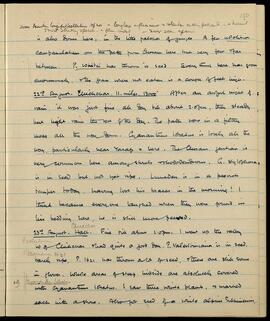
150
2100 Aconitum longipedicellatum sp. nov. - long lax inflorescence & slender arching pedicels - a distinct & most striking species. - blue violet - never seen again
is also down here, in the little patches of juniper. A few Notholirion
campanulatum on the path from Chusam here, but very few & far
between. P. whitei has thrown its seed. Everything here has grown
enormously. The grass where not eaten is a couple of feet high.

22nd August. Chuichchar. 11 miles. 13000' After an awful night of
rain, it was just fine all day till about 2.0pm, then steady
but light rain the rest of the day. The path was in a filthy
mess all the way down. Cyananthus lobatus is lovely all the
way, particularly near Yarap & here. The Chusam gentian is
very common here among shrubs & rhododendrons. C. stylophora
is in seed but not yet ripe. Lumsden is in a peevish
temper today, having lost his braces in the morning! I
think because everyone laughed when they were found in
his bedding here, he is still more peeved.

23rd August. Halt. Fine till about 1.0pm. I went up the valley
W of Chuichchar, & had quite a good day. P. valentiniana is in seed,
barely ripe, P. 1621 has thrown a lot of seed, others are still some
in flower. Whole areas of steep hillside are absolutely covered
with Cyananthus lobatus. I saw three white plants, & marked
each with a stone. Also got seed of a white alpine Delphinium,

LSH/1/1/7/1/13 · Part · 1940-05-24
Part of The Ludlow & Sherriff Collection

SUMMARY:
The writer describes difficult access near a Himalayan pass, noting most rhododendrons were over, while several primulas remained in flower, including a new species later named P. tsangpoensis. After retreating to the drier Tsangpo valley, they explored a nearby spur called Go ngi re, recording diverse alpine plants and collecting seed with the help of a hopa.

CONTENT:
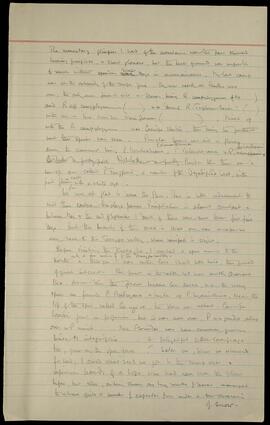
The momentary glimpses I had of the mountains near the pass showed towering precipices and short glaciers, but the best ground was impossible to reach without spending some days in reconnaissance. The last camp was at the extremity of the conifer zone. By now nearly all Rhodos were over, the only ones found still in flower being R. campylogynum (No. ) and R. aff. campylogynum ( ) and a dwarf R. Triflorum series? ( ) with one or two crimson neriiflorum ( ). Mixed up with the R. campylogynum was Cassiope wardii, this being the furthest west this species was seen. Primulas however were still in flower, among the commonest being P. morsheadiana, P. chamaethauma, P. valentiniana and P. tsariensis. Besides this there was a new sp. now called P. tsangpoensis, a member of the Dryadifolia section, with pink flowers each with a white eye.

We were all glad to leave the Pass. There is little inducement to visit these eastern Himalayan passes. Precipitation is almost constant between May and the end of September; I doubt if there were more than five fine days. But the beauty of the area is that one can escape so easily back to the Tsangpo valley, where rainfall is slight.

Before visiting the Kucha La, I worked a spur only a few miles N. of the Tsangpo valley. Though I was rather late and had little time, this proved of great interest. The forest in the valley bed was mostly Quercus ilex. Above this the forest became less dense, and on the rocky spurs we found P. baileyana, and higher up P. hyacinthina. Near the top of the spur, called Go ngi re, the flora was richest. Cassiope wardii grew in profusion, but it was now over, P. unijuga also over and of merit. Meconopsis florindae was here common, growing beside M. integrifolia. A delightful little saxifrage too, grew on the open scree. Later on, when we returned for seed, I owed what seed we got to the sharp eyes and unwearying hands of a hopa who had never seen the plant before, but who, on being shown one tiny rosette of leaves, managed to retrieve quite a number of capsules from under a thin covering of snow.

LSH/1/1/6/1/141 · Part · 1936-10-02
Part of The Ludlow & Sherriff Collection

SUMMARY:
At Lo La, the diarist collected Primula and Rhododendron specimens around a small lake amid frost, snow, and sun, noting Jill’s reluctance to collect seeds and the coolies’ hardiness. On October 8 a halt was made; a circuit to the southwest of the lakes yielded a few bulbs, and Tsongpen arrived reporting difficulties obtaining ripe seed, fears of Lhopas on the route, and a theft problem with a dismissed man.

CONTENT:
Lo La. Oct 7. P. chamaethauma 6551, P. calderiana 6552, P. subularia 6553, tsangpoensis 6554.
Oct 8. Gent. hamberxii f. caulibaccans 6555, Rh. pumilum 6556, R. concatenans 6560.
Rh. lopsangianum 6561, 6567 R. lindleyi 6562, R. xeriflorum 6563, R. haysii 6565.
R. elatum 6568, R. brachyanthum v. hypolepidotum 6576, R. sulphureum 6580.
abrivale 6558, normaniana 6574.
laccata 6575, Omph. minor 6585.

On Gonyi-re the other day, so it seems common to Omphalifolia primulas. I thought I had P. laeta, with leaves all withered (6552), but a nice winter bud, but when on the way down, I decided it was P. calderiana so went up again to the little lake. There I took 6551, which does not seem to be P. tsariensis, which has more cordate leaves & a red winter bud. So I hope this will be P. laeta. Jill hates seed collecting, & does her best to get me to come on. We were four hours in one small patch, getting two full packets of P. valentiniana. I'm sorry not to have been here in the flowering season, to know more exactly where things are. Snow & a hot sun has withered everything completely. It is very cold at night, with a heavy white frost. But my coolies lie outside with hardly any covering at all. But they don't seem to feel the cold, as there is the fir forest only 100 yards away, where they could lie under cover & have a fire all night. One man comes into me each day, this is quite good. I give him cigarettes for helping to collect seeds, & that keeps him perfectly happy.

8th October. Halt. Rain & snow last night. Thick mist this morning till 9.00 am then clear with some sun. The really clear spell has gone, but it does not look as if we should have a great deal of rain or snow yet. I went to the SW round about the lakes, & took some bulbs of Nom. souliei, & a few odd seeds. In the afternoon Tsongpen came in. He has done well, but could not get seeds of a good many wanted things, especially the Cortusoides primula growing with P. normaniana, & the little Prim 3640. Most of the rhododendrons too are not really ripe, though we may make something of the seeds of most. His two men were very frightened about Lhopas, as is everyone on that route. The Lhopas have carried off 5 near the Chudi-Cun this summer. They saw a few & were warned not to come over again. Tsongpen had three men originally, but one was so useless he was returned. Besides being useless he is a thief. He stole a knife from the cookhouse at Molo, then stole my gun oil & cloth from Tsongpen. I found the tin with him here, but he has removed all the oil, so that I have none with me at all now. Since he has been here in camp he has continued to steal, & today when all the rest had gone for wood, he was seen to take the leather from one of the yak saddles, & to...

LSH/1/1/6/1/67 · Part · 1937-06-05
Part of The Ludlow & Sherriff Collection

SUMMARY:
The diarist describes views toward Pa La and Lanyong, debates whether the seen pass is Pa La or Lingtsangha La on the route to Migyitun, and notes a prominent peak likely the Migyitun Peak. Camping north of Chubumbu La, they record weather, altitudes, and fieldwork with Thompson, including bird specimens and several Primula and Omphalogramma finds, with a halt day spent revisiting the Chubumbu La.

CONTENT:
about 2 miles from here. From there we could see the Pa La & Lanyong. The Pa La lies at a bearing of 266° & Lanyong at 47°. I should say that the Pa La was further than Lanyong but not much. Again failed to find flowers, though P. tsariensis is in masses everywhere, P. dryadifolia common to the N. of the pass, some P. Valentiniana a mile South. This valley is said to lead to Migyitun, but we could not see how it does so. Shokakuling was bloody pleasant on the way up, but with bare patches. They must be sitting, but we could find no nests. Also collected two more Phylloscopus tibetanus & a flycatcher with eggs c/3. There is obviously nothing yet, this side of the main Range. There is a fine peak to the S. of the Pa La. Can it be the Pk. to the E of Migyitun - (N.E.?). I have heard that the Pass we saw today is not the Pa La but the Lingtsangha La, viz on the road to Migyitun. In that case the peak is almost certainly the Migyitun Peak. It is almost impossible to get information that one can rely on though. - Chubumbu La - see June 2.

6th June. Camp 2m N of Chubumbu La. B.P. 189.8° Temp 35° Time 3.0pm. Ht. approx. 12596'. Rained in the night up to 7.0am, then cleared & was a fine day with a good deal of sun till 3.0pm. Then mist & some rain, clearing up later. Some thunder yesterday evening & again this evening. Thompson & I went direct South from camp over the hills, but ran into a lot of mist, & so to get down to the valley we had a series of cliffs to negotiate. A valley comes in from the SW just above here, up it we went. The only real find was Omphalogramma minus 3970, which is fairly common on the edge of the last bit of abies forest. P. Valentiniana & P. Pauliana & P. tsariensis are coming everywhere. A nice little dwarf rhododendron was No. 3975, common about here, but nowhere else. Although reports of the Chubumbu La are not a bit favourable, we go over it tomorrow & hope for a fine day.

7th June. Halt. Misty, but fine nearly all day: some showers. Went up to the Chubumbu La, at mile 2. B.P. 187.2° Temp. 45° Time 7.30 am. Ht. approx 13900'. A good day on the whole. On our way up to the pass we came across a lot of what I had thought to be a new primula collected beyond the Lo La under No. 3762. At that time I could not make it out, but now I see it

LSH/1/1/6/1/75 · Part · 1938-06-15
Part of The Ludlow & Sherriff Collection

SUMMARY:
Notes on the Kyag Chu spring’s seasonal flow, a halt at Trashiying with poor weather, and a wet march to the Tsokang at Shacho Pebo in Tsari Sama. The diarist describes logistical issues with coolies and rations, and records abundant Primula and Rhododendron, including vast masses of P. valentiniana; blood pheasant chicks are noted.

CONTENT:
'Kyag Chu' or Indian spring. During the winter it does not flow - but is said to flow to India. On the 10th of the 4th Tibetan month it begins to flow here again. All the coolies washed in it as soon as they arrived.

14th June. Halt. Trashiying. Cloudy & rainy nearly all day. I went up the hillside E of camp for about 2000 ft or more, but the mist was very thick & decided not to traverse on to the head of the valley, which abounds in cliffs & has a good deal of snow still lying. We went over the ridge to the next valley & returned by the Trashi La. Very little seen of any interest. P. tsariensis everywhere, but no P. valentiniana. Mec. simplicifolia very common & good colour. Blood pheasant now have their chicks hatched out - one or two days old.

15th June. The Tsokang at Shacho Pebo, Tsari Sama. 7 1/2 miles. BP. 187.7°. Temp. 46°. Time 3.30 pm. Ht. app. 13576'.
A wet night last night, & a terrific downpour all day today, without a pause, with a strong wind. Yesterday evening one of my four coolies returned - with no rations - but with a chit to say the coolies were to return to Langong. This was not from the gyunpa but from his underling. He added that the Trashiying people would take me round Tsari, but ignored the fact that there are only five people there. Tsoupon-Kusho did some good work & for some rations - to be repaid in kind - from the locals, & my coolies - now 14 - agreed to come with me. It was raining hard at 4 am & has not yet stopped. I have seldom had such a bad day for weather, as there is a high wind with it all. We had hoped to cross to the South of the Himalayas, but this pilgrimage apparently keeps to the North. At first there was nothing at all to be found. Then we got into good country, & here it is very good, must be like the Lo La N. side, only a little higher. Of flowers, there is masses of P. Roylei (calcareum) - a very fine form - P. tsariensis, P. valentiniana, P. kongboensis, P. prenantha, P. pudibunda, P. elizabethae & others, besides one new to me - P. subularia 5561. Rhododendrons too are good, very interesting ones seen today, there are R. ludlowii 5555, & R. campylogynum (mekongense) 5560. Another nice one is one of the Glaucum Ser. (charitopes) No. 5565. The finest sight of all, is certainly P. valentiniana, which is in masses. We can see, when the mist rises a little, vast areas, coloured a deep wine red. I went this afternoon to have a look at it, & was amazed at how much there is. Beside it & among it are Rhodo. ludlowii (mekongense) & P. elizabethae. We reached here about 12 noon, all soaked to the skin. The

Trip to Chiniung La
LSH/1/1/6/1/81 · Part · 1938-06-20
Part of The Ludlow & Sherriff Collection

SUMMARY:
During a halt at Langong, two local men reconnoitred the Chiniung La, encountering deep snow, a half-frozen lake to the south, remains of Lopas on the pass, and few flowers, while the diarist records plant notes and a long circuit over the main range. That evening the gyimpon described local customs regarding Lopas and claimed that “Highburn Pk” near Tso Kar is the real Takpa Shiri; the writer wished to hear the account through Pintso but struggled to understand Kusho, who had been drinking chang. The party then moved to a camp south of the Tse La in heavy rain.

CONTENT:
Chiniung La
Trip to Chiniung La

20th June. Halt Langong. Rain nearly all day, finer in the evening. Trompen or rather two locals went up the valley to the South of Langong to try the South of the main range. It took 3 hours to reach the pass, going without a halt. The pass is called the CHINIUNG LA, (BP. 185.0, Temp 51°. 9.0 am, Ht. approx 15318.) There is a good deal of deep snow on this side still, but sufficient has melted to show the remains of some Lopas who died on the pass last year. Five died there, but we only saw one. They don't just leave their dead where they lie, but put a few stones round them, cover them with their hats & their fibre rain coat affair, then leave them little bundles of tsampa or food, & stick their bow up at one end. The arrows however, seem to have been taken away. Two Lopas crossed this pass last week & returned. On the South side, about 500 ft. down is a large lake, still half frozen, which shows how late things are here. There were hardly any flowers out as far as we went - P. Valentiniana near others of P. tsariensis. We got nothing on the South side. Then we did a big circle round to the left, over the main range again, but there was little new. P. chamaethamna was really more beautiful in masses, occasionally mixed with P. tsariensis. P. Hobsonii common & also P. macrophylla 5608. P. rotundifolia 5606 was common near the Chiniung La. Out at 5.30, back at 3.30 pm. pretty tired. The gyimpon this evening said they had not much trouble with the Lopas. When they come, a yak is killed on a stone & both the Lopas & the Langong people drink the blood. After this there is no trouble between the men, but he said that perhaps a woman or two or a child might get hit up, he did not know much about them. Tomorrow they have some kind of tamasha. As far as I can make out, they all go out with guns & let them off in Pachakshiri direction. It seems some idea of frightening the Lopas, who however know nothing about it all. I should like to have heard the whole story through Pintso. Kushos Urdu or Hindi is about as good as my Tibetan, & he is almost impossible to understand, especially as he had been drinking chang this evening. The gyimpon insists that the "Highburn Pk" - near Tso Kar - is the real Takpa Shiri, & that it is universally so called. I wonder if he can be right?

21st June. Camp S. of the Tse La. 6 miles. BP. 186.4° Temp. 50° Time 3.30 pm. Ap. ht. 14457'. Heavy rain

LSH/1/1/6/1/103 · Part · 1933-07-05
Part of The Ludlow & Sherriff Collection

SUMMARY:
At W. Tsanangho, the diarist reports heavy rain and poor visibility, explores the Tsanangha valley, and notes scarce primulas overall but finds two primulas new to them (No. 5865 of the Dryadifolia section and No. 5872, a nivalid close to P. sino-purpurea). Logistics are disrupted due to Kushu’s arrangements, reducing planned time on the Kuchaha; Kesang and a local accompany the outing, with observations of musk deer and local attire from Kongbo.

CONTENT:
And we found Cassiope wardii for the first time 5846. Primulas are more remarkable for their absence than anything else. We only saw P. Paulingii, P. prenantha, P. Dryadifolia & P. doshongensis (or is it P. Kongboensis?). No new ones, none of the old favorites like P. baileyensis, P. valentiniana or even P. Rockii, nor is there any sign here of P. Elizabethae. Thanks to Kushu's bad arrangements—it is his fault rather than the coolies—I can only stop here 1 day, owing to shortage of coolies' rations. And instead of 6 days on the Kuchaha, I will have but 2.

W. Tsanangho
18th July. Halt. A very wet night, & pouring rain all day. I would like to have seen this place on a clear day, with its glaciers & towering cliffs. It should be a fine sight, but there seems no hope in the monsoon, this year at any rate. We went straight up the main valley today to the Tsanangha. I certainly don't think laden coolies could manage it now, but why did they not say that was their reason.

We found the hillside very bare at first, on the whole there is remarkably little in this valley, good as it appears to be in the distance. However it had some good things. P. Valentiniana is profuse over a wide area, P. prenantha also, & P. Paulingii & P. vernicosa. P. Rockii is over, but common—a rather small form. P. Jonarduni too is common above 14000 ft. But we at last managed to find two new primulas—new to us anyway—after I had almost given up hope. One is I think another of the Dryadifolia section, or so it would appear from the roots & leaves & general habit. But it also has a marked pompom of hairs at the throat, which I thought was peculiar to the Bella section. It is a pretty little primula (5865) & oddly enough, grows close to P. Jonarduni. But the best found was No 5872, a Nivalid which appears to be close to P. sino-purpurea. Except for the colour, rich purple—it gives one an idea of P. obliqua, with the adaxial lobes reflexed in exactly the same way. I think it must take pride of place this year with P. Elizabethae, another nivalid. Musk deer seem to be pretty common here, as we walked on to two. Lerwa also common, & a lot of Coelicolor above.

Kesang & a local came with me today. The local wore a vampire hat, peculiar to the wet districts of Kongbo, made of coarse felt, with a wide undulating brim, very useful in this rain. Very cold indeed today, with a strong wind on the hilltops from the SW, driving what was then almost sleet. Fresh snow again on the highest peaks.