Showing 13 results

Archival description
13 results with digital objects Show results with digital objects
LSH/1/1/6/1/161 · Part · 1933-11-10 - 1933-11-13
Part of The Ludlow & Sherriff Collection

SUMMARY:
On 10 November at Trimo, the diarist notes seed collections and plants seen en route to the Pō La, and reports that Taylor has gathered many specimens between Sirimo and Shakti. They describe leaving Tsona, meeting the Dzongpen who discussed Tawang and Assam officials, sending mail by special runner toward Trashi-yang, and note health updates for Phunbo and the Dzongpen along with gifts from H.H. the Maharani, Padmadechen, and Phunbo Wangdi Palden.

CONTENT:
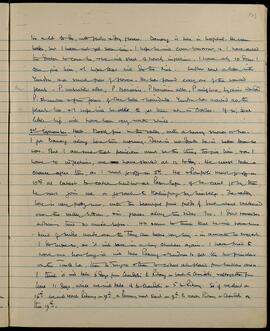
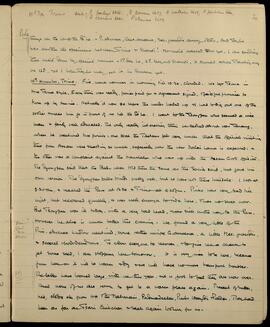
10th Nov. Trimo. seeds of R. baileyi 6656, R. tsariense 6657, R. wallichii 6659, P. pendulum 6660, R. tsariense 6661, P. strumosa 6658

Poda
things on the way to the Pō La - P. eburnea, Gent. amoena, Mec. grandis among others. And Taylor has another 150 specimens between Sirimo & Shakti! No mail reached them yet. I am sending their mail down by special runner - 1st day Le, 2nd beyond Shakti. It should reach Trashi-yang on 13th, so I hope Taylor may get it in Bhutan yet.

10th November. Trimo. Fine, much warmer in morning till 10:30, clouded. We left Tsona in true Tsona style. Everything was ready, ponies paid for & agreement signed, faithful promises to turn up by sunrise. Actually it was 9:00 before the mules loaded up & had to dig out one of the cooks & make him go in front of me till the Pō La. I went to the Dzongpen who seemed a nice man & fairly well educated. The only really interesting thing he talked about was Tawang, when he mentioned two points: one that the Tibetans felt very much that the officials visiting there from Assam were shooting so much, especially now the new Dalai Lama is expected: & the other was a complaint against the translator who was up with the Assam Govt official. The Dzongpen said that the Babu never told them the same as the Sahib said, but gave his own version. The Dzongpen talks Hindi pretty well, but he was not there himself. I left at 9:30 am, & reached the Pass at 12:30 & Trimo at 4:30 pm. Phunbo was very bad last night, but recovered quickly, & was well enough to ride here, has no fever now. But Dzongpen was ill today, with a very bad head, was sick on the way to the Pass.

Prim.
Gent.
Mec.
Rhodo
However he also is much better this evening. We found a very little of the Prim. eburnea Ludlow mentioned, some rather unripe G. amoena, a little Mec. grandis, & several Rhododendrons. To allow everyone to recover, & to give us a chance to get some seed, I am stopping here tomorrow. It is very nice to be here, because from here on it will be warm & dry & we will have no more transport troubles.

RB
The latter have loomed large with me this year, & it is good to feel they are now over. And none of us are sorry to get to a warm place again. Presents of butter, rice, cloths etc. from H.H. the Maharani, Padmadechen, Phunbo Wangdi Palden. They had been as far as Tsari Chinchu & back again looking for us.
LSH/1/1/9/1/86 · Part · 1949-06-30
Part of The Ludlow & Sherriff Collection

SUMMARY:
Seed collections are listed with specimen numbers and brief locality notes around camp, river, lake, and cliffs, including several Primula species, anemones, Rheum, and Androsace. Notes record seed sent to Taylor and to G.T.

CONTENT:
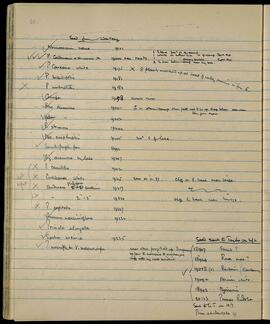
Seed from Waitang

Nomocharis nana 19121 1 ½ blue 300' N of camp.
P. calderiana x strumosa 19000 ABC roots. 1 white in bottom ½ m N of camp. Dark eye.
1 " " " among shrubs. light eye.
2 ½ blue below camp near big rock.
P. caveana white 19175 X 8 plants marked up at head of valley, river in from E.
P. bellidifolia 19181
P. muscarioides 19183
Conifer 19198 across river
Blue anemone 19201 ½ m above camp where path used to go up. Keep below near where they join again.
Yellow " 19202
P. strumosa 19204
Rheum spiciforme 19205 200' S of lake.
Small purple pea 18992
Big anemone by lake 19207
P. tenuifolia 19212
Cochlearia white 19215 some as in 37. Cliff on L. bank near bridge. (not ripe)
Androsace globifera cushion 19217 (not ripe)
" " 2" - 3" 19220 cliff L. bank near bridge.
P. capitata 19227
Anemone narcissiflora 19232
Primula elongata
Sorbus ursina 19235
P. macrophylla v. macrocarpa near where pony tied up Dumpra. up past R moraine to overhanging cliff with big rock beside it.

Seed sent to Taylor on 30/6
18907 Surus?
18924 Rosa mac?
19058 (2) Berberis (Kautam)
19092 Allium white.
18943 Myricaria.
20123 Prunus Rudolpha
Sent to G.T. on 10/7.
Prim. atrodentata 19

LSH/1/1/9/1/146 · Part · 1933-09-01
Part of The Ludlow & Sherriff Collection

SUMMARY:
Page lists Primula taxa with collection numbers and notes on abundance, habitat, flowering/fruiting status, and seed or root collections. Mentions very late flowering in some cases and specific quantities. One entry records a collection at Chendebi Sovo.

CONTENT:
4 138

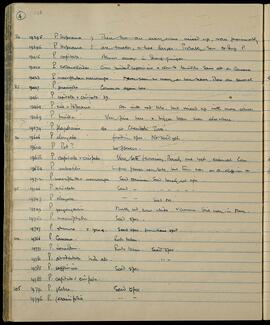
80 19395 P. Hopeana } These two are everywhere mixed up, one presumably
19396 P. Hopeana } are smaller, & here larger. Probably best to drop P.
19416 P. capitata. Almost always in dwarf juniper.
19420 P. soldanelloides Grows beside P. sapphirina & close to tenuiloba. Same alt. as Caveana
19423 P. macrophylla v. macrocarpa. Never seen so many as here before. There are several
85 19447 P. geraniifolia Common again here.
19461 P. capitata v crispata. 39.
19464 P. sin. v Hopeana. An with red tube, but mixed up with more which
19469 P. pusilla. Very fine here & bigger than seen elsewhere.
19574 P. flagellaris 40 at Chendebi Sovo.
90 19606 P. elongata fruiting spec. No seed yet.
19610 P. Pet? No flowers.
19656 P. capitata v crispata Very late flowering. Barely one yet, even at low
19684 P. umbratilis. In full flower very late, but this was on a cliff in a
19712 P. macrophylla v. macrocarpa. Seed specimen. Seed barely yet ripe.
95 19746 P. reticulata Seed - - - - - - -
19747 P. elongata. Seed ok.
19749 P. yargongensis. Mostly red, some white. Common. Still many in flower.
19750 P. macrophylla Seed spec.
19757 P. strumosa = 19204. Seed spec. from same spot.

  1. 19766 P. Caveana. Roots taken.
    19777 P. Jonarduni. Roots taken. Seed spec.
    19781 P. atrodentata high alt. " "
    19785 P. sapphirina Seed spec.
    19788 P. capitata v crispata.
    105 19791 P. flaccida. Seed spec.
    19796 P. geraniifolia " "
LSH/1/1/9/1/143 · Part · 1933-09-01
Part of The Ludlow & Sherriff Collection

SUMMARY:
Notes reconsidering identifications of Primula specimens, suggesting 1937 L+S mixtures (3433–3437) are P. strumosa × P. calderiana hybrids rather than tsariensis, and discussing affinities among P. Barnardoana, elongata, involucrata, and alpicola. Mentions observations at Lussing La and references comments by Fletcher and a possible need to await Prof. Brown.

CONTENT:
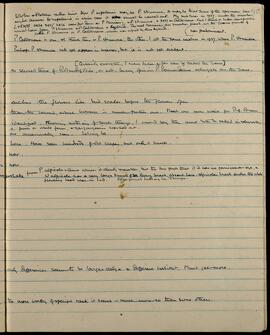
Words of Fletcher rather hint that P. nepalensis may be P. strumosa. It may be that some of the specimens here which answer to nepalensis, in which case it should be washed out. My mixtures in 1937, under the numbers L+S 3433, 3434, 3435, 3436 were put down as P. tsariensis, & P. strumosa, & 3437 as Calderiana. But I think a better identification would have been P. strumosa & P. Calderiana hybrids. The real tsariensis are smaller plants, and the coarse growth of either P. strumosa or P. Calderiana, which was copied in these hybrids, was predominant. P. Calderiana is one, I think this is P. strumosa, the other. I got the same mixture in 1937, where P. strumosa
Perhaps P. strumosa will yet appear in masses, but it is not yet evident.

[Certainly everything I have taken so far can be called the same]
as showed those of Rotundifoliae, or not. In my opinion P. Barnardoana & elongata are the same.

enclose the flowers like bud scales before the flowers open.
than the second, which however is much further on. Must one now wait for Prof. Brown
identified. Knowing nothing of such things, I would say they must both be called involucrata,
a pink or white form, or any orangeing washed out.
are occasionally seen. Lussing La.

here. Have seen hundreds of old scapes, but only 1 bunch.
now.
now.

unshakable from P. alpicola v. luna which it closely resembles, but the two facts that i) it has no farinaceous eye, &
ii) alpicola has a very large bunch of leafy bracts, absent here. alpicola bracts enclose the whole
flowering head when in bud. Also found Lussing La. Tsampa.

only differences seem to be larger calyx & different habitat. Must get more.

the more worthy of specific rank it seems - much more so than some others.

LSH/1/1/9/1/142 · Part · 1933-09-01
Part of The Ludlow & Sherriff Collection

SUMMARY:
The page lists numerous Primula taxa with specimen numbers and brief notes on abundance and flowering, many recorded as common at Kantanang on 10/6. It mentions elevation comparison within the same valley, white forms of P. glabra, a hybrid (P. sikkimensis × hopeana), and comments on varieties such as caveana var. alba and macrophylla var. macrocarpa.

CONTENT:
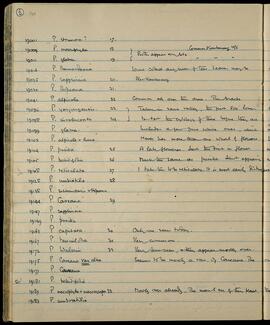
(2) 134

  1. P. strumosa? 17.
    19009 P. macrophylla 18 } Both appear very late. Common Kantanang 10/6
    19011 P. glabra 19 } Common Kantanang 10/6
  2. P. barnardoana Won't collect any more of this. Leaves may be
    19025 P. sapphirina 20. Also Kantanang
    19030 P. hopeana 21.
    19041 P. alpicola 22 Common all over this area. The bracts
    19096 P. yarongensis. 23. } Taken in same valley, the first 500' lower
    19098 P. involucrata 24. } to test the cytology of these before they are
    19099 P. glabra. Includes a few pure white ones, which
    19103 P. alpicola var. luna Never has more than one whorl of flowers
    19104 P. pusilla. 25 A late flowerer. Just the first in flower
    19105 P. bellidifolia 26 Much the same as pusilla. Just appearing
    19108 P. reticulata 27 I take this to be reticulata. It is most easily distinguished
    19128 P. umbratilis 28
    19138 P. sikkimensis x hopeana
    19144 P. caveana 29
    19147 P. sapphirina
    19149 P. pusilla
    19163 P. capitata. 30 Only one seen today.
    19167 P. tenuiloba 31 Very common.
    19172 P. walshii 32 Very few seen, & they appear mostly over.
    19175 P. caveana var. alba Seems to be merely a var. of caveana. The
    19177 P. caveana
    50) 19181 P. bellidifolia.
    19189 P. macrophylla var. macrocarpa 33. Mostly over already. The more I see of this plant, the
    19183 P. umbratilis
LSH/1/1/9/1/144 · Part · 1933-09-01
Part of The Ludlow & Sherriff Collection

SUMMARY:
Page lists Primula specimens with notes on morphology, flower colors, abundance, and growth habits, including forms such as P. caveana, P. muscoides, P. glabra, and P. waddellii. Mentions comparison with earlier collections at Waitang and a reference to a specimen from 1938.

CONTENT:
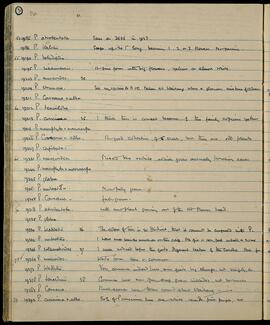
(3) 136 33.

  1. 19185 P. atrodentata Same as 3636 in 1938.
    19186 P. walshii Scape up to 1" long bearing 1, 2 or 3 flowers. No farina.
  2. 19190 P. bellidifolia.
    19195 P. sikkimensis. A fine form with big flowers, yellow or almost white.
    19203 P. muscoides. 34.
    19204 P. strumosa. See my 19000 A B or C taken at Waitang where a glorious mixture of colours
    19211 P. caveana v. alba
  3. 19212 P. tenuiloba
    19213 P. concinna 35. I think this is correct because of the fairly copious yellow
    19216 P. macrophylla v. macrocarpa
    19226 P. caveana v. alba. A good collection of 5 sheets, but they are odd plants
    19227 P. capitata.
  4. 19231 P. muscoides. Mixed blue and white, which grow actually touching each
    19244 P. macrophylla v. macrocarpa
    19245 P. glabra
    19251 P. umbratilis. Not fully grown.
    19255 P. caveana - full grown.
  5. 19318 P. atrodentata. With new plants growing out from old flower head.
    19325 P. glabra.
    19330 P. waddellii 36. The colour of this is so distinct, that it cannot be confused with P.
    19332 P. umbratilis. I have never seen so much as on this cliff. All of it is very pale indeed, or some
    19346 P. soldanelloides 37 I never noticed before the quite different texture of the corolla. Ask for
  6. 19364 P. muscoides. White form. Here v. common.
    19373 P. waddellii. Very common indeed here, in quite big clumps, not singly, as
    19378 P. jonardunii. 38 Common here, on open steep grass hillsides, not so much
    19383 P. caveana. Much scarcer here than round about Waitang.
  7. 19392 P. concinna v. alba. 80% of P. concinna here are white, remainder pink purple, no
LSH/1/1/9/1/78 · Part · 1933-06-17
Part of The Ludlow & Sherriff Collection

SUMMARY:
Page records photographic notes using Dufaycolor and Kodachrome films for subjects including Primula caveana, P. umbratilis, Cassiope, Rhododendron setosum, and Meconopsis simplicifolia. Locations mentioned include Menla-harchu La and areas above it, including a lake. Entries are dated through mid to late June.

CONTENT:
73

B.W. 7. Dufaycolor 13
1 P. macrophylla 10/6 1 P. Caveana no filter 16/6
2 P. involucrata 19090 10/6 2 P. Caveana habitat 16/6
3 P. reticulata 19108 13/6 3 P. Caveana closer 19144 16/6
4 Cypripedium tibeticum 19123 14/6 4 P. tenuiloba 19167 16/6
5 Prim. umbratilis 19128 14/6. 5 P. umbratilis 19183 18/6
6 Nomocharis nana 14/6 6 Cassiope 19095 18/6
7 P. Caveana. moved? 19144 16/6
8 P. Caveana habitat v.g. 16/6 Dufaycolor 14
9 P. Caveana closer 16/6 1 Cassiope & Rhod. setosum & Nomocharis 19/6
10 P. tenuiloba 19167 16/6 2 R. setosum. R. anthopogon & R. aeruginosum 19/6
11 P. umbratilis 19183 18/6 3 Mec. simplicifolia or P. strumosa 19204 20/6
12 Cassiope 19095 18/6 4 Mec. simplicifolia or P. strumosa 19204 20/6
5 Mec. simp. Lake at Menla-harchu La 20/6
Kodachrome CS. 14. 6 Mec. simp. Lake at Menla-harchu La 20/6
Prim. Caveana. behind. bad. 16/6. 7 Prim. bellidifolia 21/6
Rest would not turn. 8 Small purple pea 1"-2" 18992 21/6

Kodachrome 15.
P. umbratilis 1/2 speed 19183 18/6.
Cassiope 19095 18/6
P. Caveana 19144 18/6
P. macrophylla v macrocarpa -
Mec. simplicifolia above Menla-harchu 20/6.
Mec. simplicifolia or P. strumosa 19204 20/6

LSH/1/1/9/1/129 · Part · 1933-09-01
Part of The Ludlow & Sherriff Collection

SUMMARY:
The diarist manages specimens and arranges penicillin injections for Danang in hospital, while noting a letter from Ludlow via Yundu confirming successful plant finds. Plans are made for travel to meet Ludlow at Pasu Sefu and for Pasang and Mundrup to collect primulas via Tumle La, Tongsa, Chendesi, and Ritang, with mention of a hoped-for bridge over the Tang Chu.

CONTENT:
I've a lot to do, with photos and dry flowers. Danang is here in hospital. He seems better, but I have not yet seen him. I hope he will come tomorrow, as I have asked the doctor to come too, and will start 4 hourly injections. I have only 10 doses I can give him, and hope that will do the trick. Ludlow sent a letter with Yundu, and a small press of flowers. He has found every one of the wanted plants - P. umbratilis alba, P. tsariensis, P. tsariensis alba, P. uniflora, Lychnis Wardii, P. strumosa and fine forms of Meconopsis horridula. Yundu has marked all the plants too, and I hope will be able to get them all in October. If so, that little trip will have been very worth while.

2nd September. Haat. Mostly fine in the valley, with a heavy shower or two. I got Danang along here this morning. There is no doubt he is better than he was. But I am sure that penicillin must be the thing to give him, as I have 10 injections, we have started at 12 today. He must take a chance after this, as I must go off on 5th. He and Sompoli must go off on 10th at latest to catch Ludlow at Pasu Sefu. If he can't go by then, he must join me or go back to Kalimpong by himself. The valley here is very pretty now, with the beautiful pink fields of buckwheat scattered over the valley bottom, and in places along the sides too. I don't remember noticing this so much before. HH seems to think that he will have some kind of bridge made over the Tang Chu before very long - in a month he suggests. I do hope so, as it will save us a long chukker again. I have tried to work out how long it will take Pasang and Mundrup to get the two primulas on the Tumle La, then to Tongsa and then to collect all plants from Ludlow's area. I think it will take 6 days from Chendesi to Ritang or back to Chendesi, and altogether from here 11 days, which will take 4 to Chendesi or 5 to Ritang. So if we start on 15th we will reach Ritang on 19th, and Pasang must start on 9th to reach Ritang or Chendesi on the 19th.

LSH/1/1/5/1/123 · Part · 1933-06-21
Part of The Ludlow & Sherriff Collection

SUMMARY:
The diarist reports fever and painful throat affecting both himself and Tsongpen, while Pinto has recovered. They move from Dungshuggang to a camp 2 miles beyond Wangchelah at about 12,500 ft, finding few new plants but noting abundant rhododendrons and several Primula species.

CONTENT:
Sherriff 60

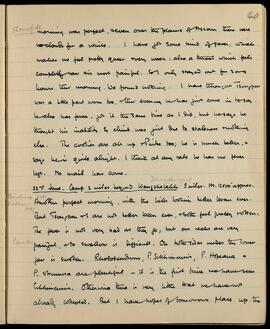
Morning was perfect, even over the plains of Assam there were no clouds for a while. I have got some kind of fever, which makes me feel pretty queer every week; also a throat which feels completely raw and most painful. So I only stayed out for 3 or 4 hours this morning. We found nothing. I have thought Tsongpen was a little past work too, this evening he has just come in to say he also has fever, got it the same time as I did, but he says he thought his inability to climb was just due to staleness and nothing else. The coolies are all up and Pinto too; he is much better, and says he is quite alright. I think at any rate he has no fever left. No mail has come.

Dungshuggang
22nd June. Camp 2 miles beyond Wangchelah 5 miles. Ht. 12500' approx.
Another perfect morning, with the hills looking better than ever. But Tsongpen and I are not better than ever, and both feel pretty rotten. The fever is not very bad as they go, but our necks are very painful, and to swallow is difficult. On both sides under the lower jaw is swollen. Rhododendrons, P. sikkimensis, P. Hopeana and P. strumosa are plentiful — it is the first time we have seen sikkimensis. Otherwise there is very little that we have not already collected. But I have hopes of tomorrow's place up the

LSH/1/1/5/1/131 · Part · 1933-06-21
Part of The Ludlow & Sherriff Collection

SUMMARY:
Notes record Parnassius butterflies, a woodcock nest with four eggs found on 22 June, and a list of Primula species observed. The writer describes the steep peaks of Dungshinggang, clear views toward Sikkim and beyond Chomolahri, getting soaked in a noon storm, and a 25 June entry noting rain overnight, a clear morning, and later cloud.

CONTENT:
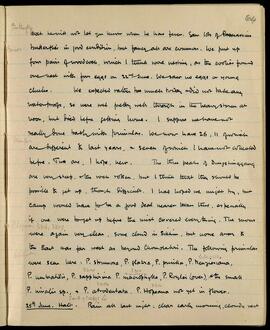
that he will not let you know when he has fever. Saw lots of Parnassius butterflies in good condition, but fancy all are common. We put up four pairs of woodcock, which I think were nesting, as the coolies found one nest with four eggs on 22nd June. We saw no eggs or young chicks.

We expected rather too much today and did not take any waterproofs, so were wet pretty well through in the heavy storm at noon, but dried before getting home. I suppose we have not really done badly with primulas. We now have 26, 11 of which are different to last year's, and seven of which I have not collected before. Two are, I hope, new.

The three peaks of Dungshinggang are very steep, the rock rotten, but I think that they should be possible to get up, though difficult. I had hoped we might try, but camp would have to be a good deal nearer than this, especially if one were to get up before the mist covered everything. The snows were again very clear, some cloud in Sikkim, but none away to the East as far west as beyond Chomolahri. The following primulas
were seen here: P. strumosa, P. glabra, P. pusilla, P. Menziesiana,
P. umbratilis, P. sapphirina, P. macrophylla, P. Roylei (over), the small
P. nivalis sp., and P. atrodentata. P. Hopeana not yet in flower.

25th June. Hall - Rain all last night, clear early morning, cloudy rest.