Showing 4 results

Archival description
4 results with digital objects Show results with digital objects
LSH/1/1/9/1/73 · Part · 1949-06-15
Part of The Ludlow & Sherriff Collection

SUMMARY:
The writer reports heavy rain and a reconnaissance up the valley toward Waitang, finding the route likely passable despite earlier warnings that yaks could not traverse it. They plan to leave via Pangstang and criticize Ngudup for not negotiating effectively with locals. Botanical collections include Primula pusilla, P. bellidifolia, P. reticulata, Mec. paniculata, and observations comparing P. alpicola var. luna and P. reticulata.

CONTENT:
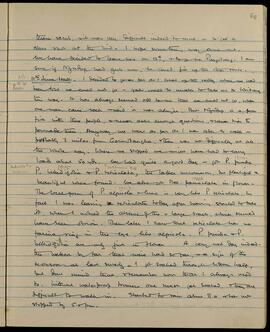
thorn scrub, it was very difficult indeed to move, or to get a clear shot at the bird. I hope something may come out. We have decided to leave here on 12th, and to go via Pangstang. I am sure if Ngudup had guts now, he could fix up the other route.

11th June Halt. I decided to go as far as I could up the valley where we had been told we could not go - yaks would be unable to take us to Waitang this way. It has always seemed odd to me that we could not go, when one man came back and said it was alright. But Ngudup is a poor fish with these people, and never asks enough questions, and never tries to persuade them. Anyway we went as far as I was able to walk - probably 3 miles from Garmotangha, there was no difficulty at all the whole way. Where we stopped we might have had to carry loads about 50 yds. We had quite a good day - got P. pusilla, P. bellidifolia and P. reticulata, the latter uncommon, but plentiful and beautiful where found. We also got Mec. paniculata in flower. The local form of P. alpicola var. luna is very like P. reticulata. In fact I was leaving reticulata today after having started to take it, when I noticed the absence of the very large bracts, which should have been obvious. Then later I saw that reticulata has no farina ring in the eye like alpicola. P. pusilla and P. bellidifolia are only just in flower. A very wet day indeed - the wettest by far that we've had so far, a sign of the monsoon at last surely. I got soaked through bottom half, but don't mind that, and remember now that I always used to. Without waterproof trousers, one must get soaked, and they are difficult to walk in. Started to rain about 8.0 and has not stopped by 5.0 pm.
LSH/1/1/9/1/146 · Part · 1933-09-01
Part of The Ludlow & Sherriff Collection

SUMMARY:
Page lists Primula taxa with collection numbers and notes on abundance, habitat, flowering/fruiting status, and seed or root collections. Mentions very late flowering in some cases and specific quantities. One entry records a collection at Chendebi Sovo.

CONTENT:
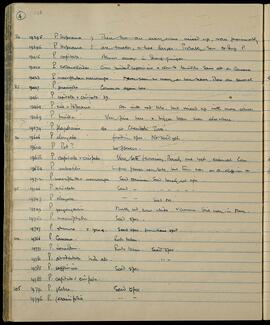
4 138

80 19395 P. Hopeana } These two are everywhere mixed up, one presumably
19396 P. Hopeana } are smaller, & here larger. Probably best to drop P.
19416 P. capitata. Almost always in dwarf juniper.
19420 P. soldanelloides Grows beside P. sapphirina & close to tenuiloba. Same alt. as Caveana
19423 P. macrophylla v. macrocarpa. Never seen so many as here before. There are several
85 19447 P. geraniifolia Common again here.
19461 P. capitata v crispata. 39.
19464 P. sin. v Hopeana. An with red tube, but mixed up with more which
19469 P. pusilla. Very fine here & bigger than seen elsewhere.
19574 P. flagellaris 40 at Chendebi Sovo.
90 19606 P. elongata fruiting spec. No seed yet.
19610 P. Pet? No flowers.
19656 P. capitata v crispata Very late flowering. Barely one yet, even at low
19684 P. umbratilis. In full flower very late, but this was on a cliff in a
19712 P. macrophylla v. macrocarpa. Seed specimen. Seed barely yet ripe.
95 19746 P. reticulata Seed - - - - - - -
19747 P. elongata. Seed ok.
19749 P. yargongensis. Mostly red, some white. Common. Still many in flower.
19750 P. macrophylla Seed spec.
19757 P. strumosa = 19204. Seed spec. from same spot.

  1. 19766 P. Caveana. Roots taken.
    19777 P. Jonarduni. Roots taken. Seed spec.
    19781 P. atrodentata high alt. " "
    19785 P. sapphirina Seed spec.
    19788 P. capitata v crispata.
    105 19791 P. flaccida. Seed spec.
    19796 P. geraniifolia " "
LSH/1/1/9/1/142 · Part · 1933-09-01
Part of The Ludlow & Sherriff Collection

SUMMARY:
The page lists numerous Primula taxa with specimen numbers and brief notes on abundance and flowering, many recorded as common at Kantanang on 10/6. It mentions elevation comparison within the same valley, white forms of P. glabra, a hybrid (P. sikkimensis × hopeana), and comments on varieties such as caveana var. alba and macrophylla var. macrocarpa.

CONTENT:
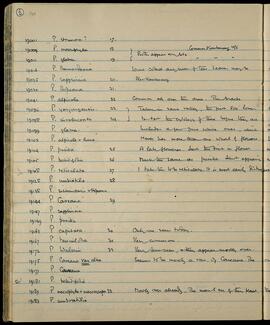
(2) 134

  1. P. strumosa? 17.
    19009 P. macrophylla 18 } Both appear very late. Common Kantanang 10/6
    19011 P. glabra 19 } Common Kantanang 10/6
  2. P. barnardoana Won't collect any more of this. Leaves may be
    19025 P. sapphirina 20. Also Kantanang
    19030 P. hopeana 21.
    19041 P. alpicola 22 Common all over this area. The bracts
    19096 P. yarongensis. 23. } Taken in same valley, the first 500' lower
    19098 P. involucrata 24. } to test the cytology of these before they are
    19099 P. glabra. Includes a few pure white ones, which
    19103 P. alpicola var. luna Never has more than one whorl of flowers
    19104 P. pusilla. 25 A late flowerer. Just the first in flower
    19105 P. bellidifolia 26 Much the same as pusilla. Just appearing
    19108 P. reticulata 27 I take this to be reticulata. It is most easily distinguished
    19128 P. umbratilis 28
    19138 P. sikkimensis x hopeana
    19144 P. caveana 29
    19147 P. sapphirina
    19149 P. pusilla
    19163 P. capitata. 30 Only one seen today.
    19167 P. tenuiloba 31 Very common.
    19172 P. walshii 32 Very few seen, & they appear mostly over.
    19175 P. caveana var. alba Seems to be merely a var. of caveana. The
    19177 P. caveana
    50) 19181 P. bellidifolia.
    19189 P. macrophylla var. macrocarpa 33. Mostly over already. The more I see of this plant, the
    19183 P. umbratilis
LSH/1/1/9/1/78 · Part · 1933-06-17
Part of The Ludlow & Sherriff Collection

SUMMARY:
Page records photographic notes using Dufaycolor and Kodachrome films for subjects including Primula caveana, P. umbratilis, Cassiope, Rhododendron setosum, and Meconopsis simplicifolia. Locations mentioned include Menla-harchu La and areas above it, including a lake. Entries are dated through mid to late June.

CONTENT:
73

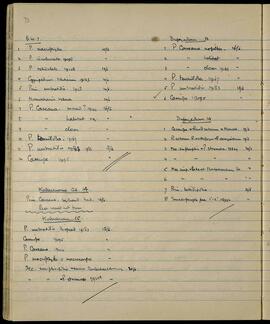
B.W. 7. Dufaycolor 13
1 P. macrophylla 10/6 1 P. Caveana no filter 16/6
2 P. involucrata 19090 10/6 2 P. Caveana habitat 16/6
3 P. reticulata 19108 13/6 3 P. Caveana closer 19144 16/6
4 Cypripedium tibeticum 19123 14/6 4 P. tenuiloba 19167 16/6
5 Prim. umbratilis 19128 14/6. 5 P. umbratilis 19183 18/6
6 Nomocharis nana 14/6 6 Cassiope 19095 18/6
7 P. Caveana. moved? 19144 16/6
8 P. Caveana habitat v.g. 16/6 Dufaycolor 14
9 P. Caveana closer 16/6 1 Cassiope & Rhod. setosum & Nomocharis 19/6
10 P. tenuiloba 19167 16/6 2 R. setosum. R. anthopogon & R. aeruginosum 19/6
11 P. umbratilis 19183 18/6 3 Mec. simplicifolia or P. strumosa 19204 20/6
12 Cassiope 19095 18/6 4 Mec. simplicifolia or P. strumosa 19204 20/6
5 Mec. simp. Lake at Menla-harchu La 20/6
Kodachrome CS. 14. 6 Mec. simp. Lake at Menla-harchu La 20/6
Prim. Caveana. behind. bad. 16/6. 7 Prim. bellidifolia 21/6
Rest would not turn. 8 Small purple pea 1"-2" 18992 21/6

Kodachrome 15.
P. umbratilis 1/2 speed 19183 18/6.
Cassiope 19095 18/6
P. Caveana 19144 18/6
P. macrophylla v macrocarpa -
Mec. simplicifolia above Menla-harchu 20/6.
Mec. simplicifolia or P. strumosa 19204 20/6