Showing 10 results

Archival description
10 results with digital objects Show results with digital objects
LSH/1/1/9/1/99 · Part · 1933-07-11
Part of The Ludlow & Sherriff Collection

SUMMARY:
The party crossed a pass and lakes into another valley but found few flowers, noting several Primula species and plants of “Pasang's Abardia” without bloom. The writer criticizes Lhakpa and Ngudup for damaging collections and considers asking Holt to replace Ngudup; on the 9th a fresh Yertsa-gumbu was found by the pony man and taken by Ngudup for rheumatic pains.

CONTENT:
lake, then steep again to a pass. Here we got more prim flowers in sand scree which there abound. Beyond this were more lakes, and we had crossed the divide, as the water flowed down another valley which comes out to the main valley a mile further up than ours. But it was a disappointing day for flowers. We can't get much now, it seems. P. jonarduni was there, and P. tenuifolia and P. waddellii and P. pusilla and P. concinna white and pink. There were also plants of Pasang's Abardia, but no flowers. I hope we can get seed of that thing somewhere. We were out soon after 6:00 and back at 4:00 pm. The trouble of doing that is that Lhakpa and Ngudup do all the flower changing, and they have ruined a number of gatherings by careless work and burning. I can't get either of those two to do anything well, and would cheerfully see them both go. I must ask Holt if I have a chance for someone in Ngudup's place. On 9th, we found one 'Yertsa-gumbu' - a queer thing - the first I have seen fresh. Certainly the root is most 'bug'-feeling and even looking. As it was found by the pony man I did not claim it. It was at once pinched by Ngudup who complained of rheumatic pains, and of course 'Yertsa-gumbu' is wonderful medicine for that. The 'flower' or
LSH/1/1/5/1/131 · Part · 1933-06-21
Part of The Ludlow & Sherriff Collection

SUMMARY:
Notes record Parnassius butterflies, a woodcock nest with four eggs found on 22 June, and a list of Primula species observed. The writer describes the steep peaks of Dungshinggang, clear views toward Sikkim and beyond Chomolahri, getting soaked in a noon storm, and a 25 June entry noting rain overnight, a clear morning, and later cloud.

CONTENT:
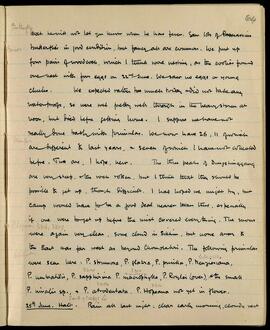
that he will not let you know when he has fever. Saw lots of Parnassius butterflies in good condition, but fancy all are common. We put up four pairs of woodcock, which I think were nesting, as the coolies found one nest with four eggs on 22nd June. We saw no eggs or young chicks.

We expected rather too much today and did not take any waterproofs, so were wet pretty well through in the heavy storm at noon, but dried before getting home. I suppose we have not really done badly with primulas. We now have 26, 11 of which are different to last year's, and seven of which I have not collected before. Two are, I hope, new.

The three peaks of Dungshinggang are very steep, the rock rotten, but I think that they should be possible to get up, though difficult. I had hoped we might try, but camp would have to be a good deal nearer than this, especially if one were to get up before the mist covered everything. The snows were again very clear, some cloud in Sikkim, but none away to the East as far west as beyond Chomolahri. The following primulas
were seen here: P. strumosa, P. glabra, P. pusilla, P. Menziesiana,
P. umbratilis, P. sapphirina, P. macrophylla, P. Roylei (over), the small
P. nivalis sp., and P. atrodentata. P. Hopeana not yet in flower.

25th June. Hall - Rain all last night, clear early morning, cloudy rest.

LSH/1/1/2/1/53 · Part · 1933-07-08
Part of The Ludlow & Sherriff Collection

SUMMARY:
The party descends north from Milakatong La, follows a lake and river, and reaches Tsukang (Shao) around mile 16, noting scant barley and rhododendron fuel. They express relief at leaving rain-soaked Tawang, criticize incompetent local officials, and describe a route transitioning from dense jungle to bamboo, rhododendron, and finally grass with dwarf rhododendron, alongside a list of collected plants.

CONTENT:
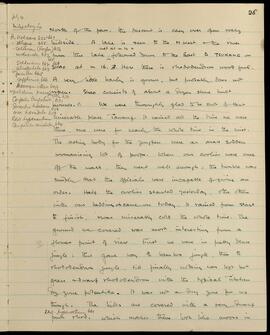
July 14.
Milakatong La

P. sikkimensis 652=667
" obliqua 655
" Calderiana (Roylei) 658
" macrophylla 657
" sikkimensis 662
" alpicola 663
" pusilla 665
" sapphirina 666
Meconopsis villosa 649
Notholirion macrophyllum 650
Corydalis trifoliata 651
Swertia hookeri 654
Meconopsis horridula 659
Rhododendron hypenanthum 660
Campanula aristata 664

North of the pass, the descent is easy over open rocky hillside. A lake is seen to the N. West and the river met at m 14. From this lake followed down to the East to TSUKANG or SHAO at m 16. Here there is rhododendron wood fuel. A very little barley is grown, but probably does not ripen. Shao consists of about a dozen stone built houses. We were thoroughly glad to be shut of that miserable place Tawang. It rained all the time we were there, and we were for nearly the whole time in the mist.

The acting body for the Jongpen were an acute sodden womanising lot of poops. When our coolies were once off the mark, they went well enough: the trouble was simply that the officials were incapable of giving an order. Half the coolies started yesterday, the others with our bedding etc came on today. It rained from start to finish, and was miserably cold the whole time. The ground we covered was most interesting from a flower point of view. First we were in pretty dense jungle: this gave way to bamboo jungle, then to rhododendron jungle, till finally nothing was left but grass and dwarf rhododendron with the typical Tibetan dry zone potentilla. It was not a dry zone for us though. The hills are covered with a very dwarf pink rhododendron which makes them look like moors in

Rhododendron hypenanthum 661

LSH/1/1/5/1/115 · Part · 1933-06-14 - 1933-06-16
Part of The Ludlow & Sherriff Collection

SUMMARY:
Heavy rain flooded the camp at Phobsikha, mail was sent via Adao and Chirang, and plans were made to proceed to Dungshinggang. Pimbo fell ill and was left behind with quinine and aspirin to rejoin later. On 16 June they reached Camp Tsophup near Dungshinggang amid hail and rain, noting Primula pusilla near camp.

CONTENT:
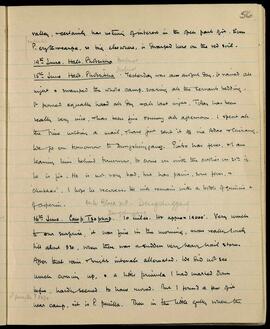
valley, certainly has nothing of interest in the open part of it. Even
P. erythrocarpa, so big elsewhere, is dwarfed here on the red soil.

14th June. Halt. Phobsikha District

15th June Halt. Phobsikha District. Yesterday was an awful day. It rained all
night & swamped the whole camp, soaking all the servants' bedding.
It poured equally hard all day & all last night. Today has been
really very nice, & has been fine & sunny all afternoon. I spent all
the time writing a mail, & have just sent it off via Adao & Chirang.
We go on tomorrow to Dungshinggang. Pimbo has fever, & I am
leaving him behind tomorrow, to come on with the coolies on 21st if
he is fit. He is not very bad, but has pains, some fever, &
'chukkas'. I hope he recovers. He will remain with a bottle of quinine &
of aspirin. onto Black Mt - Dungshinggang

16th June. Camp Tsophup. Dungshinggang 10 miles. Ht. approx. 14,000'. Very much
to our surprise, it was fine in the morning, & was really lovely
till about 9:30, when there was a sudden very heavy hailstorm.
After that rain & bright intervals alternated. We did not see
much coming up, & a little primula I had marked down
before, hardly seemed to have moved. But I found a few of it
near camp, it is P. pusilla. Then in the little gully where the

LSH/1/1/5/1/215 · Part · 1937-07-31
Part of The Ludlow & Sherriff Collection

SUMMARY:
Checklist of Primula species collected in 1937, with notes on prior collection status and several specimen numbers. Localities mentioned include Chendebi and Tang Chu.

CONTENT:
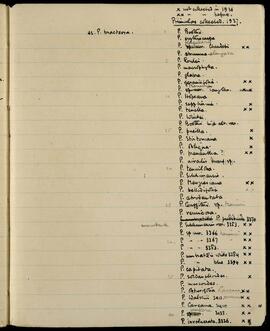
x not collected in 1936
xx " " " before.
Primulas collected. 1937.

  1. P. bracteosa.

1 P. Boothii.
P. erythrocarpa
P. flagellaris
P. sp. nov. Chendebi xx
5 P. strumosa elongata
P. Roylei.
P. macrophylla.
P. glabra.
P. geraniifolia xx
10 P. sp. nov. Tang Chu. xx
P. Hopeana
P. sapphirina x
P. tenella. xx
P. Winteri.
15 P. Boothii high alt. var.
P. pusilla. x
P. Stirtoniana x
P. obliqua. x
P. prenantha? xx
20 P. nivalis dwarf sp.
P. tenuiloba.
P. sikkimensis.
P. Menziesiana xx
P. bellidifolia xx
25 P. atrodentata
P. Griffithii sp. hancini
P. vernicosa.
P. pudibunda 3370
P. sikkimensis var. 3353. xx
30 P. sp. nov. 3366 hancini xx
P. " " 3367 xx
P. " " 3383. xx
P. umbratilis white 3384 xx
P. " blue 3394 xx
35 P. capitata.
P. soldanelloides. x
P. muscoides.
P. obtusifolia Caveana xx
P. Walshii 3413 concinna xx
40 P. Caveana 3410 xx
P. uniflora 3438. x
P. involucrata 3226. x

LSH/1/1/9/1/142 · Part · 1933-09-01
Part of The Ludlow & Sherriff Collection

SUMMARY:
The page lists numerous Primula taxa with specimen numbers and brief notes on abundance and flowering, many recorded as common at Kantanang on 10/6. It mentions elevation comparison within the same valley, white forms of P. glabra, a hybrid (P. sikkimensis × hopeana), and comments on varieties such as caveana var. alba and macrophylla var. macrocarpa.

CONTENT:
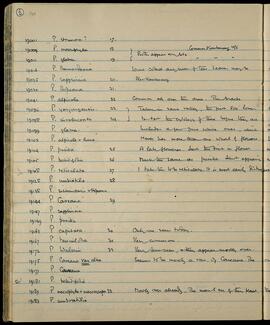
(2) 134

  1. P. strumosa? 17.
    19009 P. macrophylla 18 } Both appear very late. Common Kantanang 10/6
    19011 P. glabra 19 } Common Kantanang 10/6
  2. P. barnardoana Won't collect any more of this. Leaves may be
    19025 P. sapphirina 20. Also Kantanang
    19030 P. hopeana 21.
    19041 P. alpicola 22 Common all over this area. The bracts
    19096 P. yarongensis. 23. } Taken in same valley, the first 500' lower
    19098 P. involucrata 24. } to test the cytology of these before they are
    19099 P. glabra. Includes a few pure white ones, which
    19103 P. alpicola var. luna Never has more than one whorl of flowers
    19104 P. pusilla. 25 A late flowerer. Just the first in flower
    19105 P. bellidifolia 26 Much the same as pusilla. Just appearing
    19108 P. reticulata 27 I take this to be reticulata. It is most easily distinguished
    19128 P. umbratilis 28
    19138 P. sikkimensis x hopeana
    19144 P. caveana 29
    19147 P. sapphirina
    19149 P. pusilla
    19163 P. capitata. 30 Only one seen today.
    19167 P. tenuiloba 31 Very common.
    19172 P. walshii 32 Very few seen, & they appear mostly over.
    19175 P. caveana var. alba Seems to be merely a var. of caveana. The
    19177 P. caveana
    50) 19181 P. bellidifolia.
    19189 P. macrophylla var. macrocarpa 33. Mostly over already. The more I see of this plant, the
    19183 P. umbratilis
LSH/1/1/9/1/146 · Part · 1933-09-01
Part of The Ludlow & Sherriff Collection

SUMMARY:
Page lists Primula taxa with collection numbers and notes on abundance, habitat, flowering/fruiting status, and seed or root collections. Mentions very late flowering in some cases and specific quantities. One entry records a collection at Chendebi Sovo.

CONTENT:
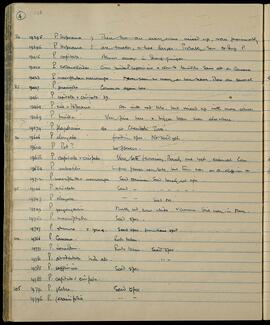
4 138

80 19395 P. Hopeana } These two are everywhere mixed up, one presumably
19396 P. Hopeana } are smaller, & here larger. Probably best to drop P.
19416 P. capitata. Almost always in dwarf juniper.
19420 P. soldanelloides Grows beside P. sapphirina & close to tenuiloba. Same alt. as Caveana
19423 P. macrophylla v. macrocarpa. Never seen so many as here before. There are several
85 19447 P. geraniifolia Common again here.
19461 P. capitata v crispata. 39.
19464 P. sin. v Hopeana. An with red tube, but mixed up with more which
19469 P. pusilla. Very fine here & bigger than seen elsewhere.
19574 P. flagellaris 40 at Chendebi Sovo.
90 19606 P. elongata fruiting spec. No seed yet.
19610 P. Pet? No flowers.
19656 P. capitata v crispata Very late flowering. Barely one yet, even at low
19684 P. umbratilis. In full flower very late, but this was on a cliff in a
19712 P. macrophylla v. macrocarpa. Seed specimen. Seed barely yet ripe.
95 19746 P. reticulata Seed - - - - - - -
19747 P. elongata. Seed ok.
19749 P. yargongensis. Mostly red, some white. Common. Still many in flower.
19750 P. macrophylla Seed spec.
19757 P. strumosa = 19204. Seed spec. from same spot.

  1. 19766 P. Caveana. Roots taken.
    19777 P. Jonarduni. Roots taken. Seed spec.
    19781 P. atrodentata high alt. " "
    19785 P. sapphirina Seed spec.
    19788 P. capitata v crispata.
    105 19791 P. flaccida. Seed spec.
    19796 P. geraniifolia " "
LSH/1/1/9/1/73 · Part · 1949-06-15
Part of The Ludlow & Sherriff Collection

SUMMARY:
The writer reports heavy rain and a reconnaissance up the valley toward Waitang, finding the route likely passable despite earlier warnings that yaks could not traverse it. They plan to leave via Pangstang and criticize Ngudup for not negotiating effectively with locals. Botanical collections include Primula pusilla, P. bellidifolia, P. reticulata, Mec. paniculata, and observations comparing P. alpicola var. luna and P. reticulata.

CONTENT:
thorn scrub, it was very difficult indeed to move, or to get a clear shot at the bird. I hope something may come out. We have decided to leave here on 12th, and to go via Pangstang. I am sure if Ngudup had guts now, he could fix up the other route.

11th June Halt. I decided to go as far as I could up the valley where we had been told we could not go - yaks would be unable to take us to Waitang this way. It has always seemed odd to me that we could not go, when one man came back and said it was alright. But Ngudup is a poor fish with these people, and never asks enough questions, and never tries to persuade them. Anyway we went as far as I was able to walk - probably 3 miles from Garmotangha, there was no difficulty at all the whole way. Where we stopped we might have had to carry loads about 50 yds. We had quite a good day - got P. pusilla, P. bellidifolia and P. reticulata, the latter uncommon, but plentiful and beautiful where found. We also got Mec. paniculata in flower. The local form of P. alpicola var. luna is very like P. reticulata. In fact I was leaving reticulata today after having started to take it, when I noticed the absence of the very large bracts, which should have been obvious. Then later I saw that reticulata has no farina ring in the eye like alpicola. P. pusilla and P. bellidifolia are only just in flower. A very wet day indeed - the wettest by far that we've had so far, a sign of the monsoon at last surely. I got soaked through bottom half, but don't mind that, and remember now that I always used to. Without waterproof trousers, one must get soaked, and they are difficult to walk in. Started to rain about 8.0 and has not stopped by 5.0 pm.

LSH/1/1/9/1/71 · Part · 1949-06-15
Part of The Ludlow & Sherriff Collection

SUMMARY:
The diarist rebukes Ngudup for overeating and refusing to shoot a monal due to the 15th, deciding to shoot and donate Rs 1 to the Gompa. Seed is collected for Pasang, Lhakpa, and Yundru; Primula taxa are noted, a white-throated dipper nest is found by a waterfall, and a blood pheasant is filmed, with a prior nest recalled at Thampa Tso in 1937.

CONTENT:
freshened up. He is now lazy and eats too much, I believe. Hence he gets headaches. I told him today he was eating too much, which he didn't quite like, but he gets all the meat there is, too greedy too soon. As we got away, a huge and fine cock monal ran along the path in front of us, so I called up Ngudup with the gun. He asked me not to shoot, but I wasn't having that. He eats all the meat, and doesn't want any bird's meat. "It is the 15th of the month, don't shoot." However, I told him it was the 15th, he should eat no meat, but I would shoot, and he could give Rs 1/- to the Gompa.

So we got our seed, enough for Pasang, Lhakpa, Yundru, and myself. We found what would probably be called P. yargongensis (19096) and 500' higher up what will be called P. involucrata (19098). Even if the cytology is different, I cannot see how these two can be separated. In the Primula monograph, one is pink (but maybe white) while the other is white (but maybe pink). One P. pusilla was found in flower only. I walked up the local river, or climbed up it, where it came down in a 45° waterfall, got one or two things by the side. I also found the nest, with 3 eggs, of a white-throated dipper, at 14,000'. It was halfway down the waterfall, in turf on a rock in the middle of the fall, not far above the water level, about 1 foot perhaps. I have only seen one other nest, on the Thampa Tso, in 1937, a much calmer, quieter place than this one. On our way back, we rushed a pair of blood pheasant, secured 1 chick, and I managed to get a short cine (telep.) of the cock, but I fear it may be underexposed. The place was in dense rhodo and

LSH/1/1/5/1/147 · Part · 1933-07-04
Part of The Ludlow & Sherriff Collection

SUMMARY:
In heavy rain, the party ascends from Omta Tso past Thita Tso to Thampe La (~16,000 ft) and descends to Thampe beside Thampe Tso, noting bearings and that Thampe Tso drains east to the Mangde Chu. Primula 3383 occurs near the pass, with masses of P. pusilla and common P. hopeana. The following day is a rainy halt with sleet, and a short valley exploration reveals another lake.

CONTENT:
Toke Maru or Rinchen Chu

6th July. Thampe La. 4 miles. B.P. 187.0°. Temp. 51°. Time 3:00 p.m.

Rained all night, and very hard all day today. Path climbs steeply for ½ mile from the Omta Tso on the left bank of the river, which comes down in a waterfall. At ½ mile, another lake, the Thita Tso, is met. This is about ½ mile long and 300–400 yards across, surrounded by steep hills. The path keeps to the west of this, and at the NE end, begins to climb to the Thampe La, which is about 16,000 ft. Bearings of the nala, the Rinchen Chu, are about 240°, and on the north side 65°M. Descent easy with cliffs on both sides to Thampe at mile 4. Thampe is a grassy clearing beside the Thampe Tso, another lake about 300 yards each way. The water on the north side of the Thampe Tso flows down east to the Mangde Chu. Primula 3383 was growing to within a mile of the pass or less, always on open ground. We found nothing new here in that line. P. pusilla is in masses, coloring the hillside blue. P. hopeana also very common.

7th July. Halt. Rain all night and day. On the hilltops it was very cold and sleet fell all morning. We went up a valley lying at about 170°M from Thampe. There is a sheep's track. On the other side of the ridge—about 1½ miles—at about the same altitude as this place, is yet another lake, about 500 x 300 yards.