Affichage de 22 résultats

Description archivistique
22 résultats avec objets numériques Afficher les résultats avec des objets numériques
LSH/1/1/5/1/119 · Part · 1870-03-15
Fait partie de The Ludlow & Sherriff Collection

SUMMARY:
Notes from Dungshinggang describe abundant Primula species, comparisons to a specimen from Bimbi La, and a sighting of Primula waddellii. The author records clear morning views of the Himalayas including Chomolhari and the Kangchenjunga group, with later heavy rain, and remarks on plentiful monal.

CONTENT:
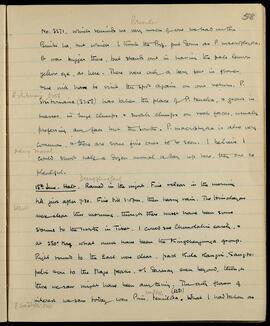
58
Primulas

No. 3271, which reminds me very much of one we had on the Bimbi La, but which I think the Prof. put down as P. macrophylla. It was bigger there, but stands out in having the pale lemon yellow eye, as here. There were only a very few in flower, one will have to visit the spot again on our return.

P. shitoriana (3258) has taken the place of P. tenella, & grows in masses, in huge clumps & small clumps on rock faces, usually preferring any face but the south. P. macrophylla is also very common, & there are some fine ones to be seen. I believe I could shoot half a dozen monal a day up here, they are so plentiful.

Dungshinggang
18th June. Halt. Rained in the night. Fine & clear in the morning till just after 7.30. Fine till 1.0pm, then heavy rain. The Himalayas were clear this morning, though there must have been some storms to the north in Tibet. I could see Chomolhari easily, & at 280° Mag what must have been the Kangchenjunga group. Right round to the East was clear, past Kula Kangri, Sangto-pelri down to the Mago peaks, or dare say even beyond, though those we saw might have been anything. The only thing of interest we saw today was Prim. waddellii (3281). What I had taken as
LSH/1/1/5/1/125 · Part · 1933-06-21
Fait partie de The Ludlow & Sherriff Collection

SUMMARY:
Notes on unsuccessful searches for bird eggs near Black mountain, observations of Primula involucrata, and receipt of fresh vegetables from HM at Bumthang with a return letter mentioning Bumthang forests and George. On 23rd June at camp on Dungshinggang south of Nabzi La, fine weather accompanied a long collecting day with Tenduk, yielding few flowers but adding a primula (No. 3301), likely P. umbratilis, which was difficult to photograph.

CONTENT:
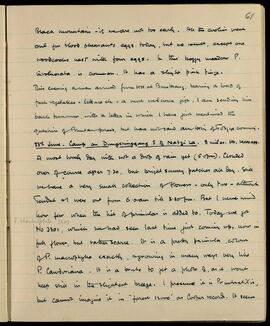
Black mountain - if we are not too early. All the coolies went out for blood pheasant's eggs today, but no result, except one woodcock's nest with four eggs. In this boggy meadow P. involucrata is common. It has a slight pink tinge. This evening a man arrived from HM at Bumthang, bearing a load of fresh vegetables - lettuce etc - a most welcome gift. I am sending him back tomorrow with a letter in which I have just mentioned the question of Bumthang forests, but have not said anything of George coming.

23rd June. Camp on Dungshinggang S of Nabzi La. 8 miles. Ht. 14000 app.
A most lovely day with not a drop of rain yet (5.0 pm). Clouded over of course after 7.30, but bright sunny patches all day. Still we have a very small collection of flowers - only two - although Tenduk and I were out from 6.0 am till 3.30 pm. But I never mind how few when the list of primulas is added to. Today we got No 3301, which we had seen last time just coming up, now in full flower, but rather scarce. It is a pretty primula, colour of P. macrophylla exactly, and growing in many ways very like P. Cawdoriana. It is a brute to get a photo of, as it won't keep still in the slightest breeze. I presume it is P. umbratilis, but

Note on 3310 and nest of Grandala
LSH/1/1/5/1/128 · Part · 1933-06-21
Fait partie de The Ludlow & Sherriff Collection

SUMMARY:
The writer disputes identifying Primula specimen no. 3310 as P. macrophylla, noting consistent differences in size, color, eye, and corolla tube, and its habitat on wetter, near-bare cliff faces. They also describe observing a Grandala nest at about 15,000 ft with three chicks, built under an overhanging cliff, and document frequent parental feeding visits.

CONTENT:
Note on 3310. I believe W. Smith put a similar primula which we got last year on the Bimbi La, as P. macrophylla forma. I cannot agree that this one is the same as P. macrophylla. The latter grows flowers in profusion all around. No 3310 is recognisable at once. It is always much bigger & always the same colour, & always has the deeper blue violet eye. The tube also is dark coloured, not nearly white as this is. The habitat is much the same, but 3310 grows on almost bare cliff faces in wetter places.

Note on nest of Grandala c.c. I have seen several Grandala carrying food for their young up here, or at about 15000 ft. Today we saw one nest. It was built under an overhanging cliff, or a rock ledge covered with grass & moss, & was quite unapproachable. But I watched both male & female come with food several times, & saw the chicks through binoculars take the food. There were three chicks. The nest appeared (15x) to be made of dry grass, a perfect round, well made, perched on a ledge, & lined with something soft looking. The nest was about 5"-6" diam outside, & about 3 1/2 or 3 inside. Parents came every 5-10 minutes.

see p. 75.

LSH/1/1/5/1/131 · Part · 1933-06-21
Fait partie de The Ludlow & Sherriff Collection

SUMMARY:
Notes record Parnassius butterflies, a woodcock nest with four eggs found on 22 June, and a list of Primula species observed. The writer describes the steep peaks of Dungshinggang, clear views toward Sikkim and beyond Chomolahri, getting soaked in a noon storm, and a 25 June entry noting rain overnight, a clear morning, and later cloud.

CONTENT:
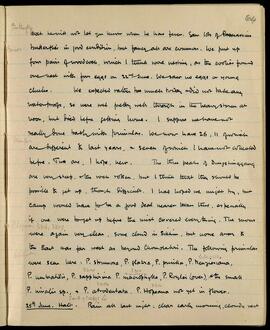
that he will not let you know when he has fever. Saw lots of Parnassius butterflies in good condition, but fancy all are common. We put up four pairs of woodcock, which I think were nesting, as the coolies found one nest with four eggs on 22nd June. We saw no eggs or young chicks.

We expected rather too much today and did not take any waterproofs, so were wet pretty well through in the heavy storm at noon, but dried before getting home. I suppose we have not really done badly with primulas. We now have 26, 11 of which are different to last year's, and seven of which I have not collected before. Two are, I hope, new.

The three peaks of Dungshinggang are very steep, the rock rotten, but I think that they should be possible to get up, though difficult. I had hoped we might try, but camp would have to be a good deal nearer than this, especially if one were to get up before the mist covered everything. The snows were again very clear, some cloud in Sikkim, but none away to the East as far west as beyond Chomolahri. The following primulas
were seen here: P. strumosa, P. glabra, P. pusilla, P. Menziesiana,
P. umbratilis, P. sapphirina, P. macrophylla, P. Roylei (over), the small
P. nivalis sp., and P. atrodentata. P. Hopeana not yet in flower.

25th June. Hall - Rain all last night, clear early morning, cloudy rest.

Primula collections list, 1937
LSH/1/1/5/1/215 · Part · 1937-07-31
Fait partie de The Ludlow & Sherriff Collection

SUMMARY:
Checklist of Primula species collected in 1937, with notes on prior collection status and several specimen numbers. Localities mentioned include Chendebi and Tang Chu.

CONTENT:
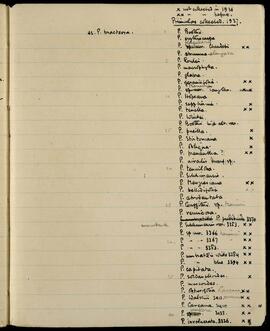
x not collected in 1936
xx " " " before.
Primulas collected. 1937.

  1. P. bracteosa.

1 P. Boothii.
P. erythrocarpa
P. flagellaris
P. sp. nov. Chendebi xx
5 P. strumosa elongata
P. Roylei.
P. macrophylla.
P. glabra.
P. geraniifolia xx
10 P. sp. nov. Tang Chu. xx
P. Hopeana
P. sapphirina x
P. tenella. xx
P. Winteri.
15 P. Boothii high alt. var.
P. pusilla. x
P. Stirtoniana x
P. obliqua. x
P. prenantha? xx
20 P. nivalis dwarf sp.
P. tenuiloba.
P. sikkimensis.
P. Menziesiana xx
P. bellidifolia xx
25 P. atrodentata
P. Griffithii sp. hancini
P. vernicosa.
P. pudibunda 3370
P. sikkimensis var. 3353. xx
30 P. sp. nov. 3366 hancini xx
P. " " 3367 xx
P. " " 3383. xx
P. umbratilis white 3384 xx
P. " blue 3394 xx
35 P. capitata.
P. soldanelloides. x
P. muscoides.
P. obtusifolia Caveana xx
P. Walshii 3413 concinna xx
40 P. Caveana 3410 xx
P. uniflora 3438. x
P. involucrata 3226. x

Trip to Chiniung La
LSH/1/1/6/1/81 · Part · 1938-06-20
Fait partie de The Ludlow & Sherriff Collection

SUMMARY:
During a halt at Langong, two local men reconnoitred the Chiniung La, encountering deep snow, a half-frozen lake to the south, remains of Lopas on the pass, and few flowers, while the diarist records plant notes and a long circuit over the main range. That evening the gyimpon described local customs regarding Lopas and claimed that “Highburn Pk” near Tso Kar is the real Takpa Shiri; the writer wished to hear the account through Pintso but struggled to understand Kusho, who had been drinking chang. The party then moved to a camp south of the Tse La in heavy rain.

CONTENT:
Chiniung La
Trip to Chiniung La

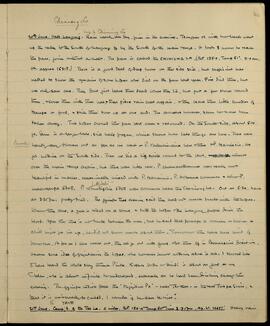
20th June. Halt Langong. Rain nearly all day, finer in the evening. Trompen or rather two locals went up the valley to the South of Langong to try the South of the main range. It took 3 hours to reach the pass, going without a halt. The pass is called the CHINIUNG LA, (BP. 185.0, Temp 51°. 9.0 am, Ht. approx 15318.) There is a good deal of deep snow on this side still, but sufficient has melted to show the remains of some Lopas who died on the pass last year. Five died there, but we only saw one. They don't just leave their dead where they lie, but put a few stones round them, cover them with their hats & their fibre rain coat affair, then leave them little bundles of tsampa or food, & stick their bow up at one end. The arrows however, seem to have been taken away. Two Lopas crossed this pass last week & returned. On the South side, about 500 ft. down is a large lake, still half frozen, which shows how late things are here. There were hardly any flowers out as far as we went - P. Valentiniana near others of P. tsariensis. We got nothing on the South side. Then we did a big circle round to the left, over the main range again, but there was little new. P. chamaethamna was really more beautiful in masses, occasionally mixed with P. tsariensis. P. Hobsonii common & also P. macrophylla 5608. P. rotundifolia 5606 was common near the Chiniung La. Out at 5.30, back at 3.30 pm. pretty tired. The gyimpon this evening said they had not much trouble with the Lopas. When they come, a yak is killed on a stone & both the Lopas & the Langong people drink the blood. After this there is no trouble between the men, but he said that perhaps a woman or two or a child might get hit up, he did not know much about them. Tomorrow they have some kind of tamasha. As far as I can make out, they all go out with guns & let them off in Pachakshiri direction. It seems some idea of frightening the Lopas, who however know nothing about it all. I should like to have heard the whole story through Pintso. Kushos Urdu or Hindi is about as good as my Tibetan, & he is almost impossible to understand, especially as he had been drinking chang this evening. The gyimpon insists that the "Highburn Pk" - near Tso Kar - is the real Takpa Shiri, & that it is universally so called. I wonder if he can be right?

21st June. Camp S. of the Tse La. 6 miles. BP. 186.4° Temp. 50° Time 3.30 pm. Ap. ht. 14457'. Heavy rain

LSH/1/1/6/1/83 · Part · 1938-06-22
Fait partie de The Ludlow & Sherriff Collection

SUMMARY:
Travel notes record heavy rain, difficult marching, and a camp on the Gyara Phu Chu, followed by a fine day reaching Gyara (Nepar). Common Primula species were noted, Lerwa with young were observed, and there is disappointment at few notable finds, with hopes to visit passes east of Lilung; transport delays prevent moving on to Pamse.

CONTENT:
Langong Trip has not been a great success (S. 647)

Last night and rain most of today with a few fine intervals. I have not been out much here yet, as we were late in, due to meeting a string of mules on a bad part of the path. The mules had come from Lhasa to summer in Langong for the grazing. I think this side of the Langong Chu must be a little drier than the south, though it does not appear to be much. Here P. hopeana, P. dryadifolia, P. macrophylla are very common, but we have seen nothing of interest.

To
22nd June. Camp on GYARA PHU CHU. 6 miles. BP. 191.1 T. 55° T. 3.0pm. Ht approx. 11832'.
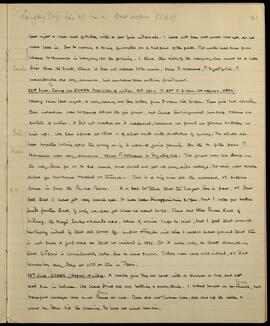
Heavy rain last night, and very heavy all day today from 8.0am till 2.0pm. Then fine but cloudy. Our intention was to camp above the fir forest, but Chulla distinguished himself and came on another 4 miles. It did not matter as it happened, because we found no flowers to delay us high up. We saw Lerwa at 15,000 - 4 adult birds with a clutch of young. The adults all kept together looking after the young as if it were a joint family. On the N. of the pass P. kansuensis was very common, and some P. hopeana and dryadifolia. The forest was too dense on the way down for us to see much, and we could not see up any side valleys. The rain was really awful for two hours and soaked us through. This is a big river at the moment, and I suppose comes in from the Pacha Peaks. It is sad to think that the longest day is past, and I don't feel that I have got very much yet. It has been disappointing so far, but I hope for better finds further East, if only we can get where we want to go. There are three Passes East of Lilung, the Magu, Shoka and Namdo Las, each of which I hope to visit, but I feel that we will be lucky indeed if that all comes off. Ludlow and Sherriff will also I expect have found that this is not such a good area as that we visited in 1936. Or it may only be that everything in East Tsari is considerably later, due to more snow. Today was very cold indeed, and I don't remember any days as cold as this in Tsari.

To
23rd June. GYARA (Nepar). 4 miles. A really fine day at last, with a shower or two, but hot real sun in between. We have dried all our bedding and everything. I hoped to get on to Pamse, but transport changes here and at Pamse as well. There are no horses here, all are up the valley and won't be down till the evening. So here we must remain.

LSH/1/1/3/3/81 · Part · 1936-03-10
Fait partie de The Ludlow & Sherriff Collection

SUMMARY:
At Lepo the party halted for two days; Danong explored a stream from Chio Tso and found masses of Primula, while the diarist noted rhododendrons, firs and larch, and prepared mail. Rain limited finds the next day, though P. Boothii was abundant at waterfalls, and Lumsden took a shot at pintail ducks.

CONTENT:
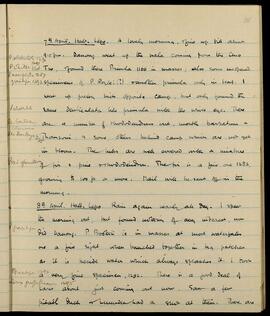
38

7th April. Halt. Lepo. A lovely morning, fine up till about 4.0 p.m. Danong went up the nala coming from the Chio Tso, found there Primula 1186 in masses; also some unopened specimens of P. Boothii (?) & another primula only in leaf. I went up pretty high opposite camp, but only found the same denticulata-like primula with the white eye. There are a number of rhododendrons out, mostly barbatum & Thomsonii, & some others behind camp which are not yet in bloom. The hills are well covered with a mixture of fir & pine & rhododendron. The fir is a fine one 1286, growing to 100 ft or more. Mail will be sent off in the morning.

8th April. Halt. Lepo. Rain again nearly all day. I spent the morning out, but found nothing of any interest, nor did Danong. P. Boothii is in masses at most waterfalls; it is a fine sight when bunched together in big patches as it is beside water which always splashes it. I took a very fine specimen, 1292. There is a good deal of larch about just coming out now. Saw a few pintail duck & Lumsden had a shot at them. There are

Marginal Notes:
P. atrodentata 1290
P. Whitei 1186, 1291
P. macrophylla 1287
gracilipes 1292
Rh. barbatum
Rh. Thomsonii
Rh. Baileyi 1285
Picea spinulosa
P. gracilipes
P. gracilipes 1292
Larix griffithiana 1295

LSH/1/1/3/3/137 · Part · 1983-05-05
Fait partie de The Ludlow & Sherriff Collection

SUMMARY:
Notes describe a valley with contrasting north and south faces, a bout of fever for Gulia, and halts on 9th and 10th May to explore and collect plants. Finds include rhododendrons, abundant P. bellidifolia (not yet out), and P. roylei and macrophylla in bloom near a terminal moraine; each member shot one crossoptilon.

CONTENT:
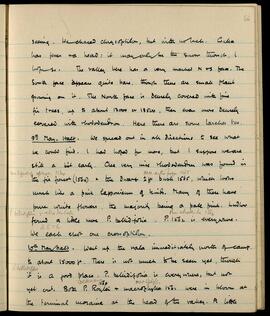
66

seeing. We chased crossoptilon, but with no luck. Gulia has fever on head: it may only be the snow thrush, I hope so. The valley here has a very marked N & S face. The South face appears quite bare, though there are small plants growing on it. The North face is densely covered with fine fir trees, up to about 13000 or 13500, then even more densely covered with rhododendron. Here there are some larches too.

9th May. Halt. We spread out in all directions to see what we could find. I had hoped for more, but I suppose we are still a bit early. One very nice rhododendron was found in the fir forest (1564) - the dwarf 2 ft bush 1565, which looks much like a pink lapponicum of kinds. Many of these have pure white flowers, the majority being a pale pink. Ludlow found a little more P. bellidifolia, P. 1562 is everywhere. We each shot one crossoptilon.

10th May. Halt. Went up the nala immediately north of camp to about 15000 ft. There is not much to be seen yet, though it is a good place. P. bellidifolia is everywhere, but not yet out. Both P. Roylei & macrophylla 1561 were in bloom at the terminal moraine at the head of the valley. A little

LSH/1/1/3/3/176 · Part · 1983-05-05
Fait partie de The Ludlow & Sherriff Collection

SUMMARY:
Notes describe S. and T. climbing toward Bimbi La via a good track through rhododendron forest to an alpine meadow and rocky, snowy ground. Plant collections at Bimbi La are listed for June 4 and June 5, including several Rhododendron, Primula, Iris, Anemone, and Vaccinium specimens with numbers.

CONTENT:
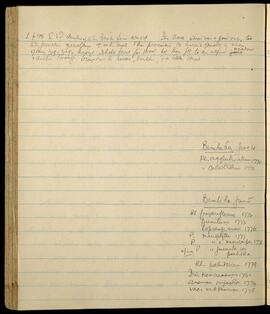
L. p. 108. S. & T. climbed to the Bimbi La - almost. The track, which was a good one, led to the junction of two valleys and on the level. Then proceeded to ascend quickly by means of easy zig-zags through rhododendron forest for 1000 feet. We then got to an alpine meadow and another 1000 feet brought us to rocks, boulders, and a little snow.

Bimbi La June 4
Rh. agglutinatum 1770
" calostrotum 1771

Bimbi La June 5
Rh. fragariflorum 1772
pumilum 1773
lopsangianum 1776
P. macrophylla 1777
P. " var. macrocarpa 1778
cf. no. P. " jucunda var. ponticola
Rh. paludosum 1779.
Iris kumaonensis 1781
Anemone rupicola 1774
Vaccinium sikkimensis 1775