Showing 3 results

Archival description
3 results with digital objects Show results with digital objects
LSH/1/1/7/1/7 · Part · 1940-05-24
Part of The Ludlow & Sherriff Collection

SUMMARY:
The diarist notes bodies with bows left beside them and observes alpine flora on nearby snow slopes and streambeds. Accompanied by Langong coolies, they visit the Tsari Sama (Sarpa) pilgrimage area, finding it rich in Primula, Rhododendron, and a new white-flowered Daphne near the pass to Lopa territory. Trashiyang is mentioned as the starting and finishing point of the pilgrimage.

CONTENT:
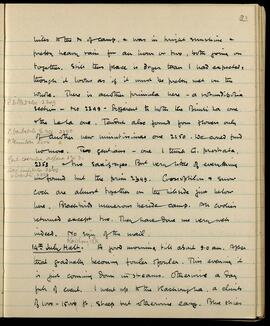
Beside each body, the owner's bow had been stuck in the ground. All arrows had been taken away, but all their other possessions seemed to have been left intact, even to their meagre rations of food. Near here, at the top of the snow slopes, were vertical cliffs. Tucked away in dust-dry pockets, completely sheltered from rain, were fine clumps of P. littledalei.

A little lower down, at 14,000', the first Meconopsis simplicifolia were coming into flower. Beside this, P. chamaethauma was in flower, and on a steep bank just above this, a little creeping Lonicera, only an inch or two off the ground, showed its yellow flowers. Some of the open swampy flats held masses of a fine Allium (No. ). On stony beds beside streams grow P. macrophylla v. macrocarpa.

There remained, near Langong, one area to visit, that was Tsari Sama. This is a place of pilgrimage, called Tsari Sama or Sarpa—the new Tsari—to distinguish it from the better-known, more important Tsari Chikchar. The Langong coolies were not anxious to go round the pilgrimage, for which I could not blame them. However, they took me, and it was a most interesting trip. As at the Lo La, there is in Tsari Sama a fairly extensive, reasonably open flat bit of country, just north of the immediate Himalayas, gradually rising to a steep rocky ridge. The whole of this area was very rich in flora. This, to a certain extent, can, I think, be put down to the fact that no yaks are kept here in the summer. None of the dwarf rhodos were now in flower, and R. campylogynum (5560), R. trichocladum (5555), R. glaucum (5565). Also 5568.

A Primula not seen elsewhere, P. Kingii covered acres of open ground with its deep wine-coloured blooms, P. laeta, a glorified form of P. Roylei. Primula, P. gracilipes.

Perhaps the most interesting Rhododendron was 5571 (yellow, red spots). Growing among rocks just below the ridge before reaching the pass to Lopa territory, we came across a fine large, white-flowered new Daphne. No seeds.

At Trashiyang, the starting and finishing point of the pilgrimage,
LSH/1/1/7/1/17 · Part · 1940-05-24
Part of The Ludlow & Sherriff Collection

SUMMARY:
Botanical observations near camp included Cremanthodium, P. littledalei, Meconopsis integrifolia, and saxifrages. After leaving the Thira La, Taylor returned to the Gyanda Chu and the party halted at Chomo Dzong to collect coracles and cross the river, observing barley harvesting and local papermaking, before abandoning a planned route from Kyakden to the Rong Chu and proceeding to Dzeng on the Tsangpo, where Primula and Gentiana waltoni were noted.

CONTENT:
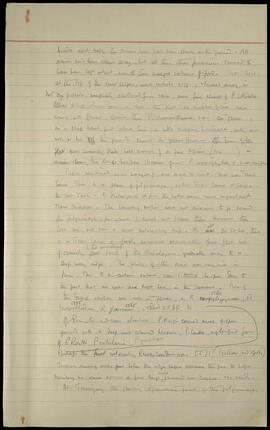
Near our camp were very fine. On the high rocky slopes were several species of Cremanthodium, we saw here more fruiting plants of P. littledalei than anywhere else, always growing among boulder scree, or at the foot of cliffs, in crevices protected from rain: a few were still in flower. Beside them grew Meconopsis integrifolia, some still with an odd flower on them. Saxifrages too were common here, the prettiest perhaps being a little wine red one only once seen, Saxifraga (No. 6).

Leaving the Thira La, Taylor returned to the Gyanda Chu, by a valley further North which entered the Gyanda Chu at Chomo Dzong. Here we had to halt a day while coracles were collected to ferry us across the river to the right bank. Barley crops were now ripe and we watched the Tibetans collecting the heads by putting two canes together and drawing them up the straws, pulling the heads off, while leaving the straw standing. Later on we watched the more dangerous method used in cutting the straw. In a small field a dozen or more men stripped to the waist, were let loose with murderous looking scythes on long handles. These were not wielded in the sedate way they are at home, but to the tunes of shouted songs were wildly swung over the left shoulder and head before being brought down in a sweep worthy of a professional golfer. The men did not advance in line, but wandered about where they fancied. Another occupation in which the people of Chomo Dzong were busy, was paper making, we watched this very simple and efficient manufacture from the peeling of the Daphne bark to the setting out of the cloth trays to dry in the air.

Unfortunately we could not manage the proposed trip from Kyakden over the hills to the East into the Rong Chu valley and had to turn down the river to Dzeng on the Tsangpo. Primula was seen on these dry slopes near the valley bed and Gentiana waltoni now appeared on an open dry hillside.

LSH/1/1/4/1/27 · Part · 1936-07-02
Part of The Ludlow & Sherriff Collection

SUMMARY:
Notes describe mixed sunshine and heavy rain near camp, with collections of primulas, gentians, and saxifrages, and sightings of Crossoptilon and snowcock; most coolies returned but no mail arrived. On 14 July at Kashong La, the morning was fair before turning to heavy rain.

CONTENT:
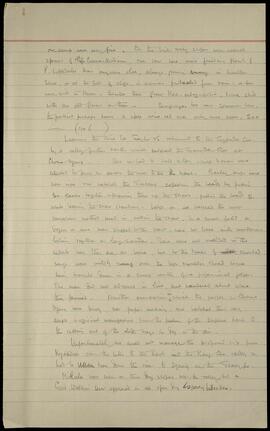
miles to the N of camp, and was in bright sunshine and
pretty heavy rain for an hour or two, both going on
together. Still this place is drier than I had expected,
though it looks as if it must be pretty wet on the
whole. There is another primula here - a rotundifolia
section - No 2349 (P. littledalei 2349) - different to both the Bimbi La one
and the Lela one. Tendu also found four flowers only
of another new minutissimae one 2350 (P. barbatula sp. nov. 2350). We could find
no more (P. tenuiloba 2354). Two gentians (Gent. coerulea aglaia 2353) - one I think G. prostrata,
and two saxifrages (Sax. hispidula 2348). But very little of everything
we found ("wardii" 2357) but the primula 2349. Crossoptilon and snow
cock are almost together on the hillside just below
here. Blackbirds numerous beside camp. All coolies
returned except two. They have done me very well
indeed. No sign of the mail.

14th July Halt. Kashong La. A good morning till about 9.0 am. After
that gradually becoming fouler and fouler. This evening it
is just coming down in streams. Otherwise a day
full of