
Mostrar 3 resultados

Descrição arquivística
3 resultados com objetos digitais Mostrar resultados com objetos digitais
LSH/1/1/6/1/155 · Part · 1938-10-22
Parte de The Ludlow & Sherriff Collection

SUMMARY:
At Migyitun the diarist reports rain and snow, finds a note from Ludlow sent from Chitsam about transport from Tume, collects limited seeds, and pays off Langong coolies. The next day, despite heavy snow, the diarist and Tsangpen search south for primulas, securing some seed and purchasing a sheep, with yak transport promised. On the 25th they march 15 miles to Chikchar, obtaining a letter from Ludlow at Podzo Sumdo en route.

CONTENT:
79

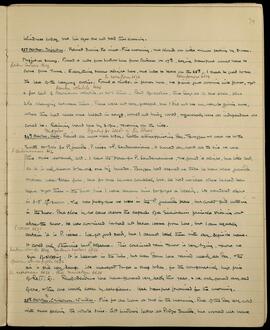
blindness today, but his eyes are not bad this evening.

23rd October. Migyitun. Rained during the night. Fine morning, but clouds on hills and snow falling by 8.00 am.

Migyitun sunny. Found a note from Ludlow here from Chitsam on 17th, saying transport would have to come from Tume [Berberis ludlowii 6623]. Everything seems alright here, and we hope to leave on the 25th. I shall be glad to see the last of the Langong coolies. Found a rhodo. [R. neriiflorum 6626] in flower here, and a Pieris [Pieris formosa 6627] just coming into flower, and got a few seed of Aconitum volubile [Aconitum volubile 6628], or so I think. Paid off coolies, three days at 12 sho each, plus 3 Rs. changing between them. They were not very grateful, but I did not see any point in giving more, when they had never once helped in camp, would not bring wood, and generally were as independent as could be. Raining hard here by 3.00 pm, snowing on the hills. [Migyitun: Hunting for seeds in the snow.]

24th October. Halt. Rained all night and all today. Rather a disappointing day. Tsangpen and I went up to the south to look for P. jucunda, P. ioessa and P. sandemaniana [P. sandemaniana 6630]. It snowed very hard all the time we were there and was extremely cold. I knew the place for P. sandemaniana, and we found it alright, but little seed, as it is only known to be one big breeder. Tsangpen had assured me that he knew where jucunda and ioessa were taken from, but for once he was completely lost. He had no idea where he had been before and got them—the first time I have known him to forget a locality. We wandered about in 6-8" of snow, and he was pretty sure we were in the P. jucunda place, but could find nothing in the snow. But close by we came across the capsules of a Sikkimensis primula sticking out above the snow. He was convinced he had not taken ioessa from here, but I am equally certain it is P. ioessa [P. ioessa 6631]. We got good seed, but I cannot label them with any definite name. It could only otherwise be P. hopeana [Berberis sheriffii 6634, Berberis hookeri 6636]. This continued rain and snow is very trying, and shows no sign of stopping. It is heaviest in the hills, but even down here rained nearly all day, and the air is still very damp [Quercus semecarpifolia 6632]. We managed to get a sheep today, for the comparatively huge price of Rs. (T) 5/-. Rhododendrons here have flowered very badly this year, and we only found any seed of one, and they are mostly eaten by caterpillars [Rh. microneres 6633, Rhod. neriiflorum 6638]. Yak transport promised for the morning.

25th October. Chikchar. 15 miles. Fine for an hour or two in the morning. Rest of the day very cold with snow falling the whole time. Got Ludlow's letter at Podzo Sumdo, but would not have
Shing-itun valley halts and plant finds, 29–30 May
LSH/1/1/3/3/171 · Part · 1983-05-05
Parte de The Ludlow & Sherriff Collection

SUMMARY:
Halt days near Shing-itun with Danang and Tenduk exploring a valley to the southwest, where a yellow primula was found above a bridge. The next day the author revisited via the right-hand valley to Champa Phé and a higher thang, noting a wren’s nest, abundant Paraquilegia, other primulas including possible P. sapphirina on west-facing cliffs, and that Lumsden’s white primula was already in seed. Weather included rain on the first day and fine conditions on the second.

CONTENT:
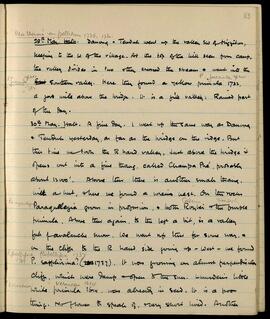
83

Rhod. thomsenii var. pallidum 1728, 1730.

29th May. Halt. Danang & Tenduk went up the valley SW of Shing-itun, keeping to the W of the village. At the top of the hill seen from camp, the valley divides in two. They crossed the stream & went into the Southern valley. Here they found a yellow primula 1732 [P. jucunda sp. nov. 1732], a good mile above the bridge. It is a fine valley. Rained part of the day.

30th May. Halt. A fine day. I went up the same way as Danang & Tenduk yesterday, as far as the bridge on the ridge. But this time we took the R hand valley, just above the bridge it opens out into a fine thang, called Champa Phé, probably about 12000'. Above this there is another small thang, with a hut, where we found a wren's nest. On the rocks Paraquilegia [Calderia macrophylla] grows in profusion, & both Roylei & the purple primula. Above this again, to the left a bit, is a valley full of avalanche snow. We went up this for some way, & on the cliffs to the R hand side going up — West — we found P. sapphirina? [P. flabellifera 1737]. It was growing on almost perpendicular cliffs, which were damp & open to the sun. Lumsden's little white primula 1644 [Vernicosa 1644], was already in seed. It is a poor thing. No flower to speak of, very short lived. Another...

Mipa Taktsa — 19 June: Halt and Primula survey
LSH/1/1/3/3/197 · Part · 1996-06-18
Parte de The Ludlow & Sherriff Collection

SUMMARY:
At Mipa Taktsa the party halted, noting fine weather early before mist and rain, and surveyed the valley northwest of camp with extensive rock ridges and a broad plain. Primulas were abundant, with mentions of a yellow form and P. rhodochroa (specimen 2137), and earlier P. jucunda (2175). There was trouble with insufficient coolies, leading to rations being left behind, and a plan to visit a large plain west of camp.

CONTENT:
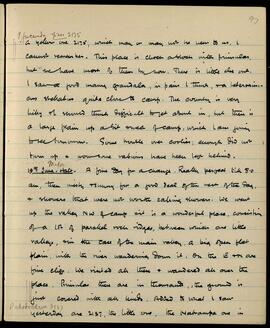
P. jucunda 2175
A yellow one 2175, which may or may not be new to us, I cannot remember. This place is chock-a-block with primulas, but we have most of them by now. There is little else out. I saw a good many glandula, in pairs I think, or heterotrichous stellatus quite close to camp. The country is very hilly and I should think difficult to get about in, but there is a large plain up a bit west of camp, which I am going to see tomorrow. Some trouble over coolies; enough did not turn up and now some rations have been left behind.

Mipa Taktsa
19th June. Halt. A fine day for a change. Really perfect till 8.0 am, then misty and rainy for a good deal of the rest of the day, and showers that were not worth calling showers. We went up the valley NW of camp and it is a wonderful place, consisting of a lot of parallel rock ridges, between which are little valleys, in the case of the main valley, a big open flat plain, with the river wandering down it. On the East side are fine cliffs. We visited all these and wandered all over the place. Primulas there are in thousands, the ground is just covered with all kinds. Added to what I saw yesterday are 2137, the little one, the Nabrampa one in
P. rhodochroa 2137