Showing 16 results

Archival description
16 results with digital objects Show results with digital objects
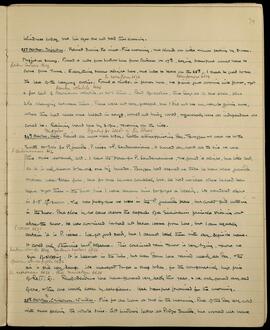
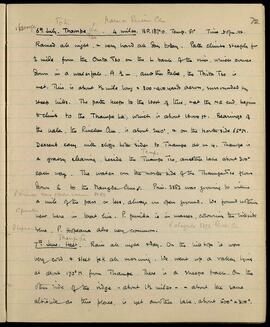
LSH/1/1/5/1/147 · Part · 1933-07-04
Part of The Ludlow & Sherriff Collection

SUMMARY:
In heavy rain, the party ascends from Omta Tso past Thita Tso to Thampe La (~16,000 ft) and descends to Thampe beside Thampe Tso, noting bearings and that Thampe Tso drains east to the Mangde Chu. Primula 3383 occurs near the pass, with masses of P. pusilla and common P. hopeana. The following day is a rainy halt with sleet, and a short valley exploration reveals another lake.

CONTENT:
Toke Maru or Rinchen Chu

6th July. Thampe La. 4 miles. B.P. 187.0°. Temp. 51°. Time 3:00 p.m.

Rained all night, and very hard all day today. Path climbs steeply for ½ mile from the Omta Tso on the left bank of the river, which comes down in a waterfall. At ½ mile, another lake, the Thita Tso, is met. This is about ½ mile long and 300–400 yards across, surrounded by steep hills. The path keeps to the west of this, and at the NE end, begins to climb to the Thampe La, which is about 16,000 ft. Bearings of the nala, the Rinchen Chu, are about 240°, and on the north side 65°M. Descent easy with cliffs on both sides to Thampe at mile 4. Thampe is a grassy clearing beside the Thampe Tso, another lake about 300 yards each way. The water on the north side of the Thampe Tso flows down east to the Mangde Chu. Primula 3383 was growing to within a mile of the pass or less, always on open ground. We found nothing new here in that line. P. pusilla is in masses, coloring the hillside blue. P. hopeana also very common.

7th July. Halt. Rain all night and day. On the hilltops it was very cold and sleet fell all morning. We went up a valley lying at about 170°M from Thampe. There is a sheep's track. On the other side of the ridge—about 1½ miles—at about the same altitude as this place, is yet another lake, about 500 x 300 yards.
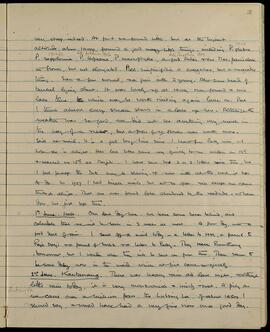
LSH/1/1/5/1/145 · Part · 1933-07-04
Part of The Ludlow & Sherriff Collection

SUMMARY:
Travel past yakherd huts at Sezi to Omta Tso, where a camp could be made. Despite foul rain and wind making photography difficult, primulas were collected and photographed, with abundant plants near Thita Tso and difficult cliff-face specimens that even Tenduk struggled to reach; P. hopeana was massed at camp.

CONTENT:
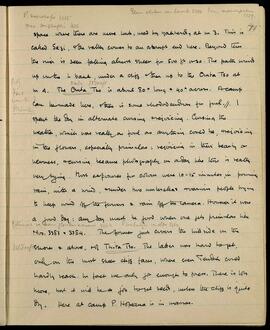
P. macrocarpa 3385
Mec integrifolia 3386
Lilium elatum var humile 3388 Prim macropetalum 3389.

space where there are some huts, used by yakherds, at m. 3. This is
called Sezi, the valley comes to an abrupt end here. Beyond this
the river is seen falling almost sheer for 500 ft. or so. The path winds
up on the left bank, under a cliff and then up to the Omta Tso at
m. 4. The Omta Tso is about 80x long and 40x across. A camp
can be made here, and there is some rhododendron for fuel. // I
spent the day in alternate cursing and rejoicing. Cursing the
weather, which was really as foul as anything could be, and rejoicing
in the flowers, especially primulas: rejoicing in their beauty or
newness, and cursing because photography on a day like this is really
very trying. Most exposures for colour were 10-15 minutes, in pouring
rain, with a wind, and under two umbrellas and various people trying
to keep wind off the flowers and rain off the camera. However it was
a good day: any day must be good when one gets primulas like
Nos. 3383 and 3384. The former just covers the hillside on the
shores and above, of Thita Tso. The latter was hard to get,
only on the most sheer cliff faces, where even Tenduk could
hardly reach. In fact we only got enough to press. There is lots
more, but it will be a job to get seed, unless the cliff is quite
dry. Here at camp P. hopeana is in masses.

LSH/1/1/6/1/152 · Part · 1938-10-22
Part of The Ludlow & Sherriff Collection

SUMMARY:
Field notes list several Primula species with localities, habitat and elevation details, flowering or seed status, and comparisons to collections made in 1936. There is uncertainty about the exact P. ioessa type locality near Lo Migyitun due to mist and deep snow, and sites such as KHERI GOMPA at Chungkar are referenced.

CONTENT:
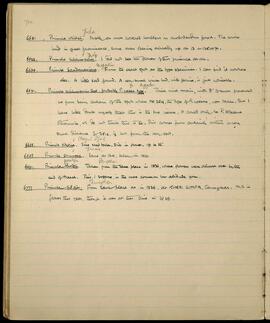
78a

  1. Primula winteri. Yuda. Mostly on moss covered boulders in Rhododendron forest. The winter bud in great prominence, some even opening already up at 13 or 13,500 ft.

  2. Primula sikkimensis. Yuda. I did not see the flowers of this primula at all.

  3. Primula Sandemaniana. Migyitun. From the exact spot as the type specimen. I can find it nowhere else. A little seed found. A very small winter bud, with farina, is just noticeable.

  4. Primula sikkimensis Sect. probably P. ioessa type. Lo Migyitun. Thick mist rain, with 8" of snow prevented us from being certain of the spot where No 2514, the type of P. ioessa, was taken. But I have little doubt myself that this is the true ioessa. It could only be P. Hopeana otherwise, and I do not think this is so. This comes from certainly within a very short distance of 2514, if not from the very spot.

  5. Primula tibetica. Chayul Dzong. Some seed taken. Still in flower. Up to 3½".

  6. Primula strumosa. Tremo. Same as 1300, taken in 1936.

  7. Primula Boothii (gracilipes). Pangchen. Taken from the same place in 1936, where flowers were almost over by the end of March. This, I suppose, is the more common low altitude form.

  8. Primula filipes. Chungkar. From same place as in 1936, at KHERI GOMPA, Chungkar. Not in flower this year, though it was at this time in 1936.

LSH/1/1/9/1/146 · Part · 1933-09-01
Part of The Ludlow & Sherriff Collection

SUMMARY:
Page lists Primula taxa with collection numbers and notes on abundance, habitat, flowering/fruiting status, and seed or root collections. Mentions very late flowering in some cases and specific quantities. One entry records a collection at Chendebi Sovo.

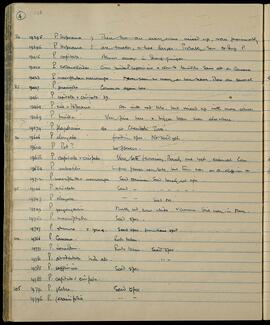
CONTENT:
4 138

80 19395 P. Hopeana } These two are everywhere mixed up, one presumably
19396 P. Hopeana } are smaller, & here larger. Probably best to drop P.
19416 P. capitata. Almost always in dwarf juniper.
19420 P. soldanelloides Grows beside P. sapphirina & close to tenuiloba. Same alt. as Caveana
19423 P. macrophylla v. macrocarpa. Never seen so many as here before. There are several
85 19447 P. geraniifolia Common again here.
19461 P. capitata v crispata. 39.
19464 P. sin. v Hopeana. An with red tube, but mixed up with more which
19469 P. pusilla. Very fine here & bigger than seen elsewhere.
19574 P. flagellaris 40 at Chendebi Sovo.
90 19606 P. elongata fruiting spec. No seed yet.
19610 P. Pet? No flowers.
19656 P. capitata v crispata Very late flowering. Barely one yet, even at low
19684 P. umbratilis. In full flower very late, but this was on a cliff in a
19712 P. macrophylla v. macrocarpa. Seed specimen. Seed barely yet ripe.
95 19746 P. reticulata Seed - - - - - - -
19747 P. elongata. Seed ok.
19749 P. yargongensis. Mostly red, some white. Common. Still many in flower.
19750 P. macrophylla Seed spec.
19757 P. strumosa = 19204. Seed spec. from same spot.

  1. 19766 P. Caveana. Roots taken.
    19777 P. Jonarduni. Roots taken. Seed spec.
    19781 P. atrodentata high alt. " "
    19785 P. sapphirina Seed spec.
    19788 P. capitata v crispata.
    105 19791 P. flaccida. Seed spec.
    19796 P. geraniifolia " "
LSH/1/1/9/1/142 · Part · 1933-09-01
Part of The Ludlow & Sherriff Collection

SUMMARY:
The page lists numerous Primula taxa with specimen numbers and brief notes on abundance and flowering, many recorded as common at Kantanang on 10/6. It mentions elevation comparison within the same valley, white forms of P. glabra, a hybrid (P. sikkimensis × hopeana), and comments on varieties such as caveana var. alba and macrophylla var. macrocarpa.

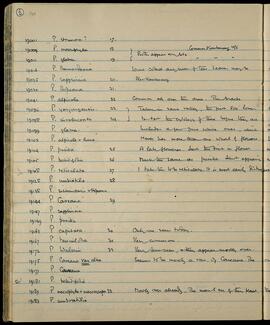
CONTENT:
(2) 134

  1. P. strumosa? 17.
    19009 P. macrophylla 18 } Both appear very late. Common Kantanang 10/6
    19011 P. glabra 19 } Common Kantanang 10/6
  2. P. barnardoana Won't collect any more of this. Leaves may be
    19025 P. sapphirina 20. Also Kantanang
    19030 P. hopeana 21.
    19041 P. alpicola 22 Common all over this area. The bracts
    19096 P. yarongensis. 23. } Taken in same valley, the first 500' lower
    19098 P. involucrata 24. } to test the cytology of these before they are
    19099 P. glabra. Includes a few pure white ones, which
    19103 P. alpicola var. luna Never has more than one whorl of flowers
    19104 P. pusilla. 25 A late flowerer. Just the first in flower
    19105 P. bellidifolia 26 Much the same as pusilla. Just appearing
    19108 P. reticulata 27 I take this to be reticulata. It is most easily distinguished
    19128 P. umbratilis 28
    19138 P. sikkimensis x hopeana
    19144 P. caveana 29
    19147 P. sapphirina
    19149 P. pusilla
    19163 P. capitata. 30 Only one seen today.
    19167 P. tenuiloba 31 Very common.
    19172 P. walshii 32 Very few seen, & they appear mostly over.
    19175 P. caveana var. alba Seems to be merely a var. of caveana. The
    19177 P. caveana
    50) 19181 P. bellidifolia.
    19189 P. macrophylla var. macrocarpa 33. Mostly over already. The more I see of this plant, the
    19183 P. umbratilis
LSH/1/1/5/1/215 · Part · 1937-07-31
Part of The Ludlow & Sherriff Collection

SUMMARY:
Checklist of Primula species collected in 1937, with notes on prior collection status and several specimen numbers. Localities mentioned include Chendebi and Tang Chu.

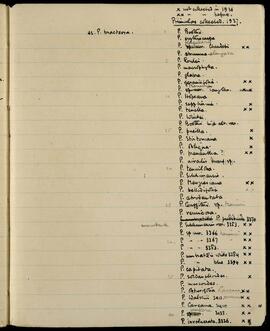
CONTENT:
x not collected in 1936
xx " " " before.
Primulas collected. 1937.

  1. P. bracteosa.

1 P. Boothii.
P. erythrocarpa
P. flagellaris
P. sp. nov. Chendebi xx
5 P. strumosa elongata
P. Roylei.
P. macrophylla.
P. glabra.
P. geraniifolia xx
10 P. sp. nov. Tang Chu. xx
P. Hopeana
P. sapphirina x
P. tenella. xx
P. Winteri.
15 P. Boothii high alt. var.
P. pusilla. x
P. Stirtoniana x
P. obliqua. x
P. prenantha? xx
20 P. nivalis dwarf sp.
P. tenuiloba.
P. sikkimensis.
P. Menziesiana xx
P. bellidifolia xx
25 P. atrodentata
P. Griffithii sp. hancini
P. vernicosa.
P. pudibunda 3370
P. sikkimensis var. 3353. xx
30 P. sp. nov. 3366 hancini xx
P. " " 3367 xx
P. " " 3383. xx
P. umbratilis white 3384 xx
P. " blue 3394 xx
35 P. capitata.
P. soldanelloides. x
P. muscoides.
P. obtusifolia Caveana xx
P. Walshii 3413 concinna xx
40 P. Caveana 3410 xx
P. uniflora 3438. x
P. involucrata 3226. x

LSH/1/1/9/1/60 · Part · 1949-06-01
Part of The Ludlow & Sherriff Collection

SUMMARY:
List of plants to collect seed from in the Pangotang area, with specimen numbers and locality notes such as cliffs opposite camp, beyond the fir zone, and near Tolegang and the first drogpa. Mentions taxa including Primula, Cypripedium, Saxifraga, Androsace, Meconopsis, Salvia, Potentilla, and others.

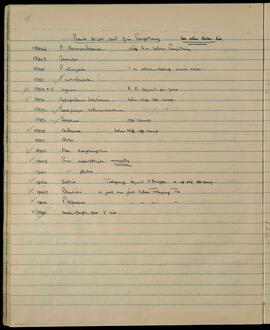
CONTENT:
55

Plants to get seed from Pangotang See also later list.

18946 P. barnardiana. cliff 1/2 m below Pangotang
18948 Cassiope
18955 P. elongata. 1 m above camp main river
18957 P. atrodentata
X 18963-5 Legume. to E beyond fir zone
V 18970 Cypripedium tibeticum. below cliff opp. camp.
18972 Saxifraga yellow cushion below cliff opp. camp.
18973 Daphne opp. camp.
V 18974 Androsace below cliff opp camp.
18977 Aster.
V 18995 Meconopsis simplicifolia
V 19009 Primula macrophylla roots.
19011 Primula glabra
V 19021 Salvia Tolegang beyond 1st drogpa & up cliff opp camp.
X 19027 Potentilla. a good one just before Tolegang 150
19030 P. hopeana a good one just before Tolegang
V 18992 small purple pea 2" high.

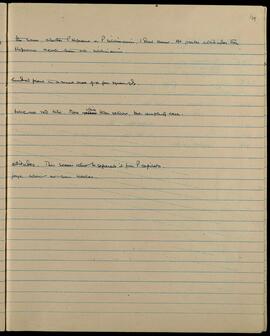
LSH/1/1/9/1/147 · Part · 1933-09-01
Part of The Ludlow & Sherriff Collection

SUMMARY:
The page compares P. Hopeana and P. sikkimensis across altitudes, noting that at greater heights they are all sikkimensis. It records dense stands in a small area, flowers lacking a red tube with more white than yellow, and distinctions from P. capitata in a sunless gorge.

CONTENT:
the same, whether P. Hopeana or P. sikkimensis, I don't know. At greater altitudes they
become then all sikkimensis.

hundred plants in a small area of a few square yards.

have no red tube. More white than yellow, but ample of each.

altitudes. This seems also to separate it from P. capitata.
gorge where no sun reaches.

LSH/1/1/6/1/155 · Part · 1938-10-22
Part of The Ludlow & Sherriff Collection

SUMMARY:
At Migyitun the diarist reports rain and snow, finds a note from Ludlow sent from Chitsam about transport from Tume, collects limited seeds, and pays off Langong coolies. The next day, despite heavy snow, the diarist and Tsangpen search south for primulas, securing some seed and purchasing a sheep, with yak transport promised. On the 25th they march 15 miles to Chikchar, obtaining a letter from Ludlow at Podzo Sumdo en route.

CONTENT:
79

blindness today, but his eyes are not bad this evening.

23rd October. Migyitun. Rained during the night. Fine morning, but clouds on hills and snow falling by 8.00 am.

Migyitun sunny. Found a note from Ludlow here from Chitsam on 17th, saying transport would have to come from Tume [Berberis ludlowii 6623]. Everything seems alright here, and we hope to leave on the 25th. I shall be glad to see the last of the Langong coolies. Found a rhodo. [R. neriiflorum 6626] in flower here, and a Pieris [Pieris formosa 6627] just coming into flower, and got a few seed of Aconitum volubile [Aconitum volubile 6628], or so I think. Paid off coolies, three days at 12 sho each, plus 3 Rs. changing between them. They were not very grateful, but I did not see any point in giving more, when they had never once helped in camp, would not bring wood, and generally were as independent as could be. Raining hard here by 3.00 pm, snowing on the hills. [Migyitun: Hunting for seeds in the snow.]

24th October. Halt. Rained all night and all today. Rather a disappointing day. Tsangpen and I went up to the south to look for P. jucunda, P. ioessa and P. sandemaniana [P. sandemaniana 6630]. It snowed very hard all the time we were there and was extremely cold. I knew the place for P. sandemaniana, and we found it alright, but little seed, as it is only known to be one big breeder. Tsangpen had assured me that he knew where jucunda and ioessa were taken from, but for once he was completely lost. He had no idea where he had been before and got them—the first time I have known him to forget a locality. We wandered about in 6-8" of snow, and he was pretty sure we were in the P. jucunda place, but could find nothing in the snow. But close by we came across the capsules of a Sikkimensis primula sticking out above the snow. He was convinced he had not taken ioessa from here, but I am equally certain it is P. ioessa [P. ioessa 6631]. We got good seed, but I cannot label them with any definite name. It could only otherwise be P. hopeana [Berberis sheriffii 6634, Berberis hookeri 6636]. This continued rain and snow is very trying, and shows no sign of stopping. It is heaviest in the hills, but even down here rained nearly all day, and the air is still very damp [Quercus semecarpifolia 6632]. We managed to get a sheep today, for the comparatively huge price of Rs. (T) 5/-. Rhododendrons here have flowered very badly this year, and we only found any seed of one, and they are mostly eaten by caterpillars [Rh. microneres 6633, Rhod. neriiflorum 6638]. Yak transport promised for the morning.

25th October. Chikchar. 15 miles. Fine for an hour or two in the morning. Rest of the day very cold with snow falling the whole time. Got Ludlow's letter at Podzo Sumdo, but would not have

LSH/1/1/9/1/63 · Part · 1949-06-01
Part of The Ludlow & Sherriff Collection

SUMMARY:
High-altitude collecting around 14,000 ft yielded several small plants and a lake, with monal and burhel observed. The diarist notes mail delays, sends letters and parcels to H.H., Raja Dorji, and Betty during a halt, then crosses the Hubsing La to reach Kantanang in wet monsoon weather.

CONTENT:
very steep indeed. At first we found little, but at the highest altitude, about 14000, found a good many little things, including P. glabra (19011), P. sapphirina (19025), P. hopeana (Lud. Sherriff 19030), P. macrophylla, a good Aster and one Mec. paniculata (Lud. Sherriff 19019) in flower, but not elongated. Plec. simplicifolia is everywhere, but a miserable thing. Saw a few monal, and a pair with 3 young. Also some heads of burhel lying about. It was lovely up at 14000, and we found a nice lake there, the which may be worth visiting again later on. But I think almost every stream starts in a lake up here. Although the weather was so good, we did not see anything very much in the way of a view, but a press of flowers was worth more.

Still no mail. It is a good long time since I heard from Betty now, and I hope she is alright. Her last letter came very quickly to me, written on 13th and reached me 15th at Menjisi. I have sent her 2 or 3 letters since then, but I feel perhaps the dak may be slowing up now with all the work it has to do. In 1937 I had bigger mails, but not so often, and all except one came through alright. That one was found later abandoned by the roadside - no harm done, but just left there.

1st June. Halt. Our last day here. We leave some boxes behind, and calculate that we will be back in 3 weeks at most. A poor day, with a good deal of rain. I sent off a mail today - a letter to H.H., a parcel to Raja Dorji and a parcel of books and a letter to Betty. They reach Bumthang tomorrow, but I wonder when they will be sent on from there. There seems to be some delay now in the mails, which at first came so quickly.

2nd June. Kantanang. There was heavy rain all last night, and although little rain today, it is very monsoonish and misty and wet. A pity as we came over a hellish pass, the Hubsing La, of about 14500 I should say, and would have had a very fine view on a good day.