
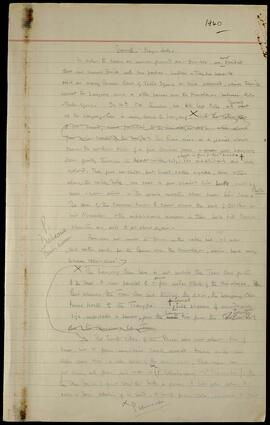
SUMMARY:
The expedition splits, with Ludlow and Taylor heading to passes east of Tsela Dzong while Sherriff works the Lanyong area and passes between Roro and Bela Dzong, departing Roro on 24 May. The page describes the Lanyong Chu valley, its isolated inhabitants and seasonal conditions, and notes early-season floral observations on high slopes, including Rhododendron repens and Primula species.
CONTENT:
1940.
Sherriff - May - July -
In order to cover as much ground as possible, we now decided that we should divide into two parties. Ludlow and Taylor were to visit as many passes East of Tsela Dzong as time allowed, while Sherriff worked the Lanyong area and other passes over the Himalayas between Roro and Bela Dzong. On 24th May therefore we all left Roro, and Sherriff went up the Lanyong Chu in easy stages to Lanyong.
The Lanyong Chu here is not unlike the Tsari Chu further to the West. It runs parallel to and about four miles North of the Himalayas. But whereas the Tsari Chu cuts through the axis, the Lanyong Chu turns North to the Tsangpo. Several side streams of considerable size, unfordable in summer, join the Lanyong from the South.
The valley, which is from 300-600 yards wide, flows gently through the valley bed. The inhabitants are very isolated. They grow no crops, but breed cattle and yaks. Here and there along the valley bed, one sees a few chalet-like huts, used by men and yaks alone in the winter months when snow lies deep. The rain of the summer turns to snow about the end of October or mid-November, and the inhabitants remain in their huts till March when they are able to get about again.
There was not much in flower in the valley bed, as it was still rather early for the passes over the Himalayas, which here vary between 13,500 - 15,000'.
The South sides of the passes were now almost free of snow, but North faces were still deeply covered. However on the open slopes about 14,000' a little North of the main axis, Rhododendron repens was just coming into flower, and with it (P. valentinianum and P. franchetii). On the same day as I first saw the latter in flower, I was also able to make a large collection of its seed. A north facing slope on which it grew P. vernicosa.