Mostrando 9 resultados

Descripción archivística
9 resultados con objetos digitales Muestra los resultados con objetos digitales
LSH/1/1/5/1/161 · Part · 1937-07-14
Parte de The Ludlow & Sherriff Collection

SUMMARY:
Notes describe abundant white Primula (P. tsariensis alba) on south- and east-facing screes, a steep shortcut descent by gully, and the winding down of high-altitude collecting. The writer lists misses (P. dryadifolia, P. Griffithii) and counts about 40 Primula species, including many not seen before, expressing satisfaction with work on the Black Mt.

CONTENT:
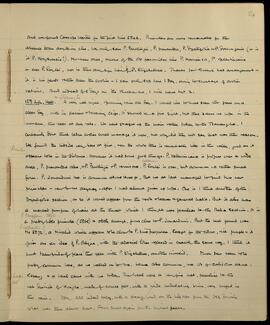
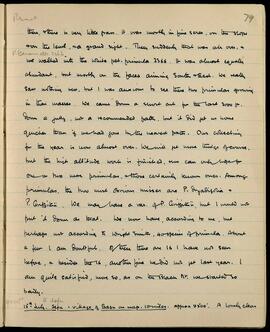
Primula 79

there, there is very little fern. It was mostly in fine screes, on the slope
above the level, a grand sight. Then suddenly that was all over, and
P. tsariensis alba 3366
we walked into the white pet. primula 3366. It was almost equally
abundant, but mostly on the faces aiming South and East. We really
saw nothing new, but I was anxious to see these two primulas growing
in their masses. We came down a short cut for the last 3000 ft.
down a gully, not a recommended path, but it did get us home
quicker than if we had gone by the nearest path. Our collecting
for the year is now almost over. We will get more things of course,
but the high altitude work is finished, one can only hope for
one or two more primulas, and those certainly known ones. Among
primulas, the two most obvious misses are P. dryadifolia and
P. Griffithii. We may have a var. of P. Griffithii, but I would not
put it down as that. We now have, according to me, but
perhaps not according to Wright Smith, 40 species of primula. About
a few I am doubtful. Of these there are 16 I have not seen
before, and besides the 16, another five we did not get last year. I
am quite satisfied, more so, as on the Black Mt.

LSH/1/1/6/1/67 · Part · 1937-06-05
Parte de The Ludlow & Sherriff Collection

SUMMARY:
The diarist describes views toward Pa La and Lanyong, debates whether the seen pass is Pa La or Lingtsangha La on the route to Migyitun, and notes a prominent peak likely the Migyitun Peak. Camping north of Chubumbu La, they record weather, altitudes, and fieldwork with Thompson, including bird specimens and several Primula and Omphalogramma finds, with a halt day spent revisiting the Chubumbu La.

CONTENT:
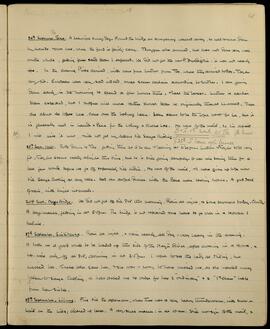
about 2 miles from here. From there we could see the Pa La & Lanyong. The Pa La lies at a bearing of 266° & Lanyong at 47°. I should say that the Pa La was further than Lanyong but not much. Again failed to find flowers, though P. tsariensis is in masses everywhere, P. dryadifolia common to the N. of the pass, some P. Valentiniana a mile South. This valley is said to lead to Migyitun, but we could not see how it does so. Shokakuling was bloody pleasant on the way up, but with bare patches. They must be sitting, but we could find no nests. Also collected two more Phylloscopus tibetanus & a flycatcher with eggs c/3. There is obviously nothing yet, this side of the main Range. There is a fine peak to the S. of the Pa La. Can it be the Pk. to the E of Migyitun - (N.E.?). I have heard that the Pass we saw today is not the Pa La but the Lingtsangha La, viz on the road to Migyitun. In that case the peak is almost certainly the Migyitun Peak. It is almost impossible to get information that one can rely on though. - Chubumbu La - see June 2.

6th June. Camp 2m N of Chubumbu La. B.P. 189.8° Temp 35° Time 3.0pm. Ht. approx. 12596'. Rained in the night up to 7.0am, then cleared & was a fine day with a good deal of sun till 3.0pm. Then mist & some rain, clearing up later. Some thunder yesterday evening & again this evening. Thompson & I went direct South from camp over the hills, but ran into a lot of mist, & so to get down to the valley we had a series of cliffs to negotiate. A valley comes in from the SW just above here, up it we went. The only real find was Omphalogramma minus 3970, which is fairly common on the edge of the last bit of abies forest. P. Valentiniana & P. Pauliana & P. tsariensis are coming everywhere. A nice little dwarf rhododendron was No. 3975, common about here, but nowhere else. Although reports of the Chubumbu La are not a bit favourable, we go over it tomorrow & hope for a fine day.

7th June. Halt. Misty, but fine nearly all day: some showers. Went up to the Chubumbu La, at mile 2. B.P. 187.2° Temp. 45° Time 7.30 am. Ht. approx 13900'. A good day on the whole. On our way up to the pass we came across a lot of what I had thought to be a new primula collected beyond the Lo La under No. 3762. At that time I could not make it out, but now I see it

LSH/1/1/6/1/83 · Part · 1938-06-22
Parte de The Ludlow & Sherriff Collection

SUMMARY:
Travel notes record heavy rain, difficult marching, and a camp on the Gyara Phu Chu, followed by a fine day reaching Gyara (Nepar). Common Primula species were noted, Lerwa with young were observed, and there is disappointment at few notable finds, with hopes to visit passes east of Lilung; transport delays prevent moving on to Pamse.

CONTENT:
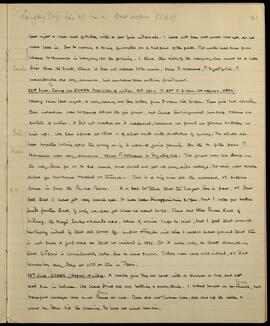
Langong Trip has not been a great success (S. 647)

Last night and rain most of today with a few fine intervals. I have not been out much here yet, as we were late in, due to meeting a string of mules on a bad part of the path. The mules had come from Lhasa to summer in Langong for the grazing. I think this side of the Langong Chu must be a little drier than the south, though it does not appear to be much. Here P. hopeana, P. dryadifolia, P. macrophylla are very common, but we have seen nothing of interest.

To
22nd June. Camp on GYARA PHU CHU. 6 miles. BP. 191.1 T. 55° T. 3.0pm. Ht approx. 11832'.
Heavy rain last night, and very heavy all day today from 8.0am till 2.0pm. Then fine but cloudy. Our intention was to camp above the fir forest, but Chulla distinguished himself and came on another 4 miles. It did not matter as it happened, because we found no flowers to delay us high up. We saw Lerwa at 15,000 - 4 adult birds with a clutch of young. The adults all kept together looking after the young as if it were a joint family. On the N. of the pass P. kansuensis was very common, and some P. hopeana and dryadifolia. The forest was too dense on the way down for us to see much, and we could not see up any side valleys. The rain was really awful for two hours and soaked us through. This is a big river at the moment, and I suppose comes in from the Pacha Peaks. It is sad to think that the longest day is past, and I don't feel that I have got very much yet. It has been disappointing so far, but I hope for better finds further East, if only we can get where we want to go. There are three Passes East of Lilung, the Magu, Shoka and Namdo Las, each of which I hope to visit, but I feel that we will be lucky indeed if that all comes off. Ludlow and Sherriff will also I expect have found that this is not such a good area as that we visited in 1936. Or it may only be that everything in East Tsari is considerably later, due to more snow. Today was very cold indeed, and I don't remember any days as cold as this in Tsari.

To
23rd June. GYARA (Nepar). 4 miles. A really fine day at last, with a shower or two, but hot real sun in between. We have dried all our bedding and everything. I hoped to get on to Pamse, but transport changes here and at Pamse as well. There are no horses here, all are up the valley and won't be down till the evening. So here we must remain.

LSH/1/1/6/1/103 · Part · 1933-07-05
Parte de The Ludlow & Sherriff Collection

SUMMARY:
At W. Tsanangho, the diarist reports heavy rain and poor visibility, explores the Tsanangha valley, and notes scarce primulas overall but finds two primulas new to them (No. 5865 of the Dryadifolia section and No. 5872, a nivalid close to P. sino-purpurea). Logistics are disrupted due to Kushu’s arrangements, reducing planned time on the Kuchaha; Kesang and a local accompany the outing, with observations of musk deer and local attire from Kongbo.

CONTENT:
And we found Cassiope wardii for the first time 5846. Primulas are more remarkable for their absence than anything else. We only saw P. Paulingii, P. prenantha, P. Dryadifolia & P. doshongensis (or is it P. Kongboensis?). No new ones, none of the old favorites like P. baileyensis, P. valentiniana or even P. Rockii, nor is there any sign here of P. Elizabethae. Thanks to Kushu's bad arrangements—it is his fault rather than the coolies—I can only stop here 1 day, owing to shortage of coolies' rations. And instead of 6 days on the Kuchaha, I will have but 2.

W. Tsanangho
18th July. Halt. A very wet night, & pouring rain all day. I would like to have seen this place on a clear day, with its glaciers & towering cliffs. It should be a fine sight, but there seems no hope in the monsoon, this year at any rate. We went straight up the main valley today to the Tsanangha. I certainly don't think laden coolies could manage it now, but why did they not say that was their reason.

We found the hillside very bare at first, on the whole there is remarkably little in this valley, good as it appears to be in the distance. However it had some good things. P. Valentiniana is profuse over a wide area, P. prenantha also, & P. Paulingii & P. vernicosa. P. Rockii is over, but common—a rather small form. P. Jonarduni too is common above 14000 ft. But we at last managed to find two new primulas—new to us anyway—after I had almost given up hope. One is I think another of the Dryadifolia section, or so it would appear from the roots & leaves & general habit. But it also has a marked pompom of hairs at the throat, which I thought was peculiar to the Bella section. It is a pretty little primula (5865) & oddly enough, grows close to P. Jonarduni. But the best found was No 5872, a Nivalid which appears to be close to P. sino-purpurea. Except for the colour, rich purple—it gives one an idea of P. obliqua, with the adaxial lobes reflexed in exactly the same way. I think it must take pride of place this year with P. Elizabethae, another nivalid. Musk deer seem to be pretty common here, as we walked on to two. Lerwa also common, & a lot of Coelicolor above.

Kesang & a local came with me today. The local wore a vampire hat, peculiar to the wet districts of Kongbo, made of coarse felt, with a wide undulating brim, very useful in this rain. Very cold indeed today, with a strong wind on the hilltops from the SW, driving what was then almost sleet. Fresh snow again on the highest peaks.

LSH/1/1/6/1/137 · Part · 1938-09-24 - 1938-09-28
Parte de The Ludlow & Sherriff Collection

SUMMARY:
Travel from Paka toward Lilung over several days in rainy weather, with washed-out bridges requiring boat crossings. The diarist meets Ludlow and Taylor at Tse, notes delays to the mail, and reports grim European news of war. Local interactions include the Tsongpen, Pinbo bearing news, a long dinner with a Paka man, and arrangements via a lady at Miling for money to be taken to Sanga Choling.

CONTENT:
24th September Paka. A beautiful sunny day. Found the bridge at Kongshing washed away, so had to come down by hamdo from here, where the ford is fairly easy. Tsongpen also arrived, but has not done very well on the whole, getting fewer seeds than I expected. We did not get the new P. dryadifolia: it was not nearly ripe. In the evening Pinbo arrived, with news from Ludlow from Tse, where they arrived today. Taylor very fit. European news very bad indeed, war seems certain according to Ludlow. I am going down early in the morning to spend a few hours there, and hear the latest. Ludlow is earlier than expected, but I suppose will move rather slower than he originally thought he would. There are about 40 lopas here, come over the Lokung leka. Leka seems to be the lopa word for la, but is generally used in hamdo and Paka for the Lokung and Kucha las. No news of the mail, so I'm afraid I will miss it now, and will not get my letters till Sanga Choling.
S.T.H. and T while at Tse for lunch.
25th. S. leaves after lunch.

25th Sept. Halt. Rode down to Tse, getting there at 6:30 am and leaving at 2:30 pm. Ludlow and Taylor both very fit: Taylor seems really alright this time, but he is still going carefully. It was nice seeing them for a last few words before we go off separately till India. No news of the mail, and have given up hope now till Sanga Choling at any rate. Had an awful dinner with the Paka man lasting hours. A good deal of rain, with bright intervals.

26th Sept. Nagu Bridge. We did not get off till 8:15 this morning. Rain at night, and some showers today. Cloudy. A long march, getting in at 5:00 pm. The bridge is not repaired and we have to go over in a kowa I believe.

27th September. Sunbitenka. Rain at night, and rain nearly all day - very heavy in the evening. It took us a good while to be loaded up this side of the Nyü River, after crossing in a kowa, and we were only off at 8:15, arriving in at 3:00 pm. I went to see the lady at Miling, but missed her. Kucha later saw her, as she was very sorry to have missed me, as she wanted money taken to Sanga Choling, and has asked me to order for her 2 "ordinary" and 2 "1st class" hats from her sister.

28th September - Lilung. Fine till the afternoon, when there was a very heavy thunderstorm, with snow or hail on the hills; cleared up later. A very short march: in at 10:00 am. Still no sign of the mail, and

Narin Thang - Kang La, 22nd August
LSH/1/1/1/1/147 · Part · 1933-08-22
Parte de The Ludlow & Sherriff Collection

SUMMARY:
Persistent mist and rain hamper work between Narin Thang and Kang La, with notes on friendly sheep rations, leech troubles, and lamas’ warnings from Singhi Dzong. The writer reports finding more eburnea and a new primula, plans seed collection arrangements for October, and records low temperatures.

CONTENT:
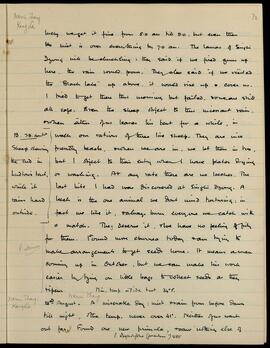
Narin Thang
Kang La

Lucky, we get it fine from 5.0 am till 9.0, but even then the mist is over everything by 7.0 am. The lamas of Singhi Dzong will be chuckling: they said if we fired guns up here, the rain would pour. They also said if we visited the "Black lake" up above, it would rise up and cover us. I tried to get there this morning but failed. Some are still all safe. Even the sheep object to this incessant rain, and when either of us leaves his tent for a while, in walk our rations of three live sheep. They are nice friendly beasts, and when we are in, we let them in too, but I object to their entry when I have plates drying or washing. At any rate there are no leeches. The last bite I had was discovered at Singhi Dzong. A leech is the one animal we don't mind torturing: in fact we like it, and always burn everyone we catch with a match. They deserve it, and we have no feeling of pity for them. Found more eburnea today and am trying to make arrangements to get seeds home. It means a man coming up in October, but we can make his work easier by tying on little bags to collect seeds as they ripen. Min. temp inside tent 34°F.

Narin Thang
Kang La
22nd August. A miserable day: mist and rain from before dawn till night, and the temp. never over 41°. Neither of us went out far. Found one new primula, and saw nothing else of P. dryadifolia (jonarduni?) 455.

Mipa and Tama La observations, 20 June
LSH/1/1/3/3/199 · Part · 1996-06-18
Parte de The Ludlow & Sherriff Collection

SUMMARY:
Field notes record Primula species near Mipa, a description of the Mipa valley, a pilgrim with a goat and a sheep, and another Anthus nest with three eggs. On 20 June at Tama La (via Shagam La), the party found P. dryadifolia on cliffs and a yellow Meconopsis (2188), likely M. horridula var. lutea.

CONTENT:
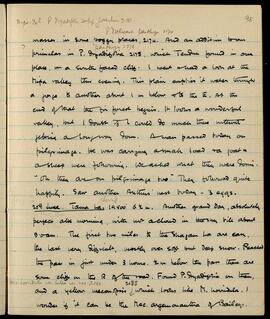
Mipa - 20th. P. dryadifolia subsp. jonarduni 2181.
P. dickieana pantlingii 2174

masses in some boggy places, 2174. And an addition to our primulas in P. dryadifolia 2178 (pantlingii 2178), which Tendrup found in one place, on a south-faced cliff. I went and had a look at the Mipa valley this evening. This plain empties its water through a gorge to another about 1 m below it to the E. At the end of that the fir forest begins. It looks a wonderful valley, but I doubt if I could do much there without getting a long way down. A man passed today on pilgrimage. He was carrying a small load and a goat and a sheep were following. We asked what they were doing. "Oh they are on pilgrimage too." They followed quite happily. Saw another Anthus' (Sherriff) nest today - 3 eggs.

20th June. Tama La. 14500' 6 ½ m. Another grand day, absolutely perfect all morning, with not a cloud in the sky till about 9.00 am. The first two miles to the Shagam La are easy, the last very difficult, mostly over soft but deep snow. Reached the pass in just under 3 hours. ½ m below the pass there are some cliffs on the R of the road. Found P. dryadifolia on them, and a yellow meconopsis (2188) which looks like M. horridula. I wonder if it can be the Mec. argemonantha of Bailey.

(Mec. horridula var. lutea var. nov. 2188)

LSH/1/1/3/3/207 · Part · 1996-06-18
Parte de The Ludlow & Sherriff Collection

SUMMARY:
The diarist crosses the steep Kangin La (c. 15,250'), descends past a small lake, joins the route from Potrang, and follows the right bank of a stream to Tahtsang. Notes include Lerwa with young and several Primula observations and collections, including a pink form like that from the Chichchar valley (No. 2195), a minutissima-section primula (No. 2194), 'Ramzana's' primula, and a yellow form (No. 2175).

CONTENT:
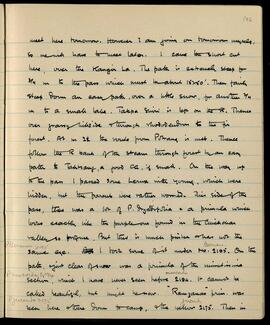
meet here tomorrow. However, I am going on tomorrow myself, so we will have to meet later. I came the short cut here, over the Kangin La. The path is extremely steep for 3/4 m to the pass which must be about 15,250'. Then fairly steep down an easy path, over a little snow, for another 3/4 m to a small lake. Takpa Shiri is left on the R. Thence over grassy hillside and through rhododendron to the fir forest. At m 2 1/2 the route from Potrang is met. Thence follow the R bank of the stream through forest by an easy path to Tahtsang, a good C.G. if small. On the way up to the pass I passed some Lerwa with young, which were hidden, but the parents were rather worried. This side of the pass, there was a lot of P. dryadifolia and a primula which looks exactly like the purple one found in the Chichchar valley so profuse. But this is much pinker and has not the same eye. I took some of it under No. 2195. On the path, just clear of snow was a primula of the minutissima section, which I have never seen before 2194. It cannot be called beautiful, but might be new. 'Ramzana's' prim. was seen here and there down to camp, and the yellow 2175. Then in

LSH/1/1/9/1/145 · Part · 1933-09-01
Parte de The Ludlow & Sherriff Collection

SUMMARY:
Notes record altitudinal occurrences and absence of hybrids, with blue flowers flowering later than white, and observations on farina and scent. Mentions that the Bumthang Chu-Trongsa Chu Divide may separate blue and white forms, and that pedicellation is not diagnostic for P. dryadifolia, with comparisons to cliffs in SE Tibet.

CONTENT:
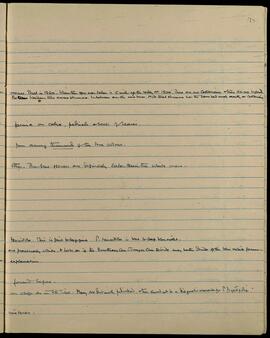
137

occurs. That is 13500'. Where the specimen was taken is 5 miles up the valley at 15000'. There are no Calderiana there are no hybrids.
Waihau there are no strumosa. In between are the mixtures. Note that strumosa has the same bad smell exactly as Calderiana.

farina on calyx, pedicels & back of leaves.

from among thousands of the true colour.

Other. The blue flowers are definitely later than the white ones.

tenuiloba. This is pink to deep pink. P. tenuiloba is blue to deep blue-violet.
are practically white. It looks as if the Bumthang Chu-Trongsa Chu Divide may be the divide of the blue & white forms.
explanation.

found before.
on cliffs as in SE Tibet. Many are distinctly pedicelled, this should not be a diagnostic character for P. dryadifolia.

mixtures.