Showing 5 results

Archival description
5 results with digital objects Show results with digital objects
LSH/1/1/9/1/99 · Part · 1933-07-11
Part of The Ludlow & Sherriff Collection

SUMMARY:
The party crossed a pass and lakes into another valley but found few flowers, noting several Primula species and plants of “Pasang's Abardia” without bloom. The writer criticizes Lhakpa and Ngudup for damaging collections and considers asking Holt to replace Ngudup; on the 9th a fresh Yertsa-gumbu was found by the pony man and taken by Ngudup for rheumatic pains.

CONTENT:
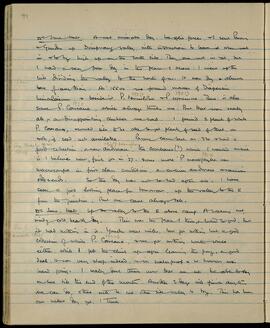
lake, then steep again to a pass. Here we got more prim flowers in sand scree which there abound. Beyond this were more lakes, and we had crossed the divide, as the water flowed down another valley which comes out to the main valley a mile further up than ours. But it was a disappointing day for flowers. We can't get much now, it seems. P. jonarduni was there, and P. tenuifolia and P. waddellii and P. pusilla and P. concinna white and pink. There were also plants of Pasang's Abardia, but no flowers. I hope we can get seed of that thing somewhere. We were out soon after 6:00 and back at 4:00 pm. The trouble of doing that is that Lhakpa and Ngudup do all the flower changing, and they have ruined a number of gatherings by careless work and burning. I can't get either of those two to do anything well, and would cheerfully see them both go. I must ask Holt if I have a chance for someone in Ngudup's place. On 9th, we found one 'Yertsa-gumbu' - a queer thing - the first I have seen fresh. Certainly the root is most 'bug'-feeling and even looking. As it was found by the pony man I did not claim it. It was at once pinched by Ngudup who complained of rheumatic pains, and of course 'Yertsa-gumbu' is wonderful medicine for that. The 'flower' or
LSH/1/1/9/1/98 · Part · 1933-07-10 - 1933-07-11
Part of The Ludlow & Sherriff Collection

SUMMARY:
Notes snow leopard tracks and sparse flowers, including masses of P. concinna and an Allardia found by Pasang, after a strenuous day. On 10 July the party stayed in camp, sent mail to several correspondents, discussed travel plans with H.H., and chose to take the pass opposite Drolmo Sishi La on the 16th; on 11 July bad weather arrived in the afternoon, Yundun could not go out, and the diarist and Pasang went up a nearby valley.

CONTENT:
93
Saxifraga contraria op no. 19390

pugs of a big snow leopard at 15000', but otherwise no wild life. Flowers were very few. P. concinna 19392 was in masses at the first lake, and nearly all white which I've never seen before. Then a little higher, certainly 15500', Pasang found a pretty Allardia, with mauve flowers and covered densely in white felt like hairs, all over. Got back dead beat - even Ngudup - to find the mail had arrived and a basket of vegetables for H.H. Nothing very much in it, but it was nice to have. No mail from Betty. She's been very lucky in weather I must say. Again a fine day.

10th July. Haah. Again a good day, with a few fine showers amid sunshine, and Kanghar visible quite a lot of the day. Stayed in camp and got a mail off to Kyong, H.H., Betty and Wangmoo. Tobsgye is asking for our dates of sailing, so that he can get M.K.'s passage booked too. So I have written H.H. today to ask what his plans are, telling him we proposed to fly, and would prefer to do this, but that we will go by sea if possible should he particularly wish it. No flowers today. We have now planned not to go by the Drolmo Sishi La, but by the one opposite here, on 16th. That decision made, is very nice. Now we have 5 days here, and we know how our time will be fitted in till we go to Bumthang.

11th July. Haah. Another beautiful morning, followed by heavy hail and rain about 2.0pm and clearing up after. Yundun's feet are too bad for him to go out, so Pasang and I went ourselves. We went up stream to the first yak herds on the R bank (1 1/2 m?) then turned up that valley. The climb was very steep at first, past a small

LSH/1/1/9/1/82 · Part · 1937-06-22 - 1937-06-23
Part of The Ludlow & Sherriff Collection

SUMMARY:
In wet conditions the party split up: the diarist had a poor day on a dry hill while Pasang returned with a strong collection including a new Androsace, a suspected new Cochlearia, and P. macrophylla var. macrocarpa, alongside notes on Diapensia himalaica and several Primula including white P. caveana. The following day they worked up the valley east of camp in soaking weather; Gunden went far and gathered white P. caveana, but little else was found, prompting thoughts of leaving the area within a few days.

CONTENT:
22nd June Haer. A wet miserable day. We split forces, I sent Pasang and Gunden up Dimpuang valley with instructions to leave it when well in, and to try high up on the south side. They are not in yet, but I had a very poor day in the place I chose. I went up the hill dividing the valley to the north of us. It was dry and almost bare of anything. At 15,500 we found masses of Diapensia himalaica, and beside it P. tenuiloba and P. concinna. There is also some P. caveana, which always tricks me. But that was really all—a disappointing chukker we had. I found two plants of white P. caveana; would like to be able to get plenty of seed of that, or roots, if seed not available. Pasang came back at 3:30 and had a good collection: a new Androsace, the Cochlearia(?) which I wanted and which is, I believe, new, first for us in '37; some more P. macrophylla var. macrocarpa in first-class condition, a cushion Androsace, and various odds and ends. So the day was not so bad after all. I have seen a good-looking place for tomorrow, up the valley to the east from the junction. But one can never tell.

23rd June - Hall. Up the valley to the east above camp. A soaking wet, windy, cold, beastly day. This was the place I thought looked so good, but it had nothing in it. Gunden went miles, but for nothing but a good collection of white P. caveana, and we got nothing worthwhile either, while I felt the climb up after leaving the pony a good deal. It was very steep indeed, and in waterproof and waterproof trousers was hard going. I really don't think now that we will be able to stay on here till the end of the month. Another three days will finish all that we can do, and there will be no other side valleys to try. This has been our wettest day yet, I think.

LSH/1/1/9/1/144 · Part · 1933-09-01
Part of The Ludlow & Sherriff Collection

SUMMARY:
Page lists Primula specimens with notes on morphology, flower colors, abundance, and growth habits, including forms such as P. caveana, P. muscoides, P. glabra, and P. waddellii. Mentions comparison with earlier collections at Waitang and a reference to a specimen from 1938.

CONTENT:
(3) 136 33.

  1. 19185 P. atrodentata Same as 3636 in 1938.
    19186 P. walshii Scape up to 1" long bearing 1, 2 or 3 flowers. No farina.
  2. 19190 P. bellidifolia.
    19195 P. sikkimensis. A fine form with big flowers, yellow or almost white.
    19203 P. muscoides. 34.
    19204 P. strumosa. See my 19000 A B or C taken at Waitang where a glorious mixture of colours
    19211 P. caveana v. alba
  3. 19212 P. tenuiloba
    19213 P. concinna 35. I think this is correct because of the fairly copious yellow
    19216 P. macrophylla v. macrocarpa
    19226 P. caveana v. alba. A good collection of 5 sheets, but they are odd plants
    19227 P. capitata.
  4. 19231 P. muscoides. Mixed blue and white, which grow actually touching each
    19244 P. macrophylla v. macrocarpa
    19245 P. glabra
    19251 P. umbratilis. Not fully grown.
    19255 P. caveana - full grown.
  5. 19318 P. atrodentata. With new plants growing out from old flower head.
    19325 P. glabra.
    19330 P. waddellii 36. The colour of this is so distinct, that it cannot be confused with P.
    19332 P. umbratilis. I have never seen so much as on this cliff. All of it is very pale indeed, or some
    19346 P. soldanelloides 37 I never noticed before the quite different texture of the corolla. Ask for
  6. 19364 P. muscoides. White form. Here v. common.
    19373 P. waddellii. Very common indeed here, in quite big clumps, not singly, as
    19378 P. jonardunii. 38 Common here, on open steep grass hillsides, not so much
    19383 P. caveana. Much scarcer here than round about Waitang.
  7. 19392 P. concinna v. alba. 80% of P. concinna here are white, remainder pink purple, no
LSH/1/1/5/1/155 · Part · 1933-07-04
Part of The Ludlow & Sherriff Collection

SUMMARY:
A stony valley leading west then north ends in a small lake below a retreating glacier, with steep, crumbling hills and few flowers. The party adds a dwarf primula (possibly Primula walshii) to their tally and compares finds with previous primulas; they travel 8 miles to Thampe with a fine morning and heavy rain in the evening.

CONTENT:
Cyananthus spathulifolius 3412 Cremanthodium cremanthodioides 3418 76

the West, then turned out of that to the north. Like all valleys here it was full of stones and boulders. It finished at about 15,500 or 16,000' in a lake 600 yds long and 200 yds wide, beyond which was a retreating glacier. The hills all round are crumbling to bits, very steep, and don't look much good for flowers. However we brought our primula total up to 39 with a dwarf one - perhaps Primula walshii - very little of which we saw, No. 3413.
P. concinna 3413 (1937)
On the way back we found a lovely primula, very like a small edition of P. obtusifolia collected yesterday.
P. caveana 3410 (1936)
This is almost certainly P. caveana, No. 3410.
P. tenuiloba 3417 (1933-34)
Flower rather smaller, a little redder, and more farina on leaves, both surfaces, bracts, calyx and pedicels.

11th July. Thampe. 8 miles. Fine for an hour or two in the morning. Rain very heavy in evening, with strong wind. Nothing new to be seen, though we