Mostrar 4 resultados

Descrição arquivística
4 resultados com objetos digitais Mostrar resultados com objetos digitais
LSH/1/1/6/1/141 · Part · 1936-10-02
Parte de The Ludlow & Sherriff Collection

SUMMARY:
At Lo La, the diarist collected Primula and Rhododendron specimens around a small lake amid frost, snow, and sun, noting Jill’s reluctance to collect seeds and the coolies’ hardiness. On October 8 a halt was made; a circuit to the southwest of the lakes yielded a few bulbs, and Tsongpen arrived reporting difficulties obtaining ripe seed, fears of Lhopas on the route, and a theft problem with a dismissed man.

CONTENT:
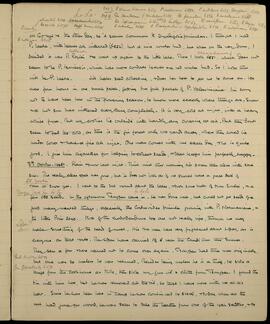
Lo La. Oct 7. P. chamaethauma 6551, P. calderiana 6552, P. subularia 6553, tsangpoensis 6554.
Oct 8. Gent. hamberxii f. caulibaccans 6555, Rh. pumilum 6556, R. concatenans 6560.
Rh. lopsangianum 6561, 6567 R. lindleyi 6562, R. xeriflorum 6563, R. haysii 6565.
R. elatum 6568, R. brachyanthum v. hypolepidotum 6576, R. sulphureum 6580.
abrivale 6558, normaniana 6574.
laccata 6575, Omph. minor 6585.

On Gonyi-re the other day, so it seems common to Omphalifolia primulas. I thought I had P. laeta, with leaves all withered (6552), but a nice winter bud, but when on the way down, I decided it was P. calderiana so went up again to the little lake. There I took 6551, which does not seem to be P. tsariensis, which has more cordate leaves & a red winter bud. So I hope this will be P. laeta. Jill hates seed collecting, & does her best to get me to come on. We were four hours in one small patch, getting two full packets of P. valentiniana. I'm sorry not to have been here in the flowering season, to know more exactly where things are. Snow & a hot sun has withered everything completely. It is very cold at night, with a heavy white frost. But my coolies lie outside with hardly any covering at all. But they don't seem to feel the cold, as there is the fir forest only 100 yards away, where they could lie under cover & have a fire all night. One man comes into me each day, this is quite good. I give him cigarettes for helping to collect seeds, & that keeps him perfectly happy.

8th October. Halt. Rain & snow last night. Thick mist this morning till 9.00 am then clear with some sun. The really clear spell has gone, but it does not look as if we should have a great deal of rain or snow yet. I went to the SW round about the lakes, & took some bulbs of Nom. souliei, & a few odd seeds. In the afternoon Tsongpen came in. He has done well, but could not get seeds of a good many wanted things, especially the Cortusoides primula growing with P. normaniana, & the little Prim 3640. Most of the rhododendrons too are not really ripe, though we may make something of the seeds of most. His two men were very frightened about Lhopas, as is everyone on that route. The Lhopas have carried off 5 near the Chudi-Cun this summer. They saw a few & were warned not to come over again. Tsongpen had three men originally, but one was so useless he was returned. Besides being useless he is a thief. He stole a knife from the cookhouse at Molo, then stole my gun oil & cloth from Tsongpen. I found the tin with him here, but he has removed all the oil, so that I have none with me at all now. Since he has been here in camp he has continued to steal, & today when all the rest had gone for wood, he was seen to take the leather from one of the yak saddles, & to...
LSH/1/1/6/1/146 · Part · 1936-10-02
Parte de The Ludlow & Sherriff Collection

SUMMARY:
Entries for 13 and 14 October describe wet, misty conditions around Trashidzung and Langong, limited success collecting rhododendron seed, and a pressing of P. chamaethauma, with coolies assisting and seeds dried for packing. News from Ludlow reports delays and rerouting due to the Lilung bridge collapse, with casualties and mail issues, and mentions movements via Lhacha, Tsela Dzong, and toward Kyindong/Sangachöling.

CONTENT:
74a
Oct. 13 Tsari Sama
seeds of P. chamaethauma 6603, P. morsheadiana 6604,
P. sikkimensis 6606, P. vernicosa 6607,
Swertia kantelu 6605.

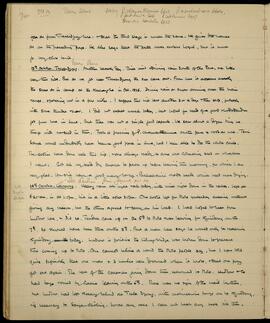
far as from Trashidzung here: & that the third stage is much the same. He gives two names as on the preceding page. He also says that the path never enters Loque, but it must go very close to it.

Tsari Sama
13th October. Trashidzung. Another beastly day. Thick mist & driving rain south of the Pass, & little on this side. But as we got near Trashidzung the sun came out. From here it appears exactly the same as in camp at the Kashong La in Oct. 1936. Driving rain or snow coming over the main range, petering out in a few miles. I suppose this will last another 3 or 4 days then stop, probably with some thunder snow. I did not expect much today, but hoped for seed of a good rhododendron got from here in June. But there was not a single good capsule. We saw about a dozen tiny wee things with no seed in them. Took a pressing of P. chamaethauma on the pass & root as well. Tsari Sama would undoubtedly have been a good place in June, had I been able to do the whole circle. The coolies have done well this trip, & are always ready to come out collecting seed or whatever I want. Got all my seeds dry enough to pack up before leaving this morning, for which I am very glad. We still have a good many Lo-La - Pachakshiri rhodo seeds which need more drying.
See Ludlow's diary - Kew Journal XII 14.

14th October. Langong. Heavy rain all night & all today, with mist right down in the valley. Left at 8.30 am, in at 1.0 pm, kit in a little after 3.0 pm. One coolie left for Molo yesterday evening without giving any reason, but the others agreed to carry on his load. I had hoped to hear from Ludlow here, & did so. Tendup came up on the 5th to Molo & was leaving for Kyindong on the 7th, so should have been there on the 9th. But a man here says he would only be reaching Kyindong today. Ludlow is positive the Lilung bridge was broken down to prevent their coming up to Molo. One cannot believe a word the Molo people say, but I was told quite definitely that one man & 3 mules were drowned when it broke, & that one pony got out again. The rest of the caravan going down then, returned to Molo. Ludlow & Co had to go round by Lhacha leaving on the 5th. There was no sign of the mail between, but Ludlow had left Kesang behind at Tsela Dzong, with instructions to go on to Kyindong, if necessary to Sangachöling. So at any rate I can not hear any more till then.

LSH/1/1/7/1/7 · Part · 1940-05-24
Parte de The Ludlow & Sherriff Collection

SUMMARY:
The diarist notes bodies with bows left beside them and observes alpine flora on nearby snow slopes and streambeds. Accompanied by Langong coolies, they visit the Tsari Sama (Sarpa) pilgrimage area, finding it rich in Primula, Rhododendron, and a new white-flowered Daphne near the pass to Lopa territory. Trashiyang is mentioned as the starting and finishing point of the pilgrimage.

CONTENT:
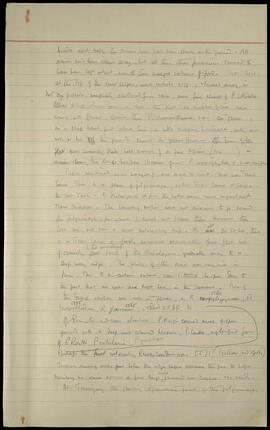
Beside each body, the owner's bow had been stuck in the ground. All arrows had been taken away, but all their other possessions seemed to have been left intact, even to their meagre rations of food. Near here, at the top of the snow slopes, were vertical cliffs. Tucked away in dust-dry pockets, completely sheltered from rain, were fine clumps of P. littledalei.

A little lower down, at 14,000', the first Meconopsis simplicifolia were coming into flower. Beside this, P. chamaethauma was in flower, and on a steep bank just above this, a little creeping Lonicera, only an inch or two off the ground, showed its yellow flowers. Some of the open swampy flats held masses of a fine Allium (No. ). On stony beds beside streams grow P. macrophylla v. macrocarpa.

There remained, near Langong, one area to visit, that was Tsari Sama. This is a place of pilgrimage, called Tsari Sama or Sarpa—the new Tsari—to distinguish it from the better-known, more important Tsari Chikchar. The Langong coolies were not anxious to go round the pilgrimage, for which I could not blame them. However, they took me, and it was a most interesting trip. As at the Lo La, there is in Tsari Sama a fairly extensive, reasonably open flat bit of country, just north of the immediate Himalayas, gradually rising to a steep rocky ridge. The whole of this area was very rich in flora. This, to a certain extent, can, I think, be put down to the fact that no yaks are kept here in the summer. None of the dwarf rhodos were now in flower, and R. campylogynum (5560), R. trichocladum (5555), R. glaucum (5565). Also 5568.

A Primula not seen elsewhere, P. Kingii covered acres of open ground with its deep wine-coloured blooms, P. laeta, a glorified form of P. Roylei. Primula, P. gracilipes.

Perhaps the most interesting Rhododendron was 5571 (yellow, red spots). Growing among rocks just below the ridge before reaching the pass to Lopa territory, we came across a fine large, white-flowered new Daphne. No seeds.

At Trashiyang, the starting and finishing point of the pilgrimage,

Flora near Kucha La and Tsangpo valley spur (Go ngi re)
LSH/1/1/7/1/13 · Part · 1940-05-24
Parte de The Ludlow & Sherriff Collection

SUMMARY:
The writer describes difficult access near a Himalayan pass, noting most rhododendrons were over, while several primulas remained in flower, including a new species later named P. tsangpoensis. After retreating to the drier Tsangpo valley, they explored a nearby spur called Go ngi re, recording diverse alpine plants and collecting seed with the help of a hopa.

CONTENT:
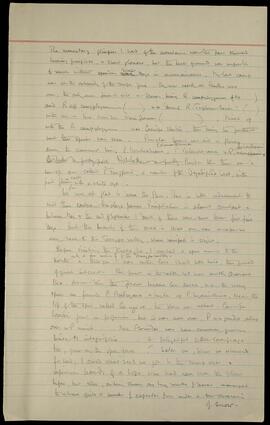
The momentary glimpses I had of the mountains near the pass showed towering precipices and short glaciers, but the best ground was impossible to reach without spending some days in reconnaissance. The last camp was at the extremity of the conifer zone. By now nearly all Rhodos were over, the only ones found still in flower being R. campylogynum (No. ) and R. aff. campylogynum ( ) and a dwarf R. Triflorum series? ( ) with one or two crimson neriiflorum ( ). Mixed up with the R. campylogynum was Cassiope wardii, this being the furthest west this species was seen. Primulas however were still in flower, among the commonest being P. morsheadiana, P. chamaethauma, P. valentiniana and P. tsariensis. Besides this there was a new sp. now called P. tsangpoensis, a member of the Dryadifolia section, with pink flowers each with a white eye.

We were all glad to leave the Pass. There is little inducement to visit these eastern Himalayan passes. Precipitation is almost constant between May and the end of September; I doubt if there were more than five fine days. But the beauty of the area is that one can escape so easily back to the Tsangpo valley, where rainfall is slight.

Before visiting the Kucha La, I worked a spur only a few miles N. of the Tsangpo valley. Though I was rather late and had little time, this proved of great interest. The forest in the valley bed was mostly Quercus ilex. Above this the forest became less dense, and on the rocky spurs we found P. baileyana, and higher up P. hyacinthina. Near the top of the spur, called Go ngi re, the flora was richest. Cassiope wardii grew in profusion, but it was now over, P. unijuga also over and of merit. Meconopsis florindae was here common, growing beside M. integrifolia. A delightful little saxifrage too, grew on the open scree. Later on, when we returned for seed, I owed what seed we got to the sharp eyes and unwearying hands of a hopa who had never seen the plant before, but who, on being shown one tiny rosette of leaves, managed to retrieve quite a number of capsules from under a thin covering of snow.