Showing 11 results

Archivistische beschrijving
11 results with digital objects Show results with digital objects
LSH/1/1/5/1/93 · Part · 1933-05-30
Part of The Ludlow & Sherriff Collection

SUMMARY:
The party revisits the La, noting flowering Lilium giganteum, rhododendrons (possibly R. maddenii or R. calophyllum), and a primula akin to P. Boothii. A sepoy brings letters and gifts from Ashi Wangmoo and Tasho Haku, with reflections on Wangmoo’s situation as a nun; the Mara Chu is observed plunging in dramatic falls.

CONTENT:
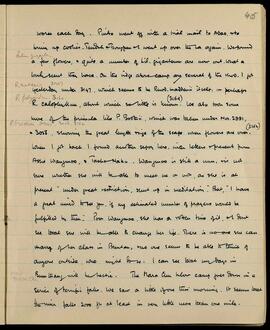
worse each day. Pintso went off with a trial mail to Adao, to bring up coolies. Tenduk & Tsoupen & I went up over the La again. We found a few flowers, & quite a number of Lil. giganteum are now out. What a lovely scent they have. On the ridge above camp are several of the Rhod. I got yesterday under 3147, which seems to be Rhod. maddenii itself, or perhaps R. calophyllum, about which so little is known. We also took some more of the primula like P. Boothii, which was taken under Nos. 2991, & 3056, showing the great length & size of the scape when flowers are over.

When I got back I found another sepoy here, with letters & presents from Ashi Wangmoo, & Tasho Haku. Wangmoo is still a nun, & is not sure whether she will be able to meet me or not, as she is at present "under great restriction, shut up in meditation". But, "I have a great mind to see you, if my estimated number of prayers would be fulfilled by then." Poor Wangmoo, she has a rotten time of it, & I don't see that she will be able to change her life. There is no one she can marry of her class in Bhutan, & no one seems to be able to think of anyone outside, who might do so. I can see that my days in Bumthang will be hectic. The Mara Chu below camp goes down in a series of terrific falls. We saw a little of one this morning. It seems that the river falls 2000 ft at least in very little more than one mile.
LSH/1/1/5/1/135 · Part · 1936-06-27
Part of The Ludlow & Sherriff Collection

SUMMARY:
The diarist halts for two days, then travels via Chendebi toward Bumthang, noting persistent rain and brief clear periods. They collect a little seed of P. Boothii and discuss an uncertain Primula (specimen 3052), comparing it with P. tenella and noting that seed is not yet ripe.

CONTENT:
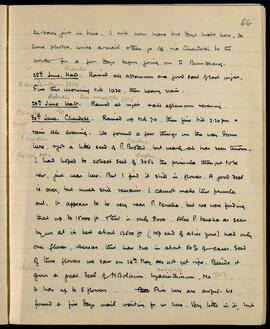
be back just in time. I will now have two days halt here, do some photos, write a mail and then go off via Chendebi to the north for a few days before going on to Bumthang.

28th June. Halt. Rained all afternoon and a good deal last night. Fine this morning till 10:30, then heavy rain.

29th June Halt. Rained at night, and all afternoon and evening.

30th June. Chendebi. Rained up till 7:00, then fine till 2:30 pm and rain all evening. We found a few things on the way down here, got a little seed of P. Boothii, but nearly all has been thrown.

I had hoped to collect seed of 3052 the primula thought to be new, just near here. But I find it still in flower. A good deal is over, but much still remains. I cannot make this primula out. It appears to be very near P. tenella, but we were finding that up to 15,000 ft and this is only 8,000. Also P. tenella as seen by us at its best about 12,500 ft (top end of abies zone) had only one flower, whereas this has two in about 50% of cases. Seed of these flowers we saw on 14th May are not yet ripe. Beside it grows a great deal of Notholirion hy

LSH/1/1/5/1/168 · Part · 1933-07-21
Part of The Ludlow & Sherriff Collection

SUMMARY:
Identifies specimen 2468 as true P. Boothii, with uncertainty about 2984 and 2991. States that 3056, 3162, and 3333 are P. bracteosa, and that seeds sent home in CO2 to Edinburgh were from 3162.

CONTENT:

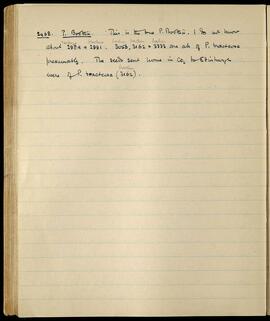
  1. P. Boothii. This is the true P. Boothii. I do not know
    about 2984 & 2991. 3056, 3162 & 3333 are all of P. bracteosa
    presumably. The seeds sent home in CO2 to Edinburgh
    were of P. bracteosa (3162).
LSH/1/1/5/1/169 · Part · 1933-07-21
Part of The Ludlow & Sherriff Collection

SUMMARY:
Notes on Codonopsis subsimplex and several Primula species, correcting earlier identifications to P. bracteosa, with collecting of P. Boothii seed and roots and observations on leech altitude. Messages arrived from Domkhar and Bumthang, and the party proceeded 5 miles to Dhomkhar where they received an army reception with bands.

CONTENT:
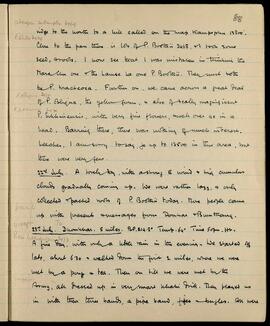
88

Codonopsis subsimplex 3469
ridge to the north to a hill called on the map Kampojohn 13800'.

P. bhutanica 3468
Close to the pass there is lots of P. Boothii 3468, & I took some seed, & roots. I now see that I was mistaken in thinking the Mara Chu one & the Lamse La one P. Boothii. They must both be P. bracteosa. Further on, we came across a great deal

P. obliqua 3470
of P. obliqua, the yellow form, & also of really magnificent

P. sikkimensis 3471
P. sikkimensis, with very fine flowers, well over 40 in a head. Barring these, there was nothing of much interest. Leeches, I am sorry to say, go up to 13500 in this area, but there were very few.

22nd July. A lovely day, with a strong E wind & big cumulus clouds gradually coming up. We were rather lazy, & only collected & packed roots of P. Boothii today. More people came
presents
up with presents & messages from Domkhar & Bumthang.

To
23rd July. Dhomkhar. 5 miles. BP. 204.8° Temp. 64° Time 5.0pm. Ht. 4000ft
Picea likiangensis 3473
A fine day, with only a little rain in the evening. We started off late, about 6.30 & walked down the first 2 miles, where we were met by a pony & tea. Then on till we were met by the
reception
Army, all dressed up in very smart khaki drill. They played us in with their three bands, a pipe band, fifes & bugles. All were

LSH/1/1/5/1/215 · Part · 1937-07-31
Part of The Ludlow & Sherriff Collection

SUMMARY:
Checklist of Primula species collected in 1937, with notes on prior collection status and several specimen numbers. Localities mentioned include Chendebi and Tang Chu.

CONTENT:
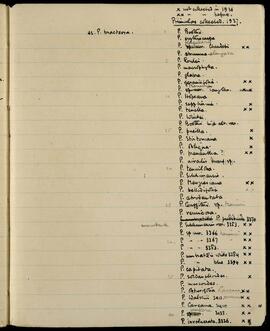
x not collected in 1936
xx " " " before.
Primulas collected. 1937.

  1. P. bracteosa.

1 P. Boothii.
P. erythrocarpa
P. flagellaris
P. sp. nov. Chendebi xx
5 P. strumosa elongata
P. Roylei.
P. macrophylla.
P. glabra.
P. geraniifolia xx
10 P. sp. nov. Tang Chu. xx
P. Hopeana
P. sapphirina x
P. tenella. xx
P. Winteri.
15 P. Boothii high alt. var.
P. pusilla. x
P. Stirtoniana x
P. obliqua. x
P. prenantha? xx
20 P. nivalis dwarf sp.
P. tenuiloba.
P. sikkimensis.
P. Menziesiana xx
P. bellidifolia xx
25 P. atrodentata
P. Griffithii sp. hancini
P. vernicosa.
P. pudibunda 3370
P. sikkimensis var. 3353. xx
30 P. sp. nov. 3366 hancini xx
P. " " 3367 xx
P. " " 3383. xx
P. umbratilis white 3384 xx
P. " blue 3394 xx
35 P. capitata.
P. soldanelloides. x
P. muscoides.
P. obtusifolia Caveana xx
P. Walshii 3413 concinna xx
40 P. Caveana 3410 xx
P. uniflora 3438. x
P. involucrata 3226. x

LSH/1/1/6/1/93 · Part · 1938-07-08
Part of The Ludlow & Sherriff Collection

SUMMARY:
The diarist travels through swampy valleys near Tum La in persistent rain, noting mallard and snipe, yakherd huts, and that the pass is very low. Botanical work records several Primula species mostly past flowering; an attempt to explore the ridge in thick mist results in getting lost and retracing the route with help from a local.

CONTENT:
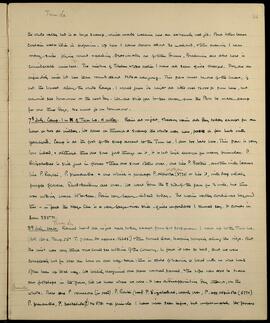
Tum La

the whole valley bed is a huge swamp, which made walking here an extremely wet job. But these lakes contain water lilies in profusion. Up here I came across about 30 mallard, this evening I hear many snipe flying round and calling. Occasionally one of them drums. Brahmins are also here in considerable numbers. The mixture of Tibetan and Lopa coolies I have all seem quite cheerful. They are an infinitely nicer lot here than round about Molo and Langong. This pass must be one of the lowest, if not the lowest along the whole Range. I would guess its height at little over 12000 ft from here, but we will see tomorrow or the next day. We are still far too far away from the Pass to make camp for our three days, so must go on tomorrow.

7th July. Camp. 1 m N of Tum La. 4 miles. Rain at night, then rain all day today except for an hour or two at midday. We came on through a swamp the whole way here, past a few huts with yakherds. Camp is at the foot of the steep ascent to the Tum La. I am too late here. This pass is very low indeed, and although there are some good things on it, it is not high enough for many primulas. P. Elizabethae is still just in flower and there are some others over, one like P. Boothii, another with leaves like P. Roylei, P. prenantha and one which is perhaps P. alpicola violacea (3770) or like it, with deep velvety purple flowers. Rhododendrons are over. We went down the S side of the pass for ½ mile, but there was nothing much to be seen. Rain very heavy indeed today. The main valley continues beyond this - in fact the Nyam Chu is a very large river still - quite unfordable I should say. It comes in from 285° M.

8th July. Halt. Tum La. Rained hard all night and all today except from 4.0 to 6.0 am. I went up to the Tum La, (B.P. 190.4. Temp. 55° T. 7.0 am. Ht approx. 12243') then turned East, keeping roughly along the ridge. But the mist was very thick and we could see nothing of the country. In fact it was so bad, that we were completely lost for over an hour on our way back: this in spite of having a local with us who had often been up that way. We luckily recognized one place we had passed, and the Lopa was able to track our footsteps in the grass, till we knew where we were. It was a disappointing day though, on the whole. There are P. vernicosa (in seed). P. Roylei (seed) P. Elizabethae, nearly over, P. aff. alpicola (5770) P. prenantha, P. barbatula No 5791 a primula I have never seen before, but unfortunately the flowers

LSH/1/1/3/3/29 · Part · 1937-02-27
Part of The Ludlow & Sherriff Collection

SUMMARY:
During a three-day halt, the party planned to head toward Sakden, while noting a Primula from Yonpu La as P. Boothii, previously found by Cooper and K. Ward in the Nyamjang chu. Lumsden treated many patients, the Dzongpen provided supplies and huts for the route up the Gamri Chu, and Ahmad Sheikh made excuses when tasked with making mince pies.

CONTENT:
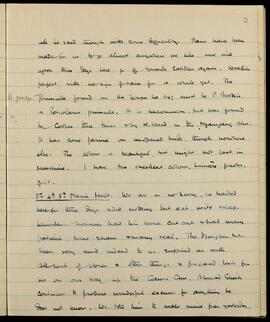
all he said, though with some difficulty. Plans have been made for us to go almost anywhere we like, and we will, after three days here, go off towards Sakden again. Weather perfect, with no sign of rain for a while yet. The Primula found on the Yonpu La 1147 must be P. Boothii, a Petiolaris primula. It is uncommon, but was found by Cooper three times and by K. Ward in the Nyamjang chu. It has some farina on unopened buds, though nowhere else. The colour is beautiful, but might not last in sunshine. I have two excellent colour Lumière photos of it.

3rd, 4th, 5th March Halt. We are in no hurry, so halted here for three days and did nothing but eat, write, and sleep. Lumsden, however, had his work cut out and had many patients, some sham and many real. The Dzongpen has been very kind indeed to us, supplied us with all sorts of stores and other things, and prepared huts for us on our way up the Gamri Chu. Ahmad Sheikh continues to produce wonderful excuses for anything he does not know. We told him to make mince pies yesterday,

LSH/1/1/3/3/79 · Part · 1936-03-10
Part of The Ludlow & Sherriff Collection

SUMMARY:
After a clear morning following heavy rain, the party marched up the rocky gorge to Lepo, crossing to the left bank and noting numerous Primula and Rhododendron species; locals were friendly and the plain resembled Pangchen. Rain returned in the afternoon. The next day was a halt at Lepo due to continuous rain, with time spent writing letters.

CONTENT:
Le-Lepo.

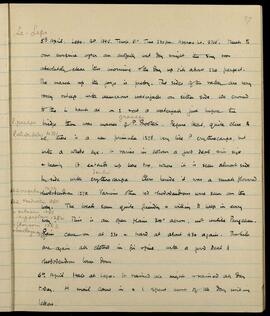
5th April. Lepo. B.P. 19.45. Temp. 51°. Time 3.30 pm. Approx ht. 9766. Much to our surprise after an awfully wet day and night the sky was absolutely clear this morning and the day up till about 2.30 perfect. The march up the gorge is pretty. The sides of the valley are very rocky and steep with numerous waterfalls on either side. We crossed to the left bank at 1 and at a waterfall just before the bridge there was masses of P. gracilipes (originally noted as P. Boothii). Before that, quite close to Le, there is a new primula (P. atrodentata 1278), very like P. erythrocarpa (denticulata), but with a white eye. It varies in colour a good deal, in size and beauty. It extends up here too, where it is seen almost side by side with erythrocarpa. Close beside it was a small flowered Rhododendron (Rhd. virgatum 1279). Various other red rhododendrons were seen on the way (including Rhod. Kendrickii 1280, R. arboreum 1281, R. argipeplum 1282, R. Thomsonii 1283, and R. baileyi 1284 & 85). The locals seem quite friendly and willing to help in every way. This is an open plain 300 yards across, not unlike Pangchen. Rain came on at 2.30 and hard at about 4.30 again. The hills are again all clothed in fir and pine, with a good deal of rhododendron lower down.

6th April. Halt at Lepo. It rained all night and rained all day today. A mail came in and I spent most of the day writing letters.

LSH/1/1/3/3/81 · Part · 1936-03-10
Part of The Ludlow & Sherriff Collection

SUMMARY:
At Lepo the party halted for two days; Danong explored a stream from Chio Tso and found masses of Primula, while the diarist noted rhododendrons, firs and larch, and prepared mail. Rain limited finds the next day, though P. Boothii was abundant at waterfalls, and Lumsden took a shot at pintail ducks.

CONTENT:
38

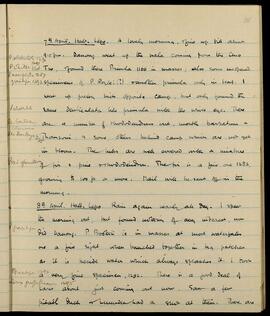
7th April. Halt. Lepo. A lovely morning, fine up till about 4.0 p.m. Danong went up the nala coming from the Chio Tso, found there Primula 1186 in masses; also some unopened specimens of P. Boothii (?) & another primula only in leaf. I went up pretty high opposite camp, but only found the same denticulata-like primula with the white eye. There are a number of rhododendrons out, mostly barbatum & Thomsonii, & some others behind camp which are not yet in bloom. The hills are well covered with a mixture of fir & pine & rhododendron. The fir is a fine one 1286, growing to 100 ft or more. Mail will be sent off in the morning.

8th April. Halt. Lepo. Rain again nearly all day. I spent the morning out, but found nothing of any interest, nor did Danong. P. Boothii is in masses at most waterfalls; it is a fine sight when bunched together in big patches as it is beside water which always splashes it. I took a very fine specimen, 1292. There is a good deal of larch about just coming out now. Saw a few pintail duck & Lumsden had a shot at them. There are

Marginal Notes:
P. atrodentata 1290
P. Whitei 1186, 1291
P. macrophylla 1287
gracilipes 1292
Rh. barbatum
Rh. Thomsonii
Rh. Baileyi 1285
Picea spinulosa
P. gracilipes
P. gracilipes 1292
Larix griffithiana 1295

LSH/1/1/7/1/23 · Part · 1940-04-22
Part of The Ludlow & Sherriff Collection

SUMMARY:
The diary describes the poorly maintained Molo–Lhalung path, the heavy loads carried by local coolies, and observations of Primula species along the route, including P. Normaniana and P. latisecta with notes on their phenology. From a camp on the Chindi Chu the party climbed over the Nyug La through dense forest with Rhododendron and bamboo, noted P. tsariensis var. porrecta and P. Boothii, and obtained a view of the Lhalung valley, with P. Boothii extending its known distribution from the type locality in Bhutan.

CONTENT:
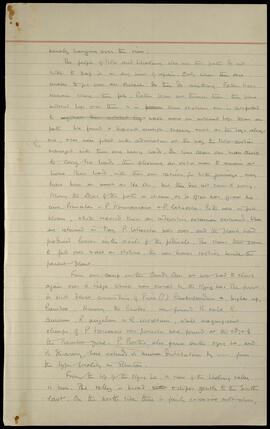
usually hanging over the river.

The people of Molo and Lhalung who use this path do not bother to keep it in any kind of repair. Only when they are unable to get over an obstacle do they do anything. Fallen trees remain where they fell. Rather than cut through them, they place notched logs over them and in some stretches one is compelled to walk more on notched logs than on path. We found it difficult enough, slippery and wet as the logs always are, and we were filled with admiration at the way the Molo coolies managed with their very heavy loads. In some cases one man chose to carry two loads, thus allowing an extra man to remain at home. These loads, with their own rations for both journeys, may have been as much as 160 lbs, but they did not seem to worry. Along the edges of the path or stream, as it often was, grew two new Primulas - P. Normaniana and P. latisecta. Both were in full bloom, and both records show an interesting extension westward. When we returned in May P. latisecta was over, and the plants had produced leaves in the axils of the pedicels. The stems then seem to fall over and act as stolons, the new leaves rooting beside the parent plant.

From our camp on the Chindi Chu we now had to climb again over a ridge which was crossed by the Nyug La. The forest is still dense, consisting of Picea (?) Rhododendron and, higher up, Bamboo. Among the Rhodos, we found R. rude, R. aureum, R. arizelum and R. uvarifolium, while magnificent clumps of P. tsariensis var porrecta were found at the edge of the Bamboo zone. P. Boothii also grows on the Nyug La, and its discovery here extends its known distribution by —— from the type locality in Bhutan.

From the top of the Nyug La, a view of the Lhalung valley is seen. The valley is broad and slopes gently to the South East. On the north side there is fairly extensive cultivation,