Showing 25 results

Archival description
25 results with digital objects Show results with digital objects
LSH/1/1/3/3/87 · Part · 1933-04-09
Part of The Ludlow & Sherriff Collection

SUMMARY:
Notes local customs of refusing meat and sending honey to the Dzongpon. Describes a 12-mile march to Tsona over a snowy pass around 14,500 ft with clear but windy conditions, and records observations of Primula species and flocks of grandala.

CONTENT:
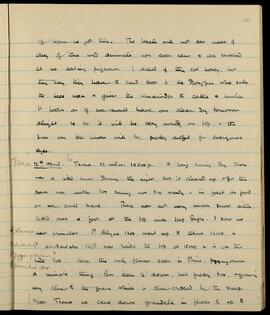
The locals will not eat meat of any of these wild animals, nor even hens, and are shocked at us eating pigeons. I asked if they eat honey, but they say they have to send that to the Dzongpon, who sells the beeswax and gives the remainder to cattle and mules. It looks as if we should have our clear day tomorrow all right. If so it will be very windy on top, and the sun on the snow will be pretty awful for everyone's eyes.

Tsona 12th April. To Tsona. 12 miles. 14500 ft. A long tiring day. There was a little snow during the night, but it cleared up and for the pass was neither too sunny nor too windy - in fact as good as we could have. There was not very much snow either, little over a foot at the top with deep drifts. I saw no new primulas. P. obliqua 1300 went up to about 14000, and P. atrodentata 1278 was beside the top at 15000 and is on this side too. Here the only flower seen is Prim. pygmaeorum, a minute thing less than 1/2 inch across, but pretty too, and growing very close to the grass which is close cropped by the sheep. Near Tsona we came across grandala in flocks of up to

LSH/1/1/3/3/158 · Part · 1983-05-05
Part of The Ludlow & Sherriff Collection

SUMMARY:
Notes describe the Tsari river dropping rapidly like a cataract, with estimates of 500–600 ft per mile after leaving camp. A plant list is recorded at Podzo Sumdo (22 May), and observations at Migyitun note cultivation and a nearby holy lake Tso Kar, with black currants often epiphytic and biting insects common between there and Chick Kar.

CONTENT:
192.4
53

10033
1.0466
10033
40132
60198
1049451

L. p. 96. Killing of newly born calves?
(offspring of "Dzos")

Tsari river falling at a tremendous pace.
For over a mile it was nothing but a
cataract confined to a narrow boulder
strewn bed.

Podzo Sumdo
22 May
Diapensia himalaica 1640
P. atrodentata 1641
spru. "tsariensis 1650
dictyoneura 1654
praealta 1658
glabra 1642
Lloydia tibetica 1645
Pedicularis roylei 1646
Rhod. tsangpoense var.
pruniflorum 1647

  • Calostrotum 1649
  • lopsangianum 1631
    Anthopogon 1653
    Caloxanthum 1656
    Vaccinium sikkimense 1644
    " nummularia 1655
    Sax. granulata 1659

    9205.
    1.0599
    9205
    46025
    82845
    8284
    9757.379

L. p. 98 I think the Tsari river must be dropping
500-600 ft per mile for the first mile after leaving camp.

At Migyitun the valley opens out & there is quite a lot of cultivation including barley, potatoes,
turnips etc. Half the inhabitants here are either pure Lobas or have Loba blood in them.
A large stream comes in from the North & 2 marches distant is a holy lake "Tso Kar".
Black currants abound between here & Chick Kar. A curious feature about the bushes
is that they are frequently epiphytic.
Biting midges, ticks, fleas, & of course a louse or two.

LSH/1/1/4/1/13 · Part · 1936-07-02
Part of The Ludlow & Sherriff Collection

SUMMARY:
Travel from high pass to Tron with yak transport only; steep shale ascents/descents over Drosung La (~16,000 ft), rain turning dry after descending. Collected seeds of Pedicularis atrodentata and noted Pedicularis bella (2306) and an unidentified Meconopsis (2309); camped near irrigation canal with flat-roofed houses observed.

CONTENT:
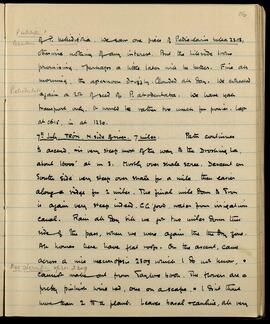
of P. bellidifolia. We saw one piece of Pedicularis bella 2306,
otherwise nothing of any interest. But the hillside looks
promising, perhaps a little later will be better. Fine all
morning, the afternoon drizzly. Clouded all day. We collected
again a lot of seed of P. atrodentata. We have yak
transport only. It would be rather too much for ponies. Left
at 06.15, in at 12.30.

7th July. TRON, N. side of river. 7 miles. Path continues
to ascend, is very steep most of the way to the Drosung La,
about 16000' at m 3. Mostly over shale scree. Descent on
South side very steep over shale for a mile, then easier
along a ridge for 2 miles. The final mile down to Tron
is again very steep indeed. C.G. good, water from irrigation
canal. Rain all day till we got two miles down this
side of the pass, when we were again in the dry zone.
All houses here have flat roofs. On the ascent, came
across a nice Meconopsis 2309 which I do not know,
cannot make out from Taylor's book. The flowers are a
pretty pinkish wine red, one on a scape, I don't think
more than 2 to a plant. Leaves basal & cauline, all very

LSH/1/1/3/3/83 · Part · 1933-04-09
Part of The Ludlow & Sherriff Collection

SUMMARY:
A 5-mile march to Trimo is recorded with weather, elevation, and route notes along the river bank and a bridge to the village. Ahmad Sheikh develops a hard cough and fever; the writer administers aspirin and quinine despite Lumsden. Botanical collecting includes rhododendrons and primulas (specimens 1296–1299) near a side valley and marshy fields.

CONTENT:
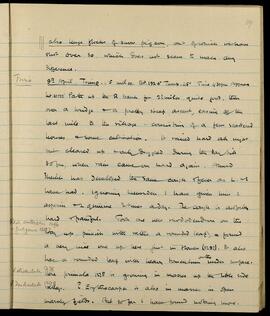
also huge flocks of snow pigeon, out of which we have shot over 30, which does not seem to make any difference.

Trimo 9th April. Trimo. 5 miles. B.P. 192.6° Temp. 45° Time 4:30 pm Approx ht. 10722' Path up the R. bank for 2 1/2 miles quite good, then over a bridge and a pretty steep ascent, easing off the last mile to the village - consisting of a few scattered houses, and some cultivation. It rained hard all night but cleared up and only drizzled during the day till 3:00 pm, when rain came on hard again. Ahmad Sheikh has developed the same cough and fever as L. and I have had. Ignoring Lumsden, I have given him 2 aspirin and quinine 3 times a day. The cough is awfully hard and painful. Took one new rhododendron on the

Rhod. wallichii 1296, fulgens 1297 way up, pinkish with rather a rounded leaf, and found a very nice one up here just in flower (1297). It also has a rounded leaf with heavy tomentum on the under surface.

P. atrodentata 1298, P. denticulata 1299 Here primula 1298 is growing in masses up the little side valley. ? Erythrocarpa is also in masses in open marshy fields. But so far I have found nothing more.

LSH/1/1/9/1/146 · Part · 1933-09-01
Part of The Ludlow & Sherriff Collection

SUMMARY:
Page lists Primula taxa with collection numbers and notes on abundance, habitat, flowering/fruiting status, and seed or root collections. Mentions very late flowering in some cases and specific quantities. One entry records a collection at Chendebi Sovo.

CONTENT:
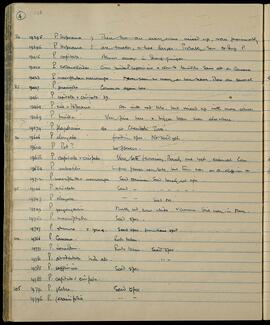
4 138

80 19395 P. Hopeana } These two are everywhere mixed up, one presumably
19396 P. Hopeana } are smaller, & here larger. Probably best to drop P.
19416 P. capitata. Almost always in dwarf juniper.
19420 P. soldanelloides Grows beside P. sapphirina & close to tenuiloba. Same alt. as Caveana
19423 P. macrophylla v. macrocarpa. Never seen so many as here before. There are several
85 19447 P. geraniifolia Common again here.
19461 P. capitata v crispata. 39.
19464 P. sin. v Hopeana. An with red tube, but mixed up with more which
19469 P. pusilla. Very fine here & bigger than seen elsewhere.
19574 P. flagellaris 40 at Chendebi Sovo.
90 19606 P. elongata fruiting spec. No seed yet.
19610 P. Pet? No flowers.
19656 P. capitata v crispata Very late flowering. Barely one yet, even at low
19684 P. umbratilis. In full flower very late, but this was on a cliff in a
19712 P. macrophylla v. macrocarpa. Seed specimen. Seed barely yet ripe.
95 19746 P. reticulata Seed - - - - - - -
19747 P. elongata. Seed ok.
19749 P. yargongensis. Mostly red, some white. Common. Still many in flower.
19750 P. macrophylla Seed spec.
19757 P. strumosa = 19204. Seed spec. from same spot.

  1. 19766 P. Caveana. Roots taken.
    19777 P. Jonarduni. Roots taken. Seed spec.
    19781 P. atrodentata high alt. " "
    19785 P. sapphirina Seed spec.
    19788 P. capitata v crispata.
    105 19791 P. flaccida. Seed spec.
    19796 P. geraniifolia " "
LSH/1/1/3/3/185 · Part · 1983-05-05
Part of The Ludlow & Sherriff Collection

SUMMARY:
The party revisited their old valley south of Chichchar, documenting nine Primula species in flower across avalanche-swept slopes and cliffs, with several specimens noted (e.g., 1614, 2141, 2153, 2154) and P. macrophylla around 15,500 feet. Tsongpen left at 6:00 am and returned at 3:00 pm, and one member is convalescing with a knee injury.

CONTENT:
convalescing, with his knee, which is doing well. Tsongpen at
left at 6.0 am and came back at 3.0 pm. We went up our old
valley south of Chichchar. It is a beautiful valley, and good for
flowers too. Above the snow avalanche we found many
primulas in flower. P. roylei still holds on, but the most
numerous was the beautiful blue-purple one first collected
here last time. It is in masses, the whole hillside, where
bare, being covered with it. P. atrodentata is also
there, but over now. The little white primula 1614, where
the snow melts, comes into flower for its short season.
P. macrophylla at about 15,500 is fairly common, and the
lovely little blue primula 2154 was found in full flower on
the cliff on the right of the avalanche. It is a beauty, with
such minute leaves and huge flower. 2141, a white sikkimensis
is common, but the pick of the white lot is a new one to
us, No. 2153, which is a bright claret colour and is common
on the bare slopes from which the avalanche sweeps every
year. The ordinary sikkimensis too is fairly common.
There are therefore 9 primulas all flowering in this one
quite small valley. We are still a little early for

LSH/1/1/5/1/77 · Part · 1937-05-22
Part of The Ludlow & Sherriff Collection

SUMMARY:
Notes several Primula species near a small lake and along a route ascending to the Naszi La. Describes the path up the stream through rhododendron and fir forest, provides hypsometer readings on the pass, and lists magnetic bearings to nearby peaks including Chomolhari, Kula kangri, Black Mountain, and Wangchelakha.

CONTENT:
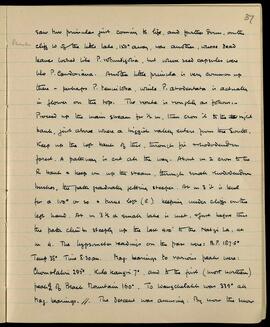
saw two primulas just coming to life, and further down, on the
cliff W of the little lake, 150x away, was another, whose dead
leaves looked like P. rotundifolia, but whose seed capsules were
like P. Cawdoriana. Another little primula is very common up
there - perhaps P. tenuiloba, while P. atrodentata is actually
in flower on the top. The route is roughly as follows:-
Proceed up the main stream for 1/2 m, then cross it to the right
bank, just above where a biggish valley enters from the South.
Keep up the left bank of this, through fir & rhododendron
forest. A pathway is cut all the way. About m 2 cross to the
R bank & keep on up the stream, through small rhododendron
bushes, the path gradually getting steeper. At m 3 it is level
for a 100x or so & turns left (E) keeping under cliffs on the
left hand. At m 3 1/2 a small lake is met, & just before this
the path climbs steeply up the last 400' to the Naszi La, at
m 4. The hypsometer readings on the pass were: B.P. 187.5°
Temp 38° Time 8.30 am. Mag. bearings to various peaks were:
Chomolhari 295°, Kula kangri 7°, and to the first (most northern)
peak of Black Mountain 160°. To Wangchelakha was 339° all
Mag. bearings. // The descent was amusing. By now the snow

LSH/1/1/5/1/215 · Part · 1937-07-31
Part of The Ludlow & Sherriff Collection

SUMMARY:
Checklist of Primula species collected in 1937, with notes on prior collection status and several specimen numbers. Localities mentioned include Chendebi and Tang Chu.

CONTENT:
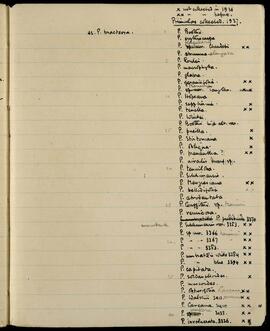
x not collected in 1936
xx " " " before.
Primulas collected. 1937.

  1. P. bracteosa.

1 P. Boothii.
P. erythrocarpa
P. flagellaris
P. sp. nov. Chendebi xx
5 P. strumosa elongata
P. Roylei.
P. macrophylla.
P. glabra.
P. geraniifolia xx
10 P. sp. nov. Tang Chu. xx
P. Hopeana
P. sapphirina x
P. tenella. xx
P. Winteri.
15 P. Boothii high alt. var.
P. pusilla. x
P. Stirtoniana x
P. obliqua. x
P. prenantha? xx
20 P. nivalis dwarf sp.
P. tenuiloba.
P. sikkimensis.
P. Menziesiana xx
P. bellidifolia xx
25 P. atrodentata
P. Griffithii sp. hancini
P. vernicosa.
P. pudibunda 3370
P. sikkimensis var. 3353. xx
30 P. sp. nov. 3366 hancini xx
P. " " 3367 xx
P. " " 3383. xx
P. umbratilis white 3384 xx
P. " blue 3394 xx
35 P. capitata.
P. soldanelloides. x
P. muscoides.
P. obtusifolia Caveana xx
P. Walshii 3413 concinna xx
40 P. Caveana 3410 xx
P. uniflora 3438. x
P. involucrata 3226. x

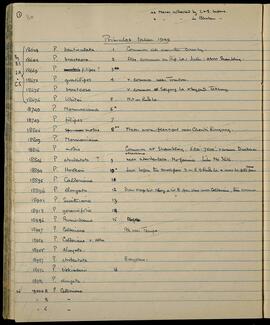
LSH/1/1/9/1/140 · Part · 1933-09-01
Part of The Ludlow & Sherriff Collection

SUMMARY:
List of Primula specimens with collection numbers and notes on abundance, elevation, and localities across Bhutan in 1949. Mentions collectors identified by initials (B.S, J.H., G.S.) and notes presence or absence around passes and places such as Rip La, Shambling, Tomtom, Sergung La, Takhung, Rudu La, Chenbi Rongang, Dunkhar-Nashima, and Tsampa; notes that some species were not previously collected by L+S.

CONTENT:
xx Never collected by L+S. before.

  • .. .. .. in Bhutan ..

Primulas taken 1949

By 18614 P. denticulata. 1 Common all over the country.
B.S 18644 P. bracteosa. 2 Also common on Rip La: Julu: above Shambling:
J.H. 18669 P. filipes? 3xx
G.S. 18673 P. gracilipes 4 v. common near Tomtom.
18675 P. bracteosa v. common at Sergung La beyond Takhung.
18676 P. whitei 5 Not on Rudu La.
18740 P. Normaniana 6
18749 P. filipes 7
18806 P. sp. non mollis 8xx Much more plentiful near Chenbi Rongang.
18809 P. Normaniana
18816 P. mollis Common at Shambling. 6500'-7500'. v. common Dunkhar-Nashima.
18846 P. atrodentata? 9 near atrodentata. No farina. Like No 3636.
18894 P. Hookeri 10
Just before the small pass 2 m E of Rudu La & more W. of the same pass.
18895 P. Calderiana 11
18896 P. elongata. 12 Down steep bit. Along a bit to open where much Calderiana, then common.
18901 P. Smithiana 13
18913 P. geraniifolia 14
18946 P. Barnardoana 15
18947 P. Calderiana All over Tsampa.
18954 P. Calderiana v. alba
18955 P. elongata.
18957 P. atrodentata Everywhere.
18976 P. sikkimensis 16
18981 P. elongata.
19000 A. P. Calderiana
B "
C "

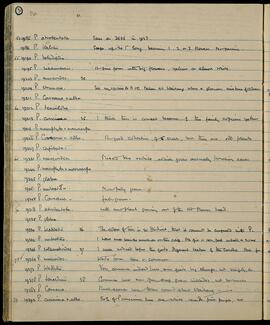
LSH/1/1/9/1/144 · Part · 1933-09-01
Part of The Ludlow & Sherriff Collection

SUMMARY:
Page lists Primula specimens with notes on morphology, flower colors, abundance, and growth habits, including forms such as P. caveana, P. muscoides, P. glabra, and P. waddellii. Mentions comparison with earlier collections at Waitang and a reference to a specimen from 1938.

CONTENT:
(3) 136 33.

  1. 19185 P. atrodentata Same as 3636 in 1938.
    19186 P. walshii Scape up to 1" long bearing 1, 2 or 3 flowers. No farina.
  2. 19190 P. bellidifolia.
    19195 P. sikkimensis. A fine form with big flowers, yellow or almost white.
    19203 P. muscoides. 34.
    19204 P. strumosa. See my 19000 A B or C taken at Waitang where a glorious mixture of colours
    19211 P. caveana v. alba
  3. 19212 P. tenuiloba
    19213 P. concinna 35. I think this is correct because of the fairly copious yellow
    19216 P. macrophylla v. macrocarpa
    19226 P. caveana v. alba. A good collection of 5 sheets, but they are odd plants
    19227 P. capitata.
  4. 19231 P. muscoides. Mixed blue and white, which grow actually touching each
    19244 P. macrophylla v. macrocarpa
    19245 P. glabra
    19251 P. umbratilis. Not fully grown.
    19255 P. caveana - full grown.
  5. 19318 P. atrodentata. With new plants growing out from old flower head.
    19325 P. glabra.
    19330 P. waddellii 36. The colour of this is so distinct, that it cannot be confused with P.
    19332 P. umbratilis. I have never seen so much as on this cliff. All of it is very pale indeed, or some
    19346 P. soldanelloides 37 I never noticed before the quite different texture of the corolla. Ask for
  6. 19364 P. muscoides. White form. Here v. common.
    19373 P. waddellii. Very common indeed here, in quite big clumps, not singly, as
    19378 P. jonardunii. 38 Common here, on open steep grass hillsides, not so much
    19383 P. caveana. Much scarcer here than round about Waitang.
  7. 19392 P. concinna v. alba. 80% of P. concinna here are white, remainder pink purple, no