Showing 25 results

Archival description
25 results with digital objects Show results with digital objects
LSH/1/1/8/1/33 · Part · 1946-12-23
Part of The Ludlow & Sherriff Collection

SUMMARY:
The party trekked through spruce, oak, pine, and larch forest, passed below Chunyima, obtained butter and fresh milk from herdsmen with yaks, and noted several plants including Primula atrodentata and Lilium wardii. They reached Tongkyuk Dzong after 68 days, glimpsing the Po Yigrong Range and collecting limited seed of an unidentified Rhododendron, a Gaultheria, and an evergreen Berberis.

CONTENT:
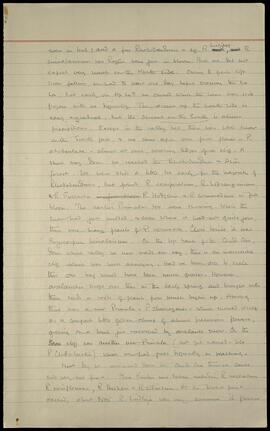
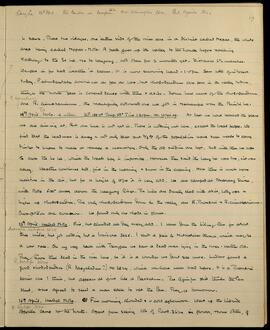
hard indeed - so much so that the kukri we used to cut out plants was broken slightly, & sparks were actually made when striking the ground! This might possibly be P. bhutanica or Whitei. Like P. atrodentata the buds were covered with dense farina. We did not see Chunyima at all, but passed below it scarcely a few miles (2?) to an open space, on the other side of the river from which is a herdsman's hut where there are two men with 50 yaks. Up behind that is a very fine snow peak (Sangdam Pu?) where the valley looks very good for flowers. We got some very dirty butter from them at 9 sangs the piece, about 1 1/2 lbs. Also most excellent fresh milk as a gift. The milk was brought in a ladle made of Rhododendron wood, holding about 1/2 gallon. Our 4 coolies caught us up today joined us here, so did 7 extra pony loads which had come on "sadsi". The path all day is through fine spruce, holly oak & latterly a little pine larch. Rhododendron in places plentiful. For the first mile or two the valley is open: thence it is a gorge, but everywhere very pretty indeed. My one only pair of shoes have given out, & am reduced to gym shoes from now on. We saw a little Mec. betonicifolia at Lunang, but no more anywhere else. I also saw one Prim. chungensis. Prim. atrodentata is everywhere & is all ready for moisture & a little warmth, to put it into flower.

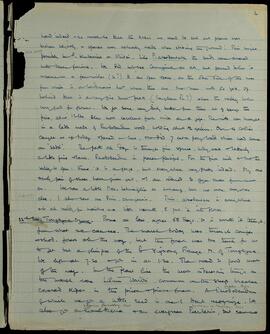
22nd Dec. Tongkyuk Dzong. Home at last, after 68 days. It is worth it though, from what we can see. The march today was through conifer & rhod. forest all the way, but the forest was too thick for us to get but a glimpse of the Po Yigrong Range N. of Tongkyuk. We left at 7.30 & got in at 1.30. The road is good most of the way. In the plant line the most interesting things on the march were Lilium Wardii, common on the steep bracken covered slopes in the picea & pinus forest. A Rhododendron of which we got a little seed is one I don't recognize. We also got a Gaultheria & an evergreen Berberis, but saw no...
LSH/1/1/6/1/39 · Part · 1933-05-17
Part of The Ludlow & Sherriff Collection

SUMMARY:
The party moved up the valley with coolies burdened by heavy loads and delays at Molo, noted weather changes, and observed several rhododendrons and primulas. On 22 April at a camp above Singo Samba, a hazardous bridge crossing led Ramzana to cross while Ludlow forded downstream with Tseringpen. On 23 April, despite fresh snow and the coolies’ refusal to move, Ludlow, Tseringpen, and the diarist scouted and broke a path to the Lo La pass, checking known plant sites now under snow.

CONTENT:
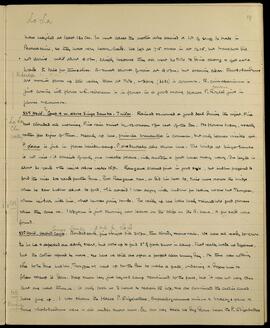
have weighed at least 130 lbs. In most cases the coolies also carried a lot of stuff to trade in Pachakshiri, so they have very heavy loads. We left at 7:15 and were in at 12:15, but transport did not arrive until about 4:00 pm, chiefly because they all went to Molo to drink chang and get extra loads to take for themselves. A small shower of rain at 4:00 pm, but evening clear. Rhododendrons are more in flower up this valley than at Molo, R. 3624 (3631) is common. R. cinnabarinum is just coming into flower and R. vellereum is in flower in a good many places. P. Roylei just in flower common.

22nd April. Camp 4 m. above Singo Samba. 7 miles. Rained and snowed a good deal during the night. Fine but clouded all morning. Fine rain and mist by 12:00 noon and for rest of the day. No flowers today, and really rather few signs of them. Nearly up here, Primula prenantha is common, but only leaves visible yet. P. glabra is just in flower beside camp. P. atrodentata also shown here. The bridge at Singo Samba is not nice - it consists of only one usable plank, with another a foot lower and very wavy. The length is about 30 yards and the height above water 15 ft. Ramzana crossed first in good style, but Ludlow preferred to ford the river 200 yards further down. Poor Ramzana ran, or did his best to, twice more across the bridge when he saw Ludlow about to ford. I'm afraid I was angry with Ludlow for telling no-one but Tseringpen, whom he took with him, what he was going to do. The valley up here looks lovely and should hold good flowers when they come on. Isopyrum is just showing new leaves on the cliffs on the R. bank. A few seed were found.

23rd April, Halted Camp. Clouded early, fine and bright till 2:00 pm, then cloudy and some rain. We were all ready to cross the Lo La and expected an early start, but woke up to find 2" of fresh snow in camp. That really made no difference, but the coolies refused to move, so here we still are after a perfect clear sunny day. As there was nothing else to be done Ludlow, Tseringpen and I went up to the Pass to make a path, ordering a dozen men to follow and stamp it down. Deep snow lay just beyond camp and continued to the pass, but it was not very often that one went through. It only took us 3 hours to reach the top, and we are convinced the coolies could have gone up. I was shown the places P. Elizabethae, Omphalogramma minus and brachysiphon and some rhododendrons were - all under snow now. On our way back we dug down near the P. Elizabethae

LSH/1/1/4/1/53 · Part · 1933-07-23
Part of The Ludlow & Sherriff Collection

SUMMARY:
Notes on flowering stages of Cyananthus and Primula, with some seeds of P. atrodentata collected. The party met a Bhutanese man with his family returning from Pemako, who spoke with Tenduk and described harsh conditions there. Entry made at Charme after a rainy night that cleared in the morning.

CONTENT:
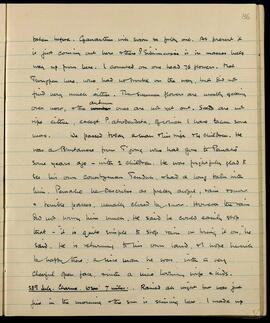
taken before. Cyananthus will soon be fully out. At present it is just coming out here and there. P. sikkimensis is in masses half way up from here. I counted on one head 76 flowers. Mah Tsongpen here, who had no trouble on the way, but did not find very much either. The summer flowers are mostly getting over now, and the autumn ones are not yet out. Seeds are not ripe either, except P. atrodentata, of which I have taken some more.

We passed today a man and his wife and 4 children. He was a Bhutanese from Tjong who had gone to Pemako some years ago - with 2 children. He was frightfully glad to see his own countryman Tenduk, and had a long talk with him. Pemako he describes as pretty awful, rain and snow, and terrible passes, usually closed by snow. However the rain did not worry him much. He said he could easily stop that - "it is quite simple to stop rain or bring it on," he said. He is returning to his own land, and I hope he will be happy there; a nice man he was, with a very cheerful open face, with a nice looking wife and kids.

28th July. Charme. 10300' 7 miles. Rained all night but was just fine in the morning and the sun is shining here. I made up

LSH/1/1/7/1/21 · Part · 1940-04-22
Part of The Ludlow & Sherriff Collection

SUMMARY:
After a snowfall delay, the party crossed the Lo La on April 24 and descended the steep south side into the Rhododendron–Abies forest. Along the Chudi Chu they observed numerous Rhododendron and Primula species, including the new Primula P. chionogenes and another unnamed Primula on an inaccessible cliff.

CONTENT:
were in bud, and a few Rhododendrons - e.g. R. hirtipes, and R. cinnabarinum var. roylei were just in bloom. But we did not expect very much on the North side. Owing to fresh soft snow falling, we had to wait one day before crossing the Lo La, but early on April 24th we crossed while the snow was still frozen with no difficulty. The ascent up the North side is easy and gradual, but the descent on the South is almost precipitous. Except in the valley bed, there was little snow on the South face, and we came upon our first flower - P. atrodentata - almost at once, covering ledges of a cliff. A short way down we reached the Rhododendron - Abies forest. We were still a little too early for the majority of Rhododendrons, but found R. exasperatum, R. lopsangianum, R. forrestii, R. hodgsonii, and R. commodum in full bloom. The earlier Primulas too were showing. Where the snow had just melted, and even where it had not quite gone, there were many plants of P. vernicosa. Close beside it was Bryocarpum himalaicum. On the left bank of the Chudi Chu, down which valley we now made our way, there is an inaccessible cliff which was most annoying. Had we been able to scale this our bag would have been much greater. However, avalanches swept over this in the early spring and brought with them seeds or roots of plants from much higher up. Among these was a new Primula - P. chionogenes - which showed itself as a compact little golden clump of almost precocious flowers, growing on a bank just uncovered by avalanche snow. On the cliff was another new Primula (not yet named - like P. clutterbuckii) which we had great difficulty in reaching.

Next day we continued down the Chudi Chu through dense and very wet forest. More Rhodos were taken, including R. uvariifolium, R. neriiflorum, R. hookeri and R. ciliatum. At the lowest point reached, about 8500', R. lindleyi was very common in flower.

LSH/1/1/5/1/131 · Part · 1933-06-21
Part of The Ludlow & Sherriff Collection

SUMMARY:
Notes record Parnassius butterflies, a woodcock nest with four eggs found on 22 June, and a list of Primula species observed. The writer describes the steep peaks of Dungshinggang, clear views toward Sikkim and beyond Chomolahri, getting soaked in a noon storm, and a 25 June entry noting rain overnight, a clear morning, and later cloud.

CONTENT:
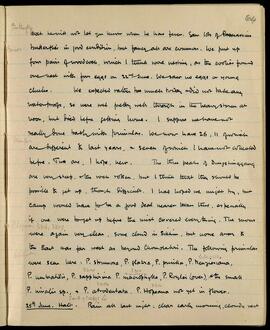
that he will not let you know when he has fever. Saw lots of Parnassius butterflies in good condition, but fancy all are common. We put up four pairs of woodcock, which I think were nesting, as the coolies found one nest with four eggs on 22nd June. We saw no eggs or young chicks.

We expected rather too much today and did not take any waterproofs, so were wet pretty well through in the heavy storm at noon, but dried before getting home. I suppose we have not really done badly with primulas. We now have 26, 11 of which are different to last year's, and seven of which I have not collected before. Two are, I hope, new.

The three peaks of Dungshinggang are very steep, the rock rotten, but I think that they should be possible to get up, though difficult. I had hoped we might try, but camp would have to be a good deal nearer than this, especially if one were to get up before the mist covered everything. The snows were again very clear, some cloud in Sikkim, but none away to the East as far west as beyond Chomolahri. The following primulas
were seen here: P. strumosa, P. glabra, P. pusilla, P. Menziesiana,
P. umbratilis, P. sapphirina, P. macrophylla, P. Roylei (over), the small
P. nivalis sp., and P. atrodentata. P. Hopeana not yet in flower.

25th June. Hall - Rain all last night, clear early morning, cloudy rest.

LSH/1/1/9/1/46 · Part · 1933-05-07
Part of The Ludlow & Sherriff Collection

SUMMARY:
The diarist halts at Dungkar, plans to cross the Rudo La, and writes to HH, Wangmoo, and Lhuntse about arrangements. Botanical notes mention a primula (18846) from Tim resembling earlier Lo La material and a likely Cochlearia (18847) previously seen in 1937 at Tang Chu, Central Bhutan. Yundru, servant of the Nyerchen Trepa, arrives from forced labour at Sam Choling monastery and is taken on permanently for the journey to Tomtem.

CONTENT:
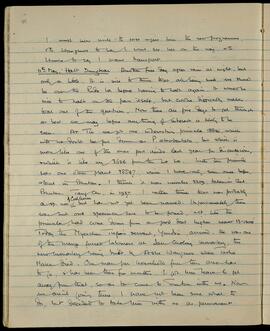
I must now write to HH & give him the new programme, & to Wangmoo to say I will see her on the way, & to Lhuntse to say I want transport.

11th May. Halt Dungkar. Another fine day after rain at night, but only a little. It is nice to think that, all being well, we should be over the Rudo La before having to halt again. It would be nice to halt on the pass itself, but coolie difficulty makes that out of the question. Now there are five days to get through as best we may before anything of interest is likely to be seen. At Tim we got one interesting primula 18846, which will no doubt be put down as P. atrodentata, but which is more like one of the ones put aside last year for discussion, & which is like my 3636 from the Lo La. With the primula was one other plant 18847, which I have only seen once before, & that in Bhutan. I think it was number 3209, taken in Cent. Bhutan, Tang Chu, in 1937. I rather think that was probably a sp. nov. of Cochlearia but has not yet been named. Unfortunately there was but one specimen here to be found, & it, like the primula, had come down from a good deal higher, near 13-14000'.

Today the Nyerchen Trepa's servant, Yundru, arrived. He was one of the many forced labourers at Sam Choling monastery, the new monastery being built by Ashe Wangmoo where Tasho Haku died. One man per household from this area has to go, & has been there for months. I got him leave to get away from that, so as to come to Tomtem with me. Now we are in fact there, I have not been sure what to do, but decided to take him with us as permanent.

LSH/1/1/3/3/81 · Part · 1936-03-10
Part of The Ludlow & Sherriff Collection

SUMMARY:
At Lepo the party halted for two days; Danong explored a stream from Chio Tso and found masses of Primula, while the diarist noted rhododendrons, firs and larch, and prepared mail. Rain limited finds the next day, though P. Boothii was abundant at waterfalls, and Lumsden took a shot at pintail ducks.

CONTENT:
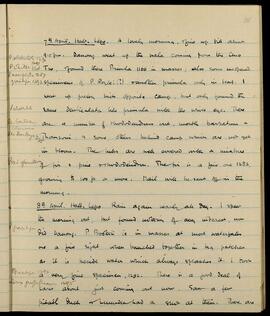
38

7th April. Halt. Lepo. A lovely morning, fine up till about 4.0 p.m. Danong went up the nala coming from the Chio Tso, found there Primula 1186 in masses; also some unopened specimens of P. Boothii (?) & another primula only in leaf. I went up pretty high opposite camp, but only found the same denticulata-like primula with the white eye. There are a number of rhododendrons out, mostly barbatum & Thomsonii, & some others behind camp which are not yet in bloom. The hills are well covered with a mixture of fir & pine & rhododendron. The fir is a fine one 1286, growing to 100 ft or more. Mail will be sent off in the morning.

8th April. Halt. Lepo. Rain again nearly all day. I spent the morning out, but found nothing of any interest, nor did Danong. P. Boothii is in masses at most waterfalls; it is a fine sight when bunched together in big patches as it is beside water which always splashes it. I took a very fine specimen, 1292. There is a good deal of larch about just coming out now. Saw a few pintail duck & Lumsden had a shot at them. There are

Marginal Notes:
P. atrodentata 1290
P. Whitei 1186, 1291
P. macrophylla 1287
gracilipes 1292
Rh. barbatum
Rh. Thomsonii
Rh. Baileyi 1285
Picea spinulosa
P. gracilipes
P. gracilipes 1292
Larix griffithiana 1295

LSH/1/1/4/1/7 · Part · 1936-07-02
Part of The Ludlow & Sherriff Collection

SUMMARY:
Field observations around Kyimpu noting numerous flowering plants and seed collections, including Roscoea alpina, Deutzia hookeriana, Stellera chamaejasme, and Meconopsis bella. A supposed crane’s eggs find proved to be partridge; later, the party halted with rain, bought a sheep, and walked toward the Le La. The locals are described as friendly.

CONTENT:
Kyimpu July 3. Roscoea alpina 2275. Onosma hookeri 2276, Stellera chamaejasme 2277 (113
Deutzia hookeriana 2279, Pedic. longiflora var tubiformis 2282, Mec. bella 2283

...a crane's eggs, but when he brought them, they turned out only to be those of a partridge, a great disappointment. There were four in the nest, of which he broke one.

A good many flowers on the way up, lots of the Primula jeffreyana 2257, of walshii 2256 just below Kyimpu 2258. Also of the Incarvillea lutea 2252 of which I took some of last year's seeds, which appear to be good. P. atrodentata is in seed too, of which I took a lot of that. Mec. bella 2283 is in flower here, others up here. There is a nice little Deutzia hookeriana 2279 in the rocky gorge between the two bridges, which is both fragrant and pretty. And the Stellera 2277 is a nice little thing, looking prettiest when it is half out—red in the centre of the buds, contrasting with white of the open corolla all around. I think we should do well up here. The locals are all a friendly lot for anything as far as I can see.

4th July. Halt. More or less fine till 1130, then heavy rain most of the day. Bought a sheep for Rs 3/-. We all went up towards the Le La, turning off right before reaching it. P. hyacinthina 2294 is very common.

LSH/1/1/4/1/119 · Part · 1933-09-24
Part of The Ludlow & Sherriff Collection

SUMMARY:
Diary entries record fine weather, observations of flowering Gentiana and seed collecting of Primula species around Kyimpu Halt and Le La. On 4 October the author moves to a camp north of Drichung La, parts from Ludlow and Lumsden, and continues with Ahmad Sheikh, Tsongpen, and Pimbo toward Trim while continuing seed collections.

CONTENT:
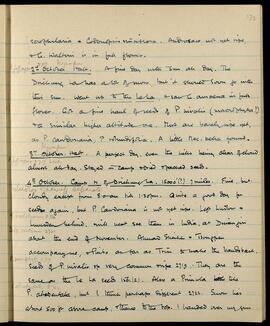
Scrophularia & Codonopsis vinciflora. Androsace not yet ripe, & G. waltonii is in full flower.

2nd October. Kyimpu Halt. A fine day with sun all day. The Drichung La has a lot of snow, but it should soon go with this sun. Went up to the Le La, & saw G. amoena in full flower. Got a fine haul of seeds of P. nivalis (macrophylla?) & a similar higher altitude one. Most are barely ripe yet, as P. cawdoriana, P. rotundifolia. A little Mec. bella found.

3rd October. Kyimpu Halt. A perfect day, even the hills being clear of cloud almost all day. Stayed in camp & dried & packed seeds.

4th October. Camp N of Drichung La. 15000'(?) 7 miles. Fine, but cloudy except from 8.0 am till 1.30 pm. Quite a good day for seeds again, but P. cawdoriana is not yet ripe. Left Ludlow & Lumsden behind, will next see them in India, at Dirang Dzong about the end of November. Ahmad Sheikh & Tsongpen accompany me, & Pimbo as far as Trim to make the bandobast. Seeds of P. nivalis sp very common & ripe 2719. They are the same as the Le La seeds 1561(2). Also a Primula like P. atrodentata, but I think perhaps different 2722. Snow lies about 500 ft above camp, & thence to the top. I handed over my gun

LSH/1/1/6/1/35 · Part · 1933-05-17
Part of The Ludlow & Sherriff Collection

SUMMARY:
Diary notes from Lang La record snow, limited rhododendrons in the valley bottom, and plant collections. The route passes through the Nepar-Molo district with references to paths toward Se La and Langong, and previous finds at Natrampa and Bimbi La. On 14 April they reach Molo, noting measurements and that the headman is away while much of the population has been sent to carry timber to Lhasa.

CONTENT:
Lang La 13th April. Rh. lanatum var. luciferum 3620. Mec. betonicifolia 3621, Prim. bryoides 3622

L bank. These two villages, one either side of the river are in a district called Nepar, the whole area being called Nepar-Molo. A path goes up the valley to the south before reaching Kethong to the Se La, so to Langong, not open for 2 months yet. Distance 2 1/2 marches. We are in for bad weather it seems. It is now snowing hard - 1.0 pm. Saw little of interest today. P. atrodentata continues as far as here, but rhododendrons are few in the valley bottom, though the north face is covered dense with them & abies. Down here most of the rhododendrons are R. cinnabarinum, the beautifully coloured one we got in Natrampa & on the Bimbi La.

14th April. To Molo. 4 miles. B.P. 193.0° Temp. 56° Time 1.30 pm. Ht. 10700 ap. At last we have reached the place we are aiming at. But our luck is not yet in. There is nothing out here, except the local people. We find that the headman is away & not only that but 2/3rds of the population have been made to carry timber to Lhasa to make or remake a