Showing 6 results

Archival description
6 results with digital objects Show results with digital objects
LSH/1/1/6/1/143 · Part · 1936-10-02
Part of The Ludlow & Sherriff Collection

SUMMARY:
The diarist reports from Singo Samba and then Trashidzong/Tsari Sama, noting misty and rainy weather, limited finds of rhododendrons and primulas, and heavy grazing by yaks that destroyed desired Meconopsis and Primula stands. Plans are made to leave kit with one man and proceed lightly with eight coolies around Tsari Sama, while noting Ludlow and Taylor’s move from Kyimdong toward the Bimbi La to target several Meconopsis species; the pilgrim season at Sacha Peso appears over.

CONTENT:
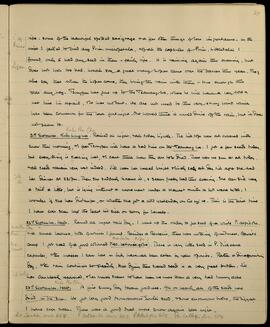
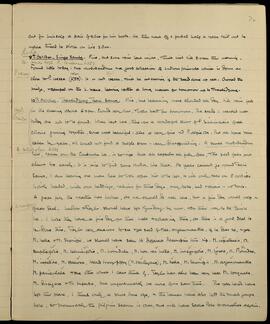
cut for himself a pair of soles for his boots. He then went off & pulled half a yak's tail out to make thread to stitch on his soles.

9th October. Singo Samba. Fine, but some rain last night, thick mist till 8.00am this morning. Found little today: two rhododendrons & a good collection of Ludlow's primula which is down as close to P. ioessa (3789). It is not ioessa, will be interesting if the seed come up well. Crossed the ridge, recamped on the L. bank, leaving rather a long march for tomorrow up to Trashidzong.

10th October. Trashidzong, Tsari Sama. Fine, but becoming more clouded all day, till rain fell in the evening about 5.0pm. Clouds very low, looks bad for tomorrow. The seeds I wanted most today are not to be found. When last here, there was a wonderful show of P. sikkimensis of all colours growing together, some most beautiful: also a very fine red P. alpicola. But all have been eaten by yaks, or dried up - not find a single stem - very disappointing. A small rhododendron here, taken on the Chumbumbu La, is so ripe that all capsules are fully open, the seed falls out almost too easily. It is nice to find some rhodos. like that. As yaks cannot go round Tsari Sama, I am leaving one man here to look after kit to be left, & will only take on 8 coolies lightly loaded, with our beddings, rations for three days, camp table, bed & chair - no tents.

A great pity the weather has broken, as we should do well here, but a fine day would help a great deal. Ludlow & Taylor should have left Kyimdong by now, for their way to the Bimbi La. I hope they have a fine day for their halt & collecting there, as there is a good deal to be done there. Taylor very anxious to see & get seed of Meconopsis argemonantha. If he does so, & gets M. bella & M. sherriffii, we should have seen 16 different Meconopsis this trip. M. nepalensis, M. simplicifolia, M. betonicifolia, M. horridula, M. hor. var lutea, M. integrifolia, M. lyrata, M. florindae, M. impedita, M. speciosa, Ward's ivory poppy (M. harleyana), M. bella, M. sherriffii, M. argemonantha, M. paniculata & one other which I can't think of. Taylor has also been very near M. torquata, M. discigera & M. superba, but unfortunately we none of us saw them. The yak herds have left this place, I think only a short time ago, & the lamas have also left the small gompa here, so presumably the pilgrim season is over, & we will have Sacha Peso to ourselves again.
LSH/1/1/7/1/9 · Part · 1940-05-24
Part of The Ludlow & Sherriff Collection

SUMMARY:
The diarist describes abundant Primula species on swampy valley slopes and notes that by October seed and leaves were scarce due to yak grazing. On June 19th they returned to Lanyong, then departed for Molo via the Tse La, later traveling down the Tsangpo valley to Mayu and making difficult river crossings (including by skin coracles and a log raft) before proceeding up the Nagu Chu valley toward the Tam La over the Himalayas.

CONTENT:
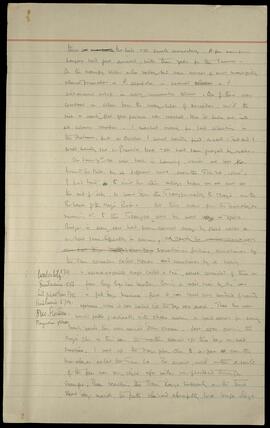
there are two huts & a small monastery. A few men
from Lanyong had just arrived, with their yaks for the summer -
On the swampy slopes in the valley bed were masses of most beautifully
coloured primulas - P. alpicola in several and a P.
sikkimensis subsp in every conceivable colour. One of these was
constant in colour down the rocky sides of cascades, until the
rich & marshy flat yak pasture was reached. Here it broke out into
all colours & shades. I marked many for seed collecting in
the Autumn, but in October I could hardly find a seed & indeed I
could hardly see a Primula leaf - all had been grazed by yaks.
On June 19th we were back in Lanyong, which we left then,
bound for Molo, by a different route, over the Tse La, 15000'.
I had time to visit two other valleys before we all met at
the end of July, so went down the Tsangpo valley to Mayu on the
R bank of the Nagu River - All these rivers from the Himalayas
running N. to the Tsangpo were by now in spate.
Bridges in every case had been carried away by flood water &
we had some difficulty in crossing, clear days sometimes fording, sometimes by
the skin coracles called Kowas and sometimes by a heavy

Waterlily 5749 unmanageable craft called a 'tru', which consisted of three or
Smilacina 5756 four long logs tied together. Crossing a rapid river by 'tru' was
Lil. giganteum 5743 a full day's business: first it was towed some hundreds of yards
Smilacina 5754 upstream, where it was loaded till the logs were awash. Then two men
Rhod. floribunda would paddle frantically with sticks making a yard across for every
Magnolia globosa twenty yards they were carried down stream. Just after crossing the
Nagu Chu in this way, the weather cleared after three days we had
sunshine. I went up the Nagu Chu valley to a pass at over the
Himalayas called the Tam La. The ascent, until within a mile
of the pass was very slight & for miles we plodded through
swamps. Then reaching the Main Range suddenly on the third
short day's march, the path climbed abruptly to a knife edge

LSH/1/1/9/1/142 · Part · 1933-09-01
Part of The Ludlow & Sherriff Collection

SUMMARY:
The page lists numerous Primula taxa with specimen numbers and brief notes on abundance and flowering, many recorded as common at Kantanang on 10/6. It mentions elevation comparison within the same valley, white forms of P. glabra, a hybrid (P. sikkimensis × hopeana), and comments on varieties such as caveana var. alba and macrophylla var. macrocarpa.

CONTENT:
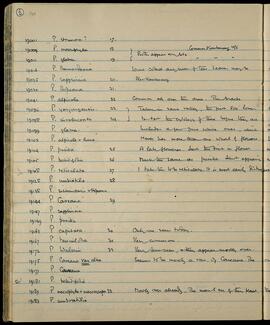
(2) 134

  1. P. strumosa? 17.
    19009 P. macrophylla 18 } Both appear very late. Common Kantanang 10/6
    19011 P. glabra 19 } Common Kantanang 10/6
  2. P. barnardoana Won't collect any more of this. Leaves may be
    19025 P. sapphirina 20. Also Kantanang
    19030 P. hopeana 21.
    19041 P. alpicola 22 Common all over this area. The bracts
    19096 P. yarongensis. 23. } Taken in same valley, the first 500' lower
    19098 P. involucrata 24. } to test the cytology of these before they are
    19099 P. glabra. Includes a few pure white ones, which
    19103 P. alpicola var. luna Never has more than one whorl of flowers
    19104 P. pusilla. 25 A late flowerer. Just the first in flower
    19105 P. bellidifolia 26 Much the same as pusilla. Just appearing
    19108 P. reticulata 27 I take this to be reticulata. It is most easily distinguished
    19128 P. umbratilis 28
    19138 P. sikkimensis x hopeana
    19144 P. caveana 29
    19147 P. sapphirina
    19149 P. pusilla
    19163 P. capitata. 30 Only one seen today.
    19167 P. tenuiloba 31 Very common.
    19172 P. walshii 32 Very few seen, & they appear mostly over.
    19175 P. caveana var. alba Seems to be merely a var. of caveana. The
    19177 P. caveana
    50) 19181 P. bellidifolia.
    19189 P. macrophylla var. macrocarpa 33. Mostly over already. The more I see of this plant, the
    19183 P. umbratilis
LSH/1/1/6/1/135 · Part · 1933-09-07
Part of The Ludlow & Sherriff Collection

SUMMARY:
Diary entries at Kula Phu Chu describe persistent rain and wind, difficulties drying collected seeds, and concern for Tsongpen traveling to the Tsanang La amid snow. Seeds of several species were gathered, and after a brief illness, Jill recovered by the 22nd; a sunny 23rd allowed successful drying and collection including Nomocharis souliei.

CONTENT:
ripe: some of the beautiful spotted saxifrage and a few other things of less importance. In the Primula marsh I failed to find any Prim. micropetala, and of all the capsules of Prim. littledalei I found, only 5 had any seed in them - fairly ripe. It is raining again this evening, but does not look too bad. Locals say a great many Lopas came over the passes this year. They also say that when the Lopas come, they bring the rain with them - true enough this year anyway. Tsongpen has gone up to the Tsanang La, where he will have a very cold and wet time I'm afraid, he has no tent. We are not used to this very strong wind which has been common for the last few nights. One would think it would drive off the rain, but it does not seem to.

Kula Phu Chu
21st September. Kulu Lungma. Rained at night, and all today lightly. The hilltops were all covered with snow this morning, I fear Tsongpen will have a bad time on the Tsanang La. I got a few seeds today, but everything is soaking wet, and I can't think how they are to be dried. There was no sun at all today, and all seeds remain very wet indeed. Jill was her usual bright and lively self all day till after she had her dinner at 2:30 pm. Then she suddenly became ill, and seems pretty bad this evening. She can still wag a tail a little, but is lying without a movement under a blanket with a hot water bottle. I wonder if she has distemper, or whether she got a cold yesterday on Go nyi re. This is the first time I have ever seen her the least bit sick or sorry for herself.

Kula Phu Chu
22nd September. Halt. Rained all night and all day. I went up the valley to get seed of a white P. alpicola, and a small lactuca, both of which I found. Besides a Berberis, there was nothing of interest. Opposite camp I got seed of a good coloured Mec. betonicifolia (Mec. betonica 6520). There is very little seed in P. Dickieana capsules, the masses I saw here in July have all been eaten by yaks and ponies. Rather a disappointing day, the rain continues so steadily, that drying these soaked seeds is a very great problem. Jill has completely recovered, her trouble seems to have been no more than a very bad tummy ache.

Kula Phu Chu
23rd September. Halt. A fine sunny day thank goodness. All or nearly all of the seeds were dried in the sun. We got very good Nomocharis souliei seed, and some enormous bulbs, the biggest I have ever seen. There was a good deal more snow again last night.

(N. souliei seeds 6518. I collected seeds 6517, P. bellidifolia 6515, Prim. calliantha flower 6524.)

LSH/1/1/2/1/53 · Part · 1933-07-08
Part of The Ludlow & Sherriff Collection

SUMMARY:
The party descends north from Milakatong La, follows a lake and river, and reaches Tsukang (Shao) around mile 16, noting scant barley and rhododendron fuel. They express relief at leaving rain-soaked Tawang, criticize incompetent local officials, and describe a route transitioning from dense jungle to bamboo, rhododendron, and finally grass with dwarf rhododendron, alongside a list of collected plants.

CONTENT:
July 14.
Milakatong La

P. sikkimensis 652=667
" obliqua 655
" Calderiana (Roylei) 658
" macrophylla 657
" sikkimensis 662
" alpicola 663
" pusilla 665
" sapphirina 666
Meconopsis villosa 649
Notholirion macrophyllum 650
Corydalis trifoliata 651
Swertia hookeri 654
Meconopsis horridula 659
Rhododendron hypenanthum 660
Campanula aristata 664

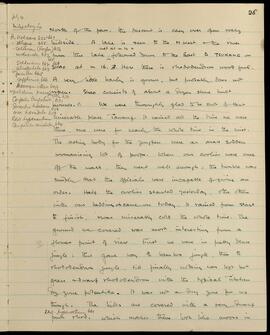
North of the pass, the descent is easy over open rocky hillside. A lake is seen to the N. West and the river met at m 14. From this lake followed down to the East to TSUKANG or SHAO at m 16. Here there is rhododendron wood fuel. A very little barley is grown, but probably does not ripen. Shao consists of about a dozen stone built houses. We were thoroughly glad to be shut of that miserable place Tawang. It rained all the time we were there, and we were for nearly the whole time in the mist.

The acting body for the Jongpen were an acute sodden womanising lot of poops. When our coolies were once off the mark, they went well enough: the trouble was simply that the officials were incapable of giving an order. Half the coolies started yesterday, the others with our bedding etc came on today. It rained from start to finish, and was miserably cold the whole time. The ground we covered was most interesting from a flower point of view. First we were in pretty dense jungle: this gave way to bamboo jungle, then to rhododendron jungle, till finally nothing was left but grass and dwarf rhododendron with the typical Tibetan dry zone potentilla. It was not a dry zone for us though. The hills are covered with a very dwarf pink rhododendron which makes them look like moors in

Rhododendron hypenanthum 661

LSH/1/1/3/3/194 · Part · 1933-07-18 - 1933-07-19
Part of The Ludlow & Sherriff Collection

SUMMARY:
Travelled toward Taktsa through a valley with dense poplar, willow, and Hippophae, noting parrots near Kyimdong Dzong and ruins of an old Dzong above Palung. The north-facing slopes carried fir, larch, and spruce, and the valley seemed rich in flowers and birds though there was no time to collect. On July 19, there was a halt at Taktsa due to diseased natives.

CONTENT:
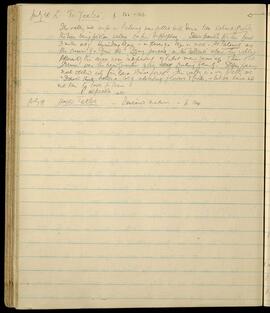
July 18. L. To Taktsa. p. 122-123

The valley as far as Palung was filled with dense tree and shrub growth, the trees being poplar, willow and a few Hippophae. Saw parrots for the first 3 miles out of Kyimdong Dzong—in flocks of a dozen or more. At Palung are the ruins of a fine old Dzong perched on the hillside above the village. Apparently this area was independent of Tibet many years ago. These old ruins were the headquarters of the ruling family. Slopes facing north clothed with fir, larch, spruce forest. This valley is a very pretty one and I should think holds a lot of interesting flowers and birds, but we have had no time to look for them.
P. alpicola etc.

July 19 Halts Taktsa - diseased natives - p 124