Mostrando 4 resultados

Descripción archivística
4 resultados con objetos digitales Muestra los resultados con objetos digitales
LSH/1/1/6/1/106 · Part · 1933-07-21
Parte de The Ludlow & Sherriff Collection

SUMMARY:
Notes list specimens 5887–5906 with habitat and identification comments on several Primula species and Meconopsis integrifolia. It records that Taylor obtained P. rotundifolia further east and includes additional taxa such as Cyananthus, Pedicularis, Geranium, Cotoneaster, and Saxifraga.

CONTENT:
53a Gonyi re
No. Taylor got rotundifolia further East.

5887 Primula Littledalei. This seems to have taken the place of 3892 (P. rotundifolia). It has much the same habitat, but does also grow out in the open on grassy ledges of the hillside. These taken from the lower altitude were in the mixed Abies rhododendron forest, which is quite unlike P. rotundifolia. They were growing just at the upper limit of P. Jaffreyana close to this. — at what I would suppose to be a very low altitude for a Rotundifolia primula.

  1. Primula hyacinthina. I don't know this form of P. bellidifolia. It has the thick farina on the back of the leaves like P. hyacinthina, but is a very small primula, much smaller than what I have seen of the latter. The usual height would be about 4"-5".

  2. Primula amabilis. I don't know this. The capsules look rather like a nivalid primula, but otherwise the plant does not. We were too late for any flowers.

5890 Primula rhodochroa. At first I thought of a dwarf kind of P. atrodentata, which it resembles in some ways. But flowers are nearly all single.

5891 Meconopsis integrifolia. Only seen growing in a very small area 50' x 50'. Flowers mostly over. There are many old scapes still standing in clumps, but the plant has old leaves at the base, just above the roots. The fresh flowers are a fine colour. Habitat is very similar to Mec. superba or Mec. Sherriffii.

Cyananthus lobatus 5893 Pedic. trichoglossa 5894 Ger. algeia x elwesii 5896 Cotoneaster nervosa 5899
" incanus v. leiocalyx 5901 " robusta 5900 " elliotii 5903
" filistyla 5906
Sax. melanocantra 5904
" signatella 5905
LSH/1/1/6/1/129 · Part · 1933-09-07
Parte de The Ludlow & Sherriff Collection

SUMMARY:
The diarist reports poor flowering at Temo La and collects seeds of several Meconopsis and Primula species. Between halts at Dzeng and trips to Sang ha, the party travels by small boats, with Tendruk arranging transport and Chuka and Tsering accompanying, despite poor, windy, misty weather; some target species were not yet ripe.

CONTENT:
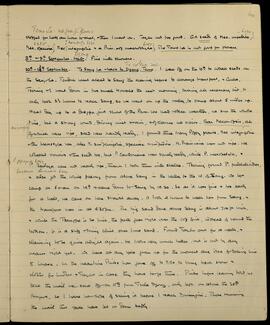
Temo La - not good for flowers - 6234
Stopped for half an hour to chat, then I went on. Taylor not too good. Got seed of Mec. impedita, 6235 Mec. speciosa, ? horridula 6236 Mec. integrifolia & a Prim. aff. macrophylla 6237. The Temo La is not good for flowers.

8th - 9th September. Halt Dzeng. Fine with showers.

10th - 14th September. To Sang ha & back to Dzeng, Temo. To collect seed. I went off on the 10th to collect seeds on the Sang ha. Tendruk went ahead to Sang the evening before to arrange transport, & Chuka, Tsering & I went down in two small kowahs the next morning, taking all necessary kit. It only took 2 1/2 hours to reach Sang, so we went on up the valley, to camp about 5 miles up. Next day up to a droppa just short of the Pass. We had rotten weather, no sun the whole time, but a strong wind, driving mist & rain, & of course no views. Bar Meconopsis, all of which were ripe, seed were hardly ready. I found three Ivory Poppy plants, Mec. integrifolia the brevistyla var, also M. simplicifolia, speciosa & impedita. M. Prainiana was not ripe. We collected various other seed too, but P. Cawdoriana was barely ready

LSH/1/1/6/1/133 · Part · 1933-09-07
Parte de The Ludlow & Sherriff Collection

SUMMARY:
Arrangements are made for a message from Tsela Dzong to reach Pana, and Kusho rejoins to assist with the Lamdo to Sanga Choling leg. Between 18–20 Sept., the party travels from Tse to Lamdo and on to Kongshong in heavy rain, checks stores, crosses the Tsangpo with loads, and collects limited seeds; Purbo reports on routes and local groups near Molo, Dzeus, Tanjong, Lo ba, and Tsari Soma. A hard ascent via Go nyi re with a Lopa guide leads to cold, windy conditions that hinder seed collecting.

CONTENT:
Tsela Dzong by Dzong-Dzong runner. So I think it should be here in 5 days or so, that with any luck I will get it at Pana. I am asking the Dzongpen to send it on there at once. I am glad to have Kusho back again to help with what will be a pretty hectic trip from Lamdo to Sanga Choling.

18th Sept. To TSE. Rain at night and nearly all today. The monsoon seems to be very busy still. In Tse all the things we left appear to be in good condition and have not suffered, as the bacon did. Nearly a whole side of it was eaten, and half a cheese too, by some kind of bug, while Ludlow and Taylor were away during June and July. We crossed the Tsangpo in six kowas, with all kit, about 24 loads the three of us.

19th Sept. To Lamdo. Rain most of yesterday, and very heavy rain all night. Collected a few seeds of Phlomis 5798 and a very few of Plectranthus. I find I can get more or less direct from here to Go nyi re, without going up to Kongshong first. That will make things much easier, though tomorrow will be a hard day's trek. I hope we have a reasonably fine day to do it in. Purbo came in this afternoon. He reached Molo from Dzeus in three days, which is extraordinary good going, but got some fever on the way back and was held up. He stays the night with us, which I hope will give some more hints to Kusho and Dzongpen about how to manage the Molo and Tanjong people. He does not anticipate any trouble with the Molo people going to the Lo ba, but it seems the Lopas have given a lot of trouble somewhere near Tsari Soma and have carried off 5 men. However I don't think they would dare do anything to a body of 12 or 15 coolies that I would have with me, especially as they would know I had a gun.

20th Sept. To Kongshong. Rain all night and all this morning, finer in afternoon. Coolies rather late, and did not get off till 6.15, with the same Lopa who lost me last time, as guide. To save a day I decided to go up direct from Lamdo to Go nyi re, and then drop down to Kongshong. It is an awful pull up, very steep for about 5000 ft, then along a rocky knife edge ridge, up and down and very tiring. The wind at the top was very cold and almost a gale, driving mist and fine rain. It was really too cold for seed collecting and I had no feeling in my fingers at all. We did not really do well either, but got lots of Meconopsis integrifolia, a good deal of Mec. florindae, which is not yet

LSH/1/1/7/1/17 · Part · 1940-05-24
Parte de The Ludlow & Sherriff Collection

SUMMARY:
Botanical observations near camp included Cremanthodium, P. littledalei, Meconopsis integrifolia, and saxifrages. After leaving the Thira La, Taylor returned to the Gyanda Chu and the party halted at Chomo Dzong to collect coracles and cross the river, observing barley harvesting and local papermaking, before abandoning a planned route from Kyakden to the Rong Chu and proceeding to Dzeng on the Tsangpo, where Primula and Gentiana waltoni were noted.

CONTENT:
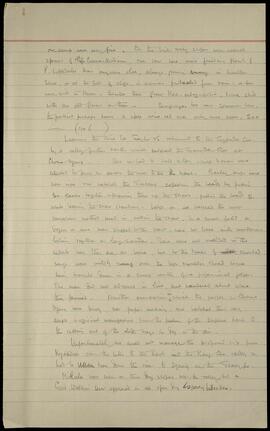
Near our camp were very fine. On the high rocky slopes were several species of Cremanthodium, we saw here more fruiting plants of P. littledalei than anywhere else, always growing among boulder scree, or at the foot of cliffs, in crevices protected from rain: a few were still in flower. Beside them grew Meconopsis integrifolia, some still with an odd flower on them. Saxifrages too were common here, the prettiest perhaps being a little wine red one only once seen, Saxifraga (No. 6).

Leaving the Thira La, Taylor returned to the Gyanda Chu, by a valley further North which entered the Gyanda Chu at Chomo Dzong. Here we had to halt a day while coracles were collected to ferry us across the river to the right bank. Barley crops were now ripe and we watched the Tibetans collecting the heads by putting two canes together and drawing them up the straws, pulling the heads off, while leaving the straw standing. Later on we watched the more dangerous method used in cutting the straw. In a small field a dozen or more men stripped to the waist, were let loose with murderous looking scythes on long handles. These were not wielded in the sedate way they are at home, but to the tunes of shouted songs were wildly swung over the left shoulder and head before being brought down in a sweep worthy of a professional golfer. The men did not advance in line, but wandered about where they fancied. Another occupation in which the people of Chomo Dzong were busy, was paper making, we watched this very simple and efficient manufacture from the peeling of the Daphne bark to the setting out of the cloth trays to dry in the air.

Unfortunately we could not manage the proposed trip from Kyakden over the hills to the East into the Rong Chu valley and had to turn down the river to Dzeng on the Tsangpo. Primula was seen on these dry slopes near the valley bed and Gentiana waltoni now appeared on an open dry hillside.