Showing 14 results

Archival description
14 results with digital objects Show results with digital objects
LSH/1/1/10/1/9 · Part · 1949-09-14
Part of The Ludlow & Sherriff Collection

SUMMARY:
The diarist notes many migratory birds from Tibet and poor seed results except likely from Marlung or passes to the west. On 21 Sept., they remain in camp while Yundon and Pasang collect Primula caveana and a fine woolly Phandra from Tamagorra Nala, returning late and exhausted, with Yundon suffering a bad headache. On 22 Sept., amid cold wind and intermittent rain and sun, letters arrive from H.H. and mail from Hicks and Ludlow, but none from Betty.

CONTENT:
This, in the same way as I did with Mec. simplicifolia. Hope it turns out well. The whole scene is too big for a cine-camera. There are a good many birds now on migration from Tibet. I saw hundreds of wagtails and two Afghan redstarts today. And I must have seen 20 Ibisbills, but they aren't on migration though. We did not do well with seed again, and certainly most of our seed this year will come from Marlung or over the passes to the West.

21st Sept. Halt. Rain at night, but a lovely day of sun and cumulus clouds. I stayed in camp to deal with yesterday's seeds, while Yundon and Pasang went up Tamagorra Nala to the NE to get P. caveana and the 8 plants of white caveana marked by Yundon when we were here before. They have just returned at 6:00 pm when I was beginning to be a bit anxious about them. Boulder scree is dangerous: one can very easily make a false step and have a nasty fall. It was too late for me to examine any seed brought, but they have got all the white P. caveana, and another basket of the usual caveana as no seed is ripe. They also found the very fine Phandra which is woolly all over, and which we took twice at Marlung, but never saw in very good flower. Today they have brought both seed and fine flower. It is a beautiful thing. I have not been able to see if the seed is good or not. Otherwise just a Sax or a Saussurea, and a few odd very small primula roots - perhaps P. cervicina or P. walshii, which I may take too. As they have had such a long day, we will not go out tomorrow, but I will do the seed and get the roots properly packed. Yundon returned with a very bad head, which he said he had most of the day.

22nd Sept. Halt. Stayed in camp. Rain and sun very cold indeed, with a strong wind. Letters came in from H.H. with food etc and a mail from Hicks, Ludlow and Kalimpong, but in some strange way no letters from Betty. Hers must have
LSH/1/1/10/1/21 · Part · 1933-10-01
Part of The Ludlow & Sherriff Collection

SUMMARY:
Describes a frosty halt day, continued collection of Gentiana (lacunulata), and praise for the seed collector Tupden. Notes comparisons of the Dhu Chu area with the Bumthang Chu, reports a letter from HH about upcoming arrivals (Hicks, MK, Tasho Drunyer), tallies seed and plant collections, and mentions confirmations by Ludlow and Taylor regarding Mec. Sherriffii.

CONTENT:
with Mec. paniculata, simplicifolia & horridula, all of which are in cultivation at home. Tupden is one of the best seed collectors there could be. He takes great pains & always goes on till called away. I wished to have had him from the beginning. Now I know him, I find him very good indeed. He is a Khampa, probably a runaway murderer or something like that, from Markham. The area of the Dhu Chu is something like shown opposite.

4th October Halt. Another lovely day, & very cold hard frost last night. The tents each night now are covered with frost inside & out, & this makes them very heavy. Nothing special happened today. I went out to look for more of yesterday's Gentiana (lacunulata) 19789, & after a while we found a lot of it. It reminds me of G. amplicrata which we first found at Zimsati near Sangacholing in Takpo. I don't think it is G. depressa, & certainly isn't G. amoena. The more I see of this area, the better it looks. It holds much more than the Bumthang Chu valley, although this is a tributary of the Bumthang Chu. It must be more than just not so many yaks here, although there is no doubt that many yaks, & sheep too, in a valley, make a very great difference to the flora. A letter came in from HH to say Tasho Drunyer will arrive on 6th. So with Hicks on 5th, MK on 6th & us on 7th, there will be some activity in Bumthang this week. The main seed collection is now over, & I have about 130 gatherings of seed now, besides the 40-50 taken before & some 25 rooted plants & a number of bulbs & tubers & corms & so on. Ludlow tells me he has 5 lbs. of seed of Mec. Sherriffii! That shows how common it is when it does occur. Taylor has confirmed that it is Mec. Sherriffii, but a very fine form of it.

LSH/1/1/3/3/198 · Part · 1996-06-18
Part of The Ludlow & Sherriff Collection

SUMMARY:
Notes from a camp east of Lang La on June 20 mention Ludlow at Lang La and describe the pass with rhododendron, juniper, and fir forest. Plant records include P. macrophylla (1843, 1844), Mec. simplicifolia (1845), and Corydalis (1846).

CONTENT:
L. p. 174 June 20 Camp east of Lang La. 14290 Ludlow at Lang La
Description of pass. - Rhod. Junip. Fir forest P. macrophylla 1843, 1844
Mec. simplicifolia 1845
Corydalis 1846

LSH/1/1/6/1/64 · Part · 1937-06-02 - 1937-06-05
Part of The Ludlow & Sherriff Collection

SUMMARY:
Field notes from Chubumbu La record collections of Meconopsis simplicifolia, several rhododendrons, Lilium souliei, Cassiope selaginoides, and primulas, with mentions of 1937 seed collected. Bird observations from Lanyong, Sheltan La, and Cheanang note probable breeding pairs and a flycatcher at a nest.

CONTENT:
32a
Chubumbu La. 2 June - See June 5

  1. Mec. simplicifolia. There were many of these growing in dwarf juniper. On the whole these have not such a true blue colour. Nearly all, but not quite, have blue filaments. The flowers were very large. Hairs on the stalk appear to fall off, when the stalk is at full length. A few 1937 seed collected.

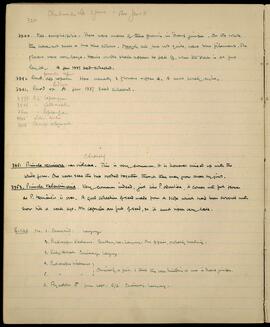
3942 Rhod. aff. repens (forrestii repens). Has usually 3 flowers often 4. A more lovely pink.

  1. Rhod sp. (ludlowii). A few 1937 seed collected.

  2. Rh. lopeangense

  3. " callimorphum

  4. " lopsangense
    3945 Lilium souliei
    3948 Cassiope selaginoides

Cheanang

3951 Primula vernicosa var. violacea. This is very common. It is however mixed up with the white form. One never sees the two rooted together, though they may grow cheek by jowl.

  1. Primula valentiana. Very common indeed, just like P. odontica, it comes into full flower as P. tsariensis is over. A good collection of seed made from a slope which had been covered with snow till a week ago. All capsules are full of seed, so it must ripen very late.

BIRDS: No. 1. Blackbird. Lanyong.

  1. Phylloscopus tibetanus. Sheltan La. Lanyong. One of pair, probably breeding.
  2. Rubythroat. Cheanang, Lanyong.
  3. Phylloscopus tibetanus ?
  4. " " " } Obviously a pair. I think they were building a nest in dwarf juniper.
  5. Flycatcher ♂ from nest. C/3. Cheanang. Lanyong.
LSH/1/1/3/3/219 · Part · 1996-06-18
Part of The Ludlow & Sherriff Collection

SUMMARY:
Botanical entries list Primula, Rhododendron, and Androsace specimens, highlighting a fine Androsace (No. 2235) nearly a foot tall. Stores from Chusam arrived with wireless, batteries, and rations; many people headed toward Sanga Chöling from the Kingkor, with women carrying bamboo poles toward Totsen, Sha ngu ha, and Sincoveni; weather was windy and sunny, mist rising up the Tsari Chu, and ponies took from 6 am to 2 pm.

CONTENT:
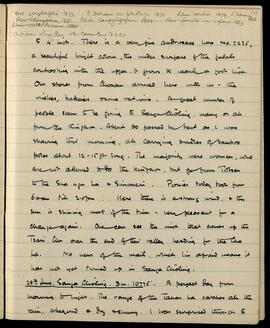
Mec. simplicifolia 1877, P. sikkimensis var. plantaginea 1878, Primula sonchifolia 1879, L. nanum 1880
Rhod. campylocarpum 1881, Rhod. campylogynum 1882, Rhod. forrestii var. repens 1883
Primula valentiana 1884
Androsace strigillosa var. cavaleriei 2235

to 4" high. There is a very fine androsace here No. 2235, a beautiful bright colour, the under surface of the petals contrasting with the upper. It grows to nearly a foot high. Our stores from Chusam arrived here with us - the wireless, batteries & some rations. A great number of people seem to be going to Sanga Chöling, many or all from the Kingkor. About 60 passed by here as I was shaving this morning, all carrying bundles of bamboo poles about 12-15 ft long. The majority were women, who are not allowed to do the Kingkor, but go from Totsen to the Sha ngu ha & Sincoveni. Ponies today took from 6.0 am till 2.0 pm. Here there is a strong wind, & the sun is shining most of the time - very pleasant for a change again. One can see the mist that comes up the Tsari Chu over the end of this

LSH/1/1/4/1/37 · Part · 1936-04-28
Part of The Ludlow & Sherriff Collection

SUMMARY:
The author follows a poor path near the Changla, then turns back and descends a small nala to a grassy plain bordered by cliffs and steep hillsides. The plain is covered with Mec. simplicifolia, with rhododendrons and a red Lonicera (2379–2383), and a striking primula (2385) thought to differ from a similar specimen collected at Mipa and seen in bud at Natrampa.

CONTENT:
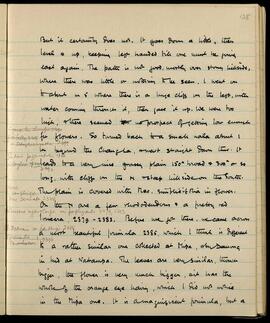
But it certainly does not. It goes down a little, then level or up, keeping left handed till one must be facing east again. The path is not good, mostly over stony hillside, where there was little or nothing to be seen. I went on to about m 5 where there is a huge cliff on the left, with water coming through it, then gave it up. We were too high, there seemed no prospect of getting low enough for flowers. So turned back to a small nala about 1 m beyond the Changla, and went straight down this. It leads to a very nice grassy plain 150 yards broad and 300 yards or so long, with cliffs on the N and steep hillside on the South.

The plain is covered with Mec. simplicifolia in flower. On the N are a few rhododendrons and a pretty red Lonicera, 2379 - 2383. Before we got there, we came across a most beautiful primula 2385, which I think is different to a rather similar one collected at Mipa, also Dawing in bud at Natrampa. The leaves are very similar, though bigger, the flower is very much bigger, and it has the wrinkle of the orange eye hairy, which I did not notice in the Mipa one. It is a magnificent primula, but a

LSH/1/1/10/1/137 · Part · 1949-10-24
Part of The Ludlow & Sherriff Collection

SUMMARY:
Notebook page listing plant specimens with collection numbers, taxa, and localities such as Marlung, Pangshang, Chela La, Tseli La, Natu La, Ha (Hato), Shanthang, and Changu, along with day–month collection dates. Brief notes occur for some entries (e.g., possible flower color).

CONTENT:
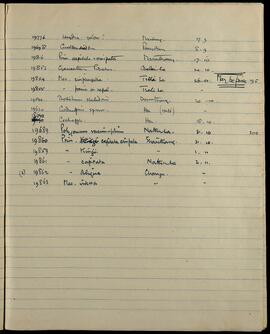
19776 Lloydia yellow? Marlung. 27.9
19698 Cremanthodium Pangshang 8.9
19856 Prim. capitata v. crispata Maruthang. 17.10
19853 Cyananthus rosatus. Chela la 24.10
19854 Mec. simplicifolia Tseli la 26.10. May be pink 195
19855 " panic or nepal. Tseli la "
19544 Thalictrum chelidonii Damthang. 30.10.
19620 Codonopsis sp. nov. Ha (Hato) "
18040 Crabapple. Ha. 25.10.
19689 Polygonum vacciniifolium Natu la. 31.10 200
19860 Prim. capitata crispata Shanthang. 31.10.
19859 " Kingii. " 1.11
19861 " capitata Natu la 2.11.
(2) 19862 " obliqua Changu. "
19863 Mec. nivosa " "

LSH/1/1/9/1/59 · Part · 1949-06-01
Part of The Ludlow & Sherriff Collection

SUMMARY:
The diarist describes promising terrain at the forest–grassland edge ('shing sam pang sam'), nearby lakes, and a retreating glacier beyond the head of the Trongsa Chu, with reports of takin in that area. On a rainy halt day, companions went far afield and returned with Mec. simplicifolia; later the writer found many near the tent and mentions Sherriff.

CONTENT:
Coming into flower. Maybe they don't grow here. I hope I haven't come to a poor primula, as they are the best things in my mind, to find. Every place where the forest ends & the grassy hillside begins, is called 'shing sam pang sam' which just means the edge of forest & grass. It is there we intend to go later on, & must say the country there & beyond looks good. To the south, about 1000 ft up, are several lakes, & I always think the slopes above them seem specially good. Away beyond, is a retreating glacier, & somewhere beyond that, I was told, is the head of the Trongsa Chu. It is here, the locals say that takin are to be found in quantity. Locally they are called them and Drong guinsi, which is the Bhutanese word. Drogpas come over from that direction soon, if they see any we will be able to find out. It was lovely open up there, & made one want to go on & on. I could cheerfully have gone on all afternoon, but would have failed to get back had I done so.

28th May. Halt. Mostly rainy, but with nice sunny patches. I stayed in camp to rest after yesterday. The lads went out a long way, & had a bad day. They brought in Mec. simplicifolia though, from miles away. In the evening I went 50 yds from my tent, & found about 100 of them! Today I took some of the dormant Sherriff's

LSH/1/1/8/1/19 · Part · 1946-11-14
Part of The Ludlow & Sherriff Collection

SUMMARY:
The diary records movements from the east side of Kongbo-nga La via Mye to Shu, with delayed coolies and negotiations for transport. It notes forest and plant observations near the pass, attempts to contact Gyantse and Ford by wireless, strong winds, and halts on 1–2 Dec due to uncertain transport.

CONTENT:
Nang.

28 Nov. Camp on E side of Kongbo-nga La. Coolies had not come in by 9.0, so we set off at 10.0 with about 30-40 loads only, leaving Samdup behind. A good day but spoilt by transport trouble. Reached the pass by 2.30 & in at camp - not at Nye - at 5.0pm. Coolies came in soon after except about 15 who only turned up next day. It was good to be in forest again, pine, larch & birch on the west side, & juniper, larch & birch on the E, with pine on N faces. Rhod. vellereum common, with two small Rhodos. On the E side saw some P. jaffreyana & a lot of Androsace of 3 species.

29 Nov. Mye. A short march in today where we should have reached yesterday. Samdup also turned up by 11.0 & our kit has again caught us up. I saw two partridge on the way up the Pass. Ludlow then saw one 'Kuling' & another, while Ludlow missed a Crossoptilon on this side. This is the first village with pent wooden roofs. All to the W of this are flat roofed. The hilltops often have early morning mist on them now - a sign of a damper climate. I was surprised to see no Mec. simplicifolia on the pass - only M. horridula.

30 Nov. Shu. An easy march. We were in by 1.0 (start 8.0) & coolies were in shortly after. A few were late. I tried to contact Gyantse at 3.30 pm (BT) by W/T, but got no answer. Later tried Ford (TASA) but again got no answer. Local Dzongpon's man tried to refuse to give us anything but day to day transport. We demanded 'Dzongyel', & we think we have succeeded, at the price of 2 days halt & a than of cloth & ten cigarettes! Supplies difficult, & we have hardly managed to get anything. Very strong wind in evening.

1st Dec. Halt. Fine, but clouded by midday. Wind by 2.30.

2nd Dec. Halt. Fine & clear & windy. We doubt if our transport will come as promised, by this evening. This is a bad place to get away from - in 1938 we were held up five days at Kyimdong Dzong.

Page 220
LSH/1/1/4/1/220 · Part · 1936-09-12
Part of The Ludlow & Sherriff Collection

CONTENT:
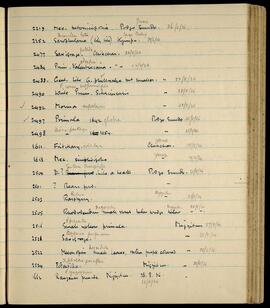
2219 Mec. betonicifolia. Yume Podzo Sumdo. 26/6/36.
2252 Ficariifolia lutea Scrophularia (like this) Sanga Choling Kyimpu. 29/6/36
2477 pallida Saxifraga. Chikchar. 23/8/36
2484 odontica Prim. Valentiniana. " - 24/8/36
2483 Gent. like G. phyllocalyx but smaller. " 23/8/36
2490 P. chionantha subsp. sikkimensis White Prim. sikkimensis - 27/8/36
2492 Morina nepalensis - 23/8/36
2497 Primula 1642 flava Podzo Sumdo 25/8/36
2498 Dicrv. pantlingii " 1654. - 25/8/36

  1. Fritillary. cirrhosa Yarap Chikchar. 18/5/36
    1613 Mec. simplicifolia Yarap 19/5/36
    2500 Gaultheria trichophylla ? like a heath. Podzo Sumdo. 25/8/36
    2501 ? Bears food. -
    2503 Rubus Raspberry. Migyitun 2