Showing 8 results

Archival description
8 results with digital objects Show results with digital objects
LSH/1/1/10/1/134 · Part · 1949-09-27
Part of The Ludlow & Sherriff Collection

SUMMARY:
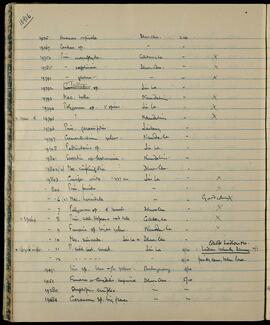
Page lists plant specimens with collection numbers and localities across Dhur Chu, Goshon La, Jin La, Namda La, Lintang, and Shu Chu. Taxa noted include Anemone rupicola, Carduus, Primula species, Trollius, Meconopsis, Polygonum, Cremanthodium, Pedicularis, Swertia, and a white Crucifer.

CONTENT:
16916

19135 Anemone rupicola Dhur Chu. 3-10
19467 Carduus sp. " "
19750 Prim. macrophylla. Goshon La " X
19785 " sapphirina Dhur Chu. " X
19791 " glabra " " X
19792 Trollius Ranunculus sp. Jin La. "
19793 Mec. bella Namda La " X
19794 Polygonum sp. 2" spikes. Jin La. " X
= 19441 ? 19795 ? Namda La " X
19796 Prim. geraniifolia. Lintang "
19797 Cremanthodium yellow. Namda La "
19798 Pedicularis sp. Jin La. "
19801 Swertia aff hookeriana. Namda La "
19802 (2) Mec. simplicifolia Dhur Chu. "
19803 Crucifer white = 1937 acc Jin La " X

  • 804 Prim. pusilla " " X
  • 6 (2) Mec. horridula " " Goshon X
  • 7 Polygonum sp. 4" tassels. Shu Chu " X
    = 19464 - 8 Prim. sikk. Hopeana red tube Goshon La "
LSH/1/1/4/1/119 · Part · 1933-09-24
Part of The Ludlow & Sherriff Collection

SUMMARY:
Diary entries record fine weather, observations of flowering Gentiana and seed collecting of Primula species around Kyimpu Halt and Le La. On 4 October the author moves to a camp north of Drichung La, parts from Ludlow and Lumsden, and continues with Ahmad Sheikh, Tsongpen, and Pimbo toward Trim while continuing seed collections.

CONTENT:
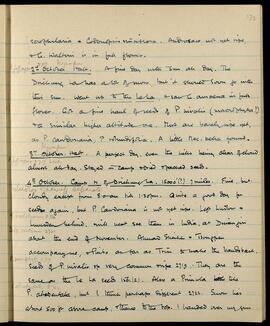
Scrophularia & Codonopsis vinciflora. Androsace not yet ripe, & G. waltonii is in full flower.

2nd October. Kyimpu Halt. A fine day with sun all day. The Drichung La has a lot of snow, but it should soon go with this sun. Went up to the Le La, & saw G. amoena in full flower. Got a fine haul of seeds of P. nivalis (macrophylla?) & a similar higher altitude one. Most are barely ripe yet, as P. cawdoriana, P. rotundifolia. A little Mec. bella found.

3rd October. Kyimpu Halt. A perfect day, even the hills being clear of cloud almost all day. Stayed in camp & dried & packed seeds.

4th October. Camp N of Drichung La. 15000'(?) 7 miles. Fine, but cloudy except from 8.0 am till 1.30 pm. Quite a good day for seeds again, but P. cawdoriana is not yet ripe. Left Ludlow & Lumsden behind, will next see them in India, at Dirang Dzong about the end of November. Ahmad Sheikh & Tsongpen accompany me, & Pimbo as far as Trim to make the bandobast. Seeds of P. nivalis sp very common & ripe 2719. They are the same as the Le La seeds 1561(2). Also a Primula like P. atrodentata, but I think perhaps different 2722. Snow lies about 500 ft above camp, & thence to the top. I handed over my gun

LSH/1/1/4/1/7 · Part · 1936-07-02
Part of The Ludlow & Sherriff Collection

SUMMARY:
Field observations around Kyimpu noting numerous flowering plants and seed collections, including Roscoea alpina, Deutzia hookeriana, Stellera chamaejasme, and Meconopsis bella. A supposed crane’s eggs find proved to be partridge; later, the party halted with rain, bought a sheep, and walked toward the Le La. The locals are described as friendly.

CONTENT:
Kyimpu July 3. Roscoea alpina 2275. Onosma hookeri 2276, Stellera chamaejasme 2277 (113
Deutzia hookeriana 2279, Pedic. longiflora var tubiformis 2282, Mec. bella 2283

...a crane's eggs, but when he brought them, they turned out only to be those of a partridge, a great disappointment. There were four in the nest, of which he broke one.

A good many flowers on the way up, lots of the Primula jeffreyana 2257, of walshii 2256 just below Kyimpu 2258. Also of the Incarvillea lutea 2252 of which I took some of last year's seeds, which appear to be good. P. atrodentata is in seed too, of which I took a lot of that. Mec. bella 2283 is in flower here, others up here. There is a nice little Deutzia hookeriana 2279 in the rocky gorge between the two bridges, which is both fragrant and pretty. And the Stellera 2277 is a nice little thing, looking prettiest when it is half out—red in the centre of the buds, contrasting with white of the open corolla all around. I think we should do well up here. The locals are all a friendly lot for anything as far as I can see.

4th July. Halt. More or less fine till 1130, then heavy rain most of the day. Bought a sheep for Rs 3/-. We all went up towards the Le La, turning off right before reaching it. P. hyacinthina 2294 is very common.

LSH/1/1/10/1/23 · Part · 1933-10-01
Part of The Ludlow & Sherriff Collection

SUMMARY:
Entries describe leaving frost-bound Gortsum after a storm, incentivizing the team to dig a large haul of lily bulbs (430 total) with little Meconopsis bella seed found, and reaching camp early. The next day at Dhur was a short march with collection of Notholirion macrophyllum bulbs and Thalictrum chelidonii seed, seed-drying and packing, games with companions, and Yundon sent to Shasjetang to collect more seed before rejoining at Kuji (Bumthang).

CONTENT:
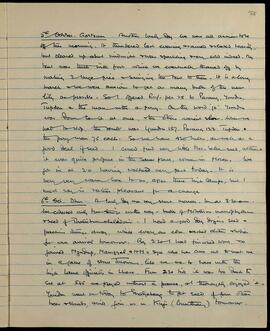
5th October. Gortsum. Another lovely day. We were all anxious to be off this morning. It thundered last evening and rained and sleeted heavily, but cleared up about midnight and was sparkling and very cold indeed. My tent was thick with frost which we eventually thawed off by making 3 large fires and bringing the tent to them. It is a long march and we were anxious to get as many bulbs of the new lily as possible. So I offered Rs 1/- per 25 to Pasang, Yundru, Tupden and the man with a pony. On the word 'go' Yundru was down to it at once, the others were slower. When we had to stop, the result was Yundru 157, Pasang 123, Tupden and the pony man 75 each. So we have 430 bulbs, as well as a good deal of seed. I could find very little Mec. bella seed, although it was quite profuse in the same place, when in flower. We got in at 2.0 having walked very fast today. It is very very warm here to us, after those high camps, but I must say is rather pleasant for a change.

6th Oct. Dhur. A lovely day and a very short march. In at 8.30 am. We collected only two things on the way - bulbs of Notholirion macrophyllum and seed of Thalictrum chelidonii. I had a good day drying seed and packing things away, while everyone else washed clothes and bodies for our arrival tomorrow. By 2.30 I had finished work, so joined Ngudup, Namgyal, and HH's syce who had come out to meet me in a game of stone throwing, like we used to have with the high lama officials in Lhasa. From 2.30 till it was too dark to see at 5.45 we played without a pause, and thoroughly enjoyed it. Yundon went on today to Shasjetang to get seed of four other trees and shrubs, and will join us in Kuji (Bumthang) tomorrow.

LSH/1/1/4/1/131 · Part · 1933-10-12
Part of The Ludlow & Sherriff Collection

SUMMARY:
Tsongpen's eyes have recovered as the party collects more yellow primula 2396, compares it with petiolaris and Sikkimensis, gathers Meconopsis bella, and secures a few seeds of Tendu's primula for cleaning next day. Persistent snow hinders plans to go beyond the Kashongha and makes crossing the Changha out of the question. The Trum gyimpu returned home but is expected back with coolies on the 15th evening.

CONTENT:
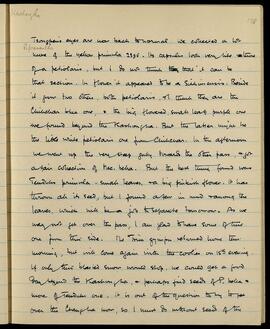
Tsongpen's eyes are now back to normal. We collected a lot more of the yellow primula 2396. Its capsules look very like those of a petiolaris, but I do not think that it can be that section. In flower it appeared to be a Sikkimensis. Beside it grow two others, both petiolaris, I think they are the Chunchar blue one, and the big flowered, small leaf purple one we found beyond the Kashongha. But the latter might be the little white petiolaris one from Chunchar. In the afternoon we went up the very steep gully towards the other pass, and got a fair collection of Mec. bella. But the best thing found was Tendu's primula - small leaves, and a big pinkish flower. It has thrown all its seed, but I found a few in mud and among the leaves, which will be a job to separate tomorrow. As we may not get over the pass, I am glad to have some of this one from this side. The Trum gyimpu returned home this morning, but will come again with the coolies on 15th evening.

If only this blasted snow would stop, we could get a good day beyond the Kashongha, and perhaps find seeds of P. bella and more of Tendu's one. It is out of the question to try to get over the Changha now, so I must do without seed of the

LSH/1/1/9/1/105 · Part · 1949-07-12
Part of The Ludlow & Sherriff Collection

SUMMARY:
Diary entries describe uncertainty about coolies, plans to reach Bumthang before Betty departs Denchung, and subsequent marches from Amhlungnang over Jü La and Goktang La to Gorzam Camp above Dhur. Noted were heavy rains, a halt day, and rich alpine flora including Meconopsis species, Primula hopeana, a high-altitude iris, and the discovery of a new lily during a fine day interrupted by a storm.

CONTENT:
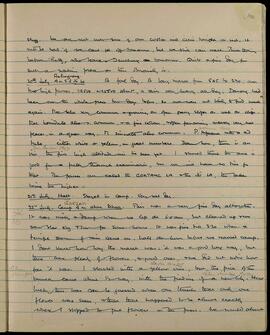
stuff. We are not now sure if our coolies will come tonight or not. It will be bad if we can't get off tomorrow, but we still can reach Bumthang before Betty, who leaves Denchung on tomorrow. Quite a fine day for such a soaking place as the Bhomali is.

20th July. Amhlungnang. 4 m S of Jü La. A fine day. A long march from 5.45 to 2.30, over two high passes, 14,500 + 15,500 about, and rain very heavy all day. Danong had been over the whole place ten days before, so we were not likely to find much again. Mec. bella very common and growing on open grassy slopes as well as cliffs. Mec. horridula also very common, and a fine colour, often favouring marshy very wet places, in a queer way. M. sinuata also common. P. Hopeana with a red tube, either white or yellow, in great numbers. Down here, there is an Iris, the first high altitude iris I've seen yet. I should think the area is good for a pretty thorough examination, but we will have no time for that. The passes are called the GOKTANG LA and the JÜ LA, the latter being the higher.

21st July. Halt. Stayed in camp. Very wet day.

22nd July. GORZAM Camp 4 m above Dhur. This was a very fine day altogether. It was misty and damp when we left at 6.0 am, but cleared up and we saw blue sky and sun for some hours. It was fine till 3.30 when a terrific storm of rain came on, half an hour before we reached camp. I don't know how long the march was: it was a good long way, but there were plenty of flowers, and good ones, and we did not notice how far it was. I started with a yellow iris, but the pick of the bunch came about halfway, with the finding of a new lily. How lucky this was can be guessed when one thinks that only one flower was seen, and that that happened to be almost exactly where I stopped to put flowers in the press. We would almost...

LSH/1/1/10/1/19 · Part · 1933-10-01
Part of The Ludlow & Sherriff Collection

SUMMARY:
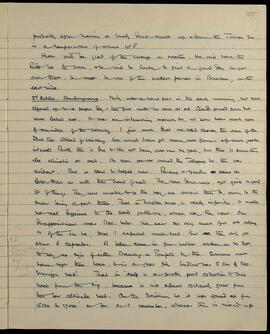
Clear, frosty day at Amelungnang with notes on Hicks needing to cross the Rudo La in Bhutan. The writer reflects that the Dhur Chu area would have yielded better flowers than Waitang, noting climatic differences after crossing the Tolegang La; Pasang and Yundru arrived later with a good haul of seed despite a foot of snow on boulder scree, and there was disappointment regarding Mec. bella near the Sin La.

CONTENT:
probably, after having a lonely duck swoosh up and down the Tumen Su in a temperature of about 10° F.

Hicks will be glad of the change in weather. He will have the Rudo La to cross, and he will be lucky to find a good day to get over that. It must be one of the wetter passes in Bhutan, on the east side.

3rd October. Amelungnang. Misty, with a hard frost in the early morning, but soon cleared up to a perfect day - the first with no rain at all. Clouds formed soon but never looked wet. It was an interesting march, too, and I now have much more of an idea of the country. I just wish that we had chosen the area of the Dhur Chu instead of Waitang. We would have got many more flowers and of much greater interest. Partly this is due to the area not being overrun by yaks, but there is something else climatic as well. As soon as we crossed the Tolegang La, this was evident. But it can't be helped now. Pasang and Yundru came on later than us with their haul of seed. They have done well, and got quite a good lot of things. They were unable to go the way we meant them to, owing to the snow being a foot thick. That on boulder scree, is really impossible. It made no real difference to the seed gathering, which way they went. One disappointment was Mec. bella. We saw so very much of it all along N of the Sin La, that I expected

LSH/1/1/3/3/211 · Part · 1996-06-18
Part of The Ludlow & Sherriff Collection

SUMMARY:
Wet, misty march of 9 miles to Simoneri at about 13,500 ft; few new plants noted except a gentian (no. 2209) and Meconopsis bella near a large swamp, which proved disappointing. Notes on local pass and rest house names (Karkyu La, Taktsang, Tomtsang, Shao ngu La), including a tale of a lama pacifying tigers and bears, and fatigue from repeated 4,000 ft climbs since the 14th.

CONTENT:
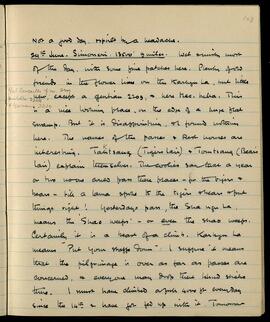
Not a good day, spoilt by a headache.

24th June. Simoneri. 13500' 9 miles. Wet, misty most of the day, with some fine patches here. Plenty of old friends in the flower line on the Karkyu La, but little new, except a gentian 2209, & here Mec. bella. This is a nice looking place, on the edge of a huge flat swamp. But it is disappointing, as I found nothing here.

The names of the passes & Rest houses are interesting. Taktsang (Tiger's lair) & Tomtsang (Bear's lair) explain themselves. The coolies say that a year or two ago none dared pass these places—for the tigers & bears—till a lama spoke to the tigers & bears & put things right!

Yesterday's pass, the Shao ngu La, means the 'Shao weeps'—or even the shao weeps. Certainly it is a beast of a climb. Karkyu La means "Put your staffs down": I suppose it means that the pilgrimage is over as far as passes are concerned, & everyone may drop their climbing sticks there. I must have climbed about 4000 ft everyday since the 14th & have got fed up with it. Tomorrow