Showing 10 results

Archival description
10 results with digital objects Show results with digital objects
LSH/1/1/7/1/8 · Part · 1940-05-24
Part of The Ludlow & Sherriff Collection

SUMMARY:
Notes compare vegetation in the Tsangpo valley with that near Kyimdong Dz, highlighting distribution differences. Plants usually confined to south slopes are observed north of the Himalayas due to increased rainfall passing the barrier, with examples including Magnolia globosa, Lilium giganteum, and possibly Nymphaea.

CONTENT:
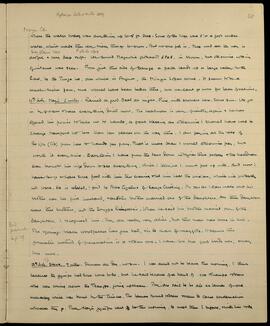
Contrast in Tsangpo valley
vegetation from that near
Kyimdong Dz-
Lil. Wardii.

Shape of side valleys Swamp

Various plants normally on South slopes only,
now appear north of the Himalayas, owing to the
increased rainfall which passes the barrier. Among these are Magnolia globosa, Lilium
giganteum, (Nymphaea?)

LSH/1/1/7/1/11 · Part · 1940-05-24
Part of The Ludlow & Sherriff Collection

SUMMARY:
The author describes the low Tum La pass and nearby areas, noting limited finds there but abundant primulas and a notable prostrate yellow-flowered rhododendron. After wet weather they returned toward Nagu, collected aquatic and tree specimens, noted Magnolia globosa and Lilium giganteum in the Nagu Chu valley, and then proceeded toward Paka to visit the Tsanang La and Kuchala passes, observing that Tsanang La is steep and little used but botanically promising.

CONTENT:
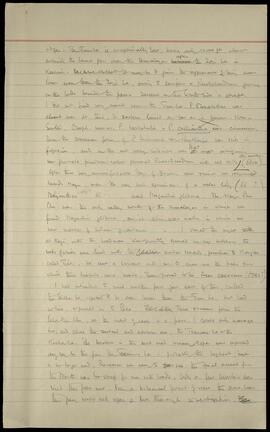
ridge. The Tum La is exceptionally low, being only 12,000 ft, almost certainly the lowest pass over the Himalayas after the Zoji La in Kashmir. It gives the appearance of being even lower even than the Zoji La, owing to conifers & Rhododendrons growing on the hills beside the pass. Descent on the south side is abrupt. I did not find very much near the Tum La. P. Elizabethae was almost over at this, its eastern limit as far as is known. Nom-Soulei, Omph. minus, P. barbata & P. calliantha were common. Here the common form of P. Dickieana var. Pantlingii was still in profusion, and on the wet rocky hillside was that most intriguing new prostrate primrose yellow flowered Rhododendron, with red spots (6600).

After three very uncomfortable days of driving rain & mist we returned towards Nagu, & on the way took specimens of a water lily (66?) Menyanthes trifoliata 66-- and Magnolia globosa. The Nagu Chu was the only valley north of the Himalayas in which we found Magnolia globosa, & it also was in which we saw masses of Lilium giganteum. I stayed the night at Nagu with the headman who proudly showed me his kitchen the walls of which were lined with wooden teapots, peculiar to Kongbo, called Tisti. He sent a servant with me to show me the trees from which these teapots were made. These proved to be Acer caesium (5740?).

I had intended to visit another pass just east of this, called the Shoka La, reputed to be even lower than the Tum La, but had no time, & pushed on to Paka. Three streams form the Paka Chu Chu, at the head of each is a pass. I could only manage two, and chose the central and eastern one, the Tsanang La & the Kuchala. The western is the most used & many Lopas were expected any day by this pass. The Tsanang La is probably the highest, but is no longer used. The reason was easy to see. The final ascent from the North was too steep for men with loads. Only a few hunters ever visit this pass now. From a botanical point of view the area near this pass, would well repay a more thorough investigation.

LSH/1/1/5/1/113 · Part · 1937-06-07
Part of The Ludlow & Sherriff Collection

SUMMARY:
Notes describe following the Longte Chu to Longtepang and continuing toward Rukubzhi, with plant finds including Primula prenantha, Meconopsis villosa, and identification of Primula tenella. On 13th June, a 10-mile march to Phobsikha via Chele La is recorded, with rain, steep ascents and descents, and observations of Magnolia globosa and a small rhododendron.

CONTENT:
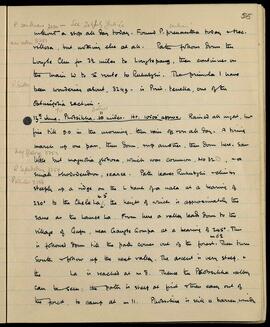
P. smithiana 3250 — See 20th July Yuto La.

...without a stop all day today. Found Primula prenantha today and Meconopsis villosa, but nothing else at all. Path follows down the Longte Chu for 3 1/2 miles to Longtepang, then continues on the main West to East route to Rukubzhi. The primula I have been wondering about, 3249 — is Primula tenella, one of the Obtusifolia section.

13th June. Phobsikha. 10 miles. Height 10,500' approx. Rained all night, but fine till 9:00 in the morning, then rain off and on all day. A tiring march up one pass, then down, and up another, then down here. Saw little but Magnolia globosa, which was common, No. 3253, and a small rhododendron, scarce. Path leaves Rukubzhi and climbs steeply up a ridge on the left bank of a nala at a bearing of 230° to the Chele La, the height of which is approximately the same as the Lausa La. From here a valley leads down to the village of Gufu, near Gangte Gompa at a bearing of 245°. This is followed down till the path comes out of the forest. Then turn South and follow up the next valley. The ascent is very steep, and the La is reached at mile 8. Thence the Phobsikha valley can be seen; the path is steep at first and then eases out of the forest, to camp at mile 11. Phobsikha is still a barren, windy...

LSH/1/1/7/1/9 · Part · 1940-05-24
Part of The Ludlow & Sherriff Collection

SUMMARY:
The diarist describes abundant Primula species on swampy valley slopes and notes that by October seed and leaves were scarce due to yak grazing. On June 19th they returned to Lanyong, then departed for Molo via the Tse La, later traveling down the Tsangpo valley to Mayu and making difficult river crossings (including by skin coracles and a log raft) before proceeding up the Nagu Chu valley toward the Tam La over the Himalayas.

CONTENT:
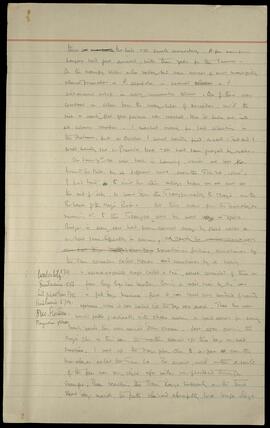
there are two huts & a small monastery. A few men
from Lanyong had just arrived, with their yaks for the summer -
On the swampy slopes in the valley bed were masses of most beautifully
coloured primulas - P. alpicola in several and a P.
sikkimensis subsp in every conceivable colour. One of these was
constant in colour down the rocky sides of cascades, until the
rich & marshy flat yak pasture was reached. Here it broke out into
all colours & shades. I marked many for seed collecting in
the Autumn, but in October I could hardly find a seed & indeed I
could hardly see a Primula leaf - all had been grazed by yaks.
On June 19th we were back in Lanyong, which we left then,
bound for Molo, by a different route, over the Tse La, 15000'.
I had time to visit two other valleys before we all met at
the end of July, so went down the Tsangpo valley to Mayu on the
R bank of the Nagu River - All these rivers from the Himalayas
running N. to the Tsangpo were by now in spate.
Bridges in every case had been carried away by flood water &
we had some difficulty in crossing, clear days sometimes fording, sometimes by
the skin coracles called Kowas and sometimes by a heavy

Waterlily 5749 unmanageable craft called a 'tru', which consisted of three or
Smilacina 5756 four long logs tied together. Crossing a rapid river by 'tru' was
Lil. giganteum 5743 a full day's business: first it was towed some hundreds of yards
Smilacina 5754 upstream, where it was loaded till the logs were awash. Then two men
Rhod. floribunda would paddle frantically with sticks making a yard across for every
Magnolia globosa twenty yards they were carried down stream. Just after crossing the
Nagu Chu in this way, the weather cleared after three days we had
sunshine. I went up the Nagu Chu valley to a pass at over the
Himalayas called the Tam La. The ascent, until within a mile
of the pass was very slight & for miles we plodded through
swamps. Then reaching the Main Range suddenly on the third
short day's march, the path climbed abruptly to a knife edge

LSH/1/1/4/1/8 · Part · 1936-07-02
Part of The Ludlow & Sherriff Collection

SUMMARY:
Field notes from Nyug La and Pachakshiri record several bird species with elevations and mention Magnolia globosa. It states that Nyug La means the bamboo pass, notes visible bamboo nearby, and reports dense bamboo jungle on the summit around 13,000 ft as reported by Pember. Ludlow is noted at Nyug La.

CONTENT:
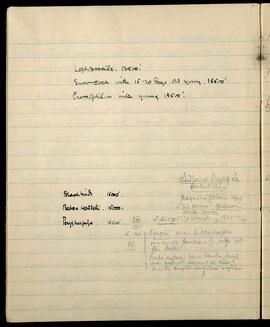
Leptopoecile. 13500'.
Snow-cock with 15-20 day old young. 15500'
Crossoptilon with young 13500'.

Ludlow at Nyug La
Pachakshiri

Magnolia globosa 1907
Blackbird 15000'. L'Abbé Bureau - Spelaeornis
Babax waddelli. 15000. soulei soulei
Pyrrhospiza. 16500'. NB. L. bis 178 (S.S. Sherriff y 1833 79/84)

L. 143 Nyug La means the bamboo pass.
NB. one can see bamboo on the ridge not
far distant
Pember reported dense bamboo jungle
on the actual summit which must
be in the neighborhood of 13000' maybe less.

LSH/1/1/6/1/97 · Part · 1933-07-05
Part of The Ludlow & Sherriff Collection

SUMMARY:
Travel along the Nayu Chu was difficult with deep water and mud; Magnolia globosa was found in bloom and a route toward the Tunza La is noted. On 11 July at Nayu, the headman offered ponies for transport to Lamdo and social visits ensued, including mention of his relation to Ashe Cyelmo of Sangacholing; a preserved bird specimen spoiled. On 12 July the party moved to SHOKA amid showers, with reports of Khampa robbers crossing the Tsangpo and the Nayu gyupon departing to meet them.

CONTENT:
Hydrangea heteromalla 5809
48

Nayu Chu
where the water today was anything up to 5 ft deep. Some of the logs were 6" or a foot under water, which made them very tricky things to cross. But no one fell in. The mud all the way is awful & very deep too. We found Magnolia globosa (?) 5805, in bloom, but otherwise nothing of interest was seen. From just this side of Damze a path leads up a large valley to the East, to the Tunza La, over which in August, the Minyu Lopas come. It seems to be a much higher pass, and would have been better there, but we can't go now for lack of rations.

11th July. Nayu 5 miles. Rained a good deal at night. Fine, with showers here. Some sun. We got in by 9 am & have everything dried now. The headman is very friendly again & he has offered his ponies to take me to Lamdo, a great blessing, as otherwise I should have had to change transport no less than ten places on the way there. I am paying at the rate of Rs 1/12 (Tib) from here to Lamdo per pony. That is more than I would otherwise pay, but worth it every time. Everything I have from the tent down intrigues these people, & the headman even brought his wife down to see everything, which I think I must put up with. And now I have to have some food with him this evening & let him hear the wireless, which will probably not work. He is related, I find to Ashe Cyelmo of Sangacholing. As far as I can make out his brother was her first husband, & another brother married one of the daughters. All three daughters were this brother's, not the Drugpa Rimpoche's. When he said his brother married one of the daughters, I recognized him. They are really very alike, but this man has more in him.

The young black woodpecker has gone bad, viz. is a mass of maggots. It seems this formalin method of preservation is a rotten one. I have lost two good birds now, & may lose more.

12th July. To SHOKA. 7 miles. Showers all day, no sun. I was asked not to leave this morning, I think because the gyupon had some work to do, but he said because of a band of 100 Khampa robbers who were coming across the Tsangpo, going upstream. They are said to be all ex-lamas of one monastery which was burnt by the Chinese. The lamas turned robbers seem to cause consternation wherever they go. The Nayu gyupon went off too this morning, to meet them I suppose, with him rode

LSH/1/1/5/1/21 · Part · 1935-11-27
Part of The Ludlow & Sherriff Collection

SUMMARY:
Orchids and magnolias were noted near the pass, and a snake that struck the diarist’s shoe was killed by Tsongpen. Rinso struggled with the local dialect, and the writer records route details around Nabzi, including the confluence at Nimjhong, the path to Trongsa via the Takotse La, and camp and weather notes.

CONTENT:
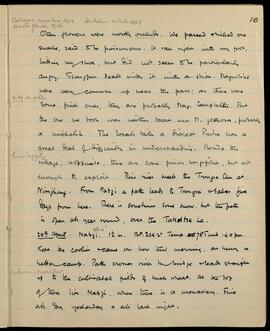
Coelogyne corymbosa 2954 Dendrobium nobile 2957 10
Phaius flavus 2956

Other flowers were mostly orchids. We passed and killed one snake, said to be poisonous. It ran right into my foot, hitting my shoe, but did not seem to be particularly angry. Tsongpen dealt with it with a stick. Magnolias were very common up near the pass; as there were some pink ones, they are probably Mag. campbellii. But the one we took was neither that nor M. globosa, probably a michelia. The locals talk a dialect Rinso has a great deal of difficulty in understanding. Beside the village, opposite, there are some Pinus longifolia, but not enough to exploit. This river meets the Trongsa Chu at Nimjhong. From Nabzi a path leads to Trongsa and takes five days from here. There is sometimes some snow, but the path is open all year round, over the Takotse La.

29th April. Nabzi. 1 1/2 m. BP. 204.2° Temp 4000' 76° Time 4.0 pm.
Kept the coolies and came on here this morning, as being a better camp. Path crosses river by bridge and leads straight up to the cultivated fields of buckwheat. At the top of these lies Nabzi, where there is a monastery. Fine all day yesterday and all last night.

LSH/1/1/1/1/213 · Part · 1933-10-04
Part of The Ludlow & Sherriff Collection

SUMMARY:
Diary notes describe travel from Kipup to Sedonchen and Rhenock with misty weather, high passes, and tiring stone paths. The party reunites with Pinto and Danong; notes mention bird collecting, scarce Bhutan lily bulbs, and bird boxes dispatched from Yatung with one possibly near Salimapo. A glimpse of Kanchenjunga and return to a leech-prone zone are recorded.

CONTENT:
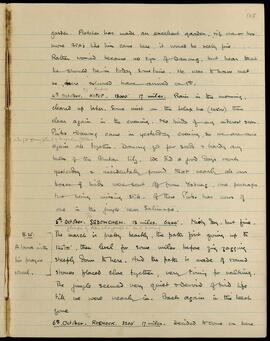
105

garden. Fletcher has made an excellent garden, if one or two more BIA's like him came here, it would be really fine. Rather worried because no sign of Danong, but hear that he should be in today sometime. He was to have met us, should have arrived on 1st.

4th October. TO KIPUP. 13000' 17 miles. Rain in the morning, cleared up later. Some mist on the Jelap La (14500) then clear again in the evening. No birds of any interest seen. Pinto & Danong came in yesterday evening, so we are once again all together. (also for young plants of Magnolia Globosa) Danong got few seeds & hardly any bulbs of the Bhutan lily. We did a good day's work yesterday & incidentally found that nearly all our boxes of birds were sent off from Yatung, one perhaps two being missing still. Of these Pinto has news of one in the jungle near Salimapo.

5th October. TO SEDONCHEN. 13 miles. 6400'. Misty day, but fine. (glimpse of Kanchenjunga in early morning) The march is pretty beastly, the path first going up to 13500', then level for some miles before zig zagging steeply down to here. And the path is made of round stones placed close together, very tiring for walking. The jungle seemed very quiet & devoid of bird life till we were nearly in. Back again in the leech zone. (B.35. A lama with his prayer wheel.)

6th October. TO RHENOCK. 3200' 17 miles. Decided to come on here

LSH/1/1/1/1/75 · Part · 1933-06-30
Part of The Ludlow & Sherriff Collection

SUMMARY:
Notes on the death of the Thimbu penlop and Tobgye’s sending of English medicine, causing concern with the Maharaja. On 30th June Ludlow and the author travelled to Lomi-Tsa-wa via Do Kyong La in clearing weather, collecting flowers including Magnolia globosa and observing that vegetation in the Trashi-cho-dzong valley and at the pass resembled Sikkim.

CONTENT:
35

Thimbu penlop. He died of dropsy & a short while ago his
relations asked Tobgye for English medicine. Against his own
lamas advice, Tobgye sent some, but with strict instructions
that the lamas should first of all decide in their usual way
whether it would do good or not. After taking one of the two
medicines, the man felt weaker, & the whole thing was
immediately reported to the Maharaja, who is said to have been
angry with Tobgye. They said nothing of the fact that the
other medicine did a lot of good. I can't believe that the
Maharaja will put any blame down to Tobgye in the end.

30th June. TO LOMI-TSA-WA. 12 miles - 6700' (An. Ht. 7700'). Ludlow & I
Embelia oleracea 182
Anemone rivularis 183 were at last able to go on our own & were allowed to shoot
Rhod. Keysii 184
Symplocos ramosissima 186 as soon as we reached the DO KYONG LA, 10410'. So we
Pedicularis megalantha 187
left at 5.30 am, although it was raining pretty hard. By
Meconopsis villosa 189
Rhod. camelliaeflorum 190 7.30 however it cleared up & remained fine till 5.0 pm. On
Berberis celestina 191
the way up & at the top we found a number of flowers,
Mag. globosa 192
Pyrola rotundifolia 193 including the magnificent Magnolia Globosa in full bloom at
Streptopus simplex 194
10000'. We also got a strange rhododendron which Dawang
Geranium pratense 198
Didissandra lanuginosa 199 has never seen before. In the Trashi-cho-dzong valley
the vegetation is quite different to what we had seen before:
trees were quite scarce, & what there were, were mostly
small. The forest again became thick, but at the pass the
vegetation was much more like Sikkim - no pines or firs, a
good deal of bamboo undergrowth & numbers of rhododendrons.