Mostrar 10 resultados

Descrição arquivística
10 resultados com objetos digitais Mostrar resultados com objetos digitais
LSH/1/1/3/3/125 · Part · 1933-04-09
Parte de The Ludlow & Sherriff Collection

SUMMARY:
The writer notes heavy tick infestations, photographs a Lopa at Lung identified as a Ding Abor, and mentions Giris and a third tribe down the Subansiri. On 3rd May at Trün (his birthday), Danang and Tenduk return with an anemone (1540) and a distinct rhododendron (1541), report a gompa and nearby houses on an upper road, and the writer observes flowering loniceras, attractive podophyllum (1538), and a primula from Natrampa.

CONTENT:
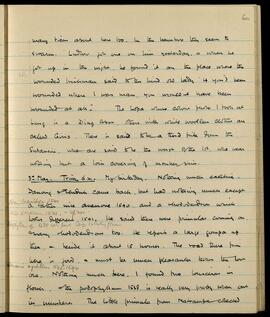
60

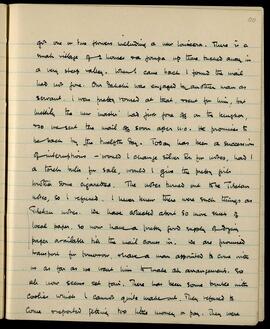
many ticks about here too. In the bamboo they seem to swarm. Ludlow got one on him yesterday. And when he got up in the night, he found it on the place where the wounded Irishman said to the kind old lady "if you'd been wounded where I was ma'am, you wouldn't have been wounded at all".

The Lopa whose colour photo I took at Lung is a Ding Abor. Others with white woollen clothes are called Giris. There is said to be a third tribe down the Subansiri, who are said to be the worst of the lot, who wear nothing but a loin covering of monkey skin.

3rd May. Trün 6 am. My birthday. Nothing much exciting. Danang and Tenduk came back, but had nothing much except a rather nice anemone 1540, and a rhododendron which looks different 1541. He said there were primulas coming on, and many rhododendrons too. He reports a large gompa up there, and beside it about 15 houses. The road there from here is good, and must be much pleasanter than the low one. Nothing much here. I found two loniceras in flower, and the podophyllum 1538, is really very pretty when out in numbers. The little primula from Natrampa collected.
Lapu camp entries for 16–17 June
LSH/1/1/3/3/191 · Part · 1936-06-13
Parte de The Ludlow & Sherriff Collection

SUMMARY:
Supplies (wireless batteries and photo boxes) were sent to Chösam and the carriers were paid, then the party moved to Lapu with delays due to a shortage of coolies amid rain and mist. A scarce new primula was found near camp and a ruby-throat nest with three advanced eggs was collected (the eggs broke during extraction); 17 June was a halt with mist after late morning.

CONTENT:
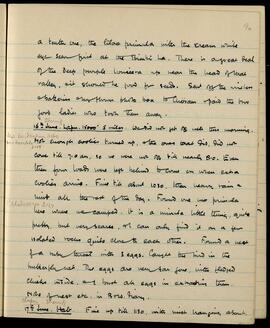
a tenth one, the lilac primula with the cream white eye seen first at the Bimbi La. There is a great deal of the deep purple Lonicera up near the head of that valley, it should be good for seeds. Sent off the wireless batteries and three photo boxes to Chösam and paid the two food ladies who took them away.

16th June. Lapu. 15000' 5 miles. We did not get off well this morning. Not enough coolies turned up, and the ones that did, did not come till 7.0 am, so we were not off till nearly 8.0. Even then four loads were left behind to come on when extra coolies arrive. Fine till about 1030, then heavy rain and mist all the rest of the day. Found one new primula here where we camped. It is a minute little thing, quite pretty, but very scarce, and can only find it on a few isolated rocks quite close to each other. Found a nest of a ruby throat with 3 eggs. Caught the bird in the butterfly net. The eggs are very far gone, with fledged chicks inside, and broke all eggs in extracting them. Note of quest etc. in Bot. diary.

17th June. Halt. Fine up till 1130, with mist hanging about.

LSH/1/1/3/3/195 · Part · 1996-06-18
Parte de The Ludlow & Sherriff Collection
  • SUMMARY:
    Notes a small patch of Primula tenuiloba on steep rocky cliffs, followed by observations of a Lerwa nest with five eggs and an Anthus nest with three eggs. At Mipa, records abundant primulas on hillsides, with Tenduk bringing specimens from Lhapu and a blue primula (2173) and another from Natrampa, and lists several Primula specimens (2137, 2173–2178).

CONTENT:
Ludlow

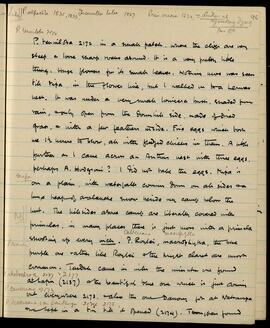
  • P. alpestris 1831, 1833, Incarvillea lutea 1827 Prim. erosa 1832, = Ludlow at Kyimdong Dzong June 18th 96

P. tenuiloba 2172
P. tenuiloba 2172 in a small patch, where the cliffs are very steep & loose sharp rocks abound. It is a very pretty little thing. Huge flowers for its small leaves. Nothing more was seen till Mipa, in the flower line, but I walked on to a Lerwa's nest. It was under a very small Lonicera bush, shaded from rain, & only open from the downhill side, made of dried grass, & with a few feathers inside. Five eggs which took me 1 1/2 hours to blow, all with fledged chicks in them. A little further on I came across an Anthus nest with three eggs, perhaps A. hodgsoni? I did not take the eggs.

Mipa
Mipa is on a plain, with waterfalls coming down on all sides & a large heap of avalanche snow beside my camp below the hut. The hillsides above camp are liberally covered with primulas, in many places there is just moss with a primula shooting up every inch. P. Roylei (Calderiana), macrophylla, the blue purple one rather like Roylei & the bright claret are most common. Tenduk came in with the minute one found at Lhapu (2137) & the beautiful blue one which is just coming out everywhere 2173, & also the one Danu found at Natrampa. Two kept in a tin till it opened (2174). Tenduk found

P. rhodochroa 2137, 2177
P. Cawdoriana 2173
P. dickieana var. pantlingii 2174, 2178

Mail dispatch, interruptions, and transport arrangements
LSH/1/1/3/3/225 · Part · 1936-07-01
Parte de The Ludlow & Sherriff Collection

SUMMARY:
The diarist collected flowers, including a new Lonicera, and noted a small remote village. After resolving a delay when their dakchi was engaged by another man, the mail was sent around 11:00 with a promise of return by the twelfth day. They refused to exchange Tibetan notes, gathered local paper for drying specimens, arranged transport with an accompanying man for tomorrow, and recorded trouble with coolies over pay.

CONTENT:
got one or two flowers including a new Lonicera. There is a small village of 2 houses or jompa up there, tucked away in a very steep valley. When I came back I found the mail had not gone. Our dakchi was engaged by another man as servant. I was pretty vexed at that, sent for him, but luckily the 'new master' had just gone off on the kunghon, so we sent the mail off soon after 11.0. He promises to be back by the twelfth day. Today has been a succession of interruptions - would I change silver Rs. for notes, had I a torch bulb for sale, would I give the pretty girl's brother some cigarettes. The notes turned out to be Tibetan notes, so I refused. I never knew there were such things as Tibetan notes. We have collected about 50 more sheets of local paper, so now have a pretty good supply of drying paper available till the mail comes in. We are promised transport for tomorrow, & have a man appointed to come with us as far as we want him to make all arrangements. So all now seems set fair. There has been some trouble with coolies which I cannot quite make out. They refused to come & reported getting too little money or pay. They were

LSH/1/1/3/3/227 · Part · 1936-07-01
Parte de The Ludlow & Sherriff Collection

SUMMARY:
The party reports porter issues over passports, which the lama Dzongpen reprimanded, and compares local wages with those of the Lhasa military forces. On 2nd July they traveled to Charme, changing coolies at Tankor, arriving by noon and finding conditions too dry for many flowers, with only a few plants collected and peaches still unripe.

CONTENT:
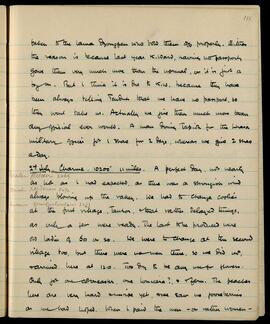
taken to the lama Dzongpen who told them off properly. Either the reason is because last year K. Ward, having no passport, gave them very much more than the normal, or it is just a try on. But I think it is due to K.W. because they have been always telling Tendup that we have no passport, so they won't take us. Actually we give them much more than any official ever would. A man driving Tapion for the Lhasa military forces for 1 shas for 2 days, whereas we give 2 shas a day.

2nd July. Charme. 10200' 11 miles. A perfect day, not nearly as hot as I had expected, as there was a strongish wind always blowing up the valley. We had to change coolies at the first village, Tankor, that rather delayed things, as only a few were ready. The last to be produced were old ladies of 60 or so. We were to change at the second village too, but there were no men there, so we did not, & arrived here at 12.0. Too dry to be any use for flowers. Only for one cotoneaster, one Lonicera?, & fern. The peaches here are very hard & unripe yet, and saw no gooseberries as we had hoped. When I paid the men - or rather women -

LSH/1/1/7/1/7 · Part · 1940-05-24
Parte de The Ludlow & Sherriff Collection

SUMMARY:
The diarist notes bodies with bows left beside them and observes alpine flora on nearby snow slopes and streambeds. Accompanied by Langong coolies, they visit the Tsari Sama (Sarpa) pilgrimage area, finding it rich in Primula, Rhododendron, and a new white-flowered Daphne near the pass to Lopa territory. Trashiyang is mentioned as the starting and finishing point of the pilgrimage.

CONTENT:
Beside each body, the owner's bow had been stuck in the ground. All arrows had been taken away, but all their other possessions seemed to have been left intact, even to their meagre rations of food. Near here, at the top of the snow slopes, were vertical cliffs. Tucked away in dust-dry pockets, completely sheltered from rain, were fine clumps of P. littledalei.

A little lower down, at 14,000', the first Meconopsis simplicifolia were coming into flower. Beside this, P. chamaethauma was in flower, and on a steep bank just above this, a little creeping Lonicera, only an inch or two off the ground, showed its yellow flowers. Some of the open swampy flats held masses of a fine Allium (No. ). On stony beds beside streams grow P. macrophylla v. macrocarpa.

There remained, near Langong, one area to visit, that was Tsari Sama. This is a place of pilgrimage, called Tsari Sama or Sarpa—the new Tsari—to distinguish it from the better-known, more important Tsari Chikchar. The Langong coolies were not anxious to go round the pilgrimage, for which I could not blame them. However, they took me, and it was a most interesting trip. As at the Lo La, there is in Tsari Sama a fairly extensive, reasonably open flat bit of country, just north of the immediate Himalayas, gradually rising to a steep rocky ridge. The whole of this area was very rich in flora. This, to a certain extent, can, I think, be put down to the fact that no yaks are kept here in the summer. None of the dwarf rhodos were now in flower, and R. campylogynum (5560), R. trichocladum (5555), R. glaucum (5565). Also 5568.

A Primula not seen elsewhere, P. Kingii covered acres of open ground with its deep wine-coloured blooms, P. laeta, a glorified form of P. Roylei. Primula, P. gracilipes.

Perhaps the most interesting Rhododendron was 5571 (yellow, red spots). Growing among rocks just below the ridge before reaching the pass to Lopa territory, we came across a fine large, white-flowered new Daphne. No seeds.

At Trashiyang, the starting and finishing point of the pilgrimage,

LSH/1/1/8/1/41 · Part · 1947-01-01 - 1947-01-04
Parte de The Ludlow & Sherriff Collection

SUMMARY:
From Tongkyuk Dzong, the party reconnoitred toward the Soshe La but was turned back by deep snow, placed a thermograph, and noted views of Gyala Peri. Botanical observations included Meconopsis and Nomocharis, abundant capsules on Lilium wardii, and a noteworthy Lonicera; weather was cold with light snow. The old Dzongpon prepared to depart for Lhasa, and local peaks including Rangzen Karpo were discussed.

CONTENT:
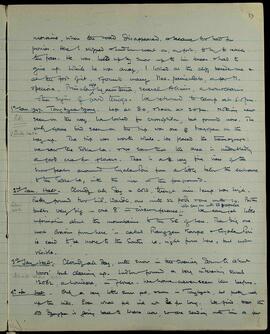
moraine, when the road disappeared, & became too bad for ponies. Here I stopped and Ludlow went on, on foot, to try to reach the pass. He was held up by snow up to his knees & had to give up. While he was away, I looked at the cliff beside me & at the foot of it, & found many Mec. paniculata, a few M. speciosa, Primula aff. hyacinthina, several Allium, a Nomocharis & other signs of good things. We returned to camp at 6.0 pm.

1st Jan. 1947. Tongkyuk Dzong. Left at 8.0, & back at 2.0 pm. Nothing new seen on the way. We looked for Cremanthodium, but found none. The only game bird seen on the trip was one ♀ tragopan on the way up. The trip was worth while - we placed the thermograph: we saw the Soshe La: & saw that the area is undoubtedly a good one for flowers. There is a very fine view of the snow peaks around Gyala Peri from a little below the entrance to the Soshe La, with the river in the foreground.

2nd Jan. Halt. - Cloudy all day + cold, though min. temp. was high. Ludlow found two Lil. Wardii, one with 22 pods & one with 14. Both bulbs very big — one 8" in circumference. (Later saw one with 28 capsules). We can get little information about the mountains to the SE of here. The big one most obvious from here is called Rangzen Karpo & Gyala Peri is said to be more to the South i.e. right from here, but not visible.

3rd Jan Halt. - Cloudy all day, with snow in the evening down to about 10,000' but clearing up. Ludlow found a very interesting shrub 12062, a Lonicera, in flower. We have never seen this before.

4th Jan. Halt. - Only a very little snow fell, none in Tongkyuk, but pretty well up the hills. Even what fell will not last for long. We find that the old Dzongpon is going back to Lhasa now, so are sending with him a few

Plant collecting notes at Bimbi La and Chichenan, 1936
LSH/1/1/4/1/219 · Part · 1936-09-07 - 1936-09-12
Parte de The Ludlow & Sherriff Collection

SUMMARY:
Notes list multiple alpine plant collections with elevations and habitats around Bimbi La and Chichenan in 1936, including Lonicera, Gentiana, Primula, Meconopsis, Androsace, and a thistle. Dated entries range from early to mid-September and also include 9 June 1936.

CONTENT:
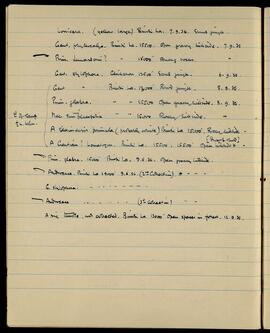
Lonicera. (yellow large) Bimbi La. 7.9.36. Shrub jungle.
Gentiana phyllocalyx. Bimbi La. 15500'. Open grassy hillside. 7.9.36.
Primula sunardsonii? - 15000' Among rocks. -
Gentiana stylophora. Chichenan 12500' Scrub jungle. 6.9.36.
Gentiana - Bimbi La. 13000' Rhododendron jungle. 8.9.36.
Primula glabra. " - 15500' Open grassy hillside. 8.9.36.
Meconopsis simplicifolia " - 15000' Rocky hillside. " (E of camp 1/2 m. below.)
A sikkimensis primula (probably white) Bimbi La. 15000'. Rocky hillside. "
A Gentian? Lomatogonium. Bimbi La. 15500'. 15500' Open hillside. " {Dwarf Rhododendron}
Primula glabra. 15000' Bimbi La. 9.6.36. Open grassy hillside.
Androsace. Bimbi La. 14000' 9.6.36. (2nd collection). " - - -
Gentiana stylophora. " - - - - -
Androsace " - - - - - (3rd collection) " - -
A big thistle, not collected. Bimbi La. 13000' Open space in forest. 12.9.36.

LSH/1/1/4/1/221 · Part · 1936-09-06
Parte de The Ludlow & Sherriff Collection

SUMMARY:
List of plant taxa with localities and notes on quantities or containers, centered on Migyitun and adjacent passes. Includes a dated entry on 06/09/1936 for Androsace from Bisbis La.

CONTENT:
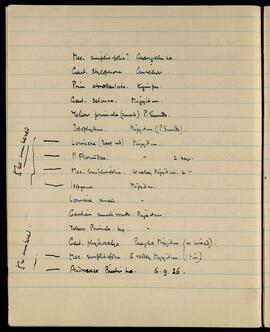
Meconopsis simplicifolia? Changchu La.
Gentiana stylophora. Amchu.
Primula atrodentata. Kyimpu.
Gentiana detonsa. Migyitun.
Yellow primula (small) P. Sundo.
Podophyllum. Migyitun (P. Sundo).

To be numbered:
— Lonicera (Deep red). Migyitun.
— Primula florindae. - 2 bags.
— Meconopsis simplicifolia. West valley Migyitun. 2 -
— Isopyrum. Migyitun.

Lonicera small. -
Gentian small rosette. Migyitun.
Yellow Primula. big. -
Gentiana phyllocalyx. Pang La Migyitun (or mixed).

To be numbered:
— Meconopsis simplicifolia. East valley Migyitun. (1 tin)
— Androsace. Bisbis La. 6.9.36.

LSH/1/1/4/1/37 · Part · 1936-04-28
Parte de The Ludlow & Sherriff Collection

SUMMARY:
The author follows a poor path near the Changla, then turns back and descends a small nala to a grassy plain bordered by cliffs and steep hillsides. The plain is covered with Mec. simplicifolia, with rhododendrons and a red Lonicera (2379–2383), and a striking primula (2385) thought to differ from a similar specimen collected at Mipa and seen in bud at Natrampa.

CONTENT:
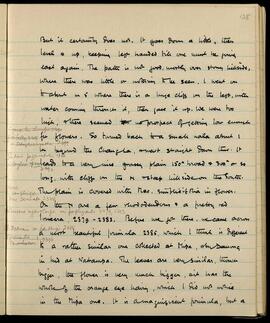
But it certainly does not. It goes down a little, then level or up, keeping left handed till one must be facing east again. The path is not good, mostly over stony hillside, where there was little or nothing to be seen. I went on to about m 5 where there is a huge cliff on the left, with water coming through it, then gave it up. We were too high, there seemed no prospect of getting low enough for flowers. So turned back to a small nala about 1 m beyond the Changla, and went straight down this. It leads to a very nice grassy plain 150 yards broad and 300 yards or so long, with cliffs on the N and steep hillside on the South.

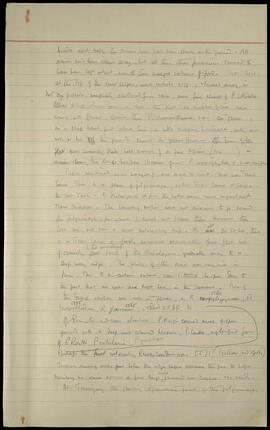
The plain is covered with Mec. simplicifolia in flower. On the N are a few rhododendrons and a pretty red Lonicera, 2379 - 2383. Before we got there, we came across a most beautiful primula 2385, which I think is different to a rather similar one collected at Mipa, also Dawing in bud at Natrampa. The leaves are very similar, though bigger, the flower is very much bigger, and it has the wrinkle of the orange eye hairy, which I did not notice in the Mipa one. It is a magnificent primula, but a