Showing 5 results

Archival description
5 results with digital objects Show results with digital objects
LSH/1/1/6/1/60 · Part · 1938-05-28 - 1938-05-29
Part of The Ludlow & Sherriff Collection

SUMMARY:
Field notes from Langong list multiple Primula specimens with observations on flowering, variation, and a possible hybrid, and note nearby passes (Lo La/Shethang La and Chubumbu La) used in July–August. Bird nesting records for Crossoptilon harmani and Blood Pheasant at about 12,000 ft are dated 28–29 May 1938.

CONTENT:
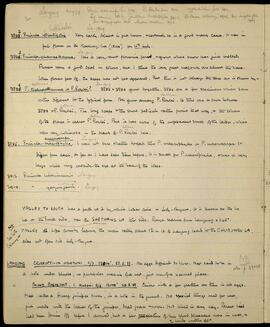
Langong - May 38. Primula macrocephala 3889, R. laudandum 3900, agglutinatum form 3902, Lil. nanum 3903, Gaultheria trichophylla 3905, Androsace delavayi 3906, Mec. integrifolia 3909, Trichophragma 3910, Lloydia serotina 3915.

30a Littledalei Langong

  1. Primula rotundifolia. Very early. Almost in full bloom, certainly so in a good many cases. It was in full flower on the Kashong La (15000') on 15th July.

  2. Primula chamaethauma. Has a very short flowering period, and grows where snow has just melted.
    Flowers vary a good deal in colour, but I think the very great majority are almost the same.
    When flowers fall off, the scape has not yet appeared. But this is not always the case as is shown by —

3894 P. chamaethauma x P. Roylei? 3893 and 3894 grow together. 3894 are a few specimens which seem rather different to the typical form. Both grow among P. Roylei. Is this one a cross between 3893 and P. Roylei? The long scape and the short pedicels rather point that way, and the colour of the flower is nearer P. Roylei. But it has none of the unpleasant smell of the latter, which was very noticeable in the plants of P. Roylei here.

  1. Primula macrophylla. I was not sure whether to call this P. macrophylla or P. macrocarpa. It differs from each, as far as I have seen them before. It is small for P. macrophylla, and has a very large white ring outside the eye at the base of the lobes.

  2. Primula sikkimensis. Langong.

  3. Primula yargonjensis. Langong.

VALLEY TO SOUTH has a path up it by which Lopas come in July - August. It is known as the Lo La on the South side, and the SHETHANG LA this side. Rough bearing from Langong = 145°.

VALLEY to Lopa country leaving the main valley about 1 1/2 m W. of Langong leads to the CHUBUMBU LA, also not open till July - August.

LANGONG CROSSOPTILON HARMANI. c/7. 12000'. 28.5.38. All eggs difficult to blow. Nest said to be in a hole under shrubs, no particular making of a nest, just use of a natural place.

BLOOD PHEASANT. I. kuseri. c/6 12000' 29.5.38. Chicks with a few feathers on them in all eggs. Nest under a dwarf juniper bush, in a hole in the ground. No special things used for nest, just made with the leaves of the juniper, dead grass and moss. Not lined in any way. Parent bird had been driven off before I arrived, but a few feathers of her blood pheasant were in nest, and 2 birds within 40 yds.

LSH/1/1/9/1/66 · Part · 1949-06-07 - 1949-06-15
Part of The Ludlow & Sherriff Collection

SUMMARY:
Notes of photographic shots on Kodachrome and Dufaycolor reels record subjects including blood pheasant, monal, and various Primula, Meconopsis, and Cypripedium, with locations such as Lobsang la, Kanta punsum, Gormotangha monastery, and Samptang. One shot mentions Ngudup with drokpas in the foreground. Reels 11–13 were sent on 15/06/1949.

CONTENT:
Kodachrome 12 Dufaycolor 11
Shots at ♀ blood pheasant. 7/6 1 Prim. alpicola v. luna. 4/6
P. calderiana yaks. 8/6 2 - - - "
Lobsang la to Kanta punsum 8/6 3 Rhod. thomsonii 19046 "
Chomby ditto telephoto " 4 Gormotangha monastery 5/6
Ditto with Ngudup & drokpas in foreground. " 5 Mec. sinuata "
Anemone narcissiflora. 8/6 6 - - - "
Lloydia serotina. "

Dufaycolor 12
1 Primula glabra. Lobsang la 8/6
2 " macrophylla. no filter 10/6
3 " " " 10/6
4 P. reticulata. 19108 13/6
5 Cypripedium tibeticum 19123 14/6
6 P. umbratilis 19128 14/6

Kodachrome 13 Dufaycolor 13
Primula macrophylla by stream 10/6 1
Mec. simplicifolia. (ov.) 10/6 2
Blood pheasant. telephoto 10/6 3 Dufay 11 & 12
Monal ♂'s 2 shots. (tele.) 12/6 4 Sent 15/6/49
Cypripedium tibeticum. 19123 14/6 5
Up valley from Samptang. 6
5 ft. lens.

11.12.13.
Sent. 15-6-49

LSH/1/1/9/1/69 · Part · 1949-06-15
Part of The Ludlow & Sherriff Collection

SUMMARY:
The author remarks on a prominent peak remembered from Dumpshinggang, sights two Lerwa and skins one, and records several alpine plants on and below the pass as snow rapidly melts. On 9–10 June, during halts, the assistants return few specimens despite instructions; the party makes a short excursion up a western valley before rain, and the author laments the absence of Tsongpen while criticizing Ngudup and considering sending him back to H.H.

CONTENT:
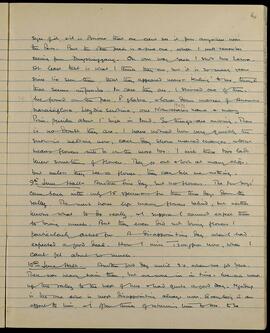
sign of it, it is obvious that one can't see it from anywhere near the Pass. But the other peak is a fine one, which I well remember seeing from Dumpshinggang. On our way back I saw two Lerwa. At least that is what I think they are, but it is so many years since I've seen them, that they appeared nearer Kuling to me, though that seems impossible. In case they are, I skinned one of them. We found on the pass, P. glabra, & lower down masses of Anemone narcissiflora, Lloydia serotina, one Nomocharis nana & many Prim. pusilla about 1" high in bud. So things are moving, there is no doubt they are. I have noticed how very quickly the snow is melting now; each day shows marked changes, that means flowers will be on the move too. I wish these two lads knew something of flowers. They go out & look at many cliffs, but unless they see a flower, they can tell me nothing.

9th June Halt - Another fine day, but no flowers. The two boys came back with only 15 specimens for their three days down the valley. They must have left many flowers behind, but neither knows what to do really, & I suppose I cannot expect them to bring much. But they even did not bring flowers I particularly asked for. A disappointing day, when I had expected a good deal. How I miss Tsongpen now, when I can't get about so much.

10th June Halt. Another good day until 2.0, when we got back. There was heavy rain then, but we were in in time. We all went up the valley to the west of here & had quite a good day. Ngudup is the one who is most disappointing always now. Everything is an effort to him, & I often think of returning him to H.H. to be

LSH/1/1/3/3/145 · Part · 1983-05-05
Part of The Ludlow & Sherriff Collection

SUMMARY:
Notes plant specimens and habitats around Cha La, with route details toward Zimsathi and mention of the Takar La being snowbound. Records Lumsden treating a local woman and reports local news about the Rimpoche's daughter and proposed marriage ties with the Bhutan Maharani's family.

CONTENT:
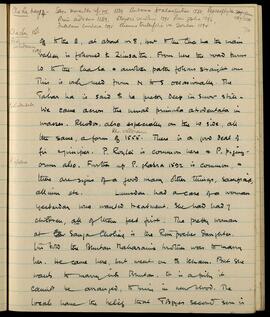
Cha La May 14 - Saxifraga monantha sp. nov. 1584, Anemone brahmaputrae 1585, Pegophyton scapiflorum 1587, 1588, Primula advena 1589, Lloydia serotina 1591, Primula glabra 1592, Fritillaria cirrhosa 1595, Anemone trullifolia var. linearis 1594.

Cha La 15th 70
Rhododendron paludosum 1598
Off to the E, at about N 8, but to the Cha La the main valley is followed to Zimsathi. From here the road turns W to the Cha La. Another path follows straight on. This is only used from N to S occasionally. The Takar La is said to be pretty deep in snow still.

Primula atrodentata
We came across the usual Primula atrodentata in masses. Rhododendrons also especially on the W side, all the same, a form of 1555 (Rhododendron vellereum). There is a good deal of fir and juniper. Primula roylei is common here and Primula pygmaeorum also. Further up Primula glabra 1592 is common, and there are signs of a good many other things, saxifrage, allium etc.

Lumsden had a case of a woman yesterday who wanted treatment. She had had 7 children, all of them feet first. The pretty woman at Sangacholing is the Rimpoche's daughter. He told the Bhutan Maharani's mother was to marry her. He came here, but went on to Kham. But she wants to marry into Bhutan. It is a pity it cannot be arranged, to bring in new blood. The locals have the belief that Tobgye's second son is...

LSH/1/1/5/1/109 · Part · 1937-06-07
Part of The Ludlow & Sherriff Collection

SUMMARY:
Observations include mass flowering of Primula whitei around 14,000 ft and a pale yellow Sikkimensis-type primula likely from hybridisation. On 10 June the party halted, marked several Primula populations, recorded Primula vernicosa as a notable westward occurrence, kept busy drying specimens, and planned to return to Phobjikha via the Pele La Range towards Chendebi while collecting a few Rhododendron variants.

CONTENT:
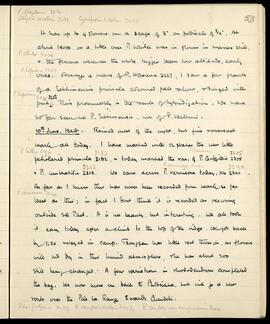
P. flagellaris 3231.
Lloydia serotina 3232 Cypripedium tibeticum 3233

It has up to 4 flowers on a scape of 3" on pedicels of 3/4". At about 14000 or a little over P. whitei was in flower in masses still, & the flowers were on the whole bigger than low altitude, early ones. Among a mass of P. Hopeana 3227, I saw a few plants of a Sikkimensis primula coloured pale yellow, tinged with pink 3228. This presumably is the result of hybridisation. We have so far seen no P. sikkimensis, nor of P. Waltoni.

10th June. Halt. - Rained most of the night, but fine & overcast nearly all today. I have marked with 12 stakes the new little petiolaris primula 3192, & today marked the var. of P. Griffithii 3205 & P. umbratilis 3213. We came across P. vernicosa today, No 3240.

As far as I know this has never been recorded from nearly so far west as this; in fact I don't think it is recorded as occurring outside SE Tibet. It is no beauty, but interesting. We all took it easy today after a climb to the top of the ridge. We got back by 11.30 & stayed in camp. Tsongpen has little rest though, as flowers will not dry in this humid atmosphere, & he has about 200 still being changed. A few variations in Rhododendron completed the bag. We now move on back to Phobjikha, but will go a new route over the Pele La Range towards Chendebi.

Rhod. fulgens 3239. R. campanulatum 3243, R. campan. var. aeruginosum 3244