Affichage de 9 résultats

Description archivistique
9 résultats avec objets numériques Afficher les résultats avec des objets numériques
LSH/1/1/5/1/101 · Part · 1928-06-02
Fait partie de The Ludlow & Sherriff Collection

SUMMARY:
The diarist travels down from the Lao La to Ritang and on to Trashidinka in the Tang Chu valley, noting dense forest, steep side valleys, masses of Lilium giganteum, rain, leeches, and a painful leg. At Ritang there is a mail mix-up involving a box of tankhas exchanged by the Maharaja, and later the party camps on the Pele La Range east of the Tang Chu; the Tang Chu area is noted as rich in Primulas.

CONTENT:
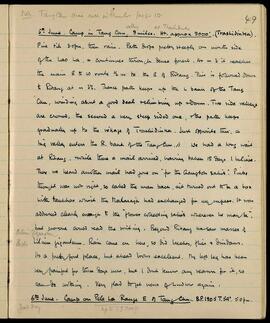
NB. Tang Chu area rich in Primulas (nos 5-10).

5th June. Camp in Tang Chu valley at Trashidinka, 9 miles. Ht. approx 9000'. (Trashidinka).

Fine till 3.0pm, then rain. Path drops pretty steeply on north side of the Lao La, and continues through dense forest. At m 3 it reaches the main E to W route 1/2 m to the E of Ritang. This is followed down to Ritang at m 3 1/2. Thence path keeps up the L bank of the Tang Chu, winding about a good deal and climbing up and down. Two side valleys are crossed, the second a very steep sided one, and the path keeps gradually up to the village of Trashidinka. Just opposite this, a big valley enters the R. bank of the Tang Chu. // We had a long wait at Ritang, and while there a mail arrived, having taken 18 days I believe. There we heard another mail had gone on "for the Gangtok sahibs". Pimbo thought it was not right, so called the man back, and it turned out to be a box with tankhas which the Maharaja had exchanged for my rupees. It was addressed clearly enough to the "flower collecting sahib wherever he may be", but no one could read the writing. Beyond Ritang we saw masses of Lilium giganteum. Rain came on here, so did leeches, flies and dimdams. It's a pretty foul place, but ahead looks excellent. My left leg has been very painful for three days now, but I don't know any reason for it, so can do nothing. Very glad to get news of Ludlow again.

6th June. Camp on Pele La Range E of Tang Chu. B.P. 190.5 T. 54°. 5.0pm. (up to 15,000 ft)

LSH/1/1/6/1/45 · Part · 1936-06-22
Fait partie de The Ludlow & Sherriff Collection

SUMMARY:
A slow, difficult march to Lalung over a bad road with intermittent rain; Lalung is a cultivated clearing whose name is explained, dam-dim flies are severe—badly affecting Ludlow—and dense low-elevation forest yields little, though Lilium giganteum is common but not in flower. The following day is a halt at Lalung with a fine morning before a violent evening storm brings rivers into flood, and Tsongpen shot a new...

CONTENT:
slowly indeed.

Lalung proves disappointing

22

To 27th April. Lalung. 5 miles. BP. 200.2° Temp. 65° Time 2.0pm. Ht. approx 6716'. A very slow march, a very bad road. Bright clear after a night of rain, till evening, then more rain. The pass is crossed 1/2 m from camp then the path keeps down steeply at times & gradually occasionally. Lalung is a large cleared area, with a good deal of cultivation. The name is from Lha = gods, Lungpa = valley, the story being that a lama reincarnation came here & found the place so nice that he called it The place of the gods. But the dam-dim flies are really very bad. They worry me a bit, but the effect is very bad on Ludlow, whose hands & wrists are twice their normal size. We saw little in the way here. The forest is so dense that it is almost impossible to spot flowers. In any case, we are really too low for good things, & intend to go off up some valley for a few days soon. Lilium giganteum is common round about, but not in flower, but I have seen no signs of other lilies.

28th April. Halt. Lalung. Fine until lovely morning. Clouded early, rain by 2.30 & a terrific storm of rain in the evening, which has brought all the rivers down in flood. Tsongpen shot a new

Field notes: Ha and Paro, mid-June
LSH/1/1/1/1/63 · Part · 1933-06-08
Fait partie de The Ludlow & Sherriff Collection
  • SUMMARY:
    Evening dancing by local men, including a lama, with observations on the music. On 14 June Ludlow went down the Ha while the writer climbed the Paro road and shot a tragopan; preparations were made for W’s arrival. Notes for 15–19 June in Ha mention entertainments such as archery, football, and a musk deer/serow drive, with botanical collections recorded.

CONTENT:
29

Report of 10. very good quality.

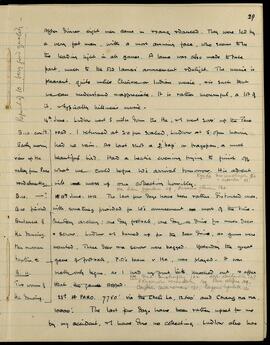
After dinner eight men came in and danced. They were led by a very fat man, with a most amusing face, who seems to be the leading light in all games. A lama was also made to take part, much to the old lama's amusement and delight. The music is pleasant, quite unlike Chinese or Indian music, and is such that we can understand and appreciate. It is rather mournful, a lot of it, typically hillmen's music.

14th June. Ludlow went 5 miles down the Ha, and I went 2000' up the Paro road. I returned at 2.0 pm soaked, Ludlow at 5.0 pm having had no rain. At last shot a 'pi bap' or tragopan, a most beautiful bird. Had a hectic evening trying to finish off what we could before W's arrival tomorrow. His advent will mess up our collecting horribly.
[Kyu La. Meconopsis 92 "superba" 93.]

B.10 contd.

  • 15-19th June. HA. [Ha. Lilium giganteum 119, Arisaema flavum 120.] The last few days have been rather disturbed ones, with something provided for W's amusement most of the time. One day archery; one day football, one day a drive for musk deer and serow. Ludlow and I turned up for the deer drive, as guns were wanted. Three
LSH/1/1/2/1/21 · Part · 1924-06-23
Fait partie de The Ludlow & Sherriff Collection

SUMMARY:
The diary describes a climb to about 8300 feet along a forested path near Yonpu La, where a lily resembling Lilium giganteum with red-streaked flowers was found. The party meets the Jongpen of Trashigong, who hosts them and plans to accompany them to Sakden, and they halt at Puntsogang to sort advance kit.

CONTENT:
The path climbs steadily to the top of the hill, about 8300', and then follows the contours for a mile or so, keeping along the west side. Between the chorten at the highest point, and another chorten near the Yonpu La, the jungle is dense. Up to the first point there were many rhododendrons, but then they give way to other trees and thick undergrowth along the level bit of the path. It was along here that we came across a fine lily, growing in the thick undergrowth under the trees. It grows like Lilium giganteum, and looks something like it too, but the flowers have red streaks inside them. I hope it may be a new one.

We were met here by the Jongpen of Trashigong. Wise man, he lives here rather than in Trashigong which is only 3500'. He has a nice, small Dzong here and small places for us. He has been most kind to us both here and before. It seems he will continue to be too, as he is doing all he can for our trek onwards. In fact he is coming on with us himself to Sakden on the frontiers.

28th June. Puntsogang HALT. We had to halt here a day to look through our advance kit, rearrange our...

LSH/1/1/3/3/67 · Part · 1936-03-10
Fait partie de The Ludlow & Sherriff Collection

SUMMARY:
Observations note a steep-sided Nyam Jang Chu valley with villages high above the river, abundant Primula denticulata, and few other flowers. On 24 March a halt at Gyipu included a jungle walk with Magnolia campbellii and rhododendron seen, and on 25 March the party marched to Shakti over ridges with scarce flowers but plentiful Lilium giganteum in damp places.

CONTENT:
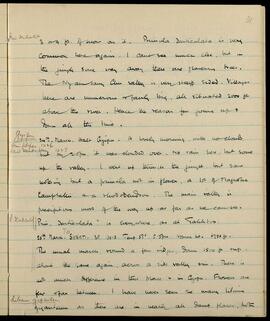
3 or 4 ft. of snow on it. Primula denticulata is very common here again. I can't see much else, but in the jungle some way away there are flowering trees. The Nyam Jang Chu valley is very steep sided. Villages here are numerous & fairly big, all situated 2000 ft above the river. Hence the reason for going up & down all the time.

24th March. Halt Gyipu. A lovely morning, with no clouds, but by 2.0pm, it was clouded over. No rain here, but some up the valley. I went up through the jungle, but saw nothing but a primula not in flower, a lot of Magnolia Campbellii & a Rhododendron. The main valley is precipitous most of the way up as far as we can see.

Prim. denticulata? is everywhere, as at Takhtoo.

25th March. To SHAKTI. BP. 199.9 Temp 58° 5.5pm Approx ht. 6790 ft.

The usual march, round a few ridges, down 1500 ft & up about the same again, across a side valley etc. There is not much difference in this place & in Gyipu. Flowers are few & far between. I have never seen so many Lilium giganteum as there are in nearly all damp places, both

LSH/1/1/2/1/173 · Part · 1933-09-08
Fait partie de The Ludlow & Sherriff Collection

SUMMARY:
Travel from Tyangsi to LAGNABI (Rocha Valley) with notes on an alternate route to Tawang, oak and Pinus longifolia forest, abundant Lilium giganteum, bird collecting success, and presence of snakes but few leeches. The next day they camp east of the Thibi La at 11,389 ft; Ludlow and the diarist set off early as mist forms from cumulus clouds.

CONTENT:
everything ready and comfortable.

9th Sept. To LAGNABI (ROCHA VALLEY) 4 miles 8047'. (BP 198° Temp 75°). This valley lies to the east of Tyangsi, and comes down pretty well due east. The path is fairly good and seems to be used often. This route is said to be a way to Tawang if the other one fails. Ascent is steady but easy. The jungle is mostly oak, with a number of Pinus longifolia mixed among them. Near camp there are a great number of L. giganteum, but seeds and bulbs are not yet ready. This is a good place for birds. In a few hours we managed to get 3 Pnoepygas, 1 Tesia, 1 Sylviparus, 1 new Yuhina and two Grammatoptila. There are no leeches, or so few as not to worry us at all. But there are some snakes, as I found this afternoon. Lilium giganteum is very common here: there are 30-40 in fruit close to camp.

10th Sept. CAMP east of the Thibi La 11389' 9 miles. (BP of Dib La 189.7° Temp 73° BP of camp 192.2° Temp 56°) Rather a remarkable day in many ways. Ludlow and I started off early (6:15) ahead of the coolies, to have an undisturbed forest to walk through. It was fine, with large cumulus clouds about, which gradually came down and formed mist over the whole

LSH/1/1/7/1/8 · Part · 1940-05-24
Fait partie de The Ludlow & Sherriff Collection

SUMMARY:
Notes compare vegetation in the Tsangpo valley with that near Kyimdong Dz, highlighting distribution differences. Plants usually confined to south slopes are observed north of the Himalayas due to increased rainfall passing the barrier, with examples including Magnolia globosa, Lilium giganteum, and possibly Nymphaea.

CONTENT:
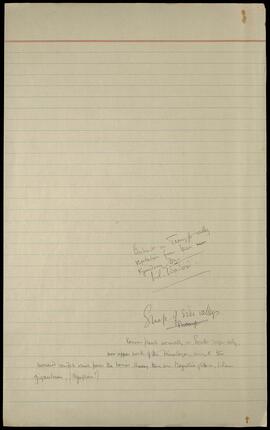
Contrast in Tsangpo valley
vegetation from that near
Kyimdong Dz-
Lil. Wardii.

Shape of side valleys Swamp

Various plants normally on South slopes only,
now appear north of the Himalayas, owing to the
increased rainfall which passes the barrier. Among these are Magnolia globosa, Lilium
giganteum, (Nymphaea?)

LSH/1/1/7/1/11 · Part · 1940-05-24
Fait partie de The Ludlow & Sherriff Collection

SUMMARY:
The author describes the low Tum La pass and nearby areas, noting limited finds there but abundant primulas and a notable prostrate yellow-flowered rhododendron. After wet weather they returned toward Nagu, collected aquatic and tree specimens, noted Magnolia globosa and Lilium giganteum in the Nagu Chu valley, and then proceeded toward Paka to visit the Tsanang La and Kuchala passes, observing that Tsanang La is steep and little used but botanically promising.

CONTENT:
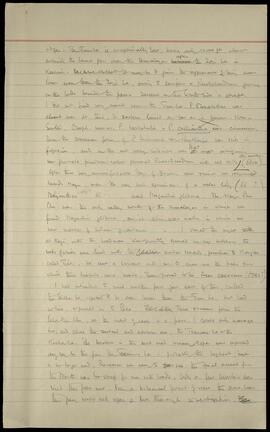
ridge. The Tum La is exceptionally low, being only 12,000 ft, almost certainly the lowest pass over the Himalayas after the Zoji La in Kashmir. It gives the appearance of being even lower even than the Zoji La, owing to conifers & Rhododendrons growing on the hills beside the pass. Descent on the south side is abrupt. I did not find very much near the Tum La. P. Elizabethae was almost over at this, its eastern limit as far as is known. Nom-Soulei, Omph. minus, P. barbata & P. calliantha were common. Here the common form of P. Dickieana var. Pantlingii was still in profusion, and on the wet rocky hillside was that most intriguing new prostrate primrose yellow flowered Rhododendron, with red spots (6600).

After three very uncomfortable days of driving rain & mist we returned towards Nagu, & on the way took specimens of a water lily (66?) Menyanthes trifoliata 66-- and Magnolia globosa. The Nagu Chu was the only valley north of the Himalayas in which we found Magnolia globosa, & it also was in which we saw masses of Lilium giganteum. I stayed the night at Nagu with the headman who proudly showed me his kitchen the walls of which were lined with wooden teapots, peculiar to Kongbo, called Tisti. He sent a servant with me to show me the trees from which these teapots were made. These proved to be Acer caesium (5740?).

I had intended to visit another pass just east of this, called the Shoka La, reputed to be even lower than the Tum La, but had no time, & pushed on to Paka. Three streams form the Paka Chu Chu, at the head of each is a pass. I could only manage two, and chose the central and eastern one, the Tsanang La & the Kuchala. The western is the most used & many Lopas were expected any day by this pass. The Tsanang La is probably the highest, but is no longer used. The reason was easy to see. The final ascent from the North was too steep for men with loads. Only a few hunters ever visit this pass now. From a botanical point of view the area near this pass, would well repay a more thorough investigation.

LSH/1/1/8/1/43 · Part · 1947-01-13
Fait partie de The Ludlow & Sherriff Collection

SUMMARY:
Entries for January 6–9 describe a snowy halt, peak angle measurements from a Dzong, and marches to Layoting and Camp Namdi. The writer disputes Ward and Bailey on the visibility of Gyala Peri, notes friendly villages, a nearby peak Gelung Jokpo, forests transitioning from pine to dense broadleaf, and observations of birds, clematis, and abundant Lilium giganteum.

CONTENT:
letters. He says he will arrive in about 22 days. Our own next mail will not leave here for 7 or 8 weeks or so until we reach India in 3 months from now, so this is worth while.

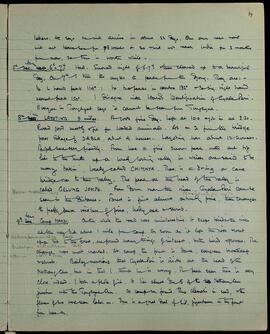
Jan 6th & 7th Halt. Snowed night of 6-7th then cleared up to a beautiful day. On 7th I took the angles to peaks from the Dzong. They are: - to left-hand peak 114° : to two peaks in centre 132° to big right-hand nearest peak 150°. I disagree with Ward's identification of Gyala Peri. Everyone in Tongkyuk says it cannot be seen from Tongkyuk.

Jan 8th LAYOTING. 9 miles. A good fine day. Left at 10.0 got in at 3.30. Road good mostly fit for loaded animals. At mile 2 from the bridge pass village of DABLA, about 4 houses. Layoting has about 12 houses. People here very friendly. From here a fine snow peak with cut top lies to the South up a bleak looking valley in which are said to be many 'takin', locally called CHIMNYA. There is a sling or cane bridge over to this valley. The peak at the head of the valley is called GELUNG JOKPO. From down near the river, Gyala Peri can be seen in the distance. Forest is first almost entirely pine, then changes to pretty dense mixture of pine, holly oak & shrubs.

Jan 9th Camp NAMDI. On the whole the road was uninteresting. It keeps beside the river all the way till about 1 mile from camp. As soon as it left the river & went up a bit to the forest, we found many things of interest, both birds & flowers. The change was most marked. At camp the forest is dense, evergreen broadleaf & shrubs. Bailey mentions that Gyala Peri is visible at the head of the Netrang Chu, but in this I think he is wrong. The peak seen there is very close indeed. I took a photo of it. It lies almost due S of the Netrang Chu junction with the Tongkyuk Chu. At camp we found three clematis in seed, the flowers of two were seen later on. There is a great deal of Lilium giganteum in this forest from here on.