
Showing 3 results

Archivistische beschrijving
3 results with digital objects Show results with digital objects
LSH/1/1/6/1/60 · Part · 1938-05-28 - 1938-05-29
Part of The Ludlow & Sherriff Collection

SUMMARY:
Field notes from Langong list multiple Primula specimens with observations on flowering, variation, and a possible hybrid, and note nearby passes (Lo La/Shethang La and Chubumbu La) used in July–August. Bird nesting records for Crossoptilon harmani and Blood Pheasant at about 12,000 ft are dated 28–29 May 1938.

CONTENT:
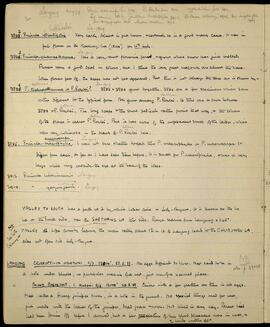
Langong - May 38. Primula macrocephala 3889, R. laudandum 3900, agglutinatum form 3902, Lil. nanum 3903, Gaultheria trichophylla 3905, Androsace delavayi 3906, Mec. integrifolia 3909, Trichophragma 3910, Lloydia serotina 3915.

30a Littledalei Langong

  1. Primula rotundifolia. Very early. Almost in full bloom, certainly so in a good many cases. It was in full flower on the Kashong La (15000') on 15th July.

  2. Primula chamaethauma. Has a very short flowering period, and grows where snow has just melted.
    Flowers vary a good deal in colour, but I think the very great majority are almost the same.
    When flowers fall off, the scape has not yet appeared. But this is not always the case as is shown by —

3894 P. chamaethauma x P. Roylei? 3893 and 3894 grow together. 3894 are a few specimens which seem rather different to the typical form. Both grow among P. Roylei. Is this one a cross between 3893 and P. Roylei? The long scape and the short pedicels rather point that way, and the colour of the flower is nearer P. Roylei. But it has none of the unpleasant smell of the latter, which was very noticeable in the plants of P. Roylei here.

  1. Primula macrophylla. I was not sure whether to call this P. macrophylla or P. macrocarpa. It differs from each, as far as I have seen them before. It is small for P. macrophylla, and has a very large white ring outside the eye at the base of the lobes.

  2. Primula sikkimensis. Langong.

  3. Primula yargonjensis. Langong.

VALLEY TO SOUTH has a path up it by which Lopas come in July - August. It is known as the Lo La on the South side, and the SHETHANG LA this side. Rough bearing from Langong = 145°.

VALLEY to Lopa country leaving the main valley about 1 1/2 m W. of Langong leads to the CHUBUMBU LA, also not open till July - August.

LANGONG CROSSOPTILON HARMANI. c/7. 12000'. 28.5.38. All eggs difficult to blow. Nest said to be in a hole under shrubs, no particular making of a nest, just use of a natural place.

BLOOD PHEASANT. I. kuseri. c/6 12000' 29.5.38. Chicks with a few feathers on them in all eggs. Nest under a dwarf juniper bush, in a hole in the ground. No special things used for nest, just made with the leaves of the juniper, dead grass and moss. Not lined in any way. Parent bird had been driven off before I arrived, but a few feathers of her blood pheasant were in nest, and 2 birds within 40 yds.
LSH/1/1/2/1/37 · Part · 1915-05-29
Part of The Ludlow & Sherriff Collection

SUMMARY:
At Sakden on 27 July, many of the Kashmiris were down with fever, with Ramzana particularly ill, which delayed progress but enabled exploration of two high areas. The writer ascended to Nyuksang La on the route to Mera, describing shepherding, buckwheat cultivation, and the route via the Gamri Chu with changing vegetation from broadleaf and fir to rhododendron.

CONTENT:
17

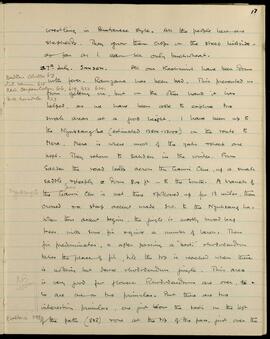
wrestling in Bhutanese style. All the people here are shepherds. They grow their crops on the steep hillside - as far as I can see only buckwheat.

27th July. SAKDEN. All our Kashmiris have been down
Buddleia colvilei 614
Lil. nanum 615
Rhod. campanulatum 616, 619, 622, 624,
Mec. horridula 623
with fever. Ramzana has been bad. This prevented us from getting on, but on the other hand it has helped, as we have been able to explore two small areas at a good height. I have been up to the Nyuksang La (estimated 12500-13000') on the route to Mera. Mera is where most of the yaks & sheep are kept. They return to Sakden in the winter. From Sakden the road leads across the Gamri Chu, up a small saddle & steeply down 800 ft - to the South. A branch of the Gamri Chu is met there & followed up for 1 1/2 miles, then crossed & a steep ascent made S.W. to the Nyuksang La. When this ascent begins, the jungle is mostly broad leaf trees, with some fir & quite a number of larch. Then fir predominates, & after passing a "basti" rhododendron takes the place of fir, till the top is reached when there is

LSH/1/1/2/1/179 · Part · 1933-09-13
Part of The Ludlow & Sherriff Collection

SUMMARY:
News from Trashigong reports daks were diverted via Neoli and handed to the wife of Babu Pradhan, who has kept them while Pradhan is away in Calcutta; a small mail is prepared to go next morning. The party moves camp to the west side of Dib La in heavy rain and mist, noting several primulas and Bryocarpum, and makes use of a log hut with prepared flats for tents.

CONTENT:
88
mail.

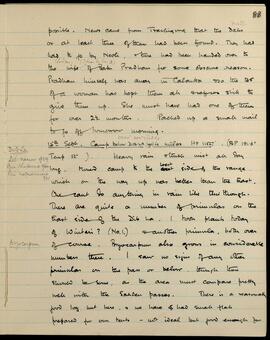
possible. News came from Trashigong that the daks or at least three of them had been found. They had had to go by Neoli, and there had been handed over to the wife of Babu Pradhan for some obscure reason. Pradhan himself was away in Calcutta so the bitch of a woman has kept them and refuses still to give them up. She must have had one of them for over 2 1/2 months. Packed up a small mail to go off tomorrow morning.

15th Sept. Camp below Dib La (west) 4 miles Ht 11527' (BP 191.6°)
Dib La.
Lil. nanum 959. Temp 52°. Heavy rain and thick mist all day
Prim. thibetica 960. long. Moved camp to the west side of the range
Prim. normanniana 961. which on the way up was better than the East.
One can't do anything in rain like this though.
There are quite a number of primulas on the
East side of the Dib La. I took plants today
of Winteri? (No. 1.) and another primula, both over
Bryocarpum. of course. Bryocarpum also grows in considerable
numbers there. I saw no signs of any other
primulas on the pass or below, though there
should be some, as the area must compare pretty
well with the Saden passes. There is a reasonably
good log hut here, and we have had small flats
prepared for our tents - not ideal but good enough for