Showing 9 results

Archival description
9 results with digital objects Show results with digital objects
LSH/1/1/5/1/181 · Part · 1933-08-08 - 1933-08-10
Part of The Ludlow & Sherriff Collection

SUMMARY:
Diary records marches from Trashidinka to Ritang and on to Samtegang, with heavy rain, heat, and severe leech problems. The author collects primula roots and some iris seed, notes lilies seen but unreachable, and mentions a mule sent by Tobgye to meet at Wangdipotrang.

CONTENT:
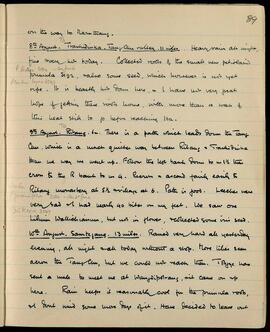
on the way to Samtegang.

8th August. To Trashidinka. Tang Chu valley. 11 miles. Heavy rain all night, fine and very hot today. Collected roots of the small new petiolaris primula 3192, and also some seed, which however is not yet ripe. It is beastly hot down here, and I have not very great hope of getting these roots home, with more than a week of this heat still to go before reaching Ha.

9th August. To Ritang. 6 m. There is a path which leads down the Tang Chu, which is a much quicker way between Ritang and Trashidinka than the way we went up. Follow the left bank down to m 1 1/2 then cross to the R bank to m 4. Recross and ascend fairly easily to Ritang monastery at 5 1/2 and village at 6. Path is good. Leeches were very bad and I had nearly 40 bites on my feet. We saw one Lilium wallichianum, but not in flower, and collected some iris seed.

10th August. Samtegang. 13 miles. Rained very hard all yesterday evening, all night and all today without a stop. More lilies seen across the Tang Chu, but we could not reach them. Tobgye has sent a mule to meet me at Wangdipotrang, and it came on up here. Rain keeps it reasonably cool for the primula roots, and I don't mind some more days of
LSH/1/1/4/1/43 · Part · 1936-04-28
Part of The Ludlow & Sherriff Collection

SUMMARY:
Notes common primula, iris, and emerging gentians, with a few Parnassius butterflies at camp; praises local butter and mentions a local man paid in food and clothing who sells to buy an ornament for his wife. Sends for coolies to leave for Changu on the 21st; on 21 July at Drötang (11700') reports mist then sun near Karutra, parched conditions, no pheasants or larks, and shooting a rubythroat while declining to skin an aegithaliscus.

CONTENT:
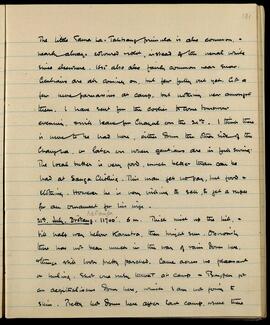
The little Tama La-Tahtsang primula is also common, nearly always coloured violet, instead of the usual white seen elsewhere. Iris also fairly common near snow. Gentians are all coming on, but few fully out yet. Got a few more parnassius at camp, but nothing new amongst them. I have sent for the coolies to come tomorrow evening, will leave for Changu on the 21st. I think there is more to be had here, either down the other side of the Chayha, or later on when gentians are in full swing. The local butter is very good, much better than can be had at Sanga Choling. This man gets no pay, but food & clothing. However he is very willing to sell, to get a rupee for an ornament for his wife.

21st. July. Drötang. 11700'. 6 m. Thick mist up the hill, till half way below Karutra, then bright sun. Obviously there has not been much in the way of rain down here, things still look pretty parched. Came across no pheasant or larking. Shot one ruby throat at camp - Bunged for an aegithaliscus down here, which I am not going to skin. Pretty hot down here after last camp, where there

LSH/1/1/9/1/105 · Part · 1949-07-12
Part of The Ludlow & Sherriff Collection

SUMMARY:
Diary entries describe uncertainty about coolies, plans to reach Bumthang before Betty departs Denchung, and subsequent marches from Amhlungnang over Jü La and Goktang La to Gorzam Camp above Dhur. Noted were heavy rains, a halt day, and rich alpine flora including Meconopsis species, Primula hopeana, a high-altitude iris, and the discovery of a new lily during a fine day interrupted by a storm.

CONTENT:
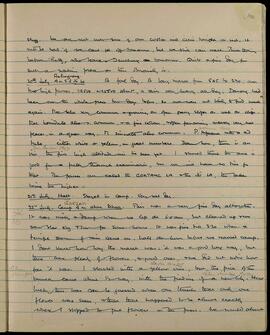
stuff. We are not now sure if our coolies will come tonight or not. It will be bad if we can't get off tomorrow, but we still can reach Bumthang before Betty, who leaves Denchung on tomorrow. Quite a fine day for such a soaking place as the Bhomali is.

20th July. Amhlungnang. 4 m S of Jü La. A fine day. A long march from 5.45 to 2.30, over two high passes, 14,500 + 15,500 about, and rain very heavy all day. Danong had been over the whole place ten days before, so we were not likely to find much again. Mec. bella very common and growing on open grassy slopes as well as cliffs. Mec. horridula also very common, and a fine colour, often favouring marshy very wet places, in a queer way. M. sinuata also common. P. Hopeana with a red tube, either white or yellow, in great numbers. Down here, there is an Iris, the first high altitude iris I've seen yet. I should think the area is good for a pretty thorough examination, but we will have no time for that. The passes are called the GOKTANG LA and the JÜ LA, the latter being the higher.

21st July. Halt. Stayed in camp. Very wet day.

22nd July. GORZAM Camp 4 m above Dhur. This was a very fine day altogether. It was misty and damp when we left at 6.0 am, but cleared up and we saw blue sky and sun for some hours. It was fine till 3.30 when a terrific storm of rain came on, half an hour before we reached camp. I don't know how long the march was: it was a good long way, but there were plenty of flowers, and good ones, and we did not notice how far it was. I started with a yellow iris, but the pick of the bunch came about halfway, with the finding of a new lily. How lucky this was can be guessed when one thinks that only one flower was seen, and that that happened to be almost exactly where I stopped to put flowers in the press. We would almost...

LSH/1/1/5/1/175 · Part · 1933-07-21
Part of The Ludlow & Sherriff Collection

SUMMARY:
At Chendebi, the diarist notes mostly fine weather, ripe buckwheat being cut, and a white Crawfurdia observed. The party splits: kit sent to Ritang, Pintso to Dungshinggang for taxation inquiries about Nepali sheep, and Tenduk collecting iris seeds near Punzor; plans are made to travel via the Rinchen Chu and Tang Chu. On 4 August, a halt at Chendebi is recorded; Primula seeds are unripe, a plant clump is taken to send by air mail, and Tsongpen goes to collect P. bracteosa roots.

CONTENT:
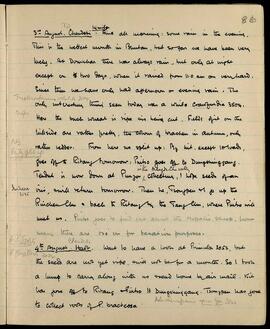
3rd August. Chendebi. 14 miles. Fine all morning: some rain in the evening.

This is the wettest month in Bhutan, but so far we have been very lucky. At Domkhar there was always rain, but only at night except on two days, when it rained from 11.0 am on, very hard. Since then we have only had afternoon or evening rain. The only interesting thing seen today was a white Crawfurdia 3504 (Tripleurospermum volubile 3504).

Here the buckwheat is ripe and is being cut. Fields of it on the hillside are rather pretty, the colour of bracken in autumn, only rather redder. From here we split up: My kit, except 10 loads, goes off to Ritang tomorrow: Pintso goes off to Dungshinggang in the Mangde Chu valley.

Tenduk is now down at Punzor, collecting, I hope seeds of an iris (Iris 3535), and will return tomorrow. Then he, Tsongpen and I go up the Rinchen Chu and back to Ritang by the Tang Chu, where Pintso will meet us. Pintso goes to find out about the Nepali sheep, how many there are and so on for taxation purposes.

4th August. Halt. Chendebi. Went to have a look at Primula 3052 (P. flagellaris 3052), but the seeds are not yet ripe, and will not be for a month. So I took a lump to carry along with us and send home by air mail. Kit has gone off to Ritang and Pintso to Dungshinggang. Tsongpen has gone to collect roots of P. bracteosa. (Aster sheriffianus approx 4000 3532)

LSH/1/1/5/1/47 · Part · 1933-05-09
Part of The Ludlow & Sherriff Collection

SUMMARY:
The diary describes travel along the Mangde Chu with a cantilever bridge leading to Langti, Yundruchöling, and Beling, noting Ashe Paldon's old winter residence and nearby pinus forest. Observations include absence of a small iris seen previously, many monkeys feeding in a large tree, effects of grass burning on regeneration, river suitability, and mapping inaccuracies, with the route leaving Bashaling toward Kiji La.

CONTENT:
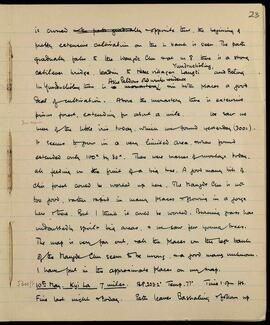
23

is crossed opposite this, the beginning of pretty extensive cultivation on the left bank is seen. The path gradually falls to the Mangde Chu at mile 8 there is a strong cantilever bridge, leading to three villages Langti, Yundruchöling, and Beling. In Yundruchöling there is Ashe Paldon's old winter residence and in both places a good deal of cultivation. Above the monastery there is extensive pinus forest, extending for about a mile. We saw no more of the little iris today, which we found yesterday (3001). It seems to grow in a very limited area, where found extended only 100 by 30. There were masses of monkeys today, all feeding on the fruit of a big tree. A good many bits of chir forest could be worked up here. The Mangde Chu is not too good, rather rapid in many places and flowing in a gorge here and there. But I think it could be worked. Burning grass has undoubtedly spoilt big areas, and we saw few young trees. The map is very far out, all the places on the left bank of the Mangde Chu seem to be wrong, and a good many unknown. I have put in the approximate places on my map.

10th May. Kiji La 7 miles. BP 203.2 Temp. 77° Time 1.0pm. Ht. 5300ft.
Fine last night and today. Path leaves Bashaling and follows up

LSH/1/1/3/3/95 · Part · 1933-04-09
Part of The Ludlow & Sherriff Collection

SUMMARY:
An easy ascent of Nyala La was followed by a steep descent to the small villages of Loro Tö. Lumsden stalked gazelle but missed, while the author wounded an Ovis ammon and later he and Ludlow tried unsuccessfully to approach two more. Locals provided limited transport by donkeys and dzos, and plants noted included Primula pygmaeorum and emerging irises along the stream.

CONTENT:
valley, keeping to the left or north. Ascent to the Nyala La (16900') easy, passed at 11.4. Then steep down for a mile, and easier descent down to Loro Tö, one or two small villages of 3 or 4 houses, where there is some cultivation. Lumsden tried again for gazelle 1 m. below the pass. He had a good stalk, and missed. At the pass there were a number of gazelle. While after them I saw some Ovis ammon and went after them, getting a shot with the .410 at about 80 yds. I only wounded one and unfortunately did not follow up my shot at once, when I would have had a perfect chance.

Ludlow and I then had great fun trying to get near enough two ammon who knew where we both were - one on either side of them. They did a most unusual thing, went straight downhill about 800 ft or more, and escaped. The locals here are very kind and attentive. They have transport of donkeys and dzos waiting for us, but only take us on a stage, and a small one at that. There is little to be seen here: the hillsides appear particularly bare, but along the bank of the stream there is some grass and Primula pygmaeorum in flower. Iris are coming up and the

LSH/1/1/4/1/213 · Part · 1936-10-10 - 1936-10-11
Part of The Ludlow & Sherriff Collection

SUMMARY:
Field notes list alpine plants with habitats and elevations at Karutra, Kashongha, Drogpa, and Natrampa. Entries dated in early October 1936 include species such as Dracocephalum, Rheum nobile, Fritillary, Primula spp., Meconopsis, Isopyrum, and Iris.

CONTENT:
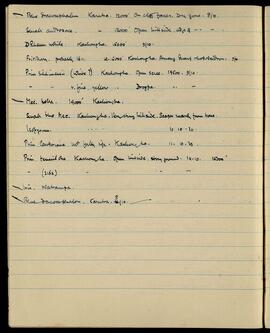
Blue Dracocephalum Karutra. 12000' On cliff faces. Dry zone. 8/10.
Small Androsace. " 13000' Open hillside. edge of " " " .
Rheum nobile. Kashongha. 15000' 9/10.
Fritillary. probably 1611. 14-15000' Kashongha. Among dwarf rhododendron. 9/10.
Prim sikkimensis (white?) Kashongha. Open scree. 14500. 9/10.
" " v. fine, yellow " Drogpa. " "
Mec. bella. 14000' Kashongha.
Small blue Mec. Kashongha. Very stony hillside. Scapes naked from base.
Isopyrum. " " " 10 10-36.
Prim Cawdoriana not fully ripe. Kashongha. 11. 10. 36.
Prim. tenuiloba. Kashongha. Open hillside. stony ground. 14.10. 15000'
" (2162) " " " -
Iris. Natrampa.
Blue Dracocephalum. Karutra. 8/10.

LSH/1/1/9/1/108 · Part · 1949-07-12
Part of The Ludlow & Sherriff Collection

SUMMARY:
Notes list seed needs and collections with specimen numbers and plant observations (e.g., Meconopsis, Primula, Notholirion) from areas including Tongsa Chu valley, Bumthang, Kyikyi La, Yuto La, and Tongsa-Tashiling. Mentions locations such as a cliff below Mandating and a Yakherd hut, with additional observations near camp.

CONTENT:
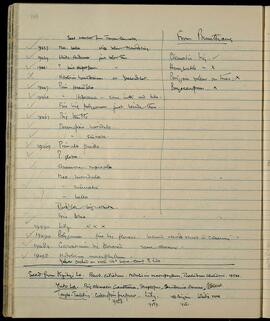
Seed wanted from Tongsa Chu valley. From Bumthang
19437 Meconopsis bella cliff below Mandating. Clematis big.
19439 White Androsace. just below there. Honeysuckle " x
19441 ? pink striped flower " Briggsia yellow on trees. x
Notholirion hyacinthinum. at Yakherd hut. Podocarpum. x
19447 Primula geraniifolia
19464 " hopeana - some with red tube.
Fine big Polygonum just beside them.
19467 Big thistle.
Meconopsis horridula.
" sinuata.
19469 Primula pusilla
? glabra.
Anemone rupicola.
Meconopsis horridula.
" sinuata
" bella
Thistle big white.
Iris blue.
19490 Lily x x x
19494 Polygonum fine big flowers. behind rhodo scrub in clearing.
19484 Geranium big flowered same clearing.
19498 Notholirion macrophyllum.
Yellow orchid on rock 100x before camp R side.

Seed from Kyikyi La. Rhododendron ciliatum. Notholirion macrophyllum, Thalictrum chelidonii. 19544.
Yuto La. Big clematis Gaultheria, Streptopus, Smilacina oleracea,
Tongsa-Tashiling. Codonopsis purpurea. Lily. alt. Briggsia White rose

    1. 19561.
LSH/1/1/3/3/75 · Part · 1936-03-10
Part of The Ludlow & Sherriff Collection

SUMMARY:
The diarist spoke with Tibetans, mostly from Tsona, who make wooden bowls and snuff boxes and report that Tsari is good for flowers. The page records Kingdon Ward’s route through numerous passes and places and his recommendations for rich collecting areas near Chayul Dz, the Lore Chu, Tsari, and Takpa Shiri, noting a Primula on Targa La and seeds of Karta iris and Dracocephalum.

CONTENT:
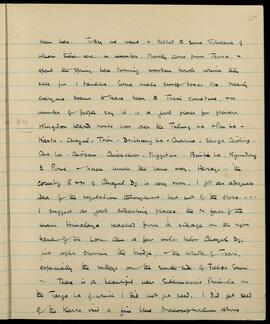
been here. Today we went & talked to some Tibetans, of
whom there are a number. Mostly come from Tsona, &
spent the spring here turning wooden bowls which they
sell for 1 tankha. Some make snuff boxes too. Nearly
everyone seems to have been to Tsari sometime, & a
number of people say it is a good place for flowers.

Kingdon Ward's route was over the Tulung La & Pen La -
Karta - Chayul - Trön - Drichung La - Charme - Sanga Chöling -
Cha La - Chösam - Chikchar - Migyitun - Bimba La, Kyimdong
to Pome & back much the same way. He says - 'the
country E & N of Chayul Dz is very rich. I got an adequate
idea of the vegetation throughout, but not of the flora. ---
I suggest as good collecting places, the N face of the
main Himalaya reached from a village on the right
bank of the Lore Chu a few miles below Chayul Dz,
just after crossing the bridge; & the whole of Tsari,
especially the valleys on the south side of Takpa Shiri.
--- There is a beautiful new Sikkimensis Primula on
the Targa La of which I did not get seed. I did get seed
of the Karta iris, a fine blue Dracocephalum above