Mostrando 3 resultados

Descripción archivística
3 resultados con objetos digitales Muestra los resultados con objetos digitales
LSH/1/1/3/3/194 · Part · 1933-07-18 - 1933-07-19
Parte de The Ludlow & Sherriff Collection

SUMMARY:
Travelled toward Taktsa through a valley with dense poplar, willow, and Hippophae, noting parrots near Kyimdong Dzong and ruins of an old Dzong above Palung. The north-facing slopes carried fir, larch, and spruce, and the valley seemed rich in flowers and birds though there was no time to collect. On July 19, there was a halt at Taktsa due to diseased natives.

CONTENT:
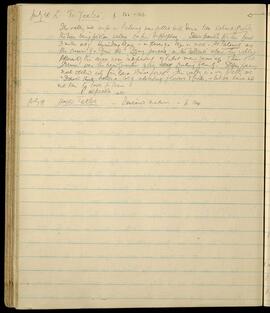
July 18. L. To Taktsa. p. 122-123

The valley as far as Palung was filled with dense tree and shrub growth, the trees being poplar, willow and a few Hippophae. Saw parrots for the first 3 miles out of Kyimdong Dzong—in flocks of a dozen or more. At Palung are the ruins of a fine old Dzong perched on the hillside above the village. Apparently this area was independent of Tibet many years ago. These old ruins were the headquarters of the ruling family. Slopes facing north clothed with fir, larch, spruce forest. This valley is a very pretty one and I should think holds a lot of interesting flowers and birds, but we have had no time to look for them.
P. alpicola etc.

July 19 Halts Taktsa - diseased natives - p 124

LSH/1/1/8/1/29 · Part · 1946-12-20
Parte de The Ludlow & Sherriff Collection

SUMMARY:
The diarist acquires a sheep and extra ponies to reach Temu La, aiming for views of snow mountains, and notes various birds including geese, a kite, Lophobasileus, a crossbill, a black woodpecker, a Sitta, and a large flock of Grandala. At Latsa Lunang above Tumbatse, poor visibility prevents mountain views; seeds of Notholirion hyacinthinum and two Berberis are collected, and weather and snow conditions are recorded before proceeding to Lunang.

CONTENT:
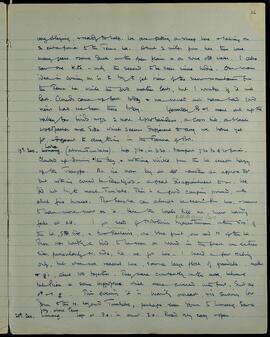
26

very obliging, ready to help. We are getting a sheep here, & taking on 2 extra ponies to the Temu La. About 2 miles from here there were many geese, some duck on the open plain & on some odd water. I also saw one kite - only the second to be seen since India. Our main idea in coming on is to try to get views of the snow mountains from the Temu La while the good weather lasts, but I wonder if it will last. Clouds came up fast today & we would not have had good views had we been there today. Yesterday B & I were out up the valley for birds & got 2 more Lophobasileus, a crossbill, a black woodpecker & a Sitta which seems different to any we have yet got, & different to anything in the Fauna of B.I.

19th Dec. Latsa Lunang (above Tumbatse). Left 7.30: in 3.30: transport 7.30 to 4.30 ponies. Clouded up during the day, & nothing visible from the La except hazy up the Tsangpo. An ice mass lay at 40° & another at approx 80°, but nothing could be identified - a great disappointment to us. We did not try to reach Tumbatse. This is a good camping ground, with about five houses. The Sancha can almost be seen from here, & seems to have more snow on it. Here the locals tell me, snow hardly falls at all. I got seed of Notholirion hyacinthinum within 500' of the La, SE side, & two Berberis, one blue fruit, one red N of the La. There was hardly a bird to be seen or heard in the forest on either side, particularly N side, till we got here - I heard a few calling only, but when we reached here, saw a large flock of Grandala, males & females, about 100 together. They were constantly on the move, between a tall Picea & some Hippophae which were covered with fruit. Shot one male or female. This evening it is heavily overcast, is snowing low down to the N beyond Tumbatse, perhaps even down to Lunang. Saw a jay, above Temo.

20th Dec. Lunang. Left at 8.0: in about 2.0. Road very easy & open.

LSH/1/1/8/1/31 · Part · 1946-12-23
Parte de The Ludlow & Sherriff Collection

SUMMARY:
After a very cold night with snowfall, the party enjoyed clear weather and fine scenery with Sengdam La visible, noted a large flock of Grandala at Tumbabe, and observed various birds including geese and mallard (two of which were shot and retrieved). They marched from Lunang to Daú below Chunjima, remarked on Lunang ironwork, and collected plants including Notholirion hyacinthinum, a Codonopsis (seed), and a probable Primula sonchifolia.

CONTENT:
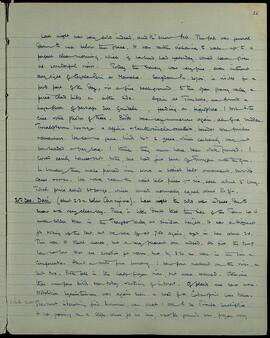
Last night was very cold indeed, and 1/2" snow fell. The fall was general down to well below this place. It was rather sickening to wake up to a perfect clear morning, which if we had had yesterday would have given us wonderful views. Today the scenery was very fine, even without any sight of Gyala Peri or Namcha. Sengdam La, 20,700', is visible for a good part of the day, in a fine background to the open grassy valley & Picea-clad hills on either side. Again at Tumbabe, we found a huge flock of perhaps 300 Grandala, feeding on Hippophae. I took both cine & still photos of these. Birds were very numerous again, all of a sudden. Trochalopteron henrici & affinis & Ianthocincla ocellata, besides rose finches & accentors. We saw no game birds but 2 geese, which certainly were not bar-headed or grey lag. I think they must have been white fronted. I could easily have shot both, but had just sent off Tsongpen with the gun. In Lunang they make pierced iron work — waist belt ornaments, swords cases & so on. We have seen the waist belt pieces — six, each about 3" long. Total price asked 20 sangs, which would normally equal about Rs 3/-.

21st Dec. Daú. (about 2-3 m. below Chunjima). Last night the cold was intense, due to snow & a very clear sky. There is little doubt that this side of the Temu La is much colder than in the Tsangpo valley at similar heights. It was a difficult job rolling up the tent, but we were off at 7.50 again, arrived here about 2.0. This was a short march, but a very pleasant one indeed. At first the temp was so low that we couldn't get warm, but by 9.30 we were in the sun & comfortable. About a mile from Lunang, I saw four mallard on the river, & shot two. Both fell in the half frozen river, but were rescued. Otherwise there were few birds seen today anything of interest. Of plants we saw more. Notholirion hyacinthinum was again seen & seed of a Codonopsis was taken.
R. Hunter 12021 The most interesting find however, was what I took to be Primula sonchifolia. It was growing on a slope which got no sun, & so the ground was frozen very