
Showing 3 results

Archival description
3 results with digital objects Show results with digital objects
LSH/1/1/9/1/141 · Part · 1933-09-01
Part of The Ludlow & Sherriff Collection

SUMMARY:
Notes on Primulas from Karponang grown at 4500', highlighting unusual rose coloration, leaf variation, and difficulty matching key characters; possible identification as elongata is questioned. Field observations report local abundance up to about 8500' near Sergong La, and above 12500' white forms of P. calderiana and natural hybrids become more common than the deep violet true P. calderiana.

CONTENT:
133

Primulas from Karponang in our garden at 4500' have grown leaves like bracteosa. Due to low altitude?
Never seen the rich rose colour before.

Locally quite common.

Eventually found very common, highest altitude about 8500' near Sergong La.

This does not answer the key 'tube 3 times as long as calyx'. It is nothing like it.

Might be elongata, but leaves are pretty rotund.

Not common.
This seemed to be the same as 18946, but leaf varies. Probably both are the same thing.

A gathering with very few old capsules even some old seed.
These three are all natural hybrids. As one gets above 12500', so white forms of P. Calderiana become more & more common until at 13000 & a little above - just at the top edge of the abies zone - these hybrids become much more common than the true P. Calderiana, which here is deep violet. What are the parents?
P.T.O.
LSH/1/1/9/1/143 · Part · 1933-09-01
Part of The Ludlow & Sherriff Collection

SUMMARY:
Notes reconsidering identifications of Primula specimens, suggesting 1937 L+S mixtures (3433–3437) are P. strumosa × P. calderiana hybrids rather than tsariensis, and discussing affinities among P. Barnardoana, elongata, involucrata, and alpicola. Mentions observations at Lussing La and references comments by Fletcher and a possible need to await Prof. Brown.

CONTENT:
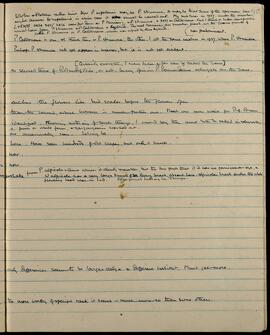
Words of Fletcher rather hint that P. nepalensis may be P. strumosa. It may be that some of the specimens here which answer to nepalensis, in which case it should be washed out. My mixtures in 1937, under the numbers L+S 3433, 3434, 3435, 3436 were put down as P. tsariensis, & P. strumosa, & 3437 as Calderiana. But I think a better identification would have been P. strumosa & P. Calderiana hybrids. The real tsariensis are smaller plants, and the coarse growth of either P. strumosa or P. Calderiana, which was copied in these hybrids, was predominant. P. Calderiana is one, I think this is P. strumosa, the other. I got the same mixture in 1937, where P. strumosa
Perhaps P. strumosa will yet appear in masses, but it is not yet evident.

[Certainly everything I have taken so far can be called the same]
as showed those of Rotundifoliae, or not. In my opinion P. Barnardoana & elongata are the same.

enclose the flowers like bud scales before the flowers open.
than the second, which however is much further on. Must one now wait for Prof. Brown
identified. Knowing nothing of such things, I would say they must both be called involucrata,
a pink or white form, or any orangeing washed out.
are occasionally seen. Lussing La.

here. Have seen hundreds of old scapes, but only 1 bunch.
now.
now.

unshakable from P. alpicola v. luna which it closely resembles, but the two facts that i) it has no farinaceous eye, &
ii) alpicola has a very large bunch of leafy bracts, absent here. alpicola bracts enclose the whole
flowering head when in bud. Also found Lussing La. Tsampa.

only differences seem to be larger calyx & different habitat. Must get more.

the more worthy of specific rank it seems - much more so than some others.

LSH/1/1/9/1/52 · Part · 1949-05-17 - 1949-05-28
Part of The Ludlow & Sherriff Collection

SUMMARY:
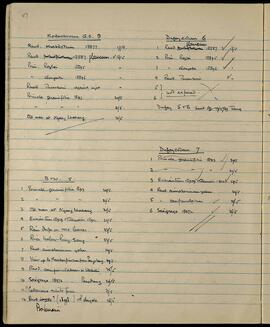
Notes of Kodachrome, Dufaycolour and B.W. photographs of Primula, Rhododendron, Enkianthus, Clematis, Saxifraga, and landscape subjects across late May 1949. Mentions sending Dufay films 5 and 6 from Tang on 19/05/1949 and includes scenes such as an old man at Ngang Lhakang, rain on rose leaves, a river below Pang Sang, and a view towards Kankar Punsum from Pangotang.

CONTENT: Kodachrome G.S. 9 Dufaycolour 6
Rhod. rhabdotum 18877. 17/5. 1 Rhod. glaucum 18887 18/5.
Rhod. glaucum 18887 18/5. 2 Prim. Roylei 18895 18/5.
Prim. Roylei 18895 18/5. 3 Prim. elongata 18896 18/5.
Prim. elongata 18896 18/5. 4 Rhod. Thomsonii 18/5.
Rhod. Thomsonii against light 18/5. 5 } not exposed.
Primula geraniifolia 18913 20/5. 6 }
Primula geraniifolia 18913 21/5. Dufay 5 & 6 sent off 19/5/49 Tang
Old man at Ngang Lhakang. 21/5.

Dufaycolour 7
1 Primula geraniifolia 18913 20/5.
2 Primula geraniifolia 18913 21/5. B.W. 5. 3 Enkianthus 18909 & Clematis 18912 22/5.
1 Primula geraniifolia 18913 20/5. 4 Rhod. cinnabarinum yellow. 24/5.
2 Primula geraniifolia 18913 21/5. 5 Rhod. campanulatum 25/5.
3 Old man at Ngang Lhakang 21/5. 6 Saxifraga 18972 26/5.
4 Enkianthus 18909 & Clematis 18912 22/5.
5 Rain drops on rose leaves. 23/5.
6 River below Pang Sang. 25/5.
7 Rhod. cinnabarinum yellow. 24/5.
8 View up to Kankar Punsum from Pangotang. 24/5.
9 Rhod. campanulatum or Wallichii 25/5.
10 Saxifraga 18972 Pangotang 26/5.
11 P. Calderiana white form. 27/5.
12 Rhod. Wightii? (18998) & elongata 28/5.
Batemanii