Showing 10 results

Archival description
10 results with digital objects Show results with digital objects
LSH/1/1/2/1/61 · Part · 1933-07-08
Part of The Ludlow & Sherriff Collection

SUMMARY:
The diarist describes finding Paraquilegia like the Kashmir flower, coping with inquisitive locals while praising Ahmad Sheikh’s patience, and taking flower photographs with notes on shutter speeds; a coolie is noted for not stealing a cash box. On 17th July at Tsong, the Dzongpens requested portraits and four colour photographs were taken and copies sent.

CONTENT:
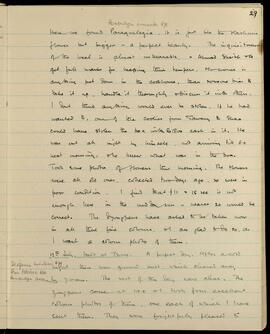
Paraquilegia anemonoides 678

Here we found Paraquilegia. It is just like the Kashmir flower but bigger - a perfect beauty. The inquisitiveness of the local is almost unbearable, and Ahmad Sheikh etc. get full marks for keeping their tempers. No sooner is anything put down in the cookhouse, than someone tries to take it up, handle it thoroughly and discuss it with others. I don't think anything would ever be stolen. If he had wanted to, one of the coolies from Tawang to Shao could have stolen the box with Rs 1800 cash in it. He was out all night by himself, not arriving till 6:00 next morning, and he knew what was in the box. Took some photos of flowers this morning. The flowers were all old ones, collected two days ago, so were in poor condition. I find that 1/10 and 1/15 sec is not enough here in the midday sun - nearer 1/20 would be correct. The Dzongpens have asked to be taken now in all their fine colours, and I am glad to do so, as I want a colour photo of them.

17th July. Halt at Tsong. A perfect day. After a cold night, there was ground mist, which cleared away by 7:00 am. The rest of the day was clear. The Dzongpens came at 10:00 and I took four excellent colour photos of them, one each of which I have sent them. They were frightfully pleased to

Diapensia himalaica 679
Prim tibetica 680
Paraquilegia anemonoides

LSH/1/1/3/3/158 · Part · 1983-05-05
Part of The Ludlow & Sherriff Collection

SUMMARY:
Notes describe the Tsari river dropping rapidly like a cataract, with estimates of 500–600 ft per mile after leaving camp. A plant list is recorded at Podzo Sumdo (22 May), and observations at Migyitun note cultivation and a nearby holy lake Tso Kar, with black currants often epiphytic and biting insects common between there and Chick Kar.

CONTENT:
192.4
53

10033
1.0466
10033
40132
60198
1049451

L. p. 96. Killing of newly born calves?
(offspring of "Dzos")

Tsari river falling at a tremendous pace.
For over a mile it was nothing but a
cataract confined to a narrow boulder
strewn bed.

Podzo Sumdo
22 May
Diapensia himalaica 1640
P. atrodentata 1641
spru. "tsariensis 1650
dictyoneura 1654
praealta 1658
glabra 1642
Lloydia tibetica 1645
Pedicularis roylei 1646
Rhod. tsangpoense var.
pruniflorum 1647

  • Calostrotum 1649
  • lopsangianum 1631
    Anthopogon 1653
    Caloxanthum 1656
    Vaccinium sikkimense 1644
    " nummularia 1655
    Sax. granulata 1659

    9205.
    1.0599
    9205
    46025
    82845
    8284
    9757.379

L. p. 98 I think the Tsari river must be dropping
500-600 ft per mile for the first mile after leaving camp.

At Migyitun the valley opens out & there is quite a lot of cultivation including barley, potatoes,
turnips etc. Half the inhabitants here are either pure Lobas or have Loba blood in them.
A large stream comes in from the North & 2 marches distant is a holy lake "Tso Kar".
Black currants abound between here & Chick Kar. A curious feature about the bushes
is that they are frequently epiphytic.
Biting midges, ticks, fleas, & of course a louse or two.

LSH/1/1/10/1/128 · Part · 1949-04-16
Part of The Ludlow & Sherriff Collection

SUMMARY:
Page lists Primula and other plant specimens with numbers. The 'ROOTS COLLECTED' section records species with day-month dates in September and October, notes such as 'NOT TO BE DIVIDED' and 'ONLY TWO PLANTS', and that Sorbus ursina seed was eaten by caterpillars.

CONTENT:
19836 Primula uniflora.
(2) 19835 " tsariensis (alba).
(3) 19832 " umbratilis (alba).
19842 " tsariensis.

ROOTS COLLECTED.

19309 Androsace white, large cushions. 13.9.
19330 P. Waddellii. 9.9.
19167 P. tenuiloba
19750 (2) P. macrophylla. 16.9.
19235 Sorbus ursina. 19.9. All seed eaten by caterpillars.
19757 Primula strumosa 20.9.
19226 Prim. Caveana white. 21.9
19766 " Caveana. "
19764 Alardia woolly blue violet. "
19767 P. concinna. "
19768 A P. Calderiana x strumosa hybrid blue 22.9 }
B " " " " " } To one place, see for report.
C " " white with dark eye " }
19771 Aconitum sp. v fine. 23.9.
19146 Diapensia himalaica "
19712 Prim. macrophylla v macrocarpa "
19123 Cypripedium tibeticum. 25.9.
19366 Androsace small 4" pink 26/9.
2 19777 = 19378 P. jonardunii. 27/9
19373 P. Waddellii. "
19404 Androsace globifera. 28/9.
19420 Prim. sonchifolia. 29/9.
19128 " umbratilis 30/9 (number not put on).
19716 Alardia wine red. 1/10. NOT TO BE DIVIDED.
19721 Gent. aff amoena 1/10 ONLY TWO PLANTS

  1. Prim. pusilla 3/10
    19544 Thalictrum chelidonii. 13/10
    19574 Prim. flagellaris. 16/10
LSH/1/1/3/3/113 · Part · 1933-04-09
Part of The Ludlow & Sherriff Collection

SUMMARY:
The diarist follows a stream with a series of waterfalls near Natrampa, noting numerous rhododendrons (including R. fulvum and R. arizelum), Diapensia himalaica, a deep wine-red primula in bud, and a very small iris; surrounding vegetation includes fir, pine, bamboo, and larch. Trees numbered 1352, 1353, 1354, 1355, and 1357 were marked with tin labels, and an entry from Lung records 7 miles traveled, 65° at 11.30 am, and an elevation of 9,113 ft.

CONTENT:
Natrampa 54

Rho. glaucophyllum 1355

  1. Also a small pink one 1355. Then we followed up the stream, which comes down in a series of waterfalls, as far as we could. Here, above us was an impassable cliff, with two streams coming down fine falls close together. This was an excellent place, as we found numerous rhododendrons,

Rho. fulvum 1357
arizelum 1358
some of which, 1357 and 1358 were particularly fine. This latter has a most striking leaf, covered with a thick bright rusty red indumentum. Also there was a great

Diapensia himalaica 1363
deal of Diapensia himalaica 1363, carpeting the damp rocks, close to the waterfalls. We could not go far either right or left, but this area should prove very good. We found a few plants of a nice little very deep wine red primula only in bud, and saw iris leaves coming up. It must have been a very small iris, as the leaves looked stunted and were only 2" high. The vegetation, besides rhododendrons, consists mostly of fir and pine, with a good deal of bamboo and some fine larch, 1367. I marked trees of 1352, 1353, 1354, 1355 and 1357 with tin labels.

28th April, LUNG. 7 miles. BP. 196.1 Temp 65° Time 11.30 am. Ht. 9113'.

LSH/1/1/4/1/33 · Part · 1936-07-02
Part of The Ludlow & Sherriff Collection

SUMMARY:
The writer reports mail troubles after Tsona, with a zho giving out at Gyá Sum and a dakchi returning to Chayul to arrange forwarding, and decides to remain in the area another week due to difficult terrain. On a foul, rainy halt day at Kashong La they traversed the pass again, collecting specimens including Primula geraniifolia (2374), macrophylla var. macrocarpa (2375), Diapensia himalaica (2376), and Primula phyllocalyx (2377), noting the Diapensia may be new.

CONTENT:
reached Tsona after we left, and had been sent on on a zho. The zho had given out at Gyá Sum, and the man returned. So where the mail is now, we don't know. But it is on the way, and a very fat one it seems. The dakchi returns tomorrow to Chayul to arrange to bring it on. I have decided to stay here a week more. The area is huge, and I can only do little bits at a time. There is always this Kashong La to climb, and almost anywhere one goes means climbing up 4000 ft if not more. The ideal camp would be somewhere close to the lake, about 1000 ft above it. A most interesting day, and from the weather point of view a most foul one.

15th July. Halt. Kashong La. A foul day, rained very heavily all day.

Prim. geraniifolia 2374
macrophylla var. macrocarpa 2375
Went over the Kashong La again, scoured to the left on the far side, then kept high to the R. But we got little, but some more specimens of what we got before.

Prim. phyllocalyx 2377
No new primulas. Possibly the Diapensia is new. It seems so much bigger and I cannot see

Diapensia himalaica 2376

LSH/1/1/10/1/132 · Part · 1949-09-20 - 1949-09-27
Part of The Ludlow & Sherriff Collection

SUMMARY:
Page lists high-altitude plant specimens with numbers, identifications, and brief notes, recorded at Waitang, Pangotang, and Karkung between 19 and 27 September 1949. Entries include taxa such as Anemone, Primula, Saxifraga, Saussurea, and others with color, size, and habitat remarks.

CONTENT:
19758 Lychnis sp. Waitang. 20.9. 6" big calyx flower?
19202 Anemone sp. (yellow) Waitang. 20.9. Likely a mixture of yellow & blue.
(2) 19205 (3) Meconopsis simplicifolia (pod) Waitang. 20.9. Likely a mixture of yellow & blue.
19207 Anemone blue high alt. 20.9. Likely a mixture of yellow & blue.
(2) 19755:19201 Anemone blue high alt. 20.9. The other blue one.
19259 Thalictrum sp. small flower long anthers high alt. 19.9.49
19005 Potentilla aff. curviseta. high alt. 20.9.
(3) 19232 Anemone narcissiflora high alt. 21.9.
2 Bags or env. 19764 Allardia sp. woolly - very fine high alt. 21.9.
19765 Saxifraga sp. - purple flowers - high alt. 21.9.
19762 Saussurea sp. big woolly white head - high alt. 21.9. 15" 18"
19146 Diapensia himalaica. high alt. 23.9
19380 Gentiana phyllocalyx high alt. 23.9
19190 Primula bellidifolia. high alt. 24.9

  • 19130 19697 Arabis sp. high alt. 24.9
    2 tins. 19135 Anemone rupicola Pangotang 25.9.
    18974 Androsace sp. big. Pangotang 25.9.
    19123 Cypripedium tibeticum Pangotang 25.9.
    19688 Sedum yellow 3". Pangotang 25.9.
    18973 Daphne sp. 1-2' Pangotang 25.9.
    19775 = 18981 Primula elongata. Karkung 26.9
    19395 and 6 Primula sikkimensis. Karkung 26.9
    19416 Primula capitata. Karkung 26.9
    19773 Potentilla May = 19350 red. Karkung 26.9
    19146 Diapensia himalaicum (pod). Karkung 27.9
    19147 Primula sapphirina Karkung 27.9
    19352 Lloydia sp. white Karkung 27.9
LSH/1/1/9/1/82 · Part · 1937-06-22 - 1937-06-23
Part of The Ludlow & Sherriff Collection

SUMMARY:
In wet conditions the party split up: the diarist had a poor day on a dry hill while Pasang returned with a strong collection including a new Androsace, a suspected new Cochlearia, and P. macrophylla var. macrocarpa, alongside notes on Diapensia himalaica and several Primula including white P. caveana. The following day they worked up the valley east of camp in soaking weather; Gunden went far and gathered white P. caveana, but little else was found, prompting thoughts of leaving the area within a few days.

CONTENT:
22nd June Haer. A wet miserable day. We split forces, I sent Pasang and Gunden up Dimpuang valley with instructions to leave it when well in, and to try high up on the south side. They are not in yet, but I had a very poor day in the place I chose. I went up the hill dividing the valley to the north of us. It was dry and almost bare of anything. At 15,500 we found masses of Diapensia himalaica, and beside it P. tenuiloba and P. concinna. There is also some P. caveana, which always tricks me. But that was really all—a disappointing chukker we had. I found two plants of white P. caveana; would like to be able to get plenty of seed of that, or roots, if seed not available. Pasang came back at 3:30 and had a good collection: a new Androsace, the Cochlearia(?) which I wanted and which is, I believe, new, first for us in '37; some more P. macrophylla var. macrocarpa in first-class condition, a cushion Androsace, and various odds and ends. So the day was not so bad after all. I have seen a good-looking place for tomorrow, up the valley to the east from the junction. But one can never tell.

23rd June - Hall. Up the valley to the east above camp. A soaking wet, windy, cold, beastly day. This was the place I thought looked so good, but it had nothing in it. Gunden went miles, but for nothing but a good collection of white P. caveana, and we got nothing worthwhile either, while I felt the climb up after leaving the pony a good deal. It was very steep indeed, and in waterproof and waterproof trousers was hard going. I really don't think now that we will be able to stay on here till the end of the month. Another three days will finish all that we can do, and there will be no other side valleys to try. This has been our wettest day yet, I think.

LSH/1/1/6/1/65 · Part · 1937-06-05
Part of The Ludlow & Sherriff Collection

SUMMARY:
From Chianang the diarist reports illness among companions, a reconnaissance with Kunio toward Chubumbu La with notable rhododendrons and Nomocharis, persistent rain, and route details. Plans to attempt the Chubumbu La despite local advice are noted, along with Brahminy Ducks near Lanyong; subsequent halts include botanical collecting and bird observations, before proceeding up-valley toward a pass.

CONTENT:
Chianang.

...vomiting everything he tried to swallow. He has no strength today at all. I went with Kunio towards Chubumbu La, which is about 6 miles from here, and has not too much snow on it to be crossed. There was nothing to be seen till we reached the head of the valley, then rhododendrons in profusion, P. pauliana all over the place, Nomocharis souliei the best of all, masses of Rhod. aff. repens, in full flower.

3rd June. CAMP CHIANANG. 5 miles. B.P. 189.0° Temp. 50° Time 11:30 am. Ht. approx. 12929'.
Rained most of the night and all today without a stop. Path follows the left bank for 2 miles, then crosses by a foot bridge to right bank. At mile 3 a side valley from the Chubumbu La is reached and crossed. The Chubumbu La lies at a bearing of 162° Magnetic and from here is about 4 miles distant. Follow up this valley left bank for ½ mile, then turn up a side valley. Ascent fairly steep for 1½ miles to a plateau, where there are 3-4 houses, where yaks are grazed in summer. Very swampy ground. We saw nothing at all today, as Lin was not yet too fit and Tsungpen only just able to come up, we did nothing today, but sat in camp and changed flowers. I'm afraid this valley is not as good as I had hoped: we are still too early. So I remain only two days and then go to the Chubumbu La for a day, to see if I can get across. It does not look impossible, though the locals say it is, and will remain so for another 2 months or more, when the Lhopas will come over. There are Brahminy Duck near Lanyong, and I saw they have their young one now and quite big.

4th June. Halt. Chianang. Fine intervals with a little sun up till 12:00 noon, then rain all day. Went up to the South, and had a fairly good day. Rhod. repens is abundant, but not above 14000'. With it were P. harrisii, and P. valentiniana 3953. This must cover the hillside, but is hardly in flower yet. Just as at Tsari Chikchar, it comes just after P. harrisii. First one gets a blue violet hillside, which is then turned into a deep velvety crimson one. P. vernicosa 3951, is here about half blue and half white. Saw a good many Grandala coelicolor above, some rubythroats; the latter is not the Yunnan bird.
Diapensia himalaica 3949, Potentilla leucanota 3950 - Bell common, Pot. stenophylla 3956, Pot. microphylla 3957 & 41, Pedicularis formis 3959.

5th June. Halt Chianang. Rain early at night, but a fine day till 2:00 pm, then thunder and rain and snow on the hills. Cleared 2 hours later. Went up the valley, past two more yak grazing grounds to a pass,

LSH/1/1/5/1/149 · Part · 1933-07-04
Part of The Ludlow & Sherriff Collection

SUMMARY:
The diarist records alpine plant finds along a high, windy ridge, including Diapensia, several Primula, Paraquilegia anemonoides, Rhododendron anthopogon, and a Meconopsis bella with a 56-inch taproot. On reaching Camp Changsethang, they note rain, brief sunshine, a steep drop past Thampe Tso into forest, and encountering an unfordable river.

CONTENT:
73

There were huts down there too, occupied I think, by shepherds.

We followed close to the ridge, along to the north, and came across a few things. Diapensia (Diapensia himalaica 3392, 3398) is very common, as are Primula hopeana, P. pusilla and P. sapphirina. The best find was a primula (Paraquilegia anemonoides 3399), which again makes me doubt some of our others. This one seems more like P. umbratilis (3394) than the one we got on the Dungshinggang. It (Rhododendron anthopogon 3400) may be possible that that one, P. chasmophila (3301), may be new. It was most horribly cold right up on the ridge between 15,500 and 16,000; there was a fairly strong wind. I took one Meconopsis bella (3395) to photograph, but was unable to do so. I pulled it out of a crack in a rock face. The crack was less than an inch across. After easing the plant, it came away quite nicely, and showed a taproot which measured exactly 56"!

(14,200 ft.) 8th July. Camp Changsethang. 8 miles. B.P. 186.8° Temp. 60° Time 3:30 p.m.

Rained all night and only a little during the day: we had sunshine for about an hour, a very pleasant change. After passing the Thampe Tso, the path drops very steeply among rocks and boulders to a big cliff at mile 1 1/2. From here on it is more or less level through Abies and Rhododendron forest to mile 3, where the river is met. It is a big stream and quite unfordable.

LSH/1/1/3/3/221 · Part · 1996-06-18
Part of The Ludlow & Sherriff Collection

SUMMARY:
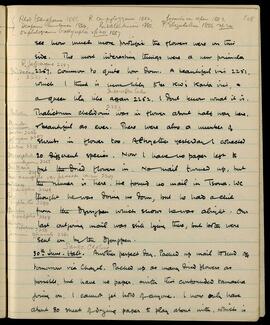
Notes prolific flowering and collections including a new primula (P. jaffreyana 2257), an iris (2251), Incarvillea lutea (2252), and Thalictrum chelidonii. Reports shortage of drying paper, and mail issues: the runner found no mail at Tsona but had a chit from the Dzongpen; outgoing mail was forwarded by the Dzongpen and more is to be sent via Chayul.

CONTENT:
Rhod. sanguineum 1881, R. campylogynum 1882, forrestii var. repens 1883.
Diapensia himalaica 1884, Prim. valentiana 1885. P. Elizabethae 1886 sp. nov.
Omphalogramma bathysepala sp. nov. 1887

...see how much more prolific the flowers were on this side. The most interesting things were a new primula P. jaffreyana 2257. Common to quite low down. A beautiful iris 2251, which I think is near the K.W.'s Karta iris, a queer lily-like affair 2252 (Incarvillea lutea), I don't know what it is.

Thalictrum chelidonii was in flower about halfway here, beautiful as ever. There were also a number of shrubs in flower too. Altogether yesterday I collected 20 different species. Now I have no paper left to put the dried flowers in. No mail turned up, but the runner is there. He found no mail in Tsona. We thought he was doing us down, but he had a chit from the Dzongpen which shows he was alright. Our last outgoing mail was still lying there, but both were sent on by the Dzongpen.

30th June. Halt. Sanga Choling. Another perfect day. Packed up mail to send off tomorrow via Chayul. Packed up as many dried flowers as possible, but have no paper; with this confounded tamasha going on, I cannot get hold of anyone. I now only have about 80 sheets of drying paper to play about with, which is...

[Marginal Notes:]
P. jaffreyana 2257
Iris decora 2251
Thalictrum 2253
Meconopsis 2256
Jeffreyana 2257
Tibetica 2258
Dracocephalum 2255
Primula 2255
Rosa macrophylla var. farreri 2259
Gentiana 2249
Cryptantha 2250
Clematis 2254
Gentiana tibetica 2258
Jasminum officinale 2261