Showing 20 results

Archival description
20 results with digital objects Show results with digital objects
LSH/1/1/8/1/101 · Part · 1947-05-06
Part of The Ludlow & Sherriff Collection

SUMMARY:
At Laba on the north side of Potrang La, the diarist reports a broken cine camera and scarce flowering, lamenting missed photographic plans between Tsona and Dirang Dzong. The next day they cross Potrang La to Lhaguari amid a blizzard and, at the request of the Jetsun Kusho, move from a planned campsite at the Lingka to quarters at the Gompa, also noting bird observations along the route.

CONTENT:
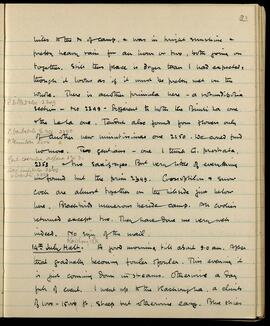
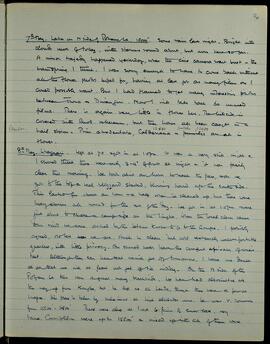
7th May. Laba on North side of Potrang La. 15,000'. Some rain last night. Bright with clouds most of today, with storms round about, but none here so far.

A minor tragedy happened yesterday, when the cine camera went bust - the mainspring I think. I was sorry enough to have to come back without all the flower photos hoped for, having at last got as many films as I could possibly want. But I had planned to get many interesting photos between Tsona and Dirang Dzong. Now I will take back 60 unused films. There is again very little in flower here. The hillside is covered with Rhododendron vellereum, but they have all been caught in a hail storm. Primula atrodentata, calderiana and pumilio are all in flower.

8th May. Lhaguari. Left at 7:00, got in at 1:00 pm. It was a very still night and I should think there were only 3-4 degrees of frost at night and it was fairly clear this morning. We took about an hour to reach the pass, and as we got to the top a real blizzard started, blowing hard up the south side. This lasted for about an hour and a half when it cleared up, but there were heavy storms all round for the rest of the day. We got in at 1:00 pm and were just about to choose a campsite at the Lingka, when the local clerk came down and said we were asked by the Jetsun Kusho to go to the Gompa. I foolishly agreed, so here we are, stuck in clean, but cold and extremely uncomfortable quarters, with little privacy. One should never leave the comfort and privacy of one's tent. Although they say here that we will get off tomorrow, I have no doubt at all that we will at least not get off till midday. On the North side of the Potrang La there were a great many blackbirds. We have had albocinctus all the way up from Kongbo, but he left us at Lenda, though there were a few at Lhapso. His place is taken by maximus at high altitudes now. He was very common from 15,500' - 16,500'. There were also at least 6 pairs of snow cock, very tame. Crossoptilon were up to 15,500' and mixed up with all of them were
LSH/1/1/3/3/137 · Part · 1983-05-05
Part of The Ludlow & Sherriff Collection

SUMMARY:
Notes describe a valley with contrasting north and south faces, a bout of fever for Gulia, and halts on 9th and 10th May to explore and collect plants. Finds include rhododendrons, abundant P. bellidifolia (not yet out), and P. roylei and macrophylla in bloom near a terminal moraine; each member shot one crossoptilon.

CONTENT:
66

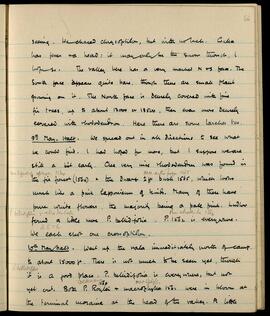
seeing. We chased crossoptilon, but with no luck. Gulia has fever on head: it may only be the snow thrush, I hope so. The valley here has a very marked N & S face. The South face appears quite bare, though there are small plants growing on it. The North face is densely covered with fine fir trees, up to about 13000 or 13500, then even more densely covered with rhododendron. Here there are some larches too.

9th May. Halt. We spread out in all directions to see what we could find. I had hoped for more, but I suppose we are still a bit early. One very nice rhododendron was found in the fir forest (1564) - the dwarf 2 ft bush 1565, which looks much like a pink lapponicum of kinds. Many of these have pure white flowers, the majority being a pale pink. Ludlow found a little more P. bellidifolia, P. 1562 is everywhere. We each shot one crossoptilon.

10th May. Halt. Went up the nala immediately north of camp to about 15000 ft. There is not much to be seen yet, though it is a good place. P. bellidifolia is everywhere, but not yet out. Both P. Roylei & macrophylla 1561 were in bloom at the terminal moraine at the head of the valley. A little

LSH/1/1/4/1/133 · Part · 1933-10-12
Part of The Ludlow & Sherriff Collection

SUMMARY:
Heavy snow and wind hinder activities; seeds of Primula, Rhododendron, and Gentiana are collected while searches for kuling yield no birds, though Tsongpen shoots one Crossoptilon. The next day, despite ongoing snow, the diarist, Tsongpen, and two Trim men reach the Kashong La in deep snow and strong wind, arriving at 8:30.

CONTENT:
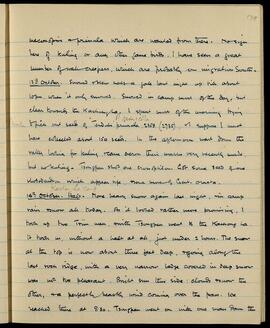
Meconopsis and Primula which are wanted from there. No sign here of kuling or any other game birds. I have seen a great number of wall creepers, which are probably on migration south.

13th October. Snowed and blew half a gale last night up till about 10pm, when it only snowed. Snowed in camp most of the day, but clear towards the Kashong La. I spent most of the morning trying to pick out seeds of Tendula Primula, 2359 (2735), and I suppose I must have collected about 150 seeds. In the afternoon went down the valley looking for kuling and came across their marks very recently made, but no kuling. Tsongpen shot one Crossoptilon. Got some seed of one Rhododendron which appear ripe, some more of Gentiana ornata.

14th October. Halt. More heavy snow again last night, in camp rain and snow all today. As it looked rather more promising, I took up two Trim men, and with Tsongpen went to the Kashong La. It took us, without a halt at all, just under 2 hours. The snow at the top is now about three feet deep, and going along the last rock ridge, with a very narrow ledge covered in deep snow was not too pleasant. Bright sun this side: clouds and snow the other, and a perfectly beastly wind coming over the pass. We reached there at 8.30. Tsongpen went on with one man down the

LSH/1/1/6/1/109 · Part · 1933-07-21
Part of The Ludlow & Sherriff Collection

SUMMARY:
Notes on bird observations near camp, including pigeons and reports of blood pheasant, with mention of sending a gun back to Pana. Halted at Gonyi re on 22 July due to weather; on 23 July marched to Kulu Lungma with fine conditions later, recording distance, temperature, and altitude, though the diarist felt unwell.

CONTENT:
Birds: here, I sent my gun back to Pana. The very same afternoon I saw pigeons close to camp. These are the first I remember seeing this way. Kulang are common on Gonyi re. Blood pheasant said to be here, but must be far from quiet. Crossoptilon do not go up far in these valleys. There are none even here only 3-4 miles up, though in the Mayu Chu we found some broken eggs about 12 miles up.

22nd July. Halt. Gonyi re. Very heavy shower at night, with much fresh snow where we were collecting yesterday. A lovely morning, clouding over. Some heavy showers & thunder in the afternoon. Stayed in camp all day. What a pity it is to be shut up in a valley like this on our one really fine day. I wish we could have a day like this on the Kucha La - our last pass of the main range. So far I have seen absolutely nothing from any pass we have been on.

Kulu Phu Chu
23rd July. Kulu Lungma. 6 1/2 miles. B.P. 192.0° Temp. 65° Time 4.30 pm. Ht app. 11593'. Pretty heavy rain at night, clouded over this morning till 8.0 am. Rest of day magnificent, with one or two light showers. My inside is still very much wrong, otherwise I think I should have been on the hillside all day long. This really

LSH/1/1/8/1/51 · Part · 1947-01-13
Part of The Ludlow & Sherriff Collection

SUMMARY:
The diarist notes failed banana trees in Dongkar, widespread illness, and persistent bad weather during a series of halts while collecting birds. They visit Denchan Gompa, hunt game birds with local shikaris, and criticize Elliot’s contribution. Bill visits Yigong Tso and learns from the Be Gyimpon of a summer route to Tongkyuk over the TRESUR LA; Ludlow departs for Suowa with companions.

CONTENT:
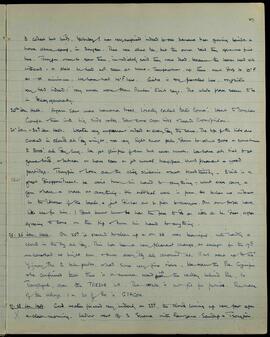
to collect bush birds. Yesterday I was very surprised indeed to see banana trees growing beside a house above camp, in Dongkar. There were about ten, but the owner said they gave no fruit here. Tseringpon, when he saw them, immediately said they were dead, because the leaves had all withered - a state he had not seen at home. Temperatures up there must drop to 10°F as a minimum. We have had 14°F here. Goitre is very prevalent here, syphilis very bad indeed - "very much worse than Bhutan" Elliot says. The whole place seems to be in decay generally.

20th Jan Halt. Again saw more banana trees, locally called 'tali loma'. Went to Denchan Gompa then into big side valley. Saw some crossbills & heard Crossoptilon.

21st Jan - 24th Jan. Halt. Weather very unpleasant indeed & every day the same. The tops of the hills are covered in clouds all day & night, & a very light snow falls, down to about 9000' or sometimes to 8000', all day long. We get glimpses of sun but never much. We have all tried to get game birds, & between us have seen or got monal, tragopan, blood pheasant & wood partridge. Tseringpon & Laku are the chief shikaris & most bloodthirsty. Elliot is a great disappointment. He won't turn his hand to anything; won't even carry a gun & have a crack at anything. His medical work is poor. He takes no interest in the illnesses of the locals, & just dishes out 2 pills to everyone. Our own people have little use for him. I don't know how he has the face to do as little as he does, after agreeing to come on this trip & turn his hand to anything.

25-26 Jan. Halt. On 25th it started to clear up & on 26 was beautiful, with hardly a cloud in the sky all day. This has been a very pleasant change, as except for the 19th we have had no bright sun, & snow every day all around us. Bill went up to the Yigong Tso to take photos, & had some very fine views. He saw the Be Gyimpon who confirmed that there is a summer road up from the valley behind Be, to Tongkyuk, over the TRESUR LA. The route is not fit for ponies. The name of the village 1 m W of Be is GYAGON.

27-28 Jan. Halt. Good weather finished very suddenly on 28th, the clouds coming up very fast after a clear morning. Ludlow went off to Suowa with Ramzana, Sandup & Tseringpon.

LSH/1/1/8/1/184 · Part · 1946-10-18 - 1946-12-22
Part of The Ludlow & Sherriff Collection

SUMMARY:
A dated log of game recorded at various locations, noting quantities of species such as pheasant, crane, geese, fish, partridge, mahseer, and others. Entries span from 18 October to 22 December 1946 and list places for each record.

CONTENT:
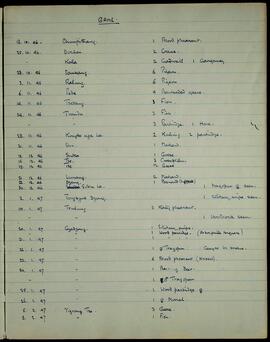
GAME

      1. Chumpithang. 1 Blood pheasant.
      1. Dochen. 2 Crane.
        " Kala 2 Gadwall. 1 Garganey.
      1. Saukang. 6 Pigeon.
      1. Ralung. 6 Pigeon.
      1. Pede. 4 Bar-headed geese.
      1. Tsetang. 3 Fish.
      1. Tronda. 3 Fish.
        " " 3 Partridge. 1 Hare.
      1. Kongbo Nga La. 2 Kuling. 2 Partridge.
      1. Shu. 1 Mahseer.
      1. Shoka. 1 Goose.
      1. Tse. 3 Crossoptilon.
      1. Tse. 12 Geese.
      1. Lunang. 2 Mahseer.
      1. Dzeng. 1 Pochard (
LSH/1/1/8/1/83 · Part · 1947-03-20
Part of The Ludlow & Sherriff Collection

SUMMARY:
The party halts for several days in a valley on the right bank of the river, noting delayed flowering compared to Tongkyuk and recalling the 1933 flood from a lake on the Munkhu Phu Chu. They describe routes toward Munkhu La and Yigong, observe various birds, and report activities including Akong collecting specimens, Tsongpen traveling to Sobhe La to repair a thermograph, and Bill ascending above camp but finding little in flower.

CONTENT:
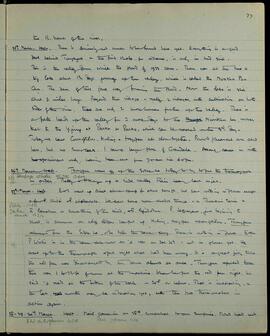
the R. bank of the river.

25th March. Halt. There is obviously not much to be found here yet. Everything is a good deal behind Tongkyuk — the pink rhodo, for instance, is only in bud still. This is the valley down which the flood of 1933 came. There was at the time a big lake about 1 1/2 days journey up this valley, which is called the Munkhu Phu Chu. The dam of this gave way forming the flood. Now the lake is still about 3 miles long. Beyond this village — really 2 villages, with cultivation on both sides of the river, there are only 2 more houses further up the valley. There is a path leads up the valley for 3 more days to the Munkhu la, over that to the Yigong at Parka or Parke, which can be reached on the 4th day. Today we saw Crossoptilon, kuling & tragopan all close together. Blood pheasant are also here, but no snowcock. I saw a large flock of Grandala. Akong came in with two specimens only, having been out from 7.0 am till 6.0 pm.

26th March Halt. Tsongpen went off up the Sobhe la today to try to put the thermograph in order. Betty & Akong up a side valley. Rain heavy last night.

27th March. Halt. Bill went up direct above camp for about 2000 ft, but saw nothing in flower except a few P. Winteri & rh. rhodentata. We saw some more rhodos though — a Thomsonii series & R. lanatum or something of the kind, rh. lepidotum. P. Jaffreyana, just beginning to shoot, is common on cliff ledges. We put up kuling, tragopan, crossoptilon. Tsongpen returned from the Sobhe la, she tells the same story. There is nothing in flower. Even P. Winteri is in the same state now as it was on Dec 31st — not in flower yet. He went up to the thermograph & put right what had been wrong. It is a great pity that the red pen was disarranged by the lama almost at once. Tsongpen reported that there was 1 to 1 1/2 ft of snow at the machine. When he put the red pen right, he said it read at the bottom of the scale — 20°F or below. That is interesting, & the last month may be interesting yet, with the two thermometers in action again.

28-29-30th March. Halt. Mail came in on 28th, somewhat to our surprise. Rhodo had not

LSH/1/1/8/1/55 · Part · 1947-01-13
Part of The Ludlow & Sherriff Collection

SUMMARY:
Entries for early February describe halts near Laka, arrival of loads, and cordial interactions with locals who report oppression by soldiers and taxes to Kanam. The author notes bird observations and hunting attempts, mentions an iron mine near Chara, sends Lahu to search for game, asks the Tonse headman for Crossoptilon, and records geographic details around Makutang, Sibhe La, and Temo Channa.

CONTENT:
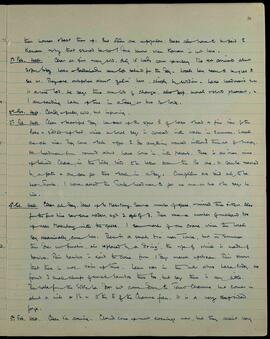
...their houses and beat them up. But others are unpopular: taxes also have to be paid to Kanam; why that should be so I don't know when Kanam is not here.

1st Feb. Halt. Clear at first and very cold. Only 15 loads came yesterday. The rest arrived about 3:00 pm today. Lahu and Balbahadur were left behind for the day. Locals here seem to be glad to see us. They are outspoken about 'zulm' here, chiefly by soldiers. Laka headman's son is a nice lad. He says there are lots of 'Chaugai', also 'kap', monal and blood pheasant. I am sending Lahu up there in a day or two to look.

2nd Feb. Halt. Cloudy and pretty cold, but improving.

3rd Feb. Halt. Clear and beautiful day. We went up the spur East of Laka and had a fine view of the lake and silted up bed, which a local says is covered with water in summer. Locals are all nice. They come and talk and offer to do anything wanted without thought of money. All headmen from round about have come in, with presents. There is an iron mine up behind Chara in the hills, said to be better than the Be one. It can be reached by a path and one can get there and back in a day. Crossoptilon are said only to be near Tonse. I have asked the Tonse headman to get me one or two and he says he will.

4th Feb. Halt. Clear all day. Went up to Makutang. Saw a number of geese, missed three sitters. Also for the first time saw some waders, got 2 out of 3. There were a number of mallard too up near Makutang with the geese. I saw marks of one crane, which the locals say occasionally come here. There is a small 'tru' near Tonse, but in summer this does not function, is replaced by a 'dring', the rope of which is made of bamboo. This bamboo is said to come from 1 day's march upstream. This shows that there is more rain up there. Lahu was in the hills above Laka today. He found 3 small clumps of small bamboo there too, but says there is very little. The nala from the Sibhe La does not come down to Temo Channa, but comes in about a mile or 1 1/2 miles to the East of the Channa fan. It is a very steep sided gorge.

5th Feb. Halt. Clear till evening. Clouds come up most evenings now, but they aren't very...

LSH/1/1/4/1/27 · Part · 1936-07-02
Part of The Ludlow & Sherriff Collection

SUMMARY:
Notes describe mixed sunshine and heavy rain near camp, with collections of primulas, gentians, and saxifrages, and sightings of Crossoptilon and snowcock; most coolies returned but no mail arrived. On 14 July at Kashong La, the morning was fair before turning to heavy rain.

CONTENT:
miles to the N of camp, and was in bright sunshine and
pretty heavy rain for an hour or two, both going on
together. Still this place is drier than I had expected,
though it looks as if it must be pretty wet on the
whole. There is another primula here - a rotundifolia
section - No 2349 (P. littledalei 2349) - different to both the Bimbi La one
and the Lela one. Tendu also found four flowers only
of another new minutissimae one 2350 (P. barbatula sp. nov. 2350). We could find
no more (P. tenuiloba 2354). Two gentians (Gent. coerulea aglaia 2353) - one I think G. prostrata,
and two saxifrages (Sax. hispidula 2348). But very little of everything
we found ("wardii" 2357) but the primula 2349. Crossoptilon and snow
cock are almost together on the hillside just below
here. Blackbirds numerous beside camp. All coolies
returned except two. They have done me very well
indeed. No sign of the mail.

14th July Halt. Kashong La. A good morning till about 9.0 am. After
that gradually becoming fouler and fouler. This evening it
is just coming down in streams. Otherwise a day
full of

LSH/1/1/8/1/19 · Part · 1946-11-14
Part of The Ludlow & Sherriff Collection

SUMMARY:
The diary records movements from the east side of Kongbo-nga La via Mye to Shu, with delayed coolies and negotiations for transport. It notes forest and plant observations near the pass, attempts to contact Gyantse and Ford by wireless, strong winds, and halts on 1–2 Dec due to uncertain transport.

CONTENT:
Nang.

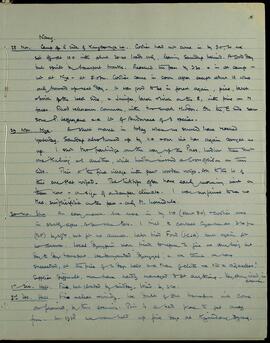
28 Nov. Camp on E side of Kongbo-nga La. Coolies had not come in by 9.0, so we set off at 10.0 with about 30-40 loads only, leaving Samdup behind. A good day but spoilt by transport trouble. Reached the pass by 2.30 & in at camp - not at Nye - at 5.0pm. Coolies came in soon after except about 15 who only turned up next day. It was good to be in forest again, pine, larch & birch on the west side, & juniper, larch & birch on the E, with pine on N faces. Rhod. vellereum common, with two small Rhodos. On the E side saw some P. jaffreyana & a lot of Androsace of 3 species.

29 Nov. Mye. A short march in today where we should have reached yesterday. Samdup also turned up by 11.0 & our kit has again caught us up. I saw two partridge on the way up the Pass. Ludlow then saw one 'Kuling' & another, while Ludlow missed a Crossoptilon on this side. This is the first village with pent wooden roofs. All to the W of this are flat roofed. The hilltops often have early morning mist on them now - a sign of a damper climate. I was surprised to see no Mec. simplicifolia on the pass - only M. horridula.

30 Nov. Shu. An easy march. We were in by 1.0 (start 8.0) & coolies were in shortly after. A few were late. I tried to contact Gyantse at 3.30 pm (BT) by W/T, but got no answer. Later tried Ford (TASA) but again got no answer. Local Dzongpon's man tried to refuse to give us anything but day to day transport. We demanded 'Dzongyel', & we think we have succeeded, at the price of 2 days halt & a than of cloth & ten cigarettes! Supplies difficult, & we have hardly managed to get anything. Very strong wind in evening.

1st Dec. Halt. Fine, but clouded by midday. Wind by 2.30.

2nd Dec. Halt. Fine & clear & windy. We doubt if our transport will come as promised, by this evening. This is a bad place to get away from - in 1938 we were held up five days at Kyimdong Dzong.