Showing 13 results

Archivistische beschrijving
13 results with digital objects Show results with digital objects
LSH/1/1/6/1/61 · Part · 1938-05-29
Part of The Ludlow & Sherriff Collection

SUMMARY:
At Langong, the diarist records collecting several Primula and other alpine plants, observing a new warbler (P. tibetanus), and noting marmots and lingering snow. A clutch of Crossoptilon eggs and a blood pheasant egg are obtained; the gyimpon arrives and promises coolies, and plans are made to explore valleys between Pa La and Lo La before visiting the Pachakshiri Loba.

CONTENT:
Langong

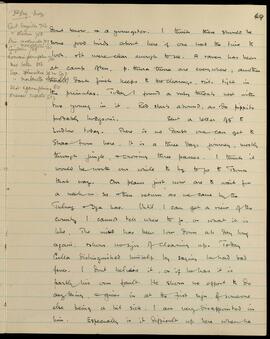
depressed, but then we saw P. bariensis, and knew that there would be other things as well. For a change, the second time only, I did not take a gun, and of course saw the new warbler P. tibetanus. There were two of them, in juniper scrub, just as on the Bimbi La. Of interesting things, we saw Mec. simplicifolia - and I particularly examined the filaments, which were white. Then Tsonypon brought in a primula, which I think must be P. chamaethauma 3893 (P. chionantha 3893). Then P. macrophylla 3894, 3895 (P. macrophylla var. macrocarpa 3895) was seen. Then over a ridge we found in almost full flower that delightfully pretty - and fragrant - P. rotundifolia. On the whole a good day. There are many marmots running about, now the snow is off the ground. The actual pass is probably still covered with snow, as there were huge drifts a good deal lower than the highest we went, on the North faces. I heard on return that one man had already found a nest of Crossoptilon, but he has not brought the eggs yet.

29th May. Halt. Langong. Fine most of the day, but clouded and showery. Started in the morning about at 11.00 a.m. Saw nothing much. In fact there is remarkably little in the valley. Collected Primula yargongensis 3914. Our offer for eggs is doing well. Today got a clutch of seven eggs of Crossoptilon, nest on the ground in a bush. Later on a man came in with one blood pheasant's egg, and will see the nest tomorrow. The eggs were very difficult to blow, having chicks inside. (P. dryadifolia 3917, Rhododendron v. microstoma 3918, Ranunculus 3919, 3923, Primula 3925, Gal. nambanensis 3920, Corydalis 3921, 3922, Lonicera litangensis 3926).

30th May. Halt. Langong. Mostly fine in Langong, but rain mist on the hills all day. I went up the valley immediately North of Langong village, running parallel to the Tscha valley. There is nothing in any of these valleys till one gets to 13,500 feet or so. Then primulas appear. This is a fine valley, with a good sized lake at about 13,500 feet above which there is a fine waterfall. But flowers are few and far between, and I think we are really too early yet. The gyimpon has arrived, seems very helpful and friendly. He wants to go off for 8 days, but has promised coolies all I want in the meantime. My plans are to stay here two more days, and then go West, up a valley which lies between the Pa La and Lo La routes. Stay there four days and return here for two before going off to the Pachakshiri Loba on the 9th, for a week. That will take up all the time I can spare in this area. Everything here seems to be late. Snow lies pretty thick on the hills yet, and nearly all passes are shut. Tsari Sama - known generally as Tsari Sarpa, "the new Tsari" is not
LSH/1/1/6/1/82 · Part · 1938-06-22
Part of The Ludlow & Sherriff Collection

SUMMARY:
Route description from Langong to Molo via the Tse La, following the Langong Chu through forests and meadows with a steep ascent to a camp at Yamto; transport suitable for yaks. Entries dated June 22 and a barometric/temperature reading at 3:30 pm on 21 June 1938 accompany plant collections, including Primula hyacinthina with notes on farina.

CONTENT:
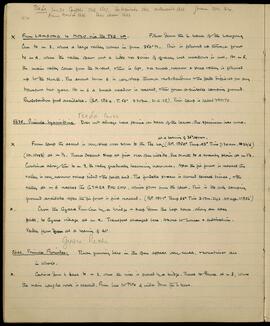
Tseda June 22. Corydalis 5626, 5627, Saxifraga 5617, melanocentra 5625, Geranium 5621, 5634,
41a Meconopsis horridula 5636 Pedicularis elwesii 5633

From LANGONG to MOLO via the TSE LA. Follow down the L bank of the Langong Chu to m 2, where a large valley comes in from 350° M. This is followed up through forest to m 4, where the valley opens out a little & a series of grassy wet meadows is met. At m 5, the main valley comes from the N. West, this is left, & a small, narrow & steep valley is followed up to the North. The ascent to m 6 is very steep through rhododendrons & the path difficult for any transport but yaks. At m 6 a small meadow is reached, this forms a suitable camping ground. Rhododendron fuel available. (BP. 186.4. T. 50° 3.30pm. 21.6.38). This camp is called YAMTO.

Tse La June 22

  1. Primula hyacinthina. Does not always have farina on back of the leaves. One specimen has none.

From camp the ascent is very steep over scree to the Tse La at a bearing of 35

LSH/1/1/6/1/118 · Part · 1933-07-27
Part of The Ludlow & Sherriff Collection

SUMMARY:
Field notes from Mura La listing numerous plant specimens and observations over several days in August, including Primula, Gentiana, Saxifraga, Meconopsis, and others with specimen numbers. Notes mention flowering status, abundance, and that Primula rigida had previously been taken in flower by Ludlow.

CONTENT:
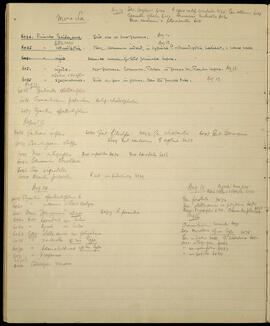
Mura La.

Aug. 12 Sax. taylori 6124. P. capit. subsp. crispata 6125, Sen. reticulatus 6126
Cyananthus lobatus 6127 Parnassia nubicola 6130.
Rosa omeiensis v. pteracantha 6131

  1. Primula baileyana. Still one or two flowers. Aug 12.
    6045 Primula littledalei rotundifolia. Very common indeed, in typical P. rotundifolia habitat. I have never seen so much of this primula before. Aug. 13.
    6051 Primula rigida
    6051 Primula rigida. No flowers. Common. Taken in flower by Ludlow before. Aug. 13.
    6055 Primula advena v. concolor szechuanica. Still a few in flower. Has the purple tube. Aug 13.
    Aug 12.
    6035 Gentianella stellarifolia
    6036 Cremanthodium palmatum subsp. rhodocephalum
    6037 Cyananthus spathulifolius

August 13
6038 Gentiana infelix 6040 Gent. filistyla 6043 Gen. stictantha 6047 Gent. tsarongensis
6039 Dracocephalum speciosum 6049 Gent. vernayi. G. aglaia 6053
6041 Mec. integrifolia Mec. impedita 6052 Mec horridula 6056
6042 Saussurea obvallata
6046 Sax. signatella
6048 Aconitum pulchellum P. sik. var. pudibunda 6139

Aug 14 Aug 15. Corydalis 6149, 6150. Pedic. bella v. holophylla 6152
6059 Cyananthus spathulifolius 6 Gen. prolata 6072
6060 Cyananthus incanus v. leiocalyx Sax. stella-aurea var. polyadena 6074

  1. Prim. Younghusbandiana sp. nov. 6067 P. pumilio Prim. dryadifolia 6154. Cremanth. plantag. 6155
    6062 Mec. horridula var. lutea Aug 16
    6064 Meconopsis lyrata var. lutea Cremanthodium humile 6077
    6063 Sax. stella-aurea var. polyadena Sax. mirelana sp. nov. type 6078
    6068 Saxifraga matanella sp. nov. type Gen. infelix 6080, G. trichotoma 6081.
    6070 Saxifraga haematochroa sp. nov. type Mec. integrifolia 6082
    6071 Saxifraga drapana Meconopsis aculeata 6083
    6073 Meconopsis impedita 6084
    6142 Codonopsis nervosa
LSH/1/1/3/3/135 · Part · 1933-03-08
Part of The Ludlow & Sherriff Collection

SUMMARY:
After a sleepless night the party set off before dawn and crossed the Le La in mist with fresh snow. They observed numerous Primula species, dense rhododendrons, Abies, and a Corydalis, noting the area would be spectacular later in the season.

CONTENT:
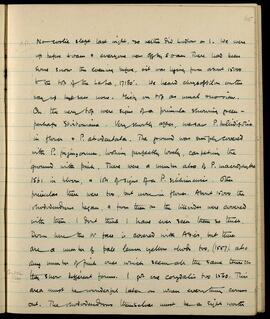
No coolie slept last night, so neither did Ludlow or I. We were up before 4.0 am & everyone was off by 5.0 am. There had been some snow the evening before, and it was lying from about 15000 to the top of the Le La, 17180'. We heard chrysochlora on the way up but saw none. Misty on top as usual no view.

On the very top were signs of a Primula showing green - perhaps Stirtoniana. Very shortly after, we saw P. bellidifolia in flower & P. atrodentata. The ground was simply covered with P. pryingorum, looking perfectly lovely, carpeting the ground with pink. There were a number also of P. macrophylla 1561 in bloom, & lots of signs of a P. sikkimensis. Other primulas there were too, but none in flower. About 15000 the rhododendrons began, & from then on the hillsides were covered with them. I don't think I have ever seen them so thick.

Down here the W face is covered with Abies, but there are a number of pale lemon yellow rhodos too, (1557). Also any number of pink ones which seem all the same though they show different forms. I got one Corydalis too 1560. This area must be wonderful later on when everything comes out. The rhododendrons themselves must be a sight worth

LSH/1/1/3/3/139 · Part · 1983-05-05
Part of The Ludlow & Sherriff Collection

SUMMARY:
Notes abundant Abies delavayi and Corydalis, sightings of Cyanopica, and Ludlow’s separate route south where he found Fritillaria cirrhosa (1574) and Thermopsis barbata (1573). Plans to move on to Migyitun with fine weather and no mail; on 11th May the party traveled 7 miles from Kyimpu to Charme along the left bank, noting Charme at the junction of the Char and Kyimpu rivers with good camping, supplies, and crops, and recording Anemone rivularis (1581), Iris decora (1582), and radishes.

CONTENT:
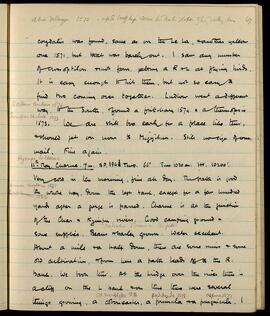
Abies delavayi 1572 - up to 100 ft high. Covers the whole slopes of the valley here. 67

Corydalis was found, same as on the La La, and another yellow one 1571, but that was barely out. I saw any number of Cyanopica which flew, putting a shot at flying birds. It is easy enough to hit them, but not so easy to find two coming over together. Ludlow went a different way to the South, found a Fritillaria 1574 and a Thermopsis 1573. We are still too early for a place like this, and should get on now to Migyitun. Still no sign of our mail. Fine again.

Fritillaria cirrhosa 1574
Thermopsis barbata 1573

Kyimpu to Charme
11th May. Charme. 7 miles. B.P. 19.43 Temp. 66° Time 10.30 am. Ht. 10200'.

Very cold in the morning, fine all day. The path is good the whole way, down the left bank, except for a few hundred yards after a gorge is passed. Charme is at the junction of the Char and Kyimpu rivers. Good camping ground and some supplies. Beans and barley grown. Water excellent.

Anemone rivularis 1581
Iris decora 1582
radishes

LSH/1/1/3/3/164 · Part · 1983-05-05
Part of The Ludlow & Sherriff Collection

SUMMARY:
Notes describe eggs and nesting of Trochalopteron henrici near Migyitun, including egg color, nest placement, and clutch size, with laying in May and early June. A list of plant taxa with specimen numbers (including several Rhododendron and Corydalis) is recorded.

CONTENT:
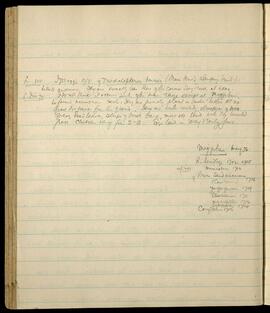
L. 100 Set eggs c/3 of Trochalopteron henrici (Prince Henri's Laughing Thrush).
Pale greenish. They are exactly like those of the common Song Thrush at home.
L. Dis 77. I do not think it occurs south of the main range except at Migyitun.
We found numerous nests, they are generally placed in bushes, seldom at no
great distance from the ground. They are rather untidy structures of dried
grass, dead leaves, strips of birch bark, moss etc. lined with dry twisted
grass. Clutches vary from 2-3. Eggs laid in May & early June.

Migyitun May 26.
R. lindleyi 1702 1715
sp. nov. miniatum 1710
? Prim. sandemaniana 1708
(Cawdorii)
yargongensis 1709
tsariensis 1711
macrophylla 1712
sikkimensis 1714
Corydalis 1705

LSH/1/1/3/3/198 · Part · 1996-06-18
Part of The Ludlow & Sherriff Collection

SUMMARY:
Notes from a camp east of Lang La on June 20 mention Ludlow at Lang La and describe the pass with rhododendron, juniper, and fir forest. Plant records include P. macrophylla (1843, 1844), Mec. simplicifolia (1845), and Corydalis (1846).

CONTENT:
L. p. 174 June 20 Camp east of Lang La. 14290 Ludlow at Lang La
Description of pass. - Rhod. Junip. Fir forest P. macrophylla 1843, 1844
Mec. simplicifolia 1845
Corydalis 1846

LSH/1/1/3/3/217 · Part · 1996-06-18
Part of The Ludlow & Sherriff Collection

SUMMARY:
Ascent to Takar La in heavy rain followed by a descent into a dry zone with lingering snow and old avalanches made travel difficult for ponies. The writer notes abundant primulas on the east side, observes and releases a Lerwa chick, and records P. bellidifolia, K.W.'s new sikkimensis, and P. tibetica near camp.

CONTENT:
Sherriff
Takar La 28. Potentilla glabra var. rhodocalyx 2231, Gentianella 2233, Androsace zayuanensis 2234, Anemone strigillosa v. canescens 2235, Anemone demissa var. grandiflora 2236, Corydalis 2237, 2238, Pedic. oldenii 2239.
Sherriff

28th June. Camp Zimsakhi 14000' 8 miles. Rained hard all morning as we climbed to the Takar La (16700') at about 11.5. The rain continued to half way down here, then we were in the dry zone, & could see there had been no rain down here. Both sides of the pass have much snow, old avalanches which will stay all year I suppose. There were masses of primulas on the E side, far more than on this side. All kinds of sikkimensis, yellow & white (2211 & 2212), the red one (odontica) 2158 in masses & the little white (vernicosa) 1615. But nothing new could we see. At about 15500 saw four Lerwa with young. Caught one chick & released it. Snow made it difficult for the ponies on the way down, often had a job, unloading, walking over their saddle cloths & then on again. All bare shale slopes both sides near the top. On this side the descent is steep most of the way every step down the last bit to camp. P. bellidifolia is pretty common on the open hillside & among scrub. K.W.'s new sikkimensis is not common. It is a queer flower, the claws folded right back on the tube & calyx - not altogether pretty, but with a most beautiful scent. P. tibetica is still in bloom & growing.

LSH/1/1/2/1/69 · Part · 1933-07-18
Part of The Ludlow & Sherriff Collection

SUMMARY:
After a late start from Tsuna, the party visited the Dzongpon to fix prices, then traveled via the Drong toward Lablung, ascended to the Nyongchung La, and descended into the Thang Chu valley where fuel and grazing were noted. Few flowers were seen, but a delphinium and a Corydalis were recorded; Himalayan blackbirds were numerous at Thang and gazelle were observed in the valley.

CONTENT:
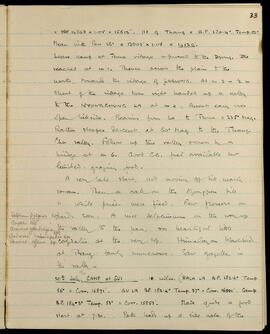
33

= 14869 x 1.05 = 15612'. Ht of Thang = B.P. 186.4°, Temp. 52°.
Mean with Pass 56° = 13903' x 1.015 = 14120'.

Leave camp at Tsuna village & proceed to the Drong, reached at m 1. Thence across the plain to the north, towards the village of LABLUNG. At m 2 — ½ m short of the village turn right handed up a valley to the NYONGCHUNG LA at m 4. Ascent easy over open hillside. Bearing from La to Tsuna = 235° Mag. Rather steeper descent at 60° Mag to the Thang Chu valley. Follow up this valley across by a bridge at m 6. Good C.G. fuel available but limited: grazing, food.

A very late start, not moving off till nearly 10 am. Then a call on the Dzongpon till 11 while prices were fixed. Few flowers seen. A nice delphinium on the way up the valley to the pass, & a beautiful little Corydalis at the very top. Himalayan blackbird at Thang fairly numerous. Saw gazelle in the valley.

[Marginal notes:]
Delphinium pylzowii 657
Corydalis 658
Arenaria glanduligera 659
And

LSH/1/1/2/1/101 · Part · 1933-07-18
Part of The Ludlow & Sherriff Collection

SUMMARY:
Notes bird activity near camp, including a ruby throat nest with two young, redstarts, pipits, and ravens. Sends a letter to Ludlow and discusses a three-day route to Shao through jungle and passes, considering going to Tsona, with plans to wait about a week and then return via the Tulung and Dza las.

CONTENT:
The text from the image is transcribed below:

3rd Aug. Mago.

49

Gent. bryoides 756
" elwesii 758
Prim. involucrata 757
" macrophylla 761
Corydalis 759
Lonicera parvifolia 760
Meconopsis bella 806
Sax. sphaerulifera 807
" montanella 808 & 809
Rhod. aganniphum 811
Anemone rupicola 813

Don't know, or a youngster. I think there should be some good birds about here if one had the time to look, or it were clear enough to see. A raven has been at camp often, p. thura thura are everywhere; another dark finch keeps to the clearings, sits tight in the primulas. Today I found a ruby throat nest with two young in it. Redstarts abound, as do pipits probably hodgsoni. Sent a letter off to Ludlow today. There is no doubt one can get to Shao from here. It is a three days journey, mostly through jungle, & crossing three passes. I think it would be worth our while to try to go to Tsona that way. Our plans just now are to wait for a week or so then return as we came by the Tulung & Dza las. Until I can get a view of the country I cannot tell where to go