
Mostrando 2 resultados

Descripción archivística
2 resultados con objetos digitales Muestra los resultados con objetos digitales
LSH/1/1/5/1/124 · Part · 1933-06-21
Parte de The Ludlow & Sherriff Collection

SUMMARY:
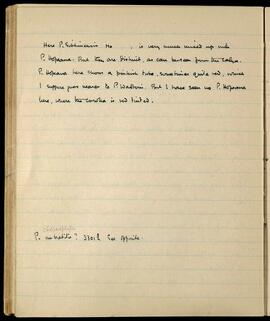
The page distinguishes P. sikkimensis from P. Hopeana by calyx features and notes that P. Hopeana here has a pinkish to red tube, possibly approaching P. Waltoni. It also mentions chasmophila and references P. umbratilis? with number 33014.

CONTENT:
Here P. sikkimensis No , is very much mixed up with
P. Hopeana. But they are distinct, as can be seen from the calyx.
P. Hopeana here shows a pinkish tube, sometimes quite red, which
I suppose goes nearer to P. Waltoni. But I have seen no P. Hopeana
here, where the corolla is red tinted.

chasmophila
P. umbratilis? 33014 See opposite.
LSH/1/1/5/1/156 · Part · 1933-07-04
Parte de The Ludlow & Sherriff Collection

SUMMARY:
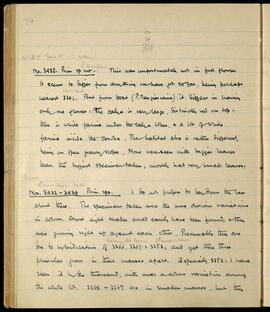
Notes describe a probable new Primula (No. 3438, P. uniflora) not in full flower, compared with 3301 (chasmophila/P. menziesiana), including calyx color, presence of white farina, habitat on open grassy slopes, and small leaves. Additional remarks cover color variation and presumed hybridization among Primula specimens Nos. 3432–3436 and references to 3366, 3367, 3358, and 3383; altitude recorded at 13,600 ft and temperature 58° at 2.0 pm.

CONTENT:
77a

570
26

3420
1140

14820

Alt. 13600' Temp 58° 2.0 pm.

No. 3438. Primula sp. nov. (P. uniflora) This was unfortunately not in full flower.

It seems to differ from anything we have got so far, being perhaps nearest 3301 (chasmophila). But from that (P. Menziesiana) it differs in having only one flower. The calyx is very large, distinctly red on top: there is white farina under the calyx lobes, & a lot of white farina inside the corolla. The habitat also is rather different, being on open grassy slopes. None were seen with bigger leaves than the biggest specimen taken; mostly had very small leaves.

Nos. 3432 - 3436 Primula spp. I do not profess to lay down the law about these. The specimens taken were the more obvious variations in colour. About eight shades could easily have been found, often were growing right up against each other. Presumably they are due to hybridisation of 3366, 3367 & 3358 (tsariensis, alb. tsariensis, strenua v. nov.), and yet these three primulas grow in their masses apart. Especially 3383: I have seen it by the thousand, with never a colour variation among the whole lot. 3366 & 3367 are in smaller masses, but they...