
Showing 2 results

Archival description
2 results with digital objects Show results with digital objects
LSH/1/1/3/3/33 · Part · 1937-02-27
Part of The Ludlow & Sherriff Collection

SUMMARY:
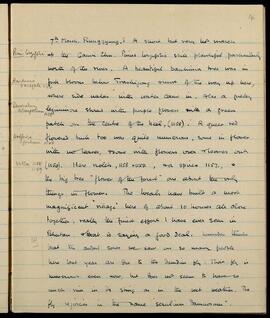
Describes a short, very hot march up the Gamri Chu from Rungzyung, noting plentiful Pinus longifolia and flowering Bauhinia variegata below Trashigong, along with Desmodium tiliaefolium, Woodfordia fruticosa, violets, and a spiraea. Mentions a notably well-built village of about ten houses, and records Lumsden’s view that the sores seen on locals last year were due to the Damdim fly (Simulium damnosum).

CONTENT:
7th March. Rungzyung. A short but very hot march
[Pinus longifolia] up the Gamri Chu. Pinus longifolia still plentiful particularly
north of the river. A beautiful Bauhinia tree was in
[Bauhinia variegata 1154] full bloom below Trashigong some of the way up here,
where side nalas with water come in. Also a pretty
[Desmodium tiliaefolium 1155] leguminous shrub with purple flowers with a green
patch in the centre of the keel, (1155). A queer red
[Woodfordia fruticosa 1150] flowered bush too was quite numerous, some in flower
with no leaves, some with flowers over & leaves out.
[Viola 1158, 1159] (1150). Here violets, 1158 & 1159, a spiraea 1157, &
the big tree "flower of the forest" are about the only
things in flower. The locals have built a most
magnificent 'village' here of about 10 houses all close
together, really the finest effort I have ever seen in
Bhutan, & that is saying a good deal. Lumsden thinks
that the awful sores we saw on so many people
here last year are due to the Damdim fly. That fly is
numerous even now, but does not seem to have so
much vim in its sting as in the wet weather. The
fly rejoices in the name 'Simulium damnosum'.

Page 5
LSH/1/1/9/1/5 · Part · 1949-09-13
Part of The Ludlow & Sherriff Collection

CONTENT:
Then turn up a side valley on the left bank; it ascends very steeply for about 2000 feet. Over the pass one loses 1000 ft at once, then starts up again a long climb which continues till within a mile of Kazare. This climb is on the ridge most of the way. Kazare must be about 4500 ft or so. Nothing interesting botanically seen.

28th March. Surelakha B.P. 204.7 = 3840. 70° 1.0844. Ht approx. 4164'
This is only three miles. An easy ascent to a pass over the ridge, and down about 1000' this side. Again nothing of interest, no Rhododendrons at all seen. In 1937 I did not come this awful up and down route, neither did I reach this village, but I went to a place called Surelakha, which must have been down in the valley from here. It struck me as very much easier than this route; what's more, there were many rhodos in the trees. All the inhabitants so far are Nepalis. It seems very wrong that there should be political agitation here, but there has been, stirred up by a Kalimpong Nepali who came here just to do that. One wonders if he does this on his own, for what he can collect, or if he is instructed by others higher up. Hot and clear today.

29th March. Camp 6 m. beyond Chungsing or Chungsemo. Cultivation at Surelakha is now quite extensive & extends from where we camped at over 4000' down to about 1500', and up the other side of the valley. We lost nearly all yesterday's altitude at once, dropping into the valley bottom and crossing the river at about m 2. Then steeply up 500' or so to a pass at m 3. Then more or less level through dense forest to Chungsing or Chungsemo at m 5. There are no huts here, but H.H.'s cattle come here in winter. The only pretty flowering trees seen were Bauhinia variegata & an Erythrina. I think I saw Albizzia Shuffii, but not in flower. Beyond Chungsing the path continues up for a mile, then