Showing 8 results

Archival description
8 results with digital objects Show results with digital objects
LSH/1/1/10/1/19 · Part · 1933-10-01
Part of The Ludlow & Sherriff Collection

SUMMARY:
Clear, frosty day at Amelungnang with notes on Hicks needing to cross the Rudo La in Bhutan. The writer reflects that the Dhur Chu area would have yielded better flowers than Waitang, noting climatic differences after crossing the Tolegang La; Pasang and Yundru arrived later with a good haul of seed despite a foot of snow on boulder scree, and there was disappointment regarding Mec. bella near the Sin La.

CONTENT:
probably, after having a lonely duck swoosh up and down the Tumen Su in a temperature of about 10° F.

Hicks will be glad of the change in weather. He will have the Rudo La to cross, and he will be lucky to find a good day to get over that. It must be one of the wetter passes in Bhutan, on the east side.

3rd October. Amelungnang. Misty, with a hard frost in the early morning, but soon cleared up to a perfect day - the first with no rain at all. Clouds formed soon but never looked wet. It was an interesting march, too, and I now have much more of an idea of the country. I just wish that we had chosen the area of the Dhur Chu instead of Waitang. We would have got many more flowers and of much greater interest. Partly this is due to the area not being overrun by yaks, but there is something else climatic as well. As soon as we crossed the Tolegang La, this was evident. But it can't be helped now. Pasang and Yundru came on later than us with their haul of seed. They have done well, and got quite a good lot of things. They were unable to go the way we meant them to, owing to the snow being a foot thick. That on boulder scree, is really impossible. It made no real difference to the seed gathering, which way they went. One disappointment was Mec. bella. We saw so very much of it all along N of the Sin La, that I expected
LSH/1/1/10/1/35 · Part · 1933-10-10
Part of The Ludlow & Sherriff Collection

SUMMARY:
The diarist reports improved weather, collects many Lilium nepalense bulbs and seeds, and notes earlier seed loss of Morina on the Pelela. Pasang and Yundru return with valuable Primula and Lychnis collections, are paid, and depart for Bumthang; the party travels from Ritang to Samtegang and then to Wangdipotrang, noting road conditions and fine weather.

CONTENT:
17th Oct. Ritang. A perfect morning at last, but even so the clouds soon came up, and we are on the edge of very heavy rain this evening, but not in it. No sign up till 4.0 pm of Pasang and Yundru, which is a little worrying. We got good bulbs of Lilium nepalense this morning, taking about 75 big size and 50 small, besides lots of seed. Nearly all the seed of the fine Morina on the Pelela had been eaten. Have everything very well arranged this time — unlike when Betty and I were here last.

18th Oct. Samtegang. Three things happened all at once last night, and only a short time before dark. First a mail came in, with letters up to 27 Sept from home. Then Pasang and Yundru came in with their seeds and plants to be written up and packed. At the same time heavy rain came on and the roof was hopelessly full of holes. So we had a lively hour straightening things out. Pasang got all that was wanted — plants of Primula umbratilis var. alba, P. uniflora, P. baronesii alba and P. baronesii. Besides these he got seed of Lychnis wardii, P. umbratilis var. alba and a few other good things. Their trip was certainly worth while. I paid Yundru Rs 175/- and they were off to Bumthang this morning. We left at 6.0 and got in at 1.30, but the mule was not in till after 3.0. I don't think the new road is bad at all, and it seems rather shorter than the old road. We had no seed to collect today, and saw no flowers. This was the first day when there was no rain and there didn't look as if there would be rain, at any rate anywhere down here. Away to the north there were some big clouds, but I think even there it would be fine, and we have now got to the fine weather — as usual, on October 18th.

19th October Wangdipotrang. Fine again of course and very hot on the 3000 ft drop down here. There is a lot of Luculia gratissima out among

LSH/1/1/10/1/23 · Part · 1933-10-01
Part of The Ludlow & Sherriff Collection

SUMMARY:
Entries describe leaving frost-bound Gortsum after a storm, incentivizing the team to dig a large haul of lily bulbs (430 total) with little Meconopsis bella seed found, and reaching camp early. The next day at Dhur was a short march with collection of Notholirion macrophyllum bulbs and Thalictrum chelidonii seed, seed-drying and packing, games with companions, and Yundon sent to Shasjetang to collect more seed before rejoining at Kuji (Bumthang).

CONTENT:
5th October. Gortsum. Another lovely day. We were all anxious to be off this morning. It thundered last evening and rained and sleeted heavily, but cleared up about midnight and was sparkling and very cold indeed. My tent was thick with frost which we eventually thawed off by making 3 large fires and bringing the tent to them. It is a long march and we were anxious to get as many bulbs of the new lily as possible. So I offered Rs 1/- per 25 to Pasang, Yundru, Tupden and the man with a pony. On the word 'go' Yundru was down to it at once, the others were slower. When we had to stop, the result was Yundru 157, Pasang 123, Tupden and the pony man 75 each. So we have 430 bulbs, as well as a good deal of seed. I could find very little Mec. bella seed, although it was quite profuse in the same place, when in flower. We got in at 2.0 having walked very fast today. It is very very warm here to us, after those high camps, but I must say is rather pleasant for a change.

6th Oct. Dhur. A lovely day and a very short march. In at 8.30 am. We collected only two things on the way - bulbs of Notholirion macrophyllum and seed of Thalictrum chelidonii. I had a good day drying seed and packing things away, while everyone else washed clothes and bodies for our arrival tomorrow. By 2.30 I had finished work, so joined Ngudup, Namgyal, and HH's syce who had come out to meet me in a game of stone throwing, like we used to have with the high lama officials in Lhasa. From 2.30 till it was too dark to see at 5.45 we played without a pause, and thoroughly enjoyed it. Yundon went on today to Shasjetang to get seed of four other trees and shrubs, and will join us in Kuji (Bumthang) tomorrow.

LSH/1/1/9/1/46 · Part · 1933-05-07
Part of The Ludlow & Sherriff Collection

SUMMARY:
The diarist halts at Dungkar, plans to cross the Rudo La, and writes to HH, Wangmoo, and Lhuntse about arrangements. Botanical notes mention a primula (18846) from Tim resembling earlier Lo La material and a likely Cochlearia (18847) previously seen in 1937 at Tang Chu, Central Bhutan. Yundru, servant of the Nyerchen Trepa, arrives from forced labour at Sam Choling monastery and is taken on permanently for the journey to Tomtem.

CONTENT:
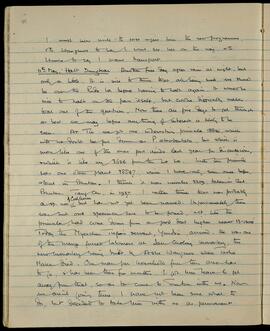
I must now write to HH & give him the new programme, & to Wangmoo to say I will see her on the way, & to Lhuntse to say I want transport.

11th May. Halt Dungkar. Another fine day after rain at night, but only a little. It is nice to think that, all being well, we should be over the Rudo La before having to halt again. It would be nice to halt on the pass itself, but coolie difficulty makes that out of the question. Now there are five days to get through as best we may before anything of interest is likely to be seen. At Tim we got one interesting primula 18846, which will no doubt be put down as P. atrodentata, but which is more like one of the ones put aside last year for discussion, & which is like my 3636 from the Lo La. With the primula was one other plant 18847, which I have only seen once before, & that in Bhutan. I think it was number 3209, taken in Cent. Bhutan, Tang Chu, in 1937. I rather think that was probably a sp. nov. of Cochlearia but has not yet been named. Unfortunately there was but one specimen here to be found, & it, like the primula, had come down from a good deal higher, near 13-14000'.

Today the Nyerchen Trepa's servant, Yundru, arrived. He was one of the many forced labourers at Sam Choling monastery, the new monastery being built by Ashe Wangmoo where Tasho Haku died. One man per household from this area has to go, & has been there for months. I got him leave to get away from that, so as to come to Tomtem with me. Now we are in fact there, I have not been sure what to do, but decided to take him with us as permanent.

LSH/1/1/9/1/85 · Part · 1949-06-30
Part of The Ludlow & Sherriff Collection

SUMMARY:
The writer reports that meat set aside by Lhahpa was stolen overnight, likely by a dog, while Lhahpa suspects passing Tibetans. A letter from Rani Chuni relays that H.H. says the Maharajkumar may go to England with them for several months, prompting logistical concerns; on 27 June they halt, deem the area poor after working all surrounding valleys, plan to leave tomorrow, and note certain plants absent here but present at the Mela.

CONTENT:
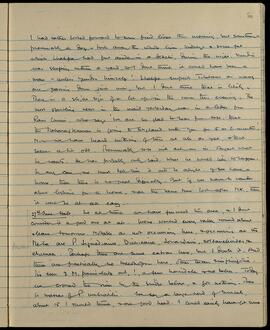
I had rather looked forward to some fried liver this morning, but something - presumably a dog - took away the whole liver, kidneys & some fat which Lhahpa had put aside in a dekchi, during the night. Yundru was sleeping within a yard, so I don't think it could have been a man - unless Yundru himself! Lhahpa suspects Tibetans as many are passing down just now, but I don't think that is likely.

There is a slight sign of a let up in the rain this evening. The most startling news in the mail yesterday was in a letter from Rani Chuni, who says 'we are so glad to hear from H.H. that the Maharajkumar is going to England with you for 5 or 6 months'. Now we have heard nothing of this at all as yet, which seems a bit odd. Presumably H.H. will ask us in August what he wants. He has probably only said what he would like to happen. In any case we must tell him it will be alright. If we have a house, then there is no real difficulty. But if we have to wander about looking for a house, & at the same time look after M.K., then it won't be at all easy.

27th June Halt. We all think we have finished this area, & I don't consider it a good one at all. We've worked every valley round about & leave tomorrow. Notable as not occurring here, & occurring at the Mela are P. sikkimensis, dich

LSH/1/1/9/1/48 · Part · 1933-05-07
Part of The Ludlow & Sherriff Collection

SUMMARY:
Notes describe intense heat in lowland Bhutan and a fine bridge over the Kuru Chu, followed by return to camp at Lhuntse Dzong. Yundru requests medicine for syphilis, mentioning prior injections by Kapo. The Tinnymu Bridge is described in detail, with no notable flowers observed.

CONTENT:
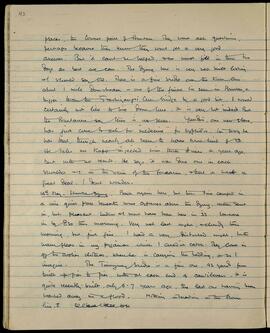
43

places, the lowest part of Bhutan. They won't ask questions, perhaps because they know they won't get a very good answer. But it can't be helped, one must fill in these two days as best we can. The Dzong here is very well worth looking at, I should say old. There is a fine bridge over the Kuru Chu about 1 mile downstream - one of the finest I've seen in Bhutan, a bit bigger than the Trashigangsi Chu bridge by a good bit. I would certainly not like to live down here. It is very hot indeed. But the Bhutanese say there is no fever. Yundru, our new slave, has just come to ask for medicine for syphilis. I'm sorry he has that, though nearly all seem to have some kind of V.D. He tells me Kapo injected him three times a year ago, but with no result. He says it was done one in each shoulder or in the vein of the forearm, and that it hurts a great deal. I don't wonder.

14th May. Lhuntse Dzong. Back again here, but this time camped in a nice quiet place beneath some cypresses above the Dzong, rather shut in, but pleasant. Ludlow and I must have been here in 1933. We were in by 8:30 this morning. Very wet last night, and cloudy this morning, but just fine. I had a very disturbed night, with water fleas in my pyjamas which I couldn't catch. They come in off the coolies' clothes, when he is carrying the bedding, or so I imagine. The Tinnymu Bridge is a fine one, 42 yards from built up pier to pier, with at each end 4 cantilevers. It is quite recently built, only 6-7 years ago, the last one having been washed away in a flood. Nothing interesting in the flower line.

LSH/1/1/10/1/11 · Part · 1949-09-14
Part of The Ludlow & Sherriff Collection

SUMMARY:
Diary notes from Pangotang describe ongoing rains, plans to visit Marlung before turning back, and requests regarding taking Yundru and Ngudup to Kalimpong, with preference for Yundru. The writer develops Hicks’ photos, comments on Thompson’s image of P. eburnea, sends Dorji with airmail to Hicks and HH, and packs a ‘tsang’ of rooted plants for shipment to London, hoping to add more from Marlung and Ritang.

CONTENT:
147

Air mail plants
more specimens and also some roots. I have now so many roots to send home by air, that I wonder how many loads there will be, also how much it will all cost!

24th Sept. Pangotang. Fine morning, and a bit of rain after midday. There really is precious little sign of the end of the rains, although I keep on hoping there is. We are, in a way, on our way back home now. But still there is one place, Marlung, to visit, before we can say we have turned round and started back. But everyone obviously feels that things are winding up. I had a request today from Pasang, from Ngudup and Yundru that I should take both to Kalimpong. I don't mind taking Yundru, who is a good and cheery lad and a good worker, but I hope I won't have to take Ngudup one day beyond Bumthang. I do not like him, and except to arrange transport, he is useless. I am writing to HH tomorrow to ask for Changchuk, and to give him our final dates. Today I developed Hicks' photos. If only he had taken my advice at first, all his photos would have been like these which are good. But he would not, and considered he knew better. Thompson's photo of P. eburnea is quite good, much better than Hicks' first efforts. It is a real disappointment to me that in 6 months he has only taken 48 photos altogether, in spite of having lots of film packs available. There were so many photos he could have taken.

25th September. Sent off Dorji and with airmail to Hicks, HH and Kalimpong and paid him Rs 24/-. We then packed up a 'tsang' with rooted plants, each rooted plant in its own little basket inside the big one. The whole thing now is ready to go to London, except that I hope there will be a few more plants added from Marlung, and then more again at Ritang.
roots

LSH/1/1/9/1/71 · Part · 1949-06-15
Part of The Ludlow & Sherriff Collection

SUMMARY:
The diarist rebukes Ngudup for overeating and refusing to shoot a monal due to the 15th, deciding to shoot and donate Rs 1 to the Gompa. Seed is collected for Pasang, Lhakpa, and Yundru; Primula taxa are noted, a white-throated dipper nest is found by a waterfall, and a blood pheasant is filmed, with a prior nest recalled at Thampa Tso in 1937.

CONTENT:
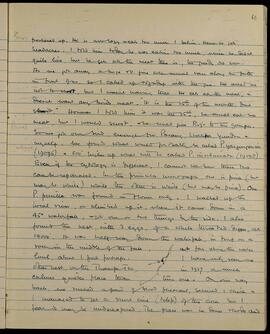
freshened up. He is now lazy and eats too much, I believe. Hence he gets headaches. I told him today he was eating too much, which he didn't quite like, but he gets all the meat there is, too greedy too soon. As we got away, a huge and fine cock monal ran along the path in front of us, so I called up Ngudup with the gun. He asked me not to shoot, but I wasn't having that. He eats all the meat, and doesn't want any bird's meat. "It is the 15th of the month, don't shoot." However, I told him it was the 15th, he should eat no meat, but I would shoot, and he could give Rs 1/- to the Gompa.

So we got our seed, enough for Pasang, Lhakpa, Yundru, and myself. We found what would probably be called P. yargongensis (19096) and 500' higher up what will be called P. involucrata (19098). Even if the cytology is different, I cannot see how these two can be separated. In the Primula monograph, one is pink (but maybe white) while the other is white (but maybe pink). One P. pusilla was found in flower only. I walked up the local river, or climbed up it, where it came down in a 45° waterfall, got one or two things by the side. I also found the nest, with 3 eggs, of a white-throated dipper, at 14,000'. It was halfway down the waterfall, in turf on a rock in the middle of the fall, not far above the water level, about 1 foot perhaps. I have only seen one other nest, on the Thampa Tso, in 1937, a much calmer, quieter place than this one. On our way back, we rushed a pair of blood pheasant, secured 1 chick, and I managed to get a short cine (telep.) of the cock, but I fear it may be underexposed. The place was in dense rhodo and