Mostrar 10 resultados

Descrição arquivística
10 resultados com objetos digitais Mostrar resultados com objetos digitais
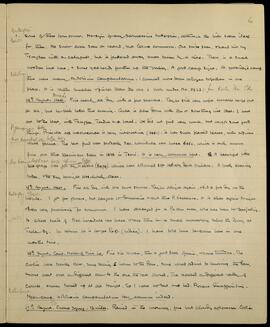
Camp on the Jirgang Chu between Korphu and Nabzi
LSH/1/1/5/1/17 · Part · 1935-11-27
Parte de The Ludlow & Sherriff Collection

SUMMARY:
The party forded rivers along the Gale Chu, noting shelters used by men tending H.H.'s cattle en route to Bumthang, and encountered their first rhododendrons (R. rhabdotum), with Tsungpen climbing a tall tree to reach blooms. They met Bhutanese with H.H.'s cattle and made camp on the Jirgang Chu between Korphu and Nabzi, with little else of interest noted in the dense forest and no knowledge of the Black Mountain from locals.

CONTENT:
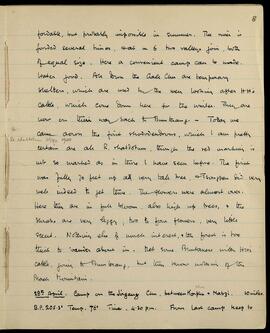
fordable, but probably impossible in summer. The river is
forded several times, and where two valleys join, both
of equal size. Here a convenient camp can be made.
Water good. All down the Gale Chu are temporary
shelters, which are used by the men looking after H.H.'s
cattle, which come down here for the winter. They are
now on their way back to Bumthang. — Today we
came across the first rhododendrons, which I am pretty
certain are all R. rhabdotum, though the red marking is
not so marked as in those I have seen before. The first
was fully 70 feet up a very tall tree, & Tsungpen did very
well indeed to get there. The flowers were almost over.
Here they are in full bloom, also high up trees, & the
shrubs are very leggy, two to four flowers, very little
scent. Nothing else of much interest, & the forest is too
thick to wander about in. Met some Bhutanese with H.H.'s
cattle, going to Bumthang, but they know nothing of the
Black Mountain.

28th April. Camp on the Jirgang Chu, between Korphu & Nabzi. 10 miles.
B.P. 205.3° Temp. 76° Time - 4.30 p.m. From last camp keep to
Pay record for Pintso, Tenduk, Cook, and Tsungpen
LSH/1/1/5/1/216 · Part · 1937-05-17 - 1937-07-05
Parte de The Ludlow & Sherriff Collection

SUMMARY:
A payroll note lists payments and calculations for four individuals—Pintso, Tenduk, Cook, and Tsungpen—with associated dates in May to July 1937.

CONTENT:
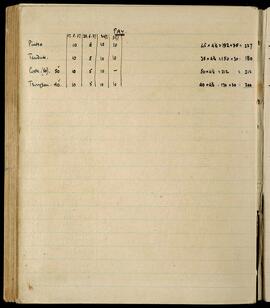
PAY.
17.5.37 29.6.37 24/7 5/7
Pintso 10 5 10 10 45 x 4 1/4 = 192 + 35 = 227
Tenduk. 10 5 10 10 35 x 4 1/4 = 150 + 30 = 180
Cook (50). 50 10 5 10 - 50 x 4 1/4 = 212 = 212
Tsungpen. 40 10 5 10 10 40 x 4 1/4 = 170 + 30 = 200

LSH/1/1/6/1/65 · Part · 1937-06-05
Parte de The Ludlow & Sherriff Collection

SUMMARY:
From Chianang the diarist reports illness among companions, a reconnaissance with Kunio toward Chubumbu La with notable rhododendrons and Nomocharis, persistent rain, and route details. Plans to attempt the Chubumbu La despite local advice are noted, along with Brahminy Ducks near Lanyong; subsequent halts include botanical collecting and bird observations, before proceeding up-valley toward a pass.

CONTENT:
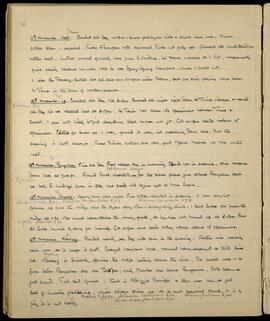
Chianang.

...vomiting everything he tried to swallow. He has no strength today at all. I went with Kunio towards Chubumbu La, which is about 6 miles from here, and has not too much snow on it to be crossed. There was nothing to be seen till we reached the head of the valley, then rhododendrons in profusion, P. pauliana all over the place, Nomocharis souliei the best of all, masses of Rhod. aff. repens, in full flower.

3rd June. CAMP CHIANANG. 5 miles. B.P. 189.0° Temp. 50° Time 11:30 am. Ht. approx. 12929'.
Rained most of the night and all today without a stop. Path follows the left bank for 2 miles, then crosses by a foot bridge to right bank. At mile 3 a side valley from the Chubumbu La is reached and crossed. The Chubumbu La lies at a bearing of 162° Magnetic and from here is about 4 miles distant. Follow up this valley left bank for ½ mile, then turn up a side valley. Ascent fairly steep for 1½ miles to a plateau, where there are 3-4 houses, where yaks are grazed in summer. Very swampy ground. We saw nothing at all today, as Lin was not yet too fit and Tsungpen only just able to come up, we did nothing today, but sat in camp and changed flowers. I'm afraid this valley is not as good as I had hoped: we are still too early. So I remain only two days and then go to the Chubumbu La for a day, to see if I can get across. It does not look impossible, though the locals say it is, and will remain so for another 2 months or more, when the Lhopas will come over. There are Brahminy Duck near Lanyong, and I saw they have their young one now and quite big.

4th June. Halt. Chianang. Fine intervals with a little sun up till 12:00 noon, then rain all day. Went up to the South, and had a fairly good day. Rhod. repens is abundant, but not above 14000'. With it were P. harrisii, and P. valentiniana 3953. This must cover the hillside, but is hardly in flower yet. Just as at Tsari Chikchar, it comes just after P. harrisii. First one gets a blue violet hillside, which is then turned into a deep velvety crimson one. P. vernicosa 3951, is here about half blue and half white. Saw a good many Grandala coelicolor above, some rubythroats; the latter is not the Yunnan bird.
Diapensia himalaica 3949, Potentilla leucanota 3950 - Bell common, Pot. stenophylla 3956, Pot. microphylla 3957 & 41, Pedicularis formis 3959.

5th June. Halt Chianang. Rain early at night, but a fine day till 2:00 pm, then thunder and rain and snow on the hills. Cleared 2 hours later. Went up the valley, past two more yak grazing grounds to a pass,

LSH/1/1/6/1/105 · Part · 1933-07-19 - 1933-07-21
Parte de The Ludlow & Sherriff Collection

SUMMARY:
Amid continuous rain and cold, the party at Tsanang Gompa finds their bridge washed away, fords the river via a natural crossing, and gathers mixed reports about the steepness of Kucha La. Reaching Kongshong, they pay off reluctant coolies, send Kusho to recruit more with nine days’ rations, and prepare for the pass. On a halt day, despite illness and heavy morning rain, the diarist makes a strenuous 4,000 ft climb as the weather clears at the top.

CONTENT:
Tsanang La 19 July. P. florindae 5877 G. phyllocalyx 5878
20 July. R. xanthocodon 5883.

19th July. Tsanang Gompa. 6 miles. Very heavy rain all night and today. We did not get off till 8.30, as the coolies had to come up from 2 miles down the valley. A filthy morning even, cold. New snow lying pretty thick on the hills above 14,000'. Our bridge, made on the 17th, had been washed away, but we found another natural one further up over half the river, the other half being fordable. Rain pours down steadily without a stop, and I am surprised how cold it has become. News about the Kucha La is still difficult to get. It is said to be as steep as the Tsanang La, but I can hardly credit that, as Lopas do use it, and it would be very difficult to cross the Tsanang La loaded as Lopas always are. The only way to find out is to go and see. The gompa here is said to be very old, about 350 years or so. There is a newer one too about 100 years old, now much smaller than it used to be. The old monastery contains some very fine old tankas. It is said to be under the Lhalu family; the only lama here complains that nowadays they get no allowance, no rations or anything, all of which they used to have. News from local people about the Kucha La is rather more hopeful. They say three days are enough to reach it from Kongshong. I hope so.

20th July. Kongshong. 6 miles. Rain all day. The coolies, going homewards, found no difficulty in getting here in two days, and would have gone on to Pana with the greatest ease. One of them did tell Tsungpen that they were unwilling to go to the Tsanang La; that is why they kept back the whole time. Phutso would have got them on alright though. The river is much lower than when we went up, but why I don't know. Paid off coolies and sent Kusho in to get another lot, with nine days' rations, to allow for three up, three at the Pass, and three down. In the meantime we must spend two very dull days here, waiting for coolies to collect rations.

21st July. Halt. This was really a red-letter day. All last night it poured and all today up till 12.0 noon it poured. I had decided to go up a hill to the North of the valley—a climb of 4000 ft fully. This morning though, I was not feeling fit, very weak and with a bit of fever. The rain was almost too much for me, and for a while we hesitated. However, I felt I must go and left at 5.30 am in pouring rain to start the climb, which proved much further and much steeper than I had expected. I could only go slowly, and we did not reach the top till nearly midday, but we got there alright. Then the weather suddenly cleared up, and we had a

Kulu Pher Chu: Primula observations and march to Lamdo
LSH/1/1/6/1/113 · Part · 1933-07-27
Parte de The Ludlow & Sherriff Collection

SUMMARY:
Field notes detail several Primula species around Kulu Pher Chu and plans with the Tsungpen to reach Lamdo over a high ridge en route to Tseladzong. A wet halt day included further plant observations on avalanche-swept slopes and concerns about mail and Shadu, followed by a cold, rain-soaked march to Lamdo (11 miles) with a guide who initially took the wrong spur.

CONTENT:
Kulu Pher Chu
58
Primula

P. rhodochroa No. 5890, about 6 more flowers. P. capitata (subsp. crispata?) 5975 is common close to camp on the steep hillside. P. micropetala? (P. hesperidium) 5888 is also fairly common higher up. Then we found a few P. bellidifolia 5966 with flowers just over. Also what I at first took to be P. macrophylla, but which I think maybe P. sinopurpurea 5964. We saw a few seed specimens with two whorls of flowers. (P. kongboensis) 5970 I think might be P. petrocharis, but I don't know. P. muscoides, the violet form was just in flower still, 5971: and a fine form of P. jonardunii (P. dryadifolia) 5952, with all scapes 2-flowered was seen. Perhaps this is P. dryadifolia. The scapes held the flowers clear of the leaves which were bigger than usual. Saxifrages abound, over from a good many. This was a hard day's climb, or don't think we will do very much tomorrow, but prepare for the next day, when Tsungpen and I intend to go to Lamdo via the top of the ridge, instead of along the valley bed. It will be a long climb first, to over 15000 ft, then a long tedious traverse, before the steep descent. But I think it should be worth it, a good finish up before reaching Tseladzong. I hope to finish this book of Field Notes, up to 6000, which will give me up to 920 specimens this year. Taylor will likely have 1500 or so.

28th July. Halt. Rained a good deal at night. Clouded all day, with light rain most of the day. Had a fairly slack day today, crossing the river and going up one of the side valleys opposite camp to 13000'. It was a very steep slope which is swept by avalanche every spring, and kept bare. A good deal of snow still near the bottom, and snow has kept several plants back. We saw for instance, several Prim. atrodentata still in flower. Nomocharis nana also common, in flower. All thoughts in camp are about the mail, and whether Shadu also will be at Tsela before us. I rather doubt whether either will be before us. We ourselves will be one day early. I rather dread tomorrow's trek, especially if wet, as seems likely. We climb over 2000 ft to start off with, then have a long traverse along the hillside, before a steep descent of 5000 ft to Lamdo. However camp will be waiting ready for us, which always is nice to have.

29th July. Lamdo. 11 miles. Yesterday was a disastrous day. It poured all day and up on the hill was very cold indeed, with a strong wind. We had a Lopa to 'show us the way'. He did not start off too well, by going up the hill the wrong spur. Then we got into thick
30th July. Halt.

LSH/1/1/6/1/121 · Part · 1933-07-27
Parte de The Ludlow & Sherriff Collection

SUMMARY:
Entries describe observations around Mira La, including Lerwa, snipe, and abundant Notholirion campanulatum, with fieldwork by the diarist alongside Tsungpen and Tendu yielding notable finds such as Meconopsis horridula var. lutea and a distinctive Saxifraga. Taylor is ill then recovers, Anna falls ill, and a Pu chu man is engaged to collect seeds for delivery to a monastery below the Dzong at Tsela Dz.; later a move north of Mira La is hampered by slow and misrouted coolies, with Chomo Dzong noted next.

CONTENT:
60

Butterflies
Some of these tomorrow. No sign of any Parnassius butterflies, although the hills seem ideal
Birds
for them. No snow cock seen or heard, but Lerwa common. One snipe seen, nearly hit by
Tsungpen with a catapult, but it fluttered away and was taken by a kite. There is a small
wooden hut here, and some yakherds further up the valley. A good camp site. At yesterday's camp
Notholirion
there were many Notholirion campanulatum. I counted more than a dozen together in one
place. It is rather smaller and pinker than the one I took under No. 5923: from Kulu Phu Chu.

Mira La
14th August. Halt. Fine nearly all day, with a few showers. Taylor still very unfit and unable to go out
at all, but he feels better this evening. Anna is also down with flu or something like that. I went
out to the West, with Tsungpen, Tendu and a coolie. We did not find very much, but we got some good
P. Younghusbandii 6061
things. Primula aff. macrocarpa is very interesting (6061): it has such flaccid leaves, with copious
Mec. horridula var. lutea 6062
white farina. The best find was probably Mec. horridula var. lutea 6062, which is only known
from our three specimens seen in 1936 in Tsari. It is very common here. A beautiful little
Sax. haematochroa 6070 sp. nov. type
Saxifraga was found by Tendu (6070) which was coloured soft velvety dark crimson. A lovely evening
today, the sky tonight absolutely clear.

15th August. Halt. Fine all day, with one short shower. Taylor all right again, and did a full day on the
Butterfly Birds
hillside. I got few flowers, but caught 10 Parnassius and saw three P. tischelanus. It is clear again tonight
and looks very promising for tomorrow. I have arranged for a Pu chu man, who has been to Darjeeling,
Seeds
to collect seeds of Mec. horridula var. lutea and take them to a small monastery below the Dzong at
Tsela Dz. In return he is to get Rs 5/- (Indian). I have told him to come here in one
month's time.

16th August. Camp. North of Mira La. Fine till 11.00 am, then a good deal of rain, some thunder. The
coolies were terribly slow, some taking 5 hours to the Pass. None would admit to knowing the Pass,
and some went over a different one to the one the rest crossed. They reached a different valley of
course, and never turned up at all tonight. So I have no tent and bed. Flowers disappointing.
Notholirion
Near camp, Notholirion campanulatum very common indeed.

17th August. Chomo Dzong. 12 miles. Rained in the morning, fine but cloudy afternoon. Coolies

LSH/1/1/6/1/162 · Part · 1933-11-13
Parte de The Ludlow & Sherriff Collection

SUMMARY:
Entries describe marches and halts from Trimo to Le, Pangchen, Shakti and Karteng with snow, rain and heat, while collecting seeds and specimens including rhododendrons. Notes include Ludlow’s rapid travel from S. Chöling, recovery of Pintso and Tsungpen, efficient Monba coolies, Tawang people wishing to come under Assam while taxed by Tsona, and Guha going missing after taking a wrong path.

CONTENT:
85

Trimo
11th November. Halt. Clouded all day: no sun: snow falling on hills & slight rain here. Much colder than I expected. Pintso & Tsungpen both recovered, Pintso not fully yet. Collected odd rhododendron & other seed. Ludlow moved quickly here from S. Chöling, the same marches as I did, & apparently quite easily because he was able to use dzong-dzong transport, which I could not.
I hear the Tawang people are all anxious to come under Assam, but are still paying large taxes to Tsona in the form of wooden planks.

To
12th November. Le. Clouded all day till 4.0pm. Snowed all night right down to Trimo village, & rained all day till we reached here at 3.0pm. As Tsering has taken 150 specimens between Trimo & Shakti, I am not likely to find anything that he has not got. Got a few seeds & about 15 specimens. Clothed for snow as I was, found it very hot marching down here. But the evening is cool enough. These Monba coolies are very good & fast, waste no time on the road.
R. crassum 6676.

To
13th November. Pangchen. Fine all day. First clear sky in morning. Clouds low in evening. Nice & warm down here at 7000 ft. Found Rhod. rhabdotum (Dalhousie 6694) at the same place just above Pangchen that we took R. lindleyi from in 1936, but seeds not begun yet to turn brown.
P. prunifer

To
14th November. Shakti. Heavy rain last night. Fine today: clouded in evening. It was very hot coming up from the bridge over the Nyam Jang Chu — a long steep climb. I sent Guha on from the bridge at 11.30, he must have taken the wrong path, as he has not turned up at 5.0pm. Poor old Guha, he will be sorry for himself. Got a few more seeds today & took about 15 specimens.
Codonopsis ovata 6702, Crawfurdia Campanulaceae 6703, Prunus cerasoides 6708, Wightia gigantea 6700

To
15th November. Karteng (Kapleng). Clouded nearly all day, with rain in the evening. Rather nice having rain now as it keeps it cool. Changed transport twice, & should have changed a third time too. Karteng is directly opposite the bridge leading across the river. The people here — & from below Pangchen are all Takpas; only Monbas are above Pangchen. Both seem a good crowd. Took seed of what I think is Albizzia Sherriffii & saw near here a good deal of Luculia gratissima, which always strikes me as a most beautiful shrub. It is a pity it is not hardy.
Kapleng & Jy-iper. Sarcococca hookeriana 6716, Luculia gratissima 6720, Lindenbergia grandiflora 6721

LSH/1/1/3/3/213 · Part · 1996-06-18
Parte de The Ludlow & Sherriff Collection

SUMMARY:
At Yume, the diarist notes wet, misty conditions, sparse flowering, and prominent rhododendron, pays off the coolies, and arranges horses to Sangacholing. The following day, during a halt, the diarist and Tsungpen follow the Yume Chu on a difficult, muddy route through dense jungle and see little in flower.

CONTENT:
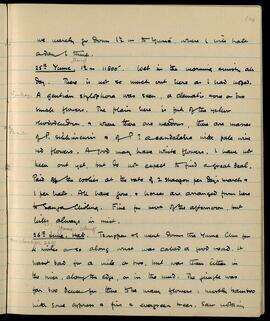
we merely go down 1½ m to Yume, where I will halt a day I think.

25th June. Yume. 1½ m. 11800'. Wet in the morning and misty all day. There is not so much out here as I had hoped. A Gentian stylophora was seen, a clematis one or two small flowers. The plain here is full of the yellow rhododendron, and where there are meadows, there are masses of P. sikkimensis and of P? a candelabra with pale wine red flowers. A good many have white flowers. I have not been out yet, but do not expect to find a great deal.

Paid off the coolies at the rate of 2 shoogon per day's march and 1 per halt. All have gone, and horses are arranged from here to Sangacholing. Fine for most of the afternoon, but hills always in mist.

26th June. Halt. Tsungpen and I went down the Yume Chu for 4 miles or so along what was called a good road. It wasn't bad for a mile or two, but was then either in the river, along the edge, or in the mud. The jungle was far too dense for there to be many flowers: mostly bamboo with some cypress and fir and evergreen trees. Saw nothing.

LSH/1/1/8/1/85 · Part · 1938-03-31 - 1938-04-09
Parte de The Ludlow & Sherriff Collection

SUMMARY:
Heavy spring rain at Tongkyun with peach blossom in Pasha; several halt days used to repack for a two‑month return journey while letters were exchanged rapidly with Ludlow via Dzeng. Tsungpen and Akong visited Trulung; plans were made for Ludlow to go to Pemakochung and the Yigrong Range, possibly leaving Suowa to Tsungpen, and Henry may accompany the diarist to Tromda. The writer, feeling heart trouble, decides to return to India amid persistently dull, rainy weather.

CONTENT:
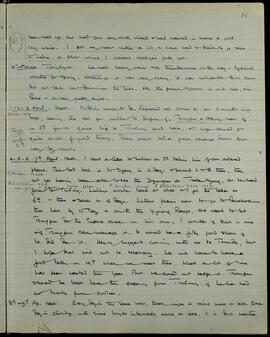
been held up, but had gone very slowly indeed & had waited in Lhasa a very long while. I felt my heart rather a lot, & have had to decide to go back to India, a blow which I haven't realized fully yet.

31st March. Tongkyun. We had heavy rain & a thunderstorm on the way - typical weather for spring. Although it was very heavy, it was noticeable that snow did not fall low down on the hills. All the peach blossom is out here, in Pasha - a very pretty sight.

1-2-3 April. Halt. Nothing much to do. Repacked all stores for our 2 months trip back, leaving the rest for Ludlow to dispose of. Tsungpen & Akong went to Trulung on 3rd for a quick trip to Trulung and back, & hope secured for quite a lot of good things. There must be a great change down that way by now.

4-5-6-7th April. Halt. I sent a letter to Ludlow on 3rd telling him of our altered plans. The lad took it to Dzeng in 2 days & found L & S there, they not yet having been able to see the Dzongpen at Tsola Dzong, as he had gone to Trulung. Ludlow wrote back at once & I got the letter on 6th - there & back in 4 days. Ludlow plans now to go to Pemakochung, then here by 15 May & on to the Yigrong Range. He wants to let Tsungpen do the Suowa area on his own. I wonder if that is wise & if Tsungpen can manage it. It would be a jolly good show if he did do it. Henry suggests coming with me to Tromda, but I hope that will not be necessary. We will have to have a good talk on 14th when we meet there. What a lot of time has been wasted this year. But we could not help it. Tsungpen should be back here this evening from Trulung, if he has had no trouble from coolies.

8th & 9th Ap. Halt. Every day is the same now. Each night it rains more or less. Each day is cloudy, with some bright intervals, more or less. It is dull weather,

Nahampa: collecting primulas and kuling; 16 October
LSH/1/1/4/1/137 · Part · 1933-10-12
Parte de The Ludlow & Sherriff Collection

SUMMARY:
In camp during snow and rain, the writer collected Gentiana ornata seed, hunted kuling with Tsungpen, shot a raven for Inglis at Darjeeling, prepared bird skins, and packed divots of several Primula species. On 16th October at Nahampa, after a clear, frosty night, they noted kuling and Crossoptilon above Karutra and recorded nearby plant finds.

CONTENT:
conditions all day in camp - snow and rain with patches of sun. All I could collect today was some seed of Gentiana ornata, but I went out again to look for kuling with Tsungpen. First of all I shot a raven for Inglis at Darjeeling, then we came across three kuling just at the top edge of the rhododendrons, I got two of them. They are in good plumage, except for the head and nape, where moulting is not quite finished. Made flat skins of all of them, but wonder how they will travel tomorrow before being set. I made a box today, and have put in it a good many divots - two good divots of the yellow Primula petiolaris 2370, and three other divots which include two primulas, both petiolaris. One, I hope, is 2373 Primula chamaedora, a most beautiful flower, and the other is only the little white petiolaris primula Primula verrucosa we first saw at Chhachar 1614 or 1615 - a most uninteresting one. Let's hope all arrive in good condition at home. Temp in tent 20°F.

16th October. Nahampa. 10 miles. Last night was clear after 5.0pm, and very cold, with no more snow. The morning was perfect, really clear, with a hard frost. We had some rain down here, but nothing much. Saw a number of kuling above Karutra (seen Androsace brahmaputrae 2737, Ranunculus vellereum 2738) and also Crossoptilon, but no blood pheasant.